MLA 2026 Panels: “Aesthetics, Politics, and Ecological Overshoot” and “Comics as Physical Objects”

At this year’s Modern Language Association Convention in Toronto, Ontario, Canada (January 8-11, 2026), I will be speaking on a roundtable Aesthetics, Politics, and Ecological Overshoot, and panel, Comics as Physical Objects. I have included the information and tentative abstracts for each paper below.

52. Comics as Physical Objects

Thursday, January 8, 2026, 1:45-3:00 p.m.

Presiding: Edward Whitley (Lehigh U)

Presentations:
1. “A Queer Print History of Comics,” Margaret Galvan (U of Florida)
2. “The Comics Megatext: Floppies, Trades, Marvel Unlimited, Podcasts, and The X-Men,” Bradley Fest (Hartwick C)
3. “Multimedia and Digital Materialities: The Blue Age of (Web) Comics and Fostering Multimodal Literacy,” Devon Harvey (Queen’s U)
4. “Framing Matter: Materiality and the Medium of Comics,” Christina Kraenzle (York U)


The Comics Megatext: Floppies, Trades, Marvel Unlimited, Podcasts, and The X-Men

As Douglas Wolk recently pointed out in his book about reading all of Marvel Comics, “The twenty-seven thousand or so superhero comic books that Marvel Comics has published since 1961 are the longest continuous, self-contained work of fiction ever created.”[1] Though a bit smaller, the over six thousand comics that constitute The X-Men (1963–) also makes it one of the longest narratives ever written. Both are what I call in my current book project megatexts: a massively unreadable twenty-first century form created through collaboration and digital technology to achieve a scale beyond what a single author could do alone and that requires incredibly nontrivial effort on the part of readers to completely traverse. In this talk, I will explore the emergence of comics as a megatextual object in the twenty-first century. In the age of floppies and trades, comics megatexts were largely inaccessible in their totality. With the emergence of platforms such as Marvel Unlimited and paratextual forms like podcasts such as Jay and Miles X-Plain “The X-Men” (2014–), we can now read comics megatexts as megatexts. For all intents and purposes, then, the comics megatext has newly emerged as an accessible and thus coherent form that, like other megatexts, also importantly calls forth collective and creative reading and criticism. Approached in this way, The X-Men in particular offers us a continuously transforming megatextual object that is also a beacon for collaboratively exploring how to build alternative communities and ways of thinking and being for an infowhelming world.


[1] Douglas Wolk, All the Marvels: A Journey to the End of the Biggest Story Ever Told (New York: Penguin, 2021), 1.


602. Aesthetics, Politics, and Ecological Overshoot

Sunday, January 11, 2026, 10:15-11:30 a.m.

Presiding: John Maerhofer (Rutgers U, New Brunswick)

Speakers: Federico Correa Pose (U of Southern California)
Bradley Fest (Hartwick C)
Christopher Gortmaker (U of Chicago)
Brenda Odria Loayza (U of Toronto)
Pedro Gabriel Soares Daher (Maine C of Art and Design)

Megatextual Eco-Utopia: Jonathan Hickman’s X-Men and Mutant Poiesis

In 2019, in one of the more audacious reboots of a long-running megatextual franchise, Jonathan Hickman reimagined the now decades-long political aspirations of Marvel Comics’ X-Men (1963–) franchise in explicitly eco-utopian terms. Rather than continuing to pursue his decades-long dream of mutant and human peaceful coexistence, in House of X/Powers of X (2019) Professor X creates a separatist sovereign nation on the sentient living island Krakoa, an achieved utopia for all mutants. Notable even in its genre for its exploration of alternative presents and various futures, The X-Men franchise’s subsequent five-year pivot fleshes out the politics of a separatist utopia where no mutant dies and the dead are reborn. Despite the ecologically harmonious, sustainable technologies the mutant nation develops and despite their offer to share their miraculous, life-saving drugs and technology with the rest of the world, humans nonetheless turn toward the genocidal destruction of what appears the last, best hope for the continued flourishing for organic life on the planet. As such, Hickman’s eco-utopia emerges not from the dreams of the 1960s but from the despair of the present, a somewhat reactionary imaginary attempting to respond to the slow violence of climate change and the rise and resurgence of far-right, ecocidal extremism in the United States and around the world. Ultimately, however, the mutant survivors of Krakoa discover that their story was not one of separatist paradise gained but historical subjectivity achieved without the yoke of human bigotry and hatred, enabling them to build their world with others, crafting its institutions and practices, its culture and its politics—in short, mutant poiesis—the swift, violent destruction of which should serve as a warning for us in this moment of political destituency.


For previous essays of mine on megatexts and unreadable texts, see:

“Toward a Theory of the Megatext: Speculative Criticism and Richard Grossman’s ‘Breeze Avenue Working Paper.’”

“‘Is an Archive Enough?’: Megatextual Debris in the Work of Rachel Blau DuPlessis.”
“Reading Now and Again: Hyperarchivalism and Democracy in Ranjan Ghosh and J. Hillis Miller’s Thinking Literature across Continents.”

“Writing Briefly about Really Big Things.”

MLA 2025 Panel: Hypergraphia and Hypographia: Literary Maximalism and the Literature of Writer’s Block

At this year’s Modern Language Association Convention in New Orleans, LA (January 9-12, 2025), I will be speaking on a panel discussing Hypergraphia and Hypographia: Literary Maximalism and the Literature of Writer’s Block. I have included the information about the panel and a tentative abstract for the paper I will be presenting below.


65. Hypergraphia and Hypographia: Literary Maximalism and the Literature of Writer’s Block

Thursday, January 9, 2025, 1:45-3:00 pm, Windsor (Hilton Riverside New Orleans)

Presiding: Benjamin Bergholtz (Louisiana Tech U) and Aaron Colton (Emory U)

Presentations:
1. “‘No!—But I Must’: The Blocked Writer in Maximalist Fiction,” Benjamin Bergholtz (Louisiana Tech U) 
2. “The Craft of Writer’s Block: Autofiction, Process, and Pedagogy,” Aaron Colton (Emory U)
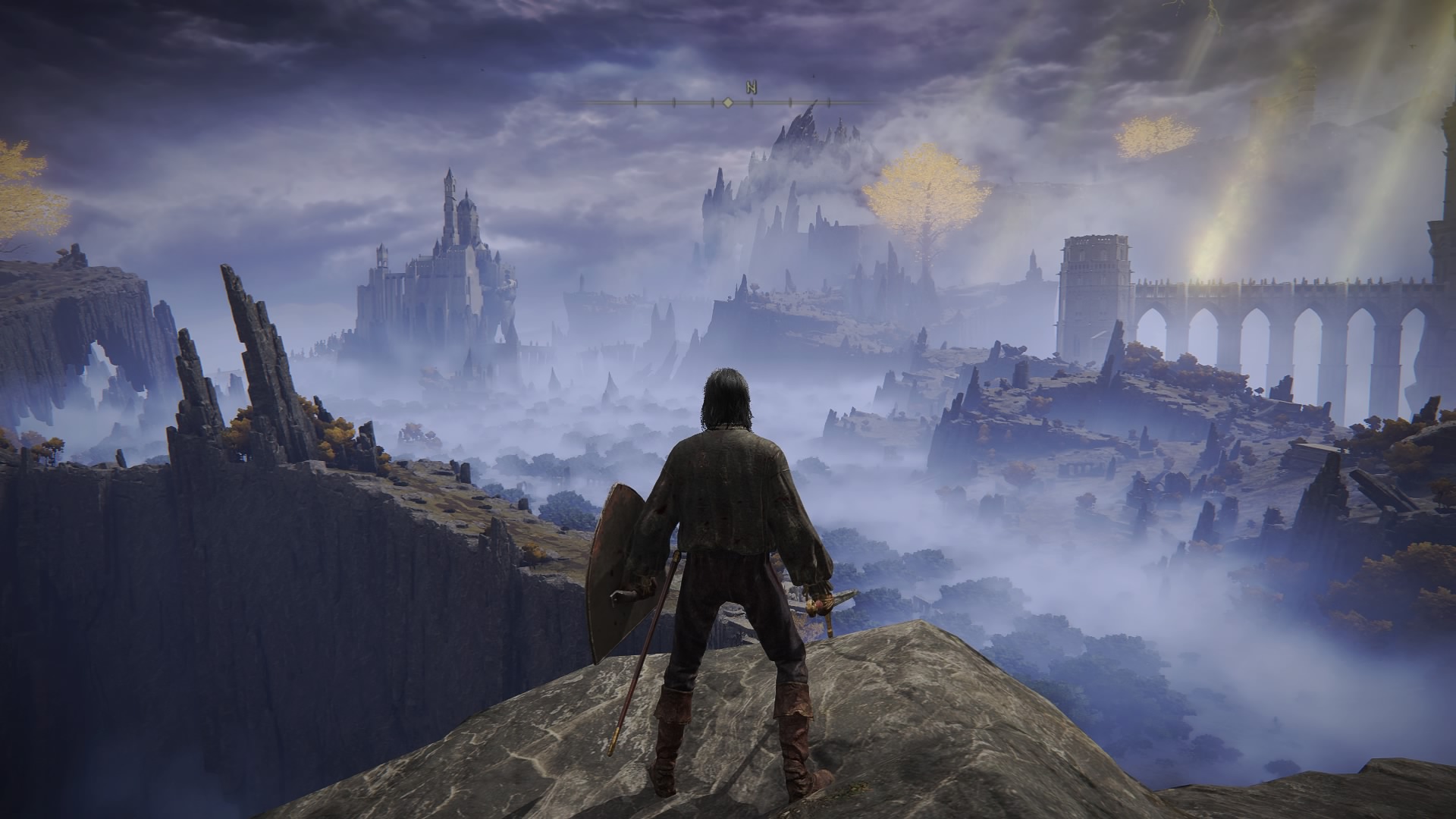
3. “Megatextual Kinaesthetics: The Wanderer above the Sea of Elden Ring,” Bradley Fest (Hartwick C) 
4. “Wallace’s Maximalism: Other-Flood and Self-Blockage,” Yonina Hoffman (US Merchant Marine Acad.)


ELDEN RING™_20230207194711

Elden Ring, v. 1.09.1 (Tokyo: Bandai Namco, 2022), PlayStation 4, screenshot by author.


“Megatextual Kinaesthetics: The Wanderer above the Sea of Elden Ring

In the twenty-first century, the maximalist impulse evident in the big, ambitious novel of the twentieth century has expanded toward the creation of massively unreadable works across media, what Fest has elsewhere called megatexts. From experimental literary projects, to popular forms, to transmedia corporate intellectual property, megatexts abound in the twenty-first century and their presence in both avant-garde and corporate cultural production signals that the megatext is an emergent form native to the neoliberal era. Perhaps the most paradigmatic instance of this emerging form is the massive, open-world video game requiring hundreds of hours of playtime to traverse. In the video-game megatext, we see a form striving to create worlds, to build spaces large enough to feel comparable to our own.

In his talk, Fest will focus on FromSoftware’s blockbuster 2022 game Elden Ring as not only a paradigmatic video-game megatext but also the kind of sensorial-conceptual or theoretical text that Patrick Jagoda has recently suggested experimental games can be. Fest will argue that Elden Ring’s open world is an affective, bodily, material sensorium that presents to its players something like what big data feels like, allowing players to experience a haptics of hyperarchivalism, a spatiality of the database. In this way, rather than some monumentally time-sucking waste, Elden Ring might itself constitute a moment of respite, contemplation, and critical engagement with respect to the network society, a moment where the digital realities of contemporaneity, in all their hypermediated and interconnected totality might be critically felt, even if that feeling only occurs as the sensation of a concept.


For previous essays of mine on megatexts and unreadable texts, see:

“Toward a Theory of the Megatext: Speculative Criticism and Richard Grossman’s ‘Breeze Avenue Working Paper.’”

“‘Is an Archive Enough?’: Megatextual Debris in the Work of Rachel Blau DuPlessis.”

“Reading Now and Again: Hyperarchivalism and Democracy in Ranjan Ghosh and J. Hillis Miller’s Thinking Literature across Continents.”

“Writing Briefly about Really Big Things.”

“The Megatext and Neoliberalism.”

“The Time of Megatexts: Dark Accumulation and Mark Z. Danielewski’s The Familiar.”

Recording of Twenty-First-Century Forms at MLA 2021

If you attended the virtual 2021 Modern Language Association Conference but were unable to come to the roundtable I organized, Twenty-First-Century Forms, you can watch a recording of it here (I believe for about six weeks). The speakers were (in order): myself, Amy Sara Carroll, Racheal Fest, Christian P. Haines, Hyemin Kim, and Eric Loy. For more information, see my previous post.

Summer 2019 Links

I had the privilege of meeting Richard Siken when I was quite young–an undergraduate at the University of Arizona–and he gave me lots of good advice on the poetry world (and life), conversations I still cherish. Please help him out.

Stroke Recovery Fund for Poet Richard Siken.


Nuclear and Environmental

Alenka Zupančič, “The Apocalypse Is (Still) Disappointing.”

James Livingston, “Time, Dread, Apocalypse Now.

Ted Nordhaus, “The Empty Radicalism of the Climate Apocalypse.”

Jessica Hurley and Dan Sinykin, eds., Apocalypse, special issue of ASAP/Journal.

Frame, Apocalypse.

Brad Plumer, “Humans Are Speeding Extinction and Altering the Natural World at an ‘Unprecedented’ Pace.”

Damian Carrington, “Why The Guardian Is Changing the Language It Uses about the Environment.”

Continue reading

February 2018 Links

Nuclear and Environmental

Tim Fernholz, “US Nuclear Tests Killed Far More Civilians than We Knew.”

Democracy Now, “Daniel Ellsberg Reveals He Was a Nuclear War Planner, Warns of Nuclear Winter and Global Starvation.”

Daniel Bessner, “On the Brink.”

Alastair Tancred, “A Nuclear First Strike of North Korea Is ‘Tempting’, Says Legendary US Diplomat Henry Kissinger as Kim Jong-un Warns Trump Is Pushing Toward War.”

“Senator Markey Blasts Trump Administration’s Reckless Nuclear Posture Review.”

Helena Feder, “The Realism of Our Time: Interview with Kim Stanley Robinson.”

Continue reading

News From Iraq, Nuclear Weirdness, and Shutting Down a 9 Year Old Boy’s Library

Nuclear

More adventures in nuclear incompetence (feeling like a broken record). David Willman, “$40-Billion Missile Defense System Proves Unreliable.”

The inverted nuke in the garden (seriously, a broken record) . . . : Dylan Matthews, “A New Report Shows Nuclear Weapons Almost Detonated in North Carolina in 1961.”

Alex Wellerstein found this, wow, simply amazing document: assessing post-apocalyptic land values.


Iraq

Robin Wright, “A Third Iraq War?”

Lawrence Wright, “ISIS’s Savage Strategy in Iraq.”

Elliot Ackerman, “Watching ISIS Flourish Where We Once Fought.”

Rod Nordland and Alissa J. Rubin, “Massacre Claim Shakes Iraq.”

Rod Nordland and Suadad Al-Salhay, “Extremists Attack Iraq’s Biggest Oil Refinery.”

David Frum, “Iraq Isn’t Ours to Save.”

J. M. Berger, “How ISIS Games Twitter.”

Moíses Naím, “The Rise of Militarized NGOs.”

Jeffrey Goldberg, “The New Map of the Middle East.”

And Greg Shupak at Jacobin, “No More Imperial Crusades.”

Continue reading

Quantum Data Teleportation and Other Science Fictions (Links)

Hyperarchival

Adrienne LaFrance, “The US Army Says It Can Teleport Quantum Data Now, Too.”

Joe Veix, “Top Tweets from the CIA.”

Adrienne LaFrance, “The Promise of a New Internet” and “Facebook is Expanding the Way It Tracks You and Your Data.”

Robinson Meyer, “Google Owns a Satellite Now.”

According to Tim Parks, in “Reading: The Struggle,” it is really hard to read today. I wish someone would talk to me before making such claims. . . .

Andrew Leonard, “Andrew Ross Sorkin’s Vision of the Future is Terrifying.”

And some good news in hyperarchivalism: the entire Jade Tree catalog just became available for streaming. Avail, Cap’n Jazz, Denali, Jets to Brazil, Lifetime, Milemarker, Pedro the Lion, The Promise Ring, These Arms Are Snakes, The Turing Machine, et cetera. My youth in miniature.

Continue reading

January 2014 Links

It’s been a busy month, both in the news and in the world. Here’s a few things I’ve almost had time to read.


Nuclear and Disaster

“Almost Everything in Dr. Strangelove Was True,” Eric Schlosser, The New Yorker.

The DSM-5 is the worst.

So are polar vortexes.

The state of emergency in West Virginia and its long term effects.

Literary destruction.

XKCD on the weather.


The NSA

NSA has a backdoor into your computer and to your iPhone.

Everything we know the NSA can do.

Continue reading