Links in the Time of Coronavirus, Vol. 5: July 16–August 15, 2020

Black Lives Matter

Ishmael Reed, “America’s Criminal Justice System and Me.”

Anthony Bogues, “Black Lives Matter and the Moment of the Now.”

Colin Dayan, “Police Power and Can’t Breathe.”

Dwight Garner, “Isabel Wilkerson’s Caste Is an ‘Instant American Classic’ about Our Abiding Sin.”

Jane Hu, “The Second Act of Social-Media Activism.”

Jonathan Levinson and Conrad Wilson, “Federal Law Enforcement Use Unmarked Vehicles to Grab Protesters off Portland Streets.”

Shane Harris, “DHS Compiled ‘Intelligence Reports’ on Journalists Who Published Leaked Documents.”

Ken Klippenstein, “The Border Patrol Was Responsible for an Arrest in Portland.”

Katie Shepherd and Mark Berman, “‘It Was Like Being Preyed upon’: Portland Protesters Say Federal Officers in Unmarked Vans Are Detaining Them.”

Charlie Warzel, “50 Nights of Unrest in Portland.”

Conrad Wilson, Dirk Vanderhart, and Suzanne Nuyen, “Oregon Sues Federal Agencies for Grabbing up Protesters off the Streets.”

Gillian Flaccus, “Judge Blocks US Agents from Arresting Observers in Portland.”

Richard Read, “Out of Portland Tear Gas, an Apparition Emerges, Capturing the Imagination of Protesters.”

Continue reading

Links in the Time of Coronavirus, Vol. 4: June 16–July 15, 2020

Black Lives Matter

Gina Cherelus, “How We Juneteenth.”

Mariame Kaba, “Yes, We Mean Literally Abolish the Police.”

R. H. Lossin, “In Defense of Destroying Property.”


Coronavirus

b2o Review, “COVID-19 Dossier.”

Hortense J. Spillers, “Apocalypse Now and Then.”

Charles Bernstein, “Herd Immunity.”

Nathan L. Grant, “Horseman No. 5.”

The A-Line Editorial Staff, “Convergence 5: Apocalypse Now and Then.”

Adrian Parr, “Pandemic Urbanism.”

Neil Vallelly, “The Coronavirus Decade: Post-capitalist Nightmare or Socialist Awakening?”

Umair Haque, “If Life Feels Bleak, It’s Because Our Civilization Is Beginning to Collapse.”

Hamilton Nolan, “There Is No Plan (For You).”

Continue reading

Reading of “Dead Horse Bay” and “Blason III” for the Ecopoetics Reading, July 16, 2020

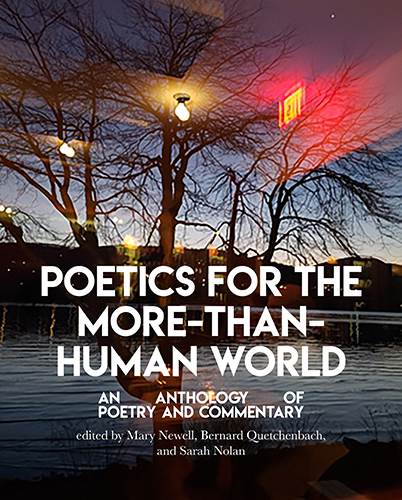
On July 16, 2020, I took part in the fourth of ten readings around the release of the Poetics for the More-than-Human World: An Anthology of Poetry and Commentary (Spuyten Duyvil, forthcoming 2020), originally published as a special issue of Dispatches from the Poetry Wars edited by Mary Newell, Bernard Quetchenbach, and Sarah Nolan. Other readers are: Cara Chamberlain, Petra Kuppers, Andrew Melrose, Eléna Rivera, Arthur Sze, and Jen Web. My reading of “Dead Horse Bay” and “Blason III” starts around 29:30 in the July 16 reading .

To find more about the series, visit the Ecopoetics Anthology Facebook page.

Links in the Time of Coronavirus, Vol. 2: April 15–May 15, 2020

Coronavirus Think Pieces

Kim Stanley Robinson, “The Coronavirus Is Rewriting Our Imaginations.”

Jodi Dean, “Neofeudalism: The End of Capitalism?”

Ibram X. Kendi, “We’re Still Living and Dying in the Slaveholders’ Republic.”

David Harvey, “We Need a Collective Response to the Collective Dilemma of Coronavirus.”

Richard Grusin, “Radical Mediation, COVID Masks, Revolutionary Collectivity.”

Charles Stross, “It’ll All Be Over by Christmas.”

Laurie Penny, “Productivity Is Not Working.”

Corey Robin, “Comrades.”

Masha Gessen on the present.

Continue reading

Poetics for the More-than-Human World Readings

To accompany the online publication of “Poetics for the More-than-Human World: An Anthology of Poetry and Commentary” at Dispatches for the Poetry Wars, along with its eventual print publication by Spuyten Duyvil, the editors have organized a series of ten readings over the next few months. The first reading kicks off next week, June 25, 2020 at 4:00 p.m. EDT with Rachel Blau DuPlessis, Patricio Ferrari, Peter O’Leary, Stephanie Strickland, Harriet Tarlo, Orchid Tierney, and Edwin Torres.

On July 16, 2020 at 4:00 pm EDT I’ll be reading with Cara Chamberlain, Petra Kuppers, Jake Levine, Eléna Rivera, Arthur Sze, and Jen Web.

Find our more on the anthology’s Facebook and Eventbrite pages.

Links in the Time of Coronavirus, Vol. 1: March 11–April 15, 2020

I originally intended in late May 2020, when the spring semester was finally over and I had some time to finish “Spring 2020 Links (Pre-COVID-19),” to post one big link dump for coronavirus-related things. But the hyperarchival barrage of news over the past three months, including everything that has happened in the United States the past three weeks (combined with how little time I still have . . .), has made it clear that it would be better to divide posts into smaller, more manageable bits. So here is everything I came across from March 11-April 15, 2020. More to come soon.

Sheri Fink and Mike Baker, “‘It’s Just Everywhere Already’: How Delays in Testing Set Back the US Coronavirus Response.”

The New York Times, “Coronavirus Map: Tracking the Global Outbreak,” “Coronavirus in the US: Latest Map and Case Count” and “Coronavirus Tips, Advice and Answers to Your New Questions.”

IHME, “COVID-19 Projections.”

Katie Zezima, Joel Achenbach, Tim Craig, and Lena H. Sun, “Coronavirus Is Shutting Down American Life as States Try to Battle Outbreak.”


Coronavirus Think Pieces (General)

Laurie Penny, “This Is Not the Apocalypse You Were Looking For.”

Naomi Klein, “Coronavirus Capitalism–and How to Beat It.”

Frank Pasquale, “Two Timelines of COVID Crisis.”

Ian Bogost, “Now Is the Time to Overreact.”

Arundhati Roy, “The Pandemic Is a Portal.”

Anne Applebaum, “The Coronavirus Called America’s Bluff.”

Dan Kois, “America Is a Sham.”

Continue reading

Spring 2020 Links (Pre-COVID-19)

A lot of stuff was going on for me this year, both personally and professionally, so I haven’t really had a chance to post links since . . . last summer (!), nine months before the global pandemic was declared. So, to catch up: here’s links from late summer 2019–March 11, 2020 that are, by the very nature of posting them now, rather outdated/anachronistic, a window onto a world that is gone yet still all too present (and excessive), a world that most certainly wasn’t going in the direction of human flourishing and that any nostalgia for may be misplaced. . . . I hope to have “Links in the Time of Coronavirus, Vol. 1” up sometime soon(er than nine months from now . . .).

Donald G. McNeil Jr., “Wuhan Coronavirus Looks Increasingly Like a Pandemic, Experts Say” (February 20, 2020).


Nuclear and Environmental

Mary Hudetz, “US Official: Research Finds Uranium in Navajo Women, Babies.”

David E. Sanger and Andrew E. Kramer, “US Officials Suspect New Nuclear Missile in Explosion That Killed Seven Russians.”

Kristin George Bagdanov, “Addressing the Atomic Specter: Ginsberg’S ‘Plutonian Ode’ and America’s Nuclear Unconscious.”

Alyssa Battistoni, “Why Naomi Klein Has Been Right.”

Henry Fountain, “Climate Change Is Accelerating, Bringing World ‘Dangerously Close’ to Irreversible Change.”

Continue reading

Summer 2019 Links

I had the privilege of meeting Richard Siken when I was quite young–an undergraduate at the University of Arizona–and he gave me lots of good advice on the poetry world (and life), conversations I still cherish. Please help him out.

Stroke Recovery Fund for Poet Richard Siken.


Nuclear and Environmental

Alenka Zupančič, “The Apocalypse Is (Still) Disappointing.”

James Livingston, “Time, Dread, Apocalypse Now.

Ted Nordhaus, “The Empty Radicalism of the Climate Apocalypse.”

Jessica Hurley and Dan Sinykin, eds., Apocalypse, special issue of ASAP/Journal.

Frame, Apocalypse.

Brad Plumer, “Humans Are Speeding Extinction and Altering the Natural World at an ‘Unprecedented’ Pace.”

Damian Carrington, “Why The Guardian Is Changing the Language It Uses about the Environment.”

Continue reading

ALA 2019 Panel: US Women Writers and Economic Forms, C19–C21

At this year’s American Literature Association Conference in Boston, Massachusetts (May 23–26, 2019), I will be speaking on a panel discussing US Women Writers and Economic Forms, C19–C21. I have included the information on the panel and a tentative abstract for the paper I will be presenting below.

For previous essays and papers of mine on what I am calling megatexts, see:

“Toward a Theory of the Megatext: Speculative Criticism and Richard Grossman’s ‘Breeze Avenue Working Paper.'”

“The Time of Megatexts: Dark Accumulation and Mark Z. Danielewski’s The Familiar.”

“The Megatext and Neoliberalism.”


Session 20-C : US Women Writers and Economic Forms, C19-C21 (St. George C)
1. “Protestant Work Epic: Labor, Loafing, and Form in Alcott’s Little Women Trilogy,” Schuyler J. Chapman, Glenville State College
2. “Megatextual Debris: Rachel Blau DuPlessis’s Drafts before and after 2008,” Bradley J. Fest, Hartwick College
3. “H.D. and the Entrepreneurial Imagination,” Racheal Fest, SUNY Oneonta


Panel Abstract

US Women Writers and Economic Forms, C19-C21

After the 2008 financial crisis, literary critics have turned increased attention to US economic ideologies and their complicated relationships to cultural production. This panel explores how US women writing across the tradition have responded to the changing economic conditions, discourses, and values that defined their moments. Panelists argue poets and prose writers Louisa May Alcott, Rachel Blau DuPlessis, and H.D. invent novel forms that at once challenge dominant discourses of free enterprise and disclose their patriarchal valences.


Presentation Abstracts

“Protestant Work Epic: Labor, Loafing, and Form in Alcott’s Little Women Trilogy”

Schuyler J. Chapman, Glenville State College

Roughly halfway into Louisa May Alcott’s Little Women, a longtime servant sends a letter to the March-family matriarch, explaining that she and the family’s four daughters have “got on very economical.” The moment underscores the narrative’s persistent attention to the financial texture of the mid-19th century. Although scholars have approached this novel and its two sequels as illustrative of period-specific perspectives on child-rearing, romance, education, and more, few have attended to the novels’ economic theories. In this series, I argue, Alcott crafts a set of consciously epic novels, reflective of both Frye’s and Lukács’s conceptualizations of the genres, as the ideal form through which she can interrogate the sources of and solutions to economic tribulations resulting from early industrial capitalism. Surveying her contemporaries, Alcott urges a return to what Weber would later identify as the Protestant Ethic, rejecting outright the malingering ethos put forth by Hawthorne, Melville, Thoreau, and Whitman. Rather than oppose an economic system that her novels represent as inherently unjust by refusing labor, Alcott proposes undermining the capitalist mode of production and its concomitant social hierarchies through a surfeit of labor, an ideal that finds itself reflected in the prolix and rather uneconomical narrative form she adopts.


“Megatextual Debris: Rachel Blau DuPlessis’s Drafts before and after 2008″

Bradley J. Fest, Hartwick College

In the twenty-first century, digital technologies have made it possible for authors to create massively unreadable works, what I call megatexts, through computational and collaborative composition. The ubiquity of texts that are quite literally too big to read appearing across media—from experimental novels and electronic literature, to television, film, and videogames—signals, as I argue elsewhere, that the megatext is an emergent form native to the era of neoliberalism. But what happens to other long forms, such as the twentieth-century long poem, when written in an era of megatextuality? Rachel Blau DuPlessis’s Drafts (6 vols.; 1987–2013) readily suggests itself as a case study for thinking through the lyric’s transformations in the era of big data and financialization. A long poem that conspicuously draws upon its modernist precursors (Pound, Zukofsky, Olson, et cetera) while disavowing at every level of its composition a patriarchal will toward totality, Drafts responds to the economic and political transformations between the end of the cold war and the 2008 financial collapse by producing a kind of fragmentary, megatextual debris. In this paper I will argue that DuPlessis, rather than simply (and futilely) resist the neoliberal logic of megatextuality, hypertrophically uses the form’s phallogocentrism against itself in order to more broadly interrogate what it means—socially, aesthetically, economically—to write a long poem in the age of hyperarchival accumulation.


“H.D. and the Entrepreneurial Imagination”

Racheal Fest, SUNY Oneonta

Although literary critics interested in neoliberal discourses usually focus on literary and economic texts composed after 1980, many neoliberal intellectuals writing in the US published their most influential theoretical works much earlier, beginning in the 1920s and 1930s. We might therefore productively reread US modernist writers with their neoliberal contemporaries in mind. When we do, I argue, familiar critical narratives about modernist understandings of the nature and function of human creativity shift. Critics often read modernist conceptions of imagination as romantic, transcendental, and incompatible with privileged materialist views of the human. Set against the entrepreneurial conceptions of culture that economists promoted in the early twentieth century, however, modernist writers seem to offer newly visible resources for oppositional projects interested in materialist representations of creativity. To give a sense of how, this paper puts the erotic view of creativity the poet and novelist H.D. develops in the fragmentary text, Notes on Thought and Vision, in conversation with the view of culture her contemporary, the Nobel-prize-winning economist Friedrich Hayek, theorized around the same time. While Hayek subsumes creativity to transcendental market logics he believes culture at its best supports, H.D. conceives imagination as an historical and embodied faculty able to influence others through the sensuous materiality of sound and image. I explore the history of these different visions and evaluate their stakes for our moment.