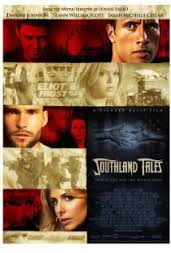
Reconsidering Southland Tales and an Old Conference Abstract

southland tales

Appropriately, as today is 4 July, an old friend directed me to Abraham Riesman’s reconsideration of the absolutely wonderful Southland Tales (2006) and interview with its director Richard Kelly, “The World Ends with a Handshake: Unraveling the Apocalypse of Southland Tales.” (Thanks Robin!)

This is a film I have taught and written about (though before this blog’s time). The incomparable Steven Shaviro talks about it here and in his most recent book. And I guess there’s a pretty decent fan site for it: Fuck Yeah, Southland Tales.

I also presented on Southland Tales at my first academic conference ever, SLSA 2008. Here is an abstract for the paper I gave there (since I’ve never posted it):

Apocalyptic and messianic narratives have traditionally taken place in a stable, teleological temporal space, and for good reason.  The affective impact of their grand narratives have depended upon the necessity for certain forms of meaning to be stable in a world with a distinct beginning and ending.  Richard Kelly’s 2006 film Southland Tales, however, takes reiterating the present, and consequently the past and the future as well, as its dominant structural mode.  From Justin Timberlake’s lip-synched music video of a Killers song, to reversing T.S. Eliot’s famous line: “Not with a whimper but with a bang,” to the division of the protagonist into two distinctly instantiated embodiments, the constant reiteration of various cultural detritus in Southland Tales reveals not so much a postmodern “mash-up” of reference and self-consciousness, as it does a reiteration of Nietzsche’s metaphor of the gateway of the Moment from Thus Spoke Zarathustra.  In other words, Southland Tales offers an alternate history of the present, a view of temporality in which, in Zarathustra’s words, “Must not whatever can happen have happened, have been done, have passed by before?”  This paper will investigate how Kelly’s film reiterates Nietzsche’s critique of the scientific enlightenment through his figure of Zarathustra and the Eternal Return, while simultaneously reiterating the very eschatological messianism that so dominates apocalyptic narratives (and Nietzsche’s own critique) in a manner that emphasizes a much more fluid, synchronic view of history, and hence the unstable present as well.

I will hold off on posting the paper, as it is definitely old graduate work that should not necessarily see the light of day. But all this is making me want to return to Southland Tales, as I do not imagine exhausting the film anytime soon. (This also makes me want to get on Twitter, just so I can follow Richard Kelly.)

What Will Probably be an Ongoing Series Reporting on the (Premature, Exaggerated, and Just Wrong) Reports About the Death of the Humanities and the End of Literature as We Know It With Links

David Brooks’s 20 June 2013 op-ed piece for The New York Times, “The Humanist Vocation,” in which he declares that the humanities are in decline, has sparked a flurry of debate and response. One of these reasons for the flurry of commentary is that the issue is more complicated than Brooks allows for in his quite brief piece (and he’s simply wrong on a few points, see Michael Bérubé below). Another reason for the considerable response is that his discussion of the humanities cuts to the bone for those of us who actually work in the humanities. (Certainly for me, as will be apparent below.)

Brooks’s article accompanied a report released by the American Academy of Arts and Sciences titled The Heart of the Matter, which takes the familiar line of: the humanities have to “retool” to fit the changes presented by our networked, scary world, with its new global economy, etc. This is not a quote,[1] but for anyone who has been following the discussions about the crisis in the humanities/higher education for the last five (or thirty) years, the kind of language The Heart of the Matter employs is familiar in its generality and emptiness, along with its refusal to look at how successful the humanities have been for the last five, ten, thirty, seventy, two-hundred, one-thousand . . . years. Indeed, part of its long-term success is that the humanities teach and emphasize old school things, like reading and writing. And that, despite all claims to the contrary (and with the requisite nods to the many questions posed about reading and writing during the theory boom, as well as to Marshall McLuhan and Friedrich Kittler), reading and writing do not change all that much, and haven’t for a long time.[2] To suggest that the technological changes bombarding us are going to remake the world and the people in it—how we interact and communicate, how we understand our place in the world—is to point out the blatantly obvious. But to suggest that the incredibly slow moving institution of humanistic study needs to rapidly change to meet these “new challenges,” is both to fundamentally misunderstand how the humanities work and to misunderstand the achievements made possible by an institution that is fundamentally stable[3] (i.e., grounded upon things—reading and writing—that do not change all that much[4]). Certainly humanistic study will have to change in some ways in these hyperarchival times, but I am of the mindset that the stability afforded by the humanities also gives them incredible flexibility to respond to and reflect upon the world. If you tend not to think the humanities is incredibly capable in terms of helping us understand, comment upon, change, and, perhaps most importantly, imagine the world . . . then you clearly haven’t studied the humanities, or at least not very well.

And I guess this is the whole point. For it is not just David Brooks that is telling me that my vocation does not matter, my students do as well (which is way worse). It seems easier and easier every semester for my, say, engineering students to inform me—thank you, by the way—that my class does not matter to them, because it will not help them get the job they want. That the stuff we are doing in this class—reading poetry, writing about it—does not matter. These skills do not pertain to their lives. Okay. Sure. I’m not going to try to convince you otherwise. I’m not. In my experience, if this is your attitude, there is only like a 1% chance I’m going to change your mind. And I’m just not interesting, charismatic, personable, or smart enough to do so. I’ve tried. I know. But of course you are able to say how this class does not matter and will not matter for you imagined-engineering-student because . . . you know very little about the humanities (which is why you are here anyway!). You also don’t know much about your own life yet, really.[5] Nor the future. Nor what skills you will actually need. Nor history. Etc. In other words, you are in a unique position. You are sitting in front of me because you do not know these things yet. You know a lot, certainly, and I can only teach you so much, and perhaps you will be able to teach me far more than I could teach you. But I do know a thing or two about literature, and I do know why it might be worthwhile to study. (And I’m certainly learning more every day. It is my job after all.) If you really knew this stuff, you would not need an education, at least from me. To base arguments for or against the humanities on undergraduate enrollment (undergrad enrollment is fine, by the way) as Brooks does, or on what undergraduates think they need, or in the way that undergraduates are now almost universally treated as consumers, again misunderstands the goals of the humanities, and certainly misunderstands the very concept of education. Imagined-engineering-student, you are in my seemingly unimportant classroom for a number of reasons, but one of those is because you cannot possibly know yet how learning to critically think, to closely read, and to carefully write will help you in the future. You can’t. Please stop informing me otherwise. And that way we can get to the really fun stuff. Which is, by the way, humanistic study.

Continue reading

Two Very Different Archives

David Pringle at a website devoted to the work of J.G. Ballard put up a list of the books Ballard read up until age 26. Pretty neat.

And did you hear? It’s official. Commercial art’s primary purpose is to collect data on you. Or at least that’s what Gawker is reporting about Jay-Z’s new album, Magna Carta Holy Grail. “It is not so much an album as a co-branded multimedia content delivery platform, Presented By Samsung™ Galaxy™ . . . . But now another, more unsettling use for the new album has become clear: It’s a massive data-mining operation. Fans used to obsess over album liner notes; now they freak out about terms-of-service.” Art used to be something we put in archives, museums, and libraries. Now it invades our home and puts us in archives. This is hyperarchival realism. Welcome to contemporaneity.

Some Links on the Current Debate About Contemporary Poetry

The July 2013 issue of Harper’s has an article that has sparked considerable amounts of debate in the world of contemporary poetry. Mark Edmundson’s “Poetry Slam: Or, The Decline of American Verse” is being widely responded to. (There’s a link, but you need a subscription or to pick up an actual copy of the magazine.) A smattering of links:

Ron Charles immediately reported on Edmundson’s polemic in The Washington Post with “Why is Modern Poetry So Bad?” (Though his use of “modern” in the title probably signals a certain ignorance of twentieth and twenty-first century poetry . . . .)

The University of Pittsburgh’s own Dawn Lundy Martin has weighed in with “In Defense of-.”

Continue reading

Some Thinking on the Present and Future of Disaster

Some wonderfully bleak things I’ve run across this week: Margaret Ronda’s, “Mourning and Melancholia in the Anthropocene,” in Post45; and I am eagerly waiting for Liam Sprod‘s Nuclear Futurism: The Work of Art in the Age of Remainderless Destruction (Zer0 Books, 2013) to arrive in the mail. Post45 also has a fairly interesting piece from October on Thomas Pynchon: David J. Alworth, “Pynchon’s Malta,” Post45.

Abstract: Infinite Oppenheimers and Postnatural Metahistory: Jonathan Hickman’s Manhattan Projects

Below is an abstract for a paper I will be presenting at the 2013 Society for Literature, Science, and the Arts Conference, taking place October 3-6 a Notre Dame University.

Infinite Oppenheimers and Postnatural Metahistory: Jonathan Hickman’s Manhattan Projects

From the perspective of what number of young scholars and nuclear critics are calling a second nuclear age, I would like to suggest that one site of the “postnatural” can be found in the remarkable cultural intersection between narratives of nuclear history and contemporary ecological understandings of catastrophe and risk. Though there are any number of instances of such aesthetic correspondences and dissonances, for instance the spectacle of cinematic destruction that dominated the last decade, one might do well to look to texts that, parallel to the non-event of Mutually Assured Destruction, eschew moments of narrative disaster. Writer Jonathan Hickman and artist Nick Pitarra’s The Manhattan Projects (Image Comics, 2012- ) is such a text, imagining that work on the atomic bomb at Los Alamos was “a front for a series of other, more unusual, programs.” Hickman’s writing picks up a tradition of re-imagining nuclear history, familiar to any reader of Thomas Pynchon, and adds a superheroic twist: J. Robert Oppenheimer is consumed by his infinite personalities, Enrico Fermi is an alien, F.D.R. is reborn as an A.I., Albert Einstein plays the role of Wolverine, etc. This paper will argue that Hickman’s work emerges from a particular moment in which nuclear, information, and biological sciences are raising a host of interesting questions for contemporary narrative. Hickman’s radically alternative history of twentieth century science and politics emerges from a postnatural perspective whose horizon surpasses the globe, positioning nuclear history within a galactic ecology in order to rigorously problematize the posthuman.

Eco-Disaster and Surveillance, Some Links

So some articles of interest.

At Jacobin, Alyssa Battistoni has followed up her piece on disaster in the wake of Hurricane Sandy with “Back to No Future,” a pretty bleak essay on environmental change and the (lack of a) future.

Jeff Goodel has a piece in Rolling Stone“Goodbye, Miami,” about what (now inevitably) rising sea-levels will do to Miami.

And here’s a number of links re: the ongoing NSA drama.

Philip Bump has reported at The Atlantic Wire that the US has filed espionage charges against Edward Snowden.

Naomi Wolf raises a number of questions about Snowden, and then raises some more.

Falguina A. Sheth writes for Salon, “Snowden’s Real Crime: Humiliating the State.”

And Michael McCanne has a very interesting essay, “Total Information Awareness,” at The New Inquiry.

And linking ecological disaster and surveillance together, Nafeez Ahmed wrote a piece for The Guardian, “Pentagon Bracing for Public Dissent Over Climate and Energy Shocks.”

Notes on This is the End

This is the End 2013

So, let’s get this out of the way quickly. This is the End (dir. Evan Goldberg and Seth Rogen, 2013) is a terrible movie. (I had a previous inkling that it was going to be pretty wretched.) It is adolescent (if self-consciously so), puerile (viz. Satan’s giant phallus), and misogynist, among its other sins. Perhaps most damning: it is poorly imagined. There are a number of other ways that actors playing themselves in a movie about the end of the world at James Franco’s house could have gone. Seriously. This is a brilliant premise[1] but This is the End is embarrassing.

Despite this pretty damning opinion, the spirit of The Hyperarchival Parallax’s subtitle obliges me to give this onanistic bropocalypse its due. For if nothing else, the film is somewhat fun. This is largely due to the constant metafiction the film is engaged in: Michael Cera is a degenerate, the Back Street Boys exist(ed) (right!?), Aziz Ansari is not generally liked, etc. And this is funny/interesting b/c each actor plays themselves.[2] (Or at least it is supposed to be [and often is] funny.)

But the true failure of This is the End lies in never asking itself what its basic premise means.[3] Namely, what does it mean to make a film about the “Christian” Apocalypse with a cast of goofballs (who made it big for whatever reason) playing themselves in 2013? Yes, the film is self-aware about how indulgent of a film it is (is it really though?), but if you are going to parody the currently (very) popular craze with representing megadeath and mass-destruction[4]—and in a time of danger, a time of surveillance, climate change, war, revolution, torture, and disaster—without once asking why one might make such a film nor why such a film might be interesting, timely, or important at this late and exhausted date in 2013 . . . this is a mistake.

To my mind, This is the End is a product of the 2013 orgy of disaster (see fn. 3) finally turning in on itself. And it is about time. (Whatever one may think about David Foster Wallace’s irony or sincerity) This is the End is very necessarily ironic in this time of serious-ass superhero movies destroying significant amounts of urban real-estate over and over. But it is not ironic enough. There are too many dick and fart jokes, and not enough acknowledgment of what it is and what it is doing: that it is metafiction satirizing contemporaneity and its multiplying disastrous projections of national fantasy. This is the End, if nothing else, emphasizes that we should be wary of the sincere expression of eschatological national fantasy at the present time.


[1] It really is. Though I will refrain from speculating too much how differently this film could have gone, it is a tempting activity.

[2] Though this is also to assuredly stress that the film could have benefitted from a quick refresher course on John Barth, Thomas Pynchon, Cynthia Ozick, David Foster Wallace, etc. Maybe especially Wallace’s “Westward the Course of Empire Takes its Way” (1989).

[3] Its other true failure rests upon its mistaken idea that, at the end of the day (literally), experiencing the end of the world w/ your friends would be kinda fun.

[4] It appears that every week a new film that imagines really massive destruction or post-apocalyptic waste will come out for the remainder of the summer. (In fact, there are a number of them playing right now!) In 2013 (just off the top of my head) we’ve seen: Olympus has Fallen (dir. Antoine Fuqua), which imagines a terrorist attack on the White House; there is the forthcoming White House Down (the new Roland Emmerich joint), also imagining a terrorist attack on the White House; there will be the xenocide of Ender’s Game (Gavin Hood); the nepotism of After Earth (M. Night Shyamalan); the (weirdly) promising looking Elysium (Neil Blomkamp); Oblivion (Joseph Kosinski) . . . ; Pacific Rim (Guillermo del Toro), which looks like it will bomb; The World’s End (Edgar Wright), another eschatological buddy-movie; World War Z (Marc Forster), Brad Pitt’s “adaptation” of Max Brook’s compelling and interesting novel of the same name (2006) (that came out today and according to Vanity Fair the film looks to be wanting); and of course finally there is Man of Steel (dir. Zack Snyder, 2013), a film I’m still puzzling over, which imagined something like two trillion dollars in damage to downtown Metropolis. There are many more such films coming out this year.

Quite simply, 2013 is the year of disaster porn. It’s everywhere. It even comes in the guise of children’s fantasy. Transformers (1984-1987) and Action Comics (1939- ) have been repurposed into visions of Armageddon and mega-death. Think about this for a second.

More selfishly, this summer blockbuster movie season is yet another reminder that a critic of the writing of the disaster will never be out of work. We are in the age of frequent, diverse, ubiquitous, and excessive disaster. It is multiplying. This is the point. The multiplication of real or imagined disaster scenarios in contemporaneity requires its own archive. Trying to deal with the reality of this requires what I have been and will continue to call hyperarchival realism.

Repackaging the Archive (Part X): The Hyperarchivalism of the NSA’s Prism with Links

In a recently published essay, I have defined the term “hyperarchive” as “an archive whose goal, whether stated or not, can be seen in an attempt to gather together as many documents and texts as it can, regardless of content.”[1] This term clearly applies to the recent revelations about the National Security Agency’s (NSA) data collection. In fact, Prism may well be the best example of a hyperarchive to date (besides the Web). To not at least gesture toward talking about Prism and massive data collection on this blog would constitute gross negligence.

One of the things that this blog consistently tries to demonstrate, draw attention to, and complicate/challenge, is the relationship between technologies of destruction and accumulation, even if only by noting (and sometimes enacting) such relationships with little-to-no commentary. I have refrained from saying much about the recent and developing story about Prism and the NSA,[2] both because it seems too “obvious” and too complex. Prism is an accumulatory technology with clear dangers and evils (which I do not think I have to spell out). Some of these dangers and evils are quite old now, and quite familiar.[3] Others are just emerging, and the potential for misusing the kind of data collected by Prism appears to be limitless. Given the parameters of the hyperarchival impulse of contemporaneity, and the reality of ubiquitous access to massive amounts of information, it is not even vaguely surprising that the NSA has been amassing massive amounts of data. And obviously there is quite a bit wrong with this (part of which is the fact that Edward J. Snowden’s revelation is not surprising).

Glen Greenwald, the writer for TheGuardian who broke this story and has been consistently reporting on it, asked nearly a month ago, “Are All Telephone Calls Recorded and Accessible to the US Government?” Most of us have probably been asking this question for a number of years. The fact that we have been asking this question seriously, for a sustained amount of time,[4] only reinforces the realities of contemporary informatics: that many of us have always tacitly assumed that we were being watched, recorded, etc., pretty much all the time. The fact that we are not much, much more upset about this scandal is probably due to this reality of contemporaneity. Thus Snowden’s whistleblowing is functioning as a confirmation of what everyone always already knew: the emperor is naked, we know, are not pretending otherwise, and don’t seem to mind. This is disturbing, to say the least.[5]

Basically, the issues being raised by the NSA scandal, the implications for thinking about information, surveillance, discipline, and control, issues regarding archives and literature, technology and war, media and communication, contemporaneity and the risk society, immigration, the nation, and the state, are many. I will not dwell on them here, in hopes that thinking about these issues will take the form of an essay (hopefully destined for a more permanent home in a [slightly] different kind of archive). In lieu of more sustained reflection and further remarks, here is a pretty decent smattering of links related to the issue in (more-or-less) chronological order. I imagine I will continue to post links regarding Prism well into the future.

Continue reading