In addition to other notable archives (David Foster Wallace, Don DeLillo, Louis Zukovsky, and many, many others), the Harry Ransom Center at the University of Texas, Austin just acquired the McSweeny’s Archive. This is kind’ve incredible, esp. considering that McSweeny’s has only been around for fifteen years.
Leaking or Spying?
R. drew my attention to this vexing article in yesterday’s New York Times: Adam Liptak‘s “Court Rulings Blur the Line Between a Spy and a Leaker.” An excerpt:
The federal government is prosecuting leakers at a brisk clip and on novel theories. It is collecting information from and about journalists, calling one a criminal and threatening another with jail. In its failed effort to persuade Russia to return another leaker, Edward J. Snowden, it felt compelled to say that he would not be tortured or executed.
These developments are rapidly revising the conventional view of the role of the First Amendment in national security cases. The scale of disclosures made possible by digital media, the government’s vast surveillance apparatus and the rise of unorthodox publishers like WikiLeaks have unsettled time-honored understandings of the role of mass media in American democracy.
Is it just me, or is contemporaneity becoming Orwellian far faster than I can keep up with?
Out of Our Control: Links on Solar Flares and PRISM
Paul Bedard wroate a rather scary account of a recent narrow miss with a solar electromagnetic pulse. In other words, human technological civilization was almost completely wiped out two weeks ago and this is the first we’ve heard of it.
And PRISM is getting more and more coverage.
Via Metafilter: Thanks to the NSA future historians will have a record of everything we did in the early 21st c. Welcome to the hyperarchive.
Googling things like “pressure cooker” or “backpack” will now get you a visit from the police. Welcome to the Orwellian present.
“The NSA’s Massive Call Record Surveillance Barely Accomplishes Anything.” Welcome to total and futile control.
From The Guardian: “Edward Snowden’s Not the Story: The Fate of the Internet Is.”
And James Fallows in The Atlantic, “Why NSA Surveillance Will Be More Damaging Than You Think.” Welcome to the desert of the real.
The National Endowment for the Humanities is Facing Huge Budget Cuts and You Can Do Something About It Right Now
From the National Humanities Alliance website:
The House of Representatives Appropriations Committee released its FY 2014 Interior and Environment Appropriations bill this morning with a 49 percent ($71 million) cut for the National Endowment for the Humanities. If enacted, this funding level would devastate an agency that has already been reduced by 19 percent since 2010.
This drastic cut would end programs that provide critical support for humanities teaching, preservation, public programming, and research, and result in positive impacts on every community in the country. Programs supported by the NEH teach essential skills and habits including reading, writing, critical thinking, and effective communication that are crucial for ensuring that each individual has the opportunity to learn and become a productive member of society. Further, NEH’s programs strengthen communities by promoting understanding of our common ideals, enduring civic values, and shared cultural heritage.
Please send a message today!
Please follow this link to quickly fill out a petition to your local congressman to oppose these cuts.
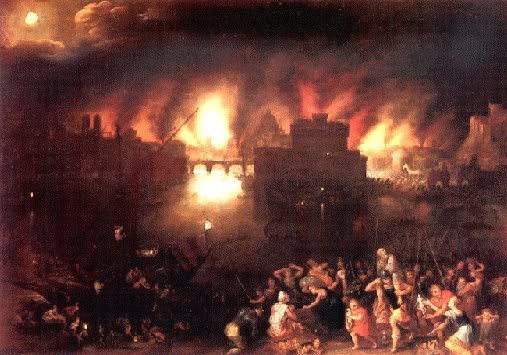
Ancient Apocalypse
Metafilter has a bunch of interesting links to the Bronze Age Apocalypse. Something took place between 1200 and 1150 BC, or a number of things took place–including natural disaster and barbarian invaders–that basically wiped out ancient civilization:
Re-Re-Writing American History
It was reported yesterday by Tom LoBianco (via The Huffington Post) that while Governor of Indiana, “Mitch Daniels Sought to Censor Public Universities, Professors.” Daniels, now president of Purdue University, wanted to ban Howard Zinn‘s seminal A People’s History of the United States: 1492-Present (1980). In emails obtained by the Associated Press through the Freedom of Information Act, we know that Daniels wrote the following about Zinn and his classic study of US history:
This terrible anti-American academic has finally passed away,” Daniels wrote. “The obits and commentaries mentioned his book, `A People’s History of the United States,’ is the `textbook of choice in high schools and colleges around the country.’ It is a truly execrable, anti-factual piece of disinformation that misstates American history on every page. Can someone assure me that it is not in use anywhere in Indiana? If it is, how do we get rid of it before more young people are force-fed a totally false version of our history?
Wow.
More Links About the Decline of the Humanities
Max Nisen has written an article titled, “America Is Raising a Generation of Kids Who Can’t Think or Write Clearly,” for Business Insider. He writes:
De-emphasizing, de-funding, and demonizing the humanities means that students don’t get trained well in the things that are the hardest to teach once at a job: thinking and writing clearly. CEOs, including Jeff Bezos, Logitech’s Bracken Darrell, Aetna’s Mark Bertolini, and legendary Intel co-founder Andy Grove emphasize how essential clear writing and the liberal arts are. STEM alone isn’t enough. Even Federal Reserve chair Ben Bernanke recently gave English majors a shout-out. The point is that good writing isn’t just a “utilitarian skill” as Klinkenborg puts it but something that takes a great deal of practice, thought, and engagement with history and what other people have written.
I have to admit I find the argument about CEOs think the humanities are valuable to be missing the point and deeply suspicious. Nisen has followed this piece with a number of other related articles: “These Charts Prove that College is More Important Than Ever,” “11 Reasons to Ignore the Haters and Major in the Humanities,” and “Humanities Grade Inflation is Luring Away Millions of Potential Scientists” (which seems like the opposite of the point). To be honest, however, who is Nisen’s audience with these pieces? All those undergraduates and recent high school grads who read Business Week? I think there’s more going on here than meets the eye.
Another Case for the Humanities: It Gives Us Science Fiction
Judith Shulevitz at The New Republic makes a fairly convincing case for the humanities through considering the power of science fiction to shape the world in “And Martians Shall Save the University: Why Do We Need the Liberal Arts? Because It Gives Us Sci-Fi.”
Freedom of Information and the University on Fire
David Harris Gershon has submitted a concerning report: “NSA Rejecting Every FOIA Request Made by US Citizens.” Specifically regarding PRISM, the letter sent back to Clayton Seymour after his FOIA request is fairly chilling: “we cannot acknowledge the existence or non-existence of such metadata . . . . Therefore, your request is denied because the fact of the existence or nonexistence of responsive records is a currently and properly classified matter in accordance with Executive Order 13526, as set for in Subparagraph (c) of section 1.4″ (emphasis mine).
Gershon unpacks the meaning of the letter: “the NSA is classifying every single bit of data it receives from ordinary American citizens based on the premise that it has been gathered covertly. Meaning: the NSA’s advertised justification for not granting FOIA requests is to protect our country. However, the real justification is the NSA’s covert violation of Americans’ Fourth Amendment right not to be subject to unwarranted searches and seizures (in this case of their personal, digital data).”
And this image seems just too apt regarding my brief post about the decline of the humanities/higher ed the other day.
Sonnets for 2013, part 2
The second part of my 2013 sonnet sequence just went up over at Spork. Please enjoy “2013.04,” “2013.05,” and “2013.06.”