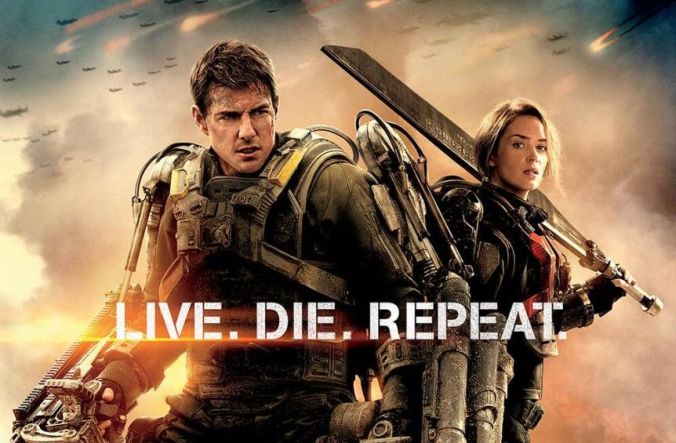
As Jon Stewart commented to Tom Cruise on The Daily Show the other night, Edge of Tomorrow (2014) resembles a videogame. Cruise’s character, William Cage, dies over and over.[1] Each time he dies, he is resurrected with the knowledge of what transpired before he died, and so, much like a videogame, he is able to get “further” than he did before with each “play-through.”[2] Also, like videogames (in general), there is something deeply nihilistic and doomy about this kind of ontological state, this state of being “reset” (often intentionally) so that a better outcome can transpire, again and again, for ends that seem largely unobtainable, and, after a while, not even desirable or coherent.[3] This representation of human life as infinitely repeatable, as a “gamified”[4] set of conditions and procedures to be mastered, as a teleological striving toward a singular objective, a boss battle at the end of every single life for the survival of humanity . . . I would like to suggest that such a vision of Being signifies a deep and abiding despair with contemporaneity, a hopelessness with life as we know it, an acknowledgment of the finitude of human life (and, indeed, the species), and an insight into the brutal logic of the gamification of the world in the twenty-first century. It also, of course, holds out a weird hope that the gamification of the very things that make us human (our experience of time, our finitude, love, knowledge, et cetera) might allow us to access transcendent, messianic, heroic existence. This hope, however, only reinforces the audacious despair at the heart of the film.
Edge of Tomorrow’s cinematic forerunner is obviously the endearing, (still) funny, and (at this point, for me at least) nostalgic film, Groundhog Day (1993). I’m surprised it has taken Hollywood this long to revisit this concept of serious repetition, for there is something weirdly fascinating about the idea of living the same day (or week, or month, or life! the possibilities are endless . . .) over and over again. There are clear “affective” pleasures that this kind of narrative produces. A single human life is littered with regrets, reflections on what could have or should have happened, words that shouldn’t have been spoken, actions taken that cannot be undone, a litany of mistakes, an index of petty tragedies. Groundhog Day takes this regret and funnels it into a single, relatively typical day, experienced by a relatively ordinary bourgeois American subject. The despair at the heart of Groundhog Day is normal: everyday life, with all its attendant regrets and failures. We take pleasure in its comedy—in all senses of the word—because the fantasy it depicts is not, as my students like to say, “relatable,” but because it is wholly other. We cannot undo the past, rework our mediocrity into perfectible “goodness,” living for others, being our best selves, et cetera. We like to imagine that we can be perfect bourgeois subjects, interpolated as Bill Murray is by the end of the film, and we take pleasure in perpetuating the illusion that such subjectivity is possible, but we cannot help but be haunted by our own selfishness, pettiness, despair, complacency, and hopelessness, a state of being that characterizes Murray’s character at the beginning of the film. Groundhog Day is an ideological fantasy that briefly covers over our own dumb, inert selfishness, and for that, it is a balm for everyday life. It briefly holds out a hope that we aren’t all the worst, and as such, we enjoy the illusion.
Edge of Tomorrow, though formally almost exactly the same, is quite different. Yes, Cruise’s character is “unlikable” at the beginning of the film, but not in a genuinely “human” fashion (i.e., Bill Murray: he’s a jerk, a misogynist, a drunk, et cetera). Rather, Cruise doesn’t want to go to war. Sure, he is in the military, performing some sort of military-media duty, but his desire to not go to war (I hope after over a decade of US military adventurism) is not unnatural.[5] At this point the alien invasion seems limited to the area Germany occupied during World War II, so why would one want to go into battle, when there are so many places on Earth that one could still live relatively unharmed (e.g., the US)? Are we really, at this late date, to sincerely accuse Cruise’s character of cowardice at this point? I would hope not. (And, as he points out to the general, he’s playing a legitimately important role in global propaganda! Why would you send one of your chief propagandists into battle?) But of course, the general is nonplussed with Cruise’s cowardice, so (I assume, drugs him? and) Cruise finds himself waking up in handcuffs, his paperwork listing him as a private, being sent into battle on the whims of a sadistic general.
Let me stress how different this is from Groundhog Day. First of all, the physical, material reason for Murray’s repetition is never explained. Cruise’s is explained quite quickly: the alien-hive-mind-Mother-Brain-glowing-thing can transcend space and time, resetting the world every time one of its special-time-whatever-units is destroyed, thus insuring its victory . . . or whatever, and Cruise accidentally got some of that magical alien goo in his blood the first time he died on the shores of, I assume, Normandy, so the Mother Brain thinks Cruise is one of its temporal units. Further, Cruise, unlike Murray, has only been characterized as a media maven with little backstory (family, wife, kids for a man clearly in his forties?[6]) and no discernible character traits. (Murray was able to distill an entire life’s failures into the first twenty minutes of Groundhog Day.) So Cruise is just a tabula rasa, a one dimensional man that, because he finds himself in this extraordinary situation, soon becomes a valiant badass, like we all could (if we were playing a videogame). In other words, Groundhog Day’s repetition does not resemble a game. It resembles the fantasies of what all us poor schlubs would do differently if we had the chance. The Edge of Tomorrow, on the other hand, places us in a (now classic) videogame situation: we don’t know who or what we are, nor why we find ourselves in this extraordinary situation, but through repetition and mastery, we will get to the final castle and save the princess![7]
Just think about the first time you played Super Mario Bros. (1985). Why am I here? What am I supposed to do and why? What are these bricks and question marks? What are these little goombas coming toward me? I doubt anyone pauses to ask themselves such questions. No. The player immediately sallies forth, knowing there is a clear teleological direction (right, always right!) and gamic procedure, and through enough repetition, the gameplay will be gradually mastered. After Cruise wakes up for the first time after having died, he is exactly in the same position as the eight-year-old player of Super Mario Bros. who has died for the first time, maybe even on the first goomba, and finds herself back at the starting position. (And, much like with videogames, his situation is only made clear to him with the introduction of another “player,” Rita, played by Emily Blunt, who also had and then lost Cruise’s ability to play the situation over and over again. She effectively becomes “player 2” in Edge of Tomorrow.)
For the logic of The Edge of Tomorrow is its banal teleology. The one scene where Cruise steps off the path, goes into London to watch the war on the television and throw back a couple of beers, results only in the alien destruction of the city. The message is clear. There is only one direction to go in. Either kill the final boss or nothing.[8] Being, with this kind of telos and repetition, then becomes mechanized, enframed, controlled, and reified. The only possibility for subjectivity, for a subject’s ontological experience of the world, is to abide by the strict limitations imposed by this experience of repetitive time. Cruise has no other choice than to abide by the logic imposed upon him (or else isn’t imaginative enough to articulate other ways of being within the logic of his gamified existence. He’s like the player of Grand Theft Auto who never deviates from the main narrative path. . . .)
Compare this to Groundhog Day. Murray’s first reaction, unlike Cruise, is a deep realization of the banality and horror of his situation. The endless repetition of the same day over and over is an utter nightmare. And so he confronts this horror not by gamifying his existence, but by playing with it, without parameters, for fun (even going so far as to kill himself in a number of clever ways). He then uses his situation to master a host of tasks, but few of them are blatantly teleological. Yes, he masters the piano, but there is no need in the diegesis of the film for him to do so. Achieving his love relationship does not get him out of his situation. Only by becoming selfless, a better person, caring, et cetera, can he get off his track. And, as we might (hope we) know, there is no clear, easy direction toward such caritas, no telos for this kind of love. Groundhog Day flirts with the gamification of Being, but it is clear there is something very much more at stake with the cosmic loop that has been imposed upon Murray.
Cruise’s situation is more horrifying than Murray’s, for he has to die to reset the “game,” and he dies over and over and over. The experience of such constant death, I have to imagine, is unpleasant, as are all those moments prior to death (he breaks his back, arms, et cetera, at points in the film, usually before being shot in the head). And it is this repetitive death, rather than resurrection or repetition, which is the clearest site of the horror of Edge of Tomorrow’s gamification of Being. In a slightly different context, communications scholar Lizbeth Klastrup has suggested that in videogames, “the experience of ‘death’ is thus not one of termination, though it may definitely cause a player grief. In most gameworlds, ‘dying’ is an activity similar to a number of other repeatable activities that occur as a part of the everyday life in the world.”[9] Death is just another mechanic, part of the aesthetic form of the game, something that ultimately can be “playful and explorative, fun and entertaining, or merely be considered an unfortunate nuisance that obstructs the flow of playing the game.”[10] Jesper Juul has taken his reflections one step further, noting that “I dislike failing in games, but I dislike not failing even more,” and as such, “failure in games tells us that we are flawed and deficient. As such, video games are the art of failure, the singular art form that sets us up for failure and allows us to experience and experiment with failure.”[11]
This is all well and good. Failure and death in games are fundamental aspects of the medium’s form, its aesthetics. Death is not an ontological condition in videogames, but a structural one, like a law of physics, a mechanic, a limitation that, by limiting one’s experience, creates meaning and pleasure. If one could not die in, say, Super Mario Bros., it would be drained of whatever (perhaps limited) meaning or pleasure it may have or produce. (This is the same reason that, though cheat codes are initially fun to use because of how they transgress the boundaries of the game mechanics, players quickly get bored with being invincible, or whatever, in games.)
Let me be clear. Death in Edge of Tomorrow is not “playful and explorative, fun and entertaining . . . an unfortunate nuisance.” It is death, clear and simple. Yes, it isn’t really death, because Cruise comes back over and over, but there is nothing playful or fun about it. It hurts. It must take a psychological toll upon him. He sees Emily Blunt die over and over again, which becomes more and more painful as he begins falling in love with her (for reasons that are largely unclear; she is also quite one dimensional). When Bill Murray plays with death in Groundhog Day, it is darkly comic, playful, and, at least for the audience, unsettlingly fun. Like videogames, death in Groundhog Day is aesthetic and formal. But it isn’t, really, in Edge of Tomorrow. By the midpoint of the film, Cruise has ceased trying to save his comrades from often grisly deaths, realizing that only the teleological goal of killing the Mother Brain matters (and if the Mother Brain had been where he thought it was in the first place, we wouldn’t have the redemptive ending we do). Death in Edge of Tomorrow never loses its feel of “reality,” with all its attendant pain, regret, loss, and horror. And gamifying death only makes it more horrifying. If the horizon of Being is death, as Martin Heidegger once suggested, and that Being is Being-toward-death, that Being is constructed on the abgrund (or lack of ground) that is death, Edge of Tomorrow only multiplies the anxieties and horrors of human existence, of Being.[12]
And here is the audacious despair at the heart of the film. Edge of Tomorrow reveals that the horizon of the contemporary fad of gamification, of gamifying increasingly nongamic aspects of life, is the gamification of Being itself. And this is not fun. It is horrific.Indeed, gamification as it is practiced today is not necessarily fun. Who really wants to earn “experience points” rather than grades, or become the mayor of an area because of their savvy shopping? (Well, actually, clearly many people.) But the logic of gamification, extended toward the horizons of human life, of our existence and not just our activities, toward our very Being, our love, knowledge, death, imagination, et cetera, is a threat to ontology itself, a threat to the very Being that is specific to humans. When we gamify human existence, the result is pain, horror, and death. And do not let the ending of Edge of Tomorrow distract us into thinking that it could be redemptive, happy, and fulfilling. It is only by resetting the entire world, by undoing what had been done, by making human activity and life meaningless, that it can achieve anything other than horror.
The ending of the film, and the film’s clear historical references to the Second World War and the invasion of Normandy, point toward a deeper despair than simply the gamification of Cruise’s Being. The film effectively gamifies the existence of the species. It seems to suggest that World War II is a repeatable, recursive activity that humans get involved in, that they will always be fighting evil, landing on Normandy, dying in the thousands (and of course the film cannot help to obliquely point toward the Shoah, another site of the horrific reification of the human). The only way to confront the present alien invasion is to reimagine the site of so much twentieth century trauma. So it is here, with this repetition of the past, the gamification of history, of war, of trauma, of suffering, of militaristic ideology, of American exceptionalism, that the film’s real despair shines through. In short, the film suggest that humanity, unless it figures out a way of gamifying the species, is doomed. Doomed toward a single end. The aliens in this film do not necessarily stand in for climate change, but they might as well. There is no reset button on the glaciers sliding into the ocean, for the disastrous effects of climate change, for the seemingly endless wars of the twenty-first century, for the increasingly nonhuman forces of capitalist exploitation.[13] And the film acknowledges that there is no other way to prevent human extinction other than resetting history. The despair at the heart of the film is this. We are already past the point of resetting anything, and we literally cannot imagine anything else except the fantasy of going back in time to make it right. And we cannot. The gamification of Being covers over this brute reality to suggest that things are alright, we can just try again. By gamifying death, the film obscures the most basic facts of human existence: that we are doomed and repetition cannot save us. And we clearly need something else.
[1] See Jesper Juul, The Art of Failure: An Essay on the Pain of Playing Video Games (Cambridge, MA: The MIT Press, 2013).
[2] Indeed, there are multiple points in the movie where Cruise says something along the lines of “I haven’t gotten this far before.”
[3] For anyone who has played games on the Nintendo Entertainment System, this frequent resetting of the game, often quite soon after one has started the game, should feel familiar. Cruise’s character is often intentionally shot in the head, or “reset,” throughout the film.
[4] For an outstanding essay on gamification, see Patrick Jagoda, “Gamification and Other Forms of Play,” boundary 2 40, no. 2 (Summer 2013): 113-144. Jagoda says that “gamification,a term that derives from behavioral economics, refers to the use of game mechanics in traditionally nongame activities” (114). So, for example, rather than give out grades in a classroom, students might “level up” and earn experience points. (A quick search of “gamifying the classroom” yields many results.) Gamification is happening all over, from corporate offices, to exercise (see that recent iPhone commercial), to shopping (e.g., Foursquare), to other social media.
[5] In fact, the beginning of the film, with its clear imperative to be “patriotic” in some sort of extra-national sense (i.e., when patriotism is applied to the species), is deeply disturbing. It’s as if the last decade and more didn’t happen. That anything less than “fighting for one’s country” (or something) against a clear “evil” (and it is no mistake the film blatantly recalls D-Day right around its seventy-fifth anniversary) is morally questionable . . . is morally questionable.
[6] Though Cruise is fifty-one now?
[7] So often games begin in media res, the player having little idea of who are what their character is, that this has become a trope of videogames. Think of all the Elder Scrolls games, which all feature characters waking up imprisoned with little or no backstory.
[8] The film implies that Cruise repeated this day many, many times. I couldn’t help but wonder how many “days off” he took. Did he structure his repetitions like a work week? Fighting Monday through Friday, but then doing something different two other days? The banality of dying over and over, I have to imagine, would require a bit of rest and recreation after a while.
[9] Lisbeth Klastrup, “What Makes World of Warcraft a World? A Note on Death and Dying,” in Digital Culture, Play, and Identity: A World of Warcraft Reader, ed. Hilde G. Corneliussen and Jill Walker Rettberg (Cambridge, MA: The MIT Press, 2008), 145.
[10] Ibid.
[11] Juul, 2, 30.
[12] This is a radically condensed and oversimplified account of Heidegger. See Martin Heidegger, Being and Time: A Translation of Sein und Zeit (1927), trans. Joan Stambaugh (Albany, NY: State University of New York Press, 1996). SUNY has recently issued a revised edition of this book. Obviously this is not the place to get into a discussion of Heidegger’s forthcoming notebooks. . . .
[13] And it is perhaps telling that immediately after seeing this film, I wandered into a bookstore and picked up Thomas Piketty’s Capital in the Twenty First Century, trans. Arthur Goldhammer (Cambridge, MA: The Belknap Press of the Harvard University Press, 2014).
 The Hyperarchival Parallax