Reconsidering Southland Tales and an Old Conference Abstract

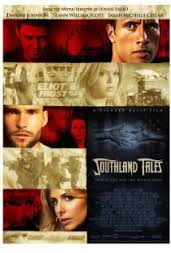
southland tales

Appropriately, as today is 4 July, an old friend directed me to Abraham Riesman’s reconsideration of the absolutely wonderful Southland Tales (2006) and interview with its director Richard Kelly, “The World Ends with a Handshake: Unraveling the Apocalypse of Southland Tales.” (Thanks Robin!)

This is a film I have taught and written about (though before this blog’s time). The incomparable Steven Shaviro talks about it here and in his most recent book. And I guess there’s a pretty decent fan site for it: Fuck Yeah, Southland Tales.

I also presented on Southland Tales at my first academic conference ever, SLSA 2008. Here is an abstract for the paper I gave there (since I’ve never posted it):

Apocalyptic and messianic narratives have traditionally taken place in a stable, teleological temporal space, and for good reason.  The affective impact of their grand narratives have depended upon the necessity for certain forms of meaning to be stable in a world with a distinct beginning and ending.  Richard Kelly’s 2006 film Southland Tales, however, takes reiterating the present, and consequently the past and the future as well, as its dominant structural mode.  From Justin Timberlake’s lip-synched music video of a Killers song, to reversing T.S. Eliot’s famous line: “Not with a whimper but with a bang,” to the division of the protagonist into two distinctly instantiated embodiments, the constant reiteration of various cultural detritus in Southland Tales reveals not so much a postmodern “mash-up” of reference and self-consciousness, as it does a reiteration of Nietzsche’s metaphor of the gateway of the Moment from Thus Spoke Zarathustra.  In other words, Southland Tales offers an alternate history of the present, a view of temporality in which, in Zarathustra’s words, “Must not whatever can happen have happened, have been done, have passed by before?”  This paper will investigate how Kelly’s film reiterates Nietzsche’s critique of the scientific enlightenment through his figure of Zarathustra and the Eternal Return, while simultaneously reiterating the very eschatological messianism that so dominates apocalyptic narratives (and Nietzsche’s own critique) in a manner that emphasizes a much more fluid, synchronic view of history, and hence the unstable present as well.

I will hold off on posting the paper, as it is definitely old graduate work that should not necessarily see the light of day. But all this is making me want to return to Southland Tales, as I do not imagine exhausting the film anytime soon. (This also makes me want to get on Twitter, just so I can follow Richard Kelly.)

What Will Probably be an Ongoing Series Reporting on the (Premature, Exaggerated, and Just Wrong) Reports About the Death of the Humanities and the End of Literature as We Know It With Links

David Brooks’s 20 June 2013 op-ed piece for The New York Times, “The Humanist Vocation,” in which he declares that the humanities are in decline, has sparked a flurry of debate and response. One of these reasons for the flurry of commentary is that the issue is more complicated than Brooks allows for in his quite brief piece (and he’s simply wrong on a few points, see Michael Bérubé below). Another reason for the considerable response is that his discussion of the humanities cuts to the bone for those of us who actually work in the humanities. (Certainly for me, as will be apparent below.)

Brooks’s article accompanied a report released by the American Academy of Arts and Sciences titled The Heart of the Matter, which takes the familiar line of: the humanities have to “retool” to fit the changes presented by our networked, scary world, with its new global economy, etc. This is not a quote,[1] but for anyone who has been following the discussions about the crisis in the humanities/higher education for the last five (or thirty) years, the kind of language The Heart of the Matter employs is familiar in its generality and emptiness, along with its refusal to look at how successful the humanities have been for the last five, ten, thirty, seventy, two-hundred, one-thousand . . . years. Indeed, part of its long-term success is that the humanities teach and emphasize old school things, like reading and writing. And that, despite all claims to the contrary (and with the requisite nods to the many questions posed about reading and writing during the theory boom, as well as to Marshall McLuhan and Friedrich Kittler), reading and writing do not change all that much, and haven’t for a long time.[2] To suggest that the technological changes bombarding us are going to remake the world and the people in it—how we interact and communicate, how we understand our place in the world—is to point out the blatantly obvious. But to suggest that the incredibly slow moving institution of humanistic study needs to rapidly change to meet these “new challenges,” is both to fundamentally misunderstand how the humanities work and to misunderstand the achievements made possible by an institution that is fundamentally stable[3] (i.e., grounded upon things—reading and writing—that do not change all that much[4]). Certainly humanistic study will have to change in some ways in these hyperarchival times, but I am of the mindset that the stability afforded by the humanities also gives them incredible flexibility to respond to and reflect upon the world. If you tend not to think the humanities is incredibly capable in terms of helping us understand, comment upon, change, and, perhaps most importantly, imagine the world . . . then you clearly haven’t studied the humanities, or at least not very well.

And I guess this is the whole point. For it is not just David Brooks that is telling me that my vocation does not matter, my students do as well (which is way worse). It seems easier and easier every semester for my, say, engineering students to inform me—thank you, by the way—that my class does not matter to them, because it will not help them get the job they want. That the stuff we are doing in this class—reading poetry, writing about it—does not matter. These skills do not pertain to their lives. Okay. Sure. I’m not going to try to convince you otherwise. I’m not. In my experience, if this is your attitude, there is only like a 1% chance I’m going to change your mind. And I’m just not interesting, charismatic, personable, or smart enough to do so. I’ve tried. I know. But of course you are able to say how this class does not matter and will not matter for you imagined-engineering-student because . . . you know very little about the humanities (which is why you are here anyway!). You also don’t know much about your own life yet, really.[5] Nor the future. Nor what skills you will actually need. Nor history. Etc. In other words, you are in a unique position. You are sitting in front of me because you do not know these things yet. You know a lot, certainly, and I can only teach you so much, and perhaps you will be able to teach me far more than I could teach you. But I do know a thing or two about literature, and I do know why it might be worthwhile to study. (And I’m certainly learning more every day. It is my job after all.) If you really knew this stuff, you would not need an education, at least from me. To base arguments for or against the humanities on undergraduate enrollment (undergrad enrollment is fine, by the way) as Brooks does, or on what undergraduates think they need, or in the way that undergraduates are now almost universally treated as consumers, again misunderstands the goals of the humanities, and certainly misunderstands the very concept of education. Imagined-engineering-student, you are in my seemingly unimportant classroom for a number of reasons, but one of those is because you cannot possibly know yet how learning to critically think, to closely read, and to carefully write will help you in the future. You can’t. Please stop informing me otherwise. And that way we can get to the really fun stuff. Which is, by the way, humanistic study.

Continue reading

Spring Semester 2013

Beginning next Tuesday I will be teaching two courses at the University of Pittsburgh during the spring semester: Seminar in Composition (ENGCMP 0200, Pitt’s freshman English) and Reading Poetry (ENGLIT 0315). I am greatly looking forward to both classes as each should prove to be interesting, challenging, and fun. These courses reprise courses taught the previous semester.

In Seminar in Composition we’ll be reading selections from the following:

David Bartholomae and Anthony Petrosky eds., Ways of Reading: An Anthology for Writers, 9th ed. (New York: Bedford/St. Martin’s, 2010).

William Strunk Jr. & E.B. White, The Elements of Style: With Revisions, an Introduction, and a Chapter on Writing, 4th ed. (New York: Longman, 2000).

David Foster Wallace,  A Supposedly Fun Thing I’ll Never Do Again: Essays and Arguments (New York: Little, Brown & Co., 1997).

And, among a number of other poems and poets, in Reading Poetry we’ll primarily be looking at:

John Ashbery,  Selected Poems (New York: Penguin, 1986).

Ben Lerner, The Lichtenberg Figures (Port Townsend, WA: Copper Canyon Press, 2004).

Robert Lowell, Life Studies and For the Union Dead (New York: Farrar, Straus & Giroux, 2007).

Harryette Mullen, Recylcopdeia: Trimmings, S*PeRM**K*T, and Muse & Drudge (Saint Paul, MN: Graywolf Press, 2006).

T.S. Eliot, The Waste Land and Other Writings (New York: The Modern Library, 2001).

Walt Whitman, Song of Myself, ed. Susan Rattiner (Mineola, NY: Dover Publications, 2001).

DFW Excerpt: “These are tense linguistic times”

My Freshman Composition course just wrapped up a lively discussion of DFW’s “Authority and American Usage” (originally published in Harper’s as “Tense Present”), and though I think I probably wanna do some different stuff w/ it next time . . . here’s a lovely excerpt:

The insecurities that drive [Politically Correct English], [Academic English], and vocab-tape ads are far from groundless, though. These are tense linguistic times. Blame it on Heisenbergian uncertainty or postmodern relativism or Image Over Substance or the ubiquity of advertising or PR or the rise of Identity Politics or whatever you will–we live in an era of terrible preoccupation with presentation and interpretation, one in which the relations between who someone is and what he believes and how he “expresses himself” [DFW’s fn.: (Notice the idiom’s syntax–it’s never “expresses his beliefs” or “expresses his ideas.”)] have been thrown into big-time flux. In rhetorical terms, certain long-held distinctions between the Ethical Appeal, Logical Appeal ( = an argument’s plausibility or soundness, from logos), and Pathetic Appeal ( = an argument’s emotional impact, from pathos) have now pretty much collapsed–or rather the different sorts of Appeals now affect and are affected by one another in ways that make it nearly impossible to advance an argument on “reason” alone. (David Foster Wallace, “Authority and American Usage,” in Consider the Lobster and Other Essays [New York: Little, Brown and Company, 2006], 116, my emphases.)

DFW Usage

I will be teaching all of Strunk & White followed by DFW’s “Authority and American Usage” to a freshman Composition course in a few weeks, and will probably be becoming a bit of a usage weenie during that time, so this little find from MetaFilter, that provides a .pdf of DFW’s “Word Notes” (among others) from the Oxford American Writer’s Thesaurus was a particularly good find today. (I guess this is especially popping up on Mac OS X’s native Dictionary app.)

all of: Other than as an ironic idiom for “no more than” (e.g., Sex with Edgar lasts all of twenty seconds), does all of have any legit uses? The answer is a qualified, complicated, and personally embarrassed yes. Here’s the story. An irksome habit of many student writers is to just automatically stick an of between all and any noun that follows— All of the firemen posed for the calendar; She gave the disease to all of her friends—and I have spent nearly a decade telling undergrads to abjure this habit, for two reasons. The first is that an excess of of’s is one of the surest signs of flabby or maladroit writing, and the second is that the usage is often wrong. Over and over, in conference and class, I have promulgated the following rule: Except for the ironic-idiom case, the only time it’s correct to use all of is when the adjective phrase is followed by a pronoun— All of them got pink-eye; I wanted Edgar to have all of me—unless, however, the relevant pronoun is possessive, in which case you must again omit the of, as in All my relatives despise Edgar. Only a few weeks ago, however, I learned (from a bright student who had gotten annoyed enough at my constant hectoring to start poring over usage guides in the hope of finding something I’d been wrong about that she could raise her hand at just the right moment in class and embarrass me with… which she did, and I was, and deserved it—there’s nothing worse than a pedant who’s wrong) that there’s actually one more complication to the first part of the rule. With all plus a noun, it turns out that a medial of is required if the noun is possessive, as in All of Edgar’s problems stem from his childhood or All of Dave’s bombast came back to haunt him that day. I doubt now I’ll ever forget this. DFW

Fall 2012

Beginning on Monday (wow the summer stormed by) I will be teaching 2 courses at the University of Pittsburgh during the fall semester: Seminar in Composition (ENGCMP 0200, Pitt’s freshman English) and Reading Poetry (ENGLIT 0315). I am greatly looking forward to both classes as each should prove to be interesting, challenging, and fun. In Seminar in Composition we’ll be reading selections from the following:

David Bartholomae and Anthony Petrosky eds., Ways of Reading: An Anthology for Writers, 9th ed. (New York: Bedford/St. Martin’s, 2010).

William Strunk Jr. & E.B. White, The Elements of Style: With Revisions, an Introduction, and a Chapter on Writing, 4th ed. (New York: Longman, 2000).

David Foster Wallace,  A Supposedly Fun Thing I’ll Never Do Again: Essays and Arguments (New York: Little, Brown & Co., 1997).


And, among a number of other poems and poets, in Reading Poetry we’ll primarily be looking at:

John Ashbery,  Selected Poems (New York: Penguin, 1986).

Ben Lerner, The Lichtenberg Figures (Port Townsend, WA: Copper Canyon Press, 2004).

Robert Lowell, Life Studies and For the Union Dead (New York: Farrar, Straus & Giroux, 2007).

Harryette Mullen, Recylcopdeia: Trimmings, S*PeRM**K*T, and Muse & Drudge (Saint Paul, MN: Graywolf Press, 2006).

T.S. Eliot The Wasteland (Norton Critical Edition), ed. Michael North (New York: W.W. Norton & Co., 2001).

Walt Whitman, Song of Myself and Other Poems, ed. Robert Haas and Paul Ebenkamp (Counterpoint: Berkeley, 2011).