Poetry magazine published a poem by Mark Karr last month addressing her relationship w/ DFW, “Suicide’s Note: An Annual.” Quite the read. (I’m also randomly teaching her introduction to The Waste Land later this week, “How to Read The Waste Land So It Alters Your Soul Rather Than Just Addling Your Head.”)
Archival Pedagogy
Jonathan Franzen’s Liberté
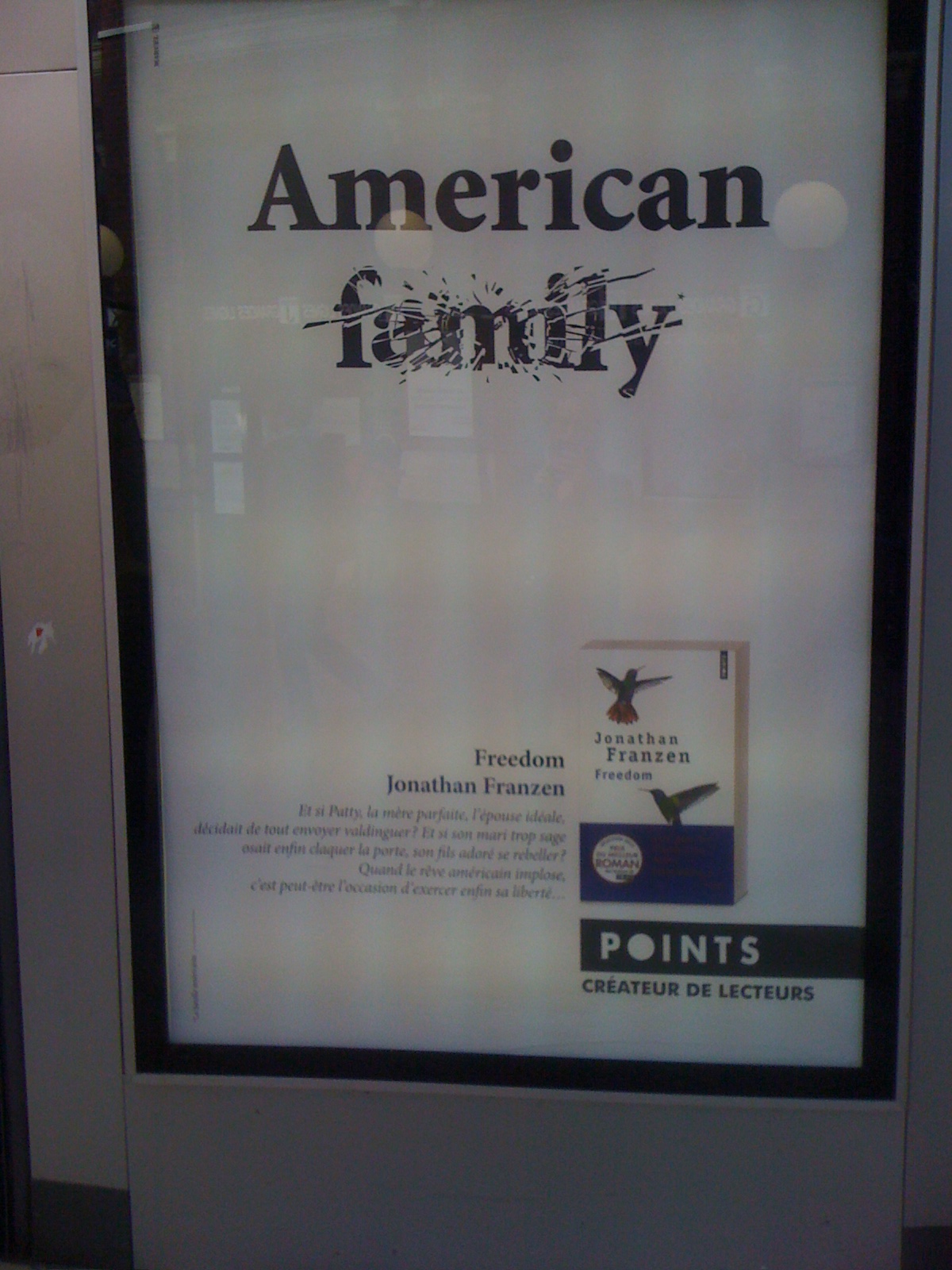
A student from my New Literature class last spring, “US Fiction in the Wake of Postmodernism,” just sent me this picture of a giant advertisement for the French translation of Jonathan Franzen’s Freedom.
DFW Excerpt: “These are tense linguistic times”
My Freshman Composition course just wrapped up a lively discussion of DFW’s “Authority and American Usage” (originally published in Harper’s as “Tense Present”), and though I think I probably wanna do some different stuff w/ it next time . . . here’s a lovely excerpt:
The insecurities that drive [Politically Correct English], [Academic English], and vocab-tape ads are far from groundless, though. These are tense linguistic times. Blame it on Heisenbergian uncertainty or postmodern relativism or Image Over Substance or the ubiquity of advertising or PR or the rise of Identity Politics or whatever you will–we live in an era of terrible preoccupation with presentation and interpretation, one in which the relations between who someone is and what he believes and how he “expresses himself” [DFW’s fn.: (Notice the idiom’s syntax–it’s never “expresses his beliefs” or “expresses his ideas.”)] have been thrown into big-time flux. In rhetorical terms, certain long-held distinctions between the Ethical Appeal, Logical Appeal ( = an argument’s plausibility or soundness, from logos), and Pathetic Appeal ( = an argument’s emotional impact, from pathos) have now pretty much collapsed–or rather the different sorts of Appeals now affect and are affected by one another in ways that make it nearly impossible to advance an argument on “reason” alone. (David Foster Wallace, “Authority and American Usage,” in Consider the Lobster and Other Essays [New York: Little, Brown and Company, 2006], 116, my emphases.)
DFW Usage
I will be teaching all of Strunk & White followed by DFW’s “Authority and American Usage” to a freshman Composition course in a few weeks, and will probably be becoming a bit of a usage weenie during that time, so this little find from MetaFilter, that provides a .pdf of DFW’s “Word Notes” (among others) from the Oxford American Writer’s Thesaurus was a particularly good find today. (I guess this is especially popping up on Mac OS X’s native Dictionary app.)
all of: Other than as an ironic idiom for “no more than” (e.g., Sex with Edgar lasts all of twenty seconds), does all of have any legit uses? The answer is a qualified, complicated, and personally embarrassed yes. Here’s the story. An irksome habit of many student writers is to just automatically stick an of between all and any noun that follows— All of the firemen posed for the calendar; She gave the disease to all of her friends—and I have spent nearly a decade telling undergrads to abjure this habit, for two reasons. The first is that an excess of of’s is one of the surest signs of flabby or maladroit writing, and the second is that the usage is often wrong. Over and over, in conference and class, I have promulgated the following rule: Except for the ironic-idiom case, the only time it’s correct to use all of is when the adjective phrase is followed by a pronoun— All of them got pink-eye; I wanted Edgar to have all of me—unless, however, the relevant pronoun is possessive, in which case you must again omit the of, as in All my relatives despise Edgar. Only a few weeks ago, however, I learned (from a bright student who had gotten annoyed enough at my constant hectoring to start poring over usage guides in the hope of finding something I’d been wrong about that she could raise her hand at just the right moment in class and embarrass me with… which she did, and I was, and deserved it—there’s nothing worse than a pedant who’s wrong) that there’s actually one more complication to the first part of the rule. With all plus a noun, it turns out that a medial of is required if the noun is possessive, as in All of Edgar’s problems stem from his childhood or All of Dave’s bombast came back to haunt him that day. I doubt now I’ll ever forget this. DFW
Fall 2012
Beginning on Monday (wow the summer stormed by) I will be teaching 2 courses at the University of Pittsburgh during the fall semester: Seminar in Composition (ENGCMP 0200, Pitt’s freshman English) and Reading Poetry (ENGLIT 0315). I am greatly looking forward to both classes as each should prove to be interesting, challenging, and fun. In Seminar in Composition we’ll be reading selections from the following:
David Bartholomae and Anthony Petrosky eds., Ways of Reading: An Anthology for Writers, 9th ed. (New York: Bedford/St. Martin’s, 2010).
William Strunk Jr. & E.B. White, The Elements of Style: With Revisions, an Introduction, and a Chapter on Writing, 4th ed. (New York: Longman, 2000).
David Foster Wallace, A Supposedly Fun Thing I’ll Never Do Again: Essays and Arguments (New York: Little, Brown & Co., 1997).
And, among a number of other poems and poets, in Reading Poetry we’ll primarily be looking at:
John Ashbery, Selected Poems (New York: Penguin, 1986).
Ben Lerner, The Lichtenberg Figures (Port Townsend, WA: Copper Canyon Press, 2004).
Robert Lowell, Life Studies and For the Union Dead (New York: Farrar, Straus & Giroux, 2007).
Harryette Mullen, Recylcopdeia: Trimmings, S*PeRM**K*T, and Muse & Drudge (Saint Paul, MN: Graywolf Press, 2006).
T.S. Eliot The Wasteland (Norton Critical Edition), ed. Michael North (New York: W.W. Norton & Co., 2001).
Walt Whitman, Song of Myself and Other Poems, ed. Robert Haas and Paul Ebenkamp (Counterpoint: Berkeley, 2011).
Humanities Cuts Come to Pitt
Mitch Smith just wrote an article for Inside Higher Education about the suspension of graduate admissions in the German, religious studies, and classics departments at Pitt.
Freedom and the Bomb Threats at the University of Pittsburgh, Spring 2012

I have been teaching Jonathan Franzen’s Freedom (2010) for the past five weeks. During that time the University of Pittsburgh received 125+ (and counting) bomb threats,[1] with as many evacuations. That the conjunction of these things would lead a college literature course to ask more general questions of “freedom,” what it means to be free, what role institutions play, etc., is obvious. And we have had quite an interesting discussion of some of these issues. But, particularly within the context of Franzen’s novel, there are some deeper and more fundamental questions regarding freedom that these threats raise.
The terrorism the university is experiencing threatens basic academic freedoms. And not in the usual sense we ivory tower dwellers mean when discussing things like tenure or FERPA, but how something as simple as Mixmaster is powerful enough to threaten the very foundations of a major public institution. The effects such threats have on an urban campus like Pitt, with its attendant hospital buildings, adjacent universities and colleges, is considerable. And the threats are now beginning to spread outside the university.[2] When 34,000 students and attendant faculty are undergoing continual evacuations, to the point that attendance policies have been thrown out the window, the stress and anxiety in the urban/academic landscape is palpably evident.
And here we are, talking about Franzen’s novel, having a very interesting discussion online, and my students are afraid to come to class. The facebooks, with its multiple grad student/student/professor connections, has only exacerbated the situation. (Like, we all know more-or-less immediately that, in a completely unrelated incident, this happened the other day.[3]) And yet we are having class. And frankly, this has been one of the most interesting classes I have had the privilege of teaching, largely due to the fortitude of my students who are coming to class. I have made it clear to them that their attendance has ceased to be mandatory. Sure, not all of my students were there for the past two weeks, but many of them were.[4]
So it struck me last week, that since the questions of the course largely involved postmodern representation, with all the simulacra and simulation of White Noise (1985), the spectacle of 9/11 in the American imaginary, and various other writings of disaster, the form of these bomb threats and the affect they are producing deserves particular attention. Pitt is experiencing, quite simply, a simulation of terrorism, terrorism as simulation. The other night I was reading a particularly strong interpretation of the presence of aerial warfare in Virginia Woolf’s Mrs. Dalloway, and could not help but note how Paul K. Saint-Amour’s analysis of false air-raid alarms after World War I was particularly apt for the current situation:
The same assessments implied that the panic induced by false alarms was in some ways more disruptive than that caused by actual raids. Unlike the realized physical violence of a raid, a false alarm provides no catharsis for the sense of endangerment it produces; it mobilizes anxiety without providing it with a kinetic output. Thus the very falsity of the alarm emphasizes a condition of hideously prolonged expectation, a state of emergency that is both perennial, in having been detached from the arrival of violence in a singular event, and horribly deferred—the advance symptom of a disaster still to come.[5]
These bomb threats have effectively revealed that what was once an advance symptom of a disaster “to come,” has become the disaster in-and-of-itself. The state of exception, the feeling my students have of being constantly threatened, has become the norm. Campus life has adjusted, and already the bomb threats have become an old, perhaps tired point of conversation. The institution has already internalized the state of exception. Receiving 3 or so text messages daily from the university’s Emergency Notification Service is not only unsurprising,[6] but expected. And this is one aspect of what is so frightening about these bomb threats. They may never end.
Further, it was reported in both The Wall Street Journal and Forbes today that the FBI has seized the servers of activist group Riseup Networks in an effort to track the emails that are making up the bulk of the threats. Riseup provides an email service so that activists and whistleblowers can remain anonymous. Says the spokesperson for Riseup, Devin Theriot-Orr, “Our position is that anonymous speech is vital to a thriving democracy. Anonymous remailers are used by democracy activists, people in oppressive regimes and whistleblowers. There isn’t a way to run an anonymous remailer that allows good anonymous speech and not bad anonymous speech.” Theriot-Orr further added that, “[The FBI’s raid] is an attack on all forms of anonymous communications.”[7] That whoever is making these bomb threats is taking advantage of a system designed to protect freedom of speech is particularly disturbing.
Compounded with the fact that recent suspects included a transgender couple once associated with the satellite Johnstown campus, there is something disconcerting about the turn these threats are taking. At the time of this writing it is unclear why these threats are being made. No demands have been made public, and no ideological position has been taken by whoever is issuing these threats. Nonetheless, so far there is an undeniable political dimension to the (public) targets of the FBI’s investigation. And the fact that the FBI has seized the server of a group whose explicit goal is to protect speech, raises some very complex questions regarding security and privacy.
It has been difficult as an instructor to think through these questions vis-à-vis teaching Freedom. For Franzen’s novel complexly explores questions of, quite simply, freedom, and the difficulty of being “truly free.” As Lev Grossman writes in his article on Franzen for Time magazine,
For Franzen’s characters, too much freedom is an empty, dangerously entropic thing. After all, energy companies are free to ravage and poison the breeding grounds of the cerulean warbler. If Patty and Walter divorced, they would be free, but it’s a freedom they would do almost anything to avoid. At her lowest ebb, Patty reflects that she “had all day every day to figure out some decent and satisfying way to live, and yet all she ever seemed to get for all her choices and all her freedom was more miserable.” And no one is freer than a person with no moral beliefs. “One of the ways of surrendering freedom is to actually have convictions,” Franzen says. “And a way of further surrendering freedom is to spend quite a bit of time acting on those convictions.”[8]
The bomb threats have made clear that a certain level of security is necessary, and I for one, as someone who is both professionally frustrated by the constant disruption of these threats, and concerned for my student’s physical and psychological well-being,[9] want these threats to end. The question of what restrictions on freedom are necessary to achieve such a conclusion, however, when it seems quite apparent that no one has any idea who is behind the threats, and that we have gone far beyond the question of does-freedom-of-speech-protect-your-right-to-yell-fire-in-a-crowded-theater, makes the current situation a particularly problematic one. For the threat being experienced by the entire Pitt community, costing millions of dollars, potentially doing damage to Fall enrollments, and further exacerbating the financial situation of an institution already making large cuts due to decreased state funding, is, at this point, fundamentally discursive.
For my final lecture of the year yesterday, this is something I emphasized to my students. For, no matter what one may think of Freedom (warts and all [or my own take, which I am of course not as emphatic about at this point]), our reading of the novel in the context of both the larger questions of the course and the ongoing bomb threats has served to emphasize that risk projection is an incredibly powerful force in the postmodern imagination. And perhaps, despite Franzen’s own worries about the role of the Novel in the late-20th c., that reading literature forces us to ask questions about freedom, representation, and disaster, about the increasingly precarious position of public vs. private discourse, this hopefully foregrounds the vital role studying the humanities can play in attempting to comprehend and imagine an alternative to the terror Pitt has experienced for months. If I myself have learned anything from my students this semester, it is that there is something important about getting together, carrying on, and talking seriously about a novel that deals with serious issues, perhaps especially in adverse conditions. And if nothing else, I am incredibly in debt to my students for that.
[1] And, crazily, the bomb threats already have their own Wikipedia page. See link above.
[2] I do not think it improper to point out that these threats are beginning to resemble spam. . . .
[3] Further, thinking that my students would feel safer outside the frequently threatened Cathedral of Learning, they are now expressing fear about the openness of the park we are in, and the possibility of a shooting.
[4] To add another layer of mediation, not only do I find myself frequently searching “bomb threats at Pitt,” I also just got a text message (one of many), informing me that the Cathedral hasn’t blown up this time either, in so many words.
[5] Paul K. Saint-Amour, “Air War Prophecy and Interwar Modernism,” Comparative Literature Studies 42.2 (2005): 140.
[6] In fact, Pitt has recently started a video campaign played on monitors at various points on campus requesting that students not opt out of the ENS. Seriously though, receiving many text messages every day is quite annoying.
Also check out this vid from MSNBC.
[7] Qtd. in Andy Greenberg, “FBI Seizes Activists’ Anonymizing Server in the Probe of Pittsburgh’s Bomb Threats,” Forbes (19 April 2012), http://www.forbes.com/sites/andygreenberg/2012/04/19/fbi-seizes-activists-anonymizing-server-in-probe-of-pittsburghs-bomb-threats/.
[8] Lev Grossman, “Jonathan Franzen: The Wide Shot,” Time176. 8 (23 August 2010): 46, http://www.time.com/time/magazine/article/0,9171,2010185,00.html.
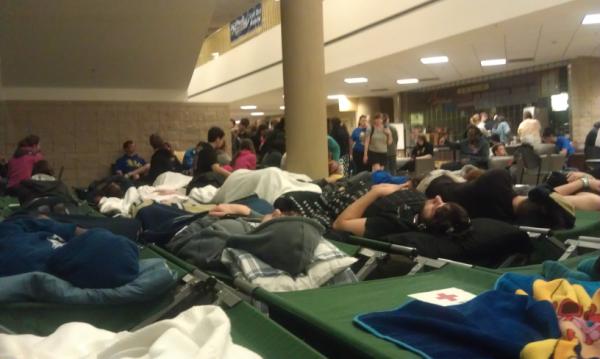
[9] One of the more despicable aspects of the threats has been the frequent and continual threats to student dormitories at late hours of the night or early morning. For instance, students have been forced to sleep on cots in the gymnasium during these threats.
ENGLIT 0365: Literature and the Contemporary
I will be teaching Literature and the Contemporary this summer during the second six week session at the University of Pittsburgh. This course examines contemporary cultural expression across a range of forms and media. It investigates the contemporary as both a complex reworking of past narratives and traditions, and as the production of the experimental and the new. In particular, this section of Literature and the Contemporary, subtitled “Human/Machine: Exploring the Posthuman Imagination,” will examine how intersections between human and machine, between the biological and the technological have been represented in a wide range of texts. Beginning with Mary Shelley’s Frankenstein, we will then read significant 20th and 21st century novels that approach questions of posthumanity in complex and often quite shocking ways:
Paolo Bacigalupi, The Windup Girl (San Francisco: Night Shade Books, 2010 [2009]).
J.G. Ballard, Crash (New York: Picador, 2001 [1973]).
Jennifer Egan, Look at Me (New York: Anchor Books, 2002 [2001]).
Thomas Pynchon, The Crying of Lot 49 (New York: Perennial, 2006 [1965]).
Mary Shelley, Frankenstein (Norton Critical Edition), 2nd ed., ed. J. Paul Hunter (New York: W.W. Norton & Co., 2012 [1818]).
Videodrome (David Cronenberg, 1983).
ENGLIT 0635: New Literature Class Blog
For a course in New Literature I’m teaching this upcoming semester, which I’ve subtitled “U.S. Fiction in the Wake of Postmodernism,” my students are keeping a course blog. Check it out here. Content will be arriving shortly. (And wow, just realized no posts for the whole month of Dec. Been a while since I’ve done that. . . ).
Some Links: On the “End” of Postmodernism, Quantum Theory, Apocalypse, and Destroyed Archives
Edward Docx (sounds like a pseudonym) just wrote a piece, “Postmodernism is Dead,” over at Prospect.
At Nature, Eugenie Samuel Reich reports on a major breakthrough in quantum physics. “But the new paper, by a trio of physicists led by Matthew Pusey at Imperial College London, presents a theorem showing that if a quantum wavefunction were purely a statistical tool, then even quantum states that are unconnected across space and time would be able to communicate with each other. As that seems very unlikely to be true, the researchers conclude that the wavefunction must be physically real after all.”
“Why are Apocalyptic Narratives So Popular?” Why, I don’t know. . . .
Occupy Wall Street Archival Destruction.
My colleague Adriana Ramirez is having her students blog for her class “Narrative and Technology: We Might Be Gadgets.” The class just got done playing World of Warcraft (Blizzard: 2004-2011), and I had the great privilege to deliver a guest lecture a few days ago. Check out the blog here.
America’s growing anti-intellectualism.
And a nice discussion of the archival “Etymology” and “Extracts” section of Moby-Dick (which I’m teaching right now).

