MLA 2025 Panel: Hypergraphia and Hypographia: Literary Maximalism and the Literature of Writer’s Block

At this year’s Modern Language Association Convention in New Orleans, LA (January 9-12, 2025), I will be speaking on a panel discussing Hypergraphia and Hypographia: Literary Maximalism and the Literature of Writer’s Block. I have included the information about the panel and a tentative abstract for the paper I will be presenting below.


65. Hypergraphia and Hypographia: Literary Maximalism and the Literature of Writer’s Block

Thursday, January 9, 2025, 1:45-3:00 pm, Windsor (Hilton Riverside New Orleans)

Presiding: Benjamin Bergholtz (Louisiana Tech U) and Aaron Colton (Emory U)

Presentations:
1. “‘No!—But I Must’: The Blocked Writer in Maximalist Fiction,” Benjamin Bergholtz (Louisiana Tech U) 
2. “The Craft of Writer’s Block: Autofiction, Process, and Pedagogy,” Aaron Colton (Emory U)
3. “Megatextual Kinaesthetics: The Wanderer above the Sea of Elden Ring,” Bradley Fest (Hartwick C) 
4. “Wallace’s Maximalism: Other-Flood and Self-Blockage,” Yonina Hoffman (US Merchant Marine Acad.)
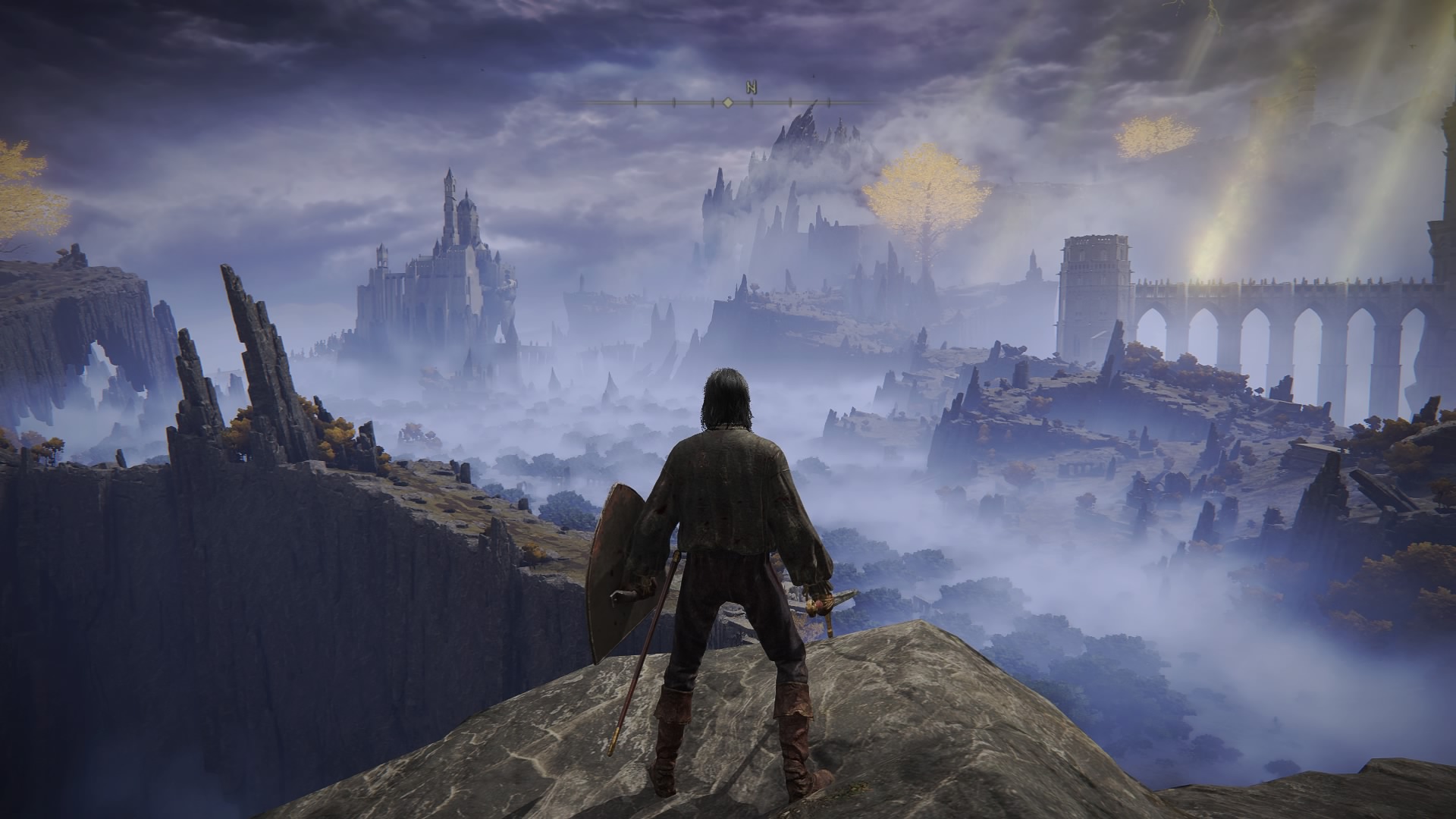
 

ELDEN RING™_20230207194711

Elden Ring, v. 1.09.1 (Tokyo: Bandai Namco, 2022), PlayStation 4, screenshot by author.


“Megatextual Kinaesthetics: The Wanderer above the Sea of Elden Ring

In the twenty-first century, the maximalist impulse evident in the big, ambitious novel of the twentieth century has expanded toward the creation of massively unreadable works across media, what Fest has elsewhere called megatexts. From experimental literary projects, to popular forms, to transmedia corporate intellectual property, megatexts abound in the twenty-first century and their presence in both avant-garde and corporate cultural production signals that the megatext is an emergent form native to the neoliberal era. Perhaps the most paradigmatic instance of this emerging form is the massive, open-world video game requiring hundreds of hours of playtime to traverse. In the video-game megatext, we see a form striving to create worlds, to build spaces large enough to feel comparable to our own.

In his talk, Fest will focus on FromSoftware’s blockbuster 2022 game Elden Ring as not only a paradigmatic video-game megatext but also the kind of sensorial-conceptual or theoretical text that Patrick Jagoda has recently suggested experimental games can be. Fest will argue that Elden Ring’s open world is an affective, bodily, material sensorium that presents to its players something like what big data feels like, allowing players to experience a haptics of hyperarchivalism, a spatiality of the database. In this way, rather than some monumentally time-sucking waste, Elden Ring might itself constitute a moment of respite, contemplation, and critical engagement with respect to the network society, a moment where the digital realities of contemporaneity, in all their hypermediated and interconnected totality might be critically felt, even if that feeling only occurs as the sensation of a concept.


For previous essays of mine on megatexts and unreadable texts, see:

“Toward a Theory of the Megatext: Speculative Criticism and Richard Grossman’s ‘Breeze Avenue Working Paper.’”

“‘Is an Archive Enough?’: Megatextual Debris in the Work of Rachel Blau DuPlessis.”

“Reading Now and Again: Hyperarchivalism and Democracy in Ranjan Ghosh and J. Hillis Miller’s Thinking Literature across Continents.”

“Writing Briefly about Really Big Things.”

“The Megatext and Neoliberalism.”

“The Time of Megatexts: Dark Accumulation and Mark Z. Danielewski’s The Familiar.”
MLA 2021: Twenty-First-Century Forms

For this year’s Modern Language Association Convention, to be held virtually from January 7–10, 2021, I organized and will be speaking on a roundtable on Twenty-First-Century Forms, along with Amy Sara Carroll, Racheal Fest, Christian P. Haines, Hyemin Kim, and Eric Loy. I have included the information about the panel and, below that, full abstracts from each speaker.

181. Twenty-First-Century Forms

Thursday, January 7, 2020, 7:00 – 8:15 p.m. (EST)

If the novel and lyric poem have become residual forms, what literary forms are emerging in contemporaneity? Participants explore emergent literary forms of the twenty-first century and their relationship with, instantiation in, or remediation by other (digital) media: film, television, video, graphic narrative, video games, transmedia, or other hybrid, novel, or megatextual forms.

Speakers
Amy Sara Carroll (U of California, San Diego)
Bradley Fest (Hartwick C)
Racheal Fest (State U of New York, Oneonta)
Christian Haines (Penn State U, University Park)
Hyemin Kim (Baruch C, City U of New York)
Eric Loy (U of Rochester)

Presiding
Bradley Fest (Hartwick C)


Continue reading

Spring 2020 Links (Pre-COVID-19)

A lot of stuff was going on for me this year, both personally and professionally, so I haven’t really had a chance to post links since . . . last summer (!), nine months before the global pandemic was declared. So, to catch up: here’s links from late summer 2019–March 11, 2020 that are, by the very nature of posting them now, rather outdated/anachronistic, a window onto a world that is gone yet still all too present (and excessive), a world that most certainly wasn’t going in the direction of human flourishing and that any nostalgia for may be misplaced. . . . I hope to have “Links in the Time of Coronavirus, Vol. 1” up sometime soon(er than nine months from now . . .).

Donald G. McNeil Jr., “Wuhan Coronavirus Looks Increasingly Like a Pandemic, Experts Say” (February 20, 2020).


Nuclear and Environmental

Mary Hudetz, “US Official: Research Finds Uranium in Navajo Women, Babies.”

David E. Sanger and Andrew E. Kramer, “US Officials Suspect New Nuclear Missile in Explosion That Killed Seven Russians.”

Kristin George Bagdanov, “Addressing the Atomic Specter: Ginsberg’S ‘Plutonian Ode’ and America’s Nuclear Unconscious.”

Alyssa Battistoni, “Why Naomi Klein Has Been Right.”

Henry Fountain, “Climate Change Is Accelerating, Bringing World ‘Dangerously Close’ to Irreversible Change.”

Continue reading

Summer 2019 Links

I had the privilege of meeting Richard Siken when I was quite young–an undergraduate at the University of Arizona–and he gave me lots of good advice on the poetry world (and life), conversations I still cherish. Please help him out.

Stroke Recovery Fund for Poet Richard Siken.


Nuclear and Environmental

Alenka Zupančič, “The Apocalypse Is (Still) Disappointing.”

James Livingston, “Time, Dread, Apocalypse Now.

Ted Nordhaus, “The Empty Radicalism of the Climate Apocalypse.”

Jessica Hurley and Dan Sinykin, eds., Apocalypse, special issue of ASAP/Journal.

Frame, Apocalypse.

Brad Plumer, “Humans Are Speeding Extinction and Altering the Natural World at an ‘Unprecedented’ Pace.”

Damian Carrington, “Why The Guardian Is Changing the Language It Uses about the Environment.”

Continue reading

“Metaproceduralism: The Stanley Parable and the Legacies of Postmodern Metafiction” in Wide Screen

homepageimage_en_us

I am pleased to announce that another essay on videogames, “Metaproceduralism: The Stanley Parable and the Legacies of Postmodern Metafiction,” just appeared in Wide Screen. The essay is part of a special issue on videogame adaptation, edited by Kevin M. Flanagan, and includes articles by Jedd HakimiCameron KunzelmanKyle MeikleBobby Schweizer, and Kalervo Sinervo. It’s also open access, so anyone can read it.

Abstract: Most critics of contemporary literature have reached a consensus that what was once called “postmodernism” is over and that its signature modes—metafiction and irony—are on the wane. This is not the case, however, with videogames. In recent years, a number of self-reflexive games have appeared, exemplified by Davey Wreden’s The Stanley Parable(2013), an ironic game about games. When self-awareness migrates form print to screen, however, something happens. If metafiction can be characterized by how it draws attention to its materiality—the artificiality of language and the construction involved in acts of representation—The Stanley Parable draws attention to the digital, procedural materiality of videogames. Following the work of Alexander R. Galloway and Ian Bogost, I argue that the self-reflexivity of The Stanley Parable is best understood in terms of action and procedure, as metaproceduralism. This essay explores the legacies of United States metafiction in videogames, suggesting that though postmodernism might be over, its lessons are important to remember for confronting the complex digital realities of the twenty-first century. If irony may be ebbing in fiction, it has found a vital and necessary home in videogames and we underestimate its power to challenge the informatic, algorithmic logic of cultural production in the digital age to our detriment.