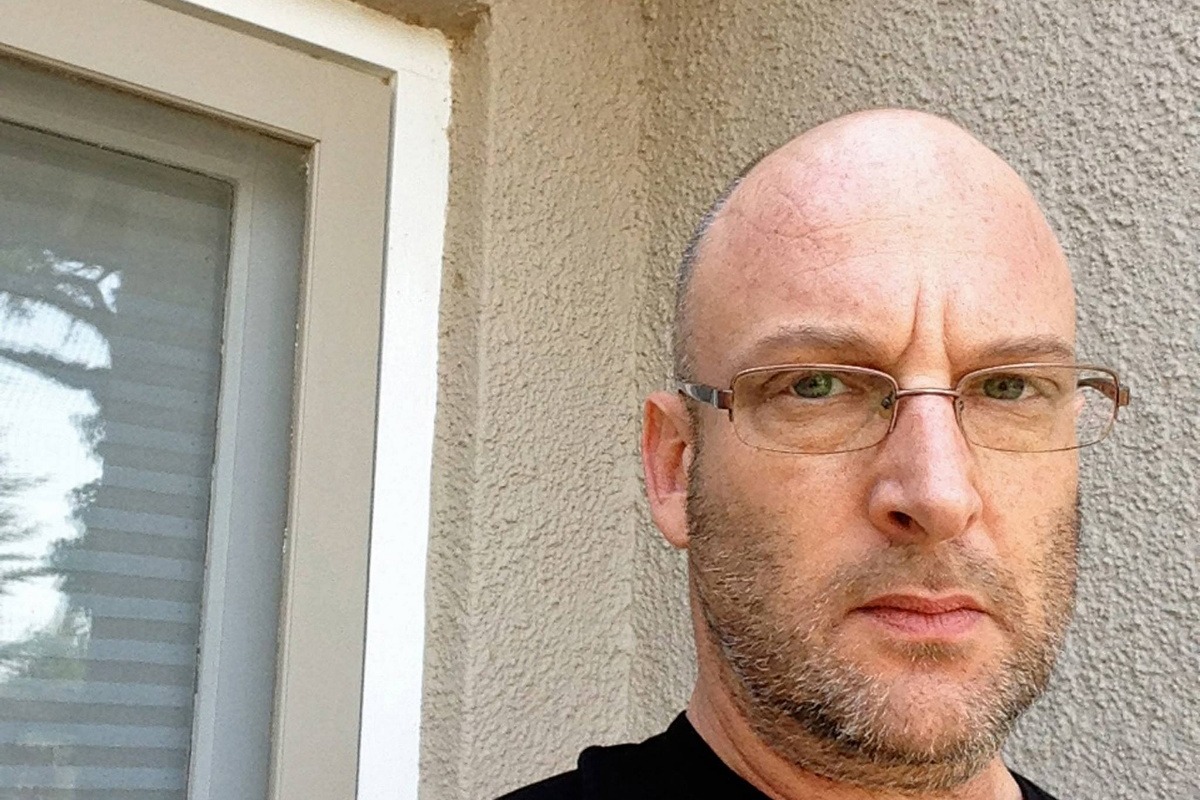
“Grateful and Generous Reading: An Interview with Robert T. Tally Jr.” in boundary 2


I am really happy that my interview with Robert T. Tally Jr.—the first of two interviews I conducted in conjunction with The Babcock Lecture at Hartwick College, which I organized as Cora A. Babcock Chair in English from 2022–25—is now out in print. “Grateful and Generous Reading: An Interview with Robert T. Tally Jr.,” has just been published in the November 2025 issue of boundary 2 (vol. 52, no. 4).

It was a busy weekend—in the course of only a few days, Tally flew to Oneonta from Texas, delivered a lecture, sat down for an interview, and then moderated the final Zoom panel celebrating Fredric Jameson’s ninetieth birthday from my home office (all while he was in the middle of editing Verso’s “Jameson at 90” [2025] blog series)—and so I am deeply thankful to Tally for taking the time to come to Hartwick and chat.

Here’s an abstract of the interview:

This interview with literary critic Robert T. Tally Jr. was conducted on April 26, 2024, in conjunction with his delivery of the 2023–24 Babcock Lecture at Hartwick College. Tally is one of the premier critics presently working in the field of spatial literary studies and has published over a dozen books and over one hundred articles and book chapters on US and world literature, critical theory, and the history of criticism. Reflecting broadly on the trajectory of his career, Tally discusses the gratitude that has accompanied his scholarly writing, his interests in spatial literary studies, his relationship with the teaching and work of Jonathan Arac, Paul A. Bové, and Fredric Jameson, and the role of theory at the present time.

The second interview conducted in conjunction with the 2025 Babcock Lecture, my interview with Anna Kornbluh, will appear in the May 2026 issue of boundary 2.

And for previous interviews: “An Interview with Jonathan Arac,” “Something Worth Leaving in Shards: An Interview with Rachel Blau DuPlessis,” and “Isn’t It a Beautiful Day? An Interview with J. Hillis Miller.”

“Something Worth Leaving in Shards: An Interview with Rachel Blau DuPlessis” in boundary 2

boundary 2, vol 50, no 2, cover image I am honored to say that my interview with the great poet and critic Rachel Blau DuPlessis, “Something Worth Leaving in Shards: An Interview with Rachel Blau DuPlessis,” has just been published in the most recent issue of boundary 2. (This link should provide access for three months.) I am deeply grateful to DuPlessis for corresponding with me during the summer of 2020. In lockdown with no childcare, corresponding with DuPlessis via email to conduct this interview (when I had a spare moment or two to do so) played a large part in keeping me sane during that difficult time. A huge thanks also to Racheal and Aviva, who were right there every day along with me while this interview was being conducted.

Here’s an abstract of the interview:

This interview with poet, essayist, literary critic, and collagist Rachel Blau DuPlessis was conducted via email correspondence between June 11 and August 29, 2020. Author of over a dozen volumes of poetry and half a dozen books in modernist studies, poetics, and feminist criticism, DuPlessis reflects broadly on her career in this interview. She discusses the ongoing role of feminism in her writing and thought, the forms of the fold and the fragment, the relationship between her poetry and criticism, her work in and on the long poem, and her post‐Drafts poetry, including her (at the time) most recent book, Late Work (2020). The interview concludes with a conversation about the relationship between poetry and theorizing practices and a meditation on writing during a global pandemic.

For my writing on DuPlessis: “‘Is an Archive Enough?’: Megatextual Debris in the Work of Rachel Blau DuPlessis.”

And for previous interviews: “Isn’t It a Beautiful Day? An Interview with J. Hillis Miller” and “An Interview with Jonathan Arac.”

Links in the Time of Coronavirus, Vol. 10: December 16, 2020–January 15, 2021

Think Pieces on . . . Everything

Timothy Snyder, “The American Abyss.”

Jelani Cobb, “Georgia, Trump’s Insurrectionists, and Lost Causes.”

Mike Davis, “Riot on the Hill” and “Hopes for 2021?”

Blair McClendon, “Lost Lost Causes.”

Adam Kotsko, “An Apocalypse about Nothing.”

Yoni Appelbaum, “How America Ends.”

Gabriel R, “Trump the Despot.”

Franklin Foer, “The Triumph of Kleptocracy.”

William Callison and Quinn Slobodian, “Coronapolitics from the Reichstag to the Capitol.”

Masha Gessen, “The Trial of Donald Trump Must Tell the Full Story of the Capitol Insurrection.”

Leah Donnella, “How The Storming of the Capitol Was — And Wasn’t — About Police.”

Eric Fretwell, “From Lynchings to the Capitol: Racism and the Violence of Revelry.”

Continue reading

Summer 2019 Links

I had the privilege of meeting Richard Siken when I was quite young–an undergraduate at the University of Arizona–and he gave me lots of good advice on the poetry world (and life), conversations I still cherish. Please help him out.

Stroke Recovery Fund for Poet Richard Siken.


Nuclear and Environmental

Alenka Zupančič, “The Apocalypse Is (Still) Disappointing.”

James Livingston, “Time, Dread, Apocalypse Now.

Ted Nordhaus, “The Empty Radicalism of the Climate Apocalypse.”

Jessica Hurley and Dan Sinykin, eds., Apocalypse, special issue of ASAP/Journal.

Frame, Apocalypse.

Brad Plumer, “Humans Are Speeding Extinction and Altering the Natural World at an ‘Unprecedented’ Pace.”

Damian Carrington, “Why The Guardian Is Changing the Language It Uses about the Environment.”

Continue reading

Special Issues of CounterText on Ranjan Ghosh and J. Hillis Miller’s Thinking Literature across Continents

I have written an essay, “Reading Now and Again:  Hyperarchivalism and Democracy in Ranjan Ghosh and J. Hillis Miller’s Thinking Literature across Continents,” which will appear in the spring issue of CounterText: A Journal for the Study of the Post-Literary, the second of two special issues devoted to Thinking Literature across Continents (Duke UP, 2016). I’ll provide more information about this essay at a later date.

In the meantime, the first issue of CounterText addressing Ghosh and Miller‘s book (vol. 3, no. 3) is now available. Additionally, a conversation between Marjorie Perloff, Charles Bernstein, and the two authors opening the special issue is available from behind the journal’s paywall.


“Thinking Literature Across . . .,” special issue, CounterText, table of contents:

Marjorie Perloff, J. Hillis Miller, Charles Bernstein. and Ranjan Ghosh, “The CounterText Conversation: Thinking Literature. . . .”

Maria Margaroni, “Dialogics, Diacritics, Diasporics: Ranjan Ghosh, J. Hillis Miller, and the Becoming-Now of Theory.”

Georges Van Den Abbeele, “Literary Intransigence: Between J. Hillis Miller and Ranjan Ghosh.”

Claire Colebrook, “Crossing Continents.”

Steven Yao, “How Many Ways of Thinking Literature across Continents?”

Pramod K. Nayar, “Literature/Ethics/Reading.”

Susana Onega, “Thinking English Literature and Criticism under the Transmodern Paradigm.”

Lene M. Johannessen, “Poetics of Peril.”

Adrian Grima and Ivan Callus, “Irreverent and Inventive Mamo.”

Juann Mamo, Nanna Venut’s Children in America: Two Chapters from the First English Translation,” trans. Albert Gatt.

Ivan Callus, “Literature, Journalism, and the Countertextual: Daphne Caruana Galizia, 1964–2017.”

Mario Aquilina, review of Essayism and the Return of the Essay, by Brian Dillon.