It’s been a busy end of the semester and I haven’t been able to post anything for a bit. So, now that I have a bit of time before the semester wraps up, here’s a bunch of stuff that has been happening the last few weeks. My apologies if I’m a bit late on some of these things.
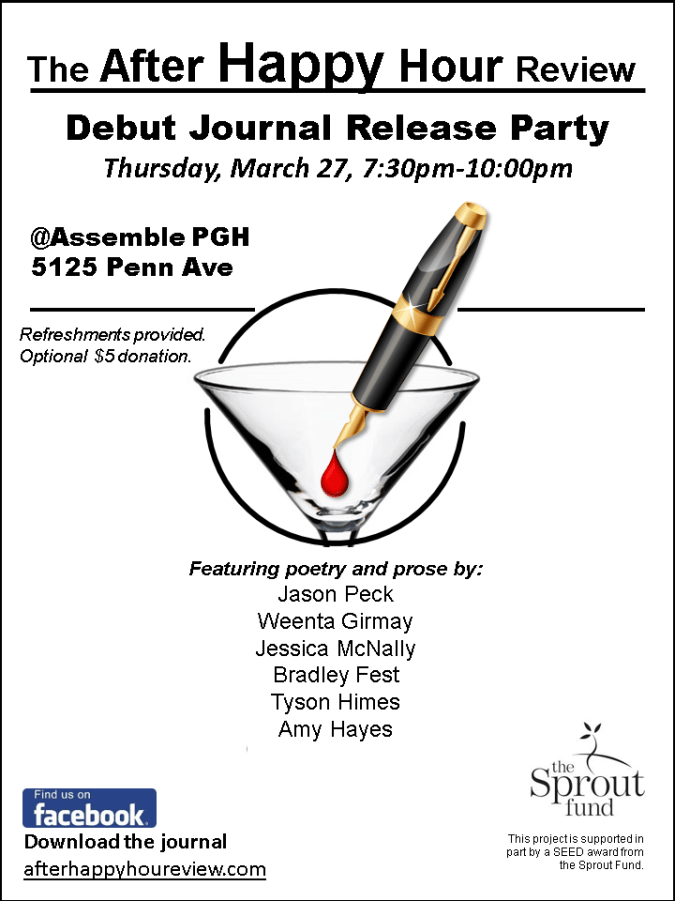
A poem of mine, “If the Marianas Trench Were a Gathering of Sound,” was just published in the very pretty first issue of The After Happy Hour Review, along with work from my friends Dean Matthews, Amy Hayes, and others.
Since this event is being sponsored by the Sprout Fund, I actually just heard a plug for it on Pittsburgh’s local NPR. So I thought it only appropriate to advertise here as well.
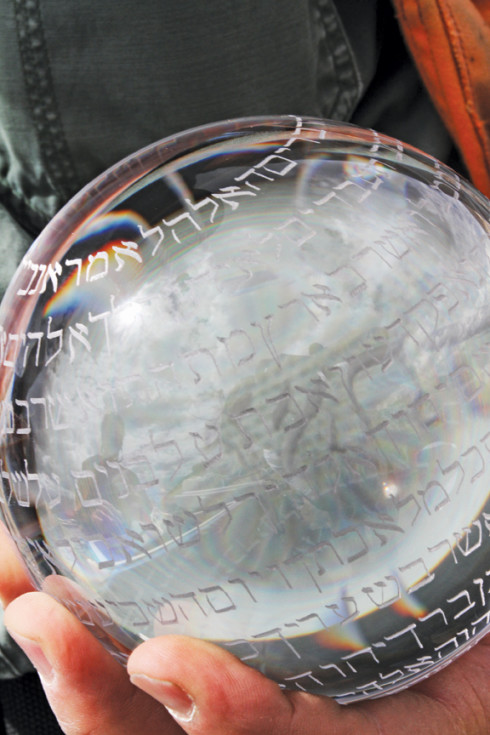
And as part of his forthcoming 3 million page novel, Breeze Avenue (2015), Richard Grossman has buried a crystal ball deep inside of Princeton Mountain in Colorado. The ball, “made of synthetic sapphire, which is almost as indestructible as diamond,” has the Ten Commandments inscribed on it in Hebrew, and in “20 million years, as a result of natural forces carefully calculated by the geologists, the Torah Ball will emerge from its eroded resting place and bear the Ten Commandments down the mountain.” Hyperarchivalists of the deep future rejoice!
Richard Grossman, The Torah Ball (Synthetic Sapphire, Princeton Mountain, 20 Million Years of Erosion, 2011).
In “NASA-Funded Study: Industrial Civilization Headed for ‘Irreversible Collapse’?” Nafeez Ahmed reports for The Guardian on a recent study produced by the National Socio-Environmental Synthesis Center that “highlight[s] the prospect that global industrial civilisation could collapse in coming decades due to unsustainable resource exploitation and increasingly unequal wealth distribution.” The most striking thing about the report to me is its interdisciplinarity, mixing bleeding edge environmental science, historical perspective, economics, Marxist cultural analysis, etc.: “Elite wealth monopolies mean that they are buffered from the most ‘detrimental effects of the environmental collapse until much later than the Commoners,’ allowing them to ‘continue “business as usual” despite the impending catastrophe.’ The same mechanism, they argue, could explain how ‘historical collapses were allowed to occur by elites who appear to be oblivious to the catastrophic trajectory (most clearly apparent in the Roman and Mayan cases).'” We’re doomed.
Surveillance, consent, networks, numbers, the hyperarchival condition of the contemporary: Natasha Lennard writes “Of Being Numerous” for The New Inquiry.
“A Game is Being Beaten” by Leigh Alexander at The New Inquiry: “The trend in video game design is to comment on violence by asking players to perform violence. But could there be pleasure in performing consent?”
And sad news in hyperarchival realism. Google is redoing its Street View for many places in Pittsburgh, and thus Ben Kinsley and Robin Hewlett’s wonderful Street With a View is going away. (Right now it goes from a marching band in the rain to a deserted, sunny street. Uncanny.) Ah, the transitory internet–perhaps it isn’t an archive at all, for really, how do we archive the present in the present. . . .
I am quite pleased to announce that, for the first time in quite a while, I will be reading some of my poems at Assemble in Pittsburgh, PA on Thursday, 27 March 2014. The reading has been put on by the Hour After Happy Hour Writing Workshop & Journal. Weenta Girmay, Tyson Himes, Jessica McNally, Jason Peck, and one of my former students, Amy Hayes, will also be reading. I am quite looking forward to sharing some of my recent writing with an audience. It has been far too long.
Hans M. Kristensen, Director of the Nuclear Information Project, has authored an article for the Federation of American Scientists, “Obama and the Nuclear War Plan.”

 The Hyperarchival Parallax