Many April Links: Catching Up

Another semester is coming to a close, and I finally have a chance to sit down and sort through the backlog of links that have been piling up over the past few months. So, with no further ado, links.


Nuclear, Environment, Ruins

Thomas Erdbrink, “Iran’s Leaders Fall Into Line Behind Nuclear Accord.”

William J. Broad, “Hydrogen Bomb Physicist’s Book Runs Afoul of Energy Department.”

John R. Bolton, “To Stop Iran’s Bomb, Bomb Iran.” Um, no.

Douglas Birch and R. Jeffrey Smith, “South African Nuclear Cache Unnerves US.”

“South Africa Rebuffs US Attempts to Take Over Its Nuclear Material.”

Jon Greenberg, “The Odd Reality of Iran’s Centrifuges: Enough for a Bomb, Not Power.”

Charlie Jane Anders, “Nanotech Could Make Nuclear Bombs Much, Much Tinier.”

Andreas Malm, “The Anthropocene Myth.”

99% Invisible, “Ten Thousand Years.”

Continue reading

February Links

It’s that time of year when I’m busy busy with all sorts of things. Combined with the miserable weather (it got down to -11° Fahrenheit in Pittsburgh last night), some links have been piling up.


Environment, Science, International, Disaster

Rebecca Solnit, “The Age of Capitalism Is Over.”

Noam Chomsky, “The World of Our Grandchildren.”

Graeme Wood, “What ISIS Really Wants.”

Raymond T. Pierrehumbert, “Climate Hacking Is Barking Mad.”

Sam Kriss, “Manifesto of the Committee to Abolish Outer Space.”

Cari Romm, “How Three People Can Make a Baby.”

Alan Taylor, “What Record-Breaking Snow Really Looks Like.”

Continue reading

Early 2015 Links

A new semester has begun and I have a lot of exciting projects for 2015 that I am eager about, some of which I hope to report soon. But in the meantime, here are some links that have accumulated while the semester was beginning, while I was in Vancouver for MLA, and since. (Also, in mini-hyperarchival news, I just received in the mail today a 32 gigabyte USB drive to replace my almost full 4 GB drive. It feels good to be moving up in the world with regard to how much textual data I have/can produced/store.)


Environment

Trent Moore, “This Is the Final Video CNN Plans To Air When the Apocalypse Eventually Arrives.”

Out of the Woods, “Klein vs. Klein.”

Rebecca Solnit, “Everything’s Coming Together While Everything Falls Apart.”

Emily Atkin, “A Nuclear Plant Leaked Oil into Lake Michigan for Two Months Straight.”

Continue reading

Spring Semester 2015

I am looking forward to a fun, productive, and challenging spring semester at the University of Pittsburgh. I’ll be teaching three classes: two sections of Narrative and Technology (ENGLIT 0399; class blog here) and a course that is being offered for the first time, Interactive Literature (ENGLIT 1001; class blog here). I owe Mark Best considerable credit for Interactive Literature as I drew many ideas about organizing the course from the design of his initial proposal.

End of the Semester Links, Fall 2014

I have been understandably busy with the end of a fun and challenging semester. So there are quite a few links that have built up.


Nuclear and Environment

William J. Broad and David E. Sanger, “US Ramping Up Major Renewal in Nuclear Arms.”

Robert Burns, “Air Force: Hagel Departure Won’t Slow Nuke Reforms.”

Mark Memmot, “Nun Who Broke Into Nuclear Complex Gets 35-Month Jail Term.”

Barbara Starr, “Navy Investigation Under Way after Female Officers Filmed.”

Eric Holthaus, “Seventy–Seven Zero–Inches of Snow for Buffalo as Winter Overpowers America.”

Continue reading

November Links

I have had a great couple days listening to the boundary 2 conference. And after a productive and interesting week teaching Dear Esther (2012), Gone Home (2013), and Jennifer Egan‘s Look at Me (2001), I’m going to take the day to deeply immerse myself in football. So, I have a bit of time for some links.


Science and Environment

Rob Nixon reviews Naomi Klein’s This Changes Everything.

Margalit Fox, “Jonathan Schell, 70, Author on War in Vietnam and Nuclear Age, Dies.”

Mark Landler, “US and China Reach Climate Accord After Months of Talks.”

Geoff Brumfiel, “New Clock May End Time as We Know It.”

Annalee Newitz, “It’s Looking More and More Likely That We Live in a Multiverse.”

Don Koenig, “Electromagnetic Pulse (EMP) Caused by a Nuclear Explosion High Over the United States – Imminent danger to the U.S. # 1.”


Continue reading

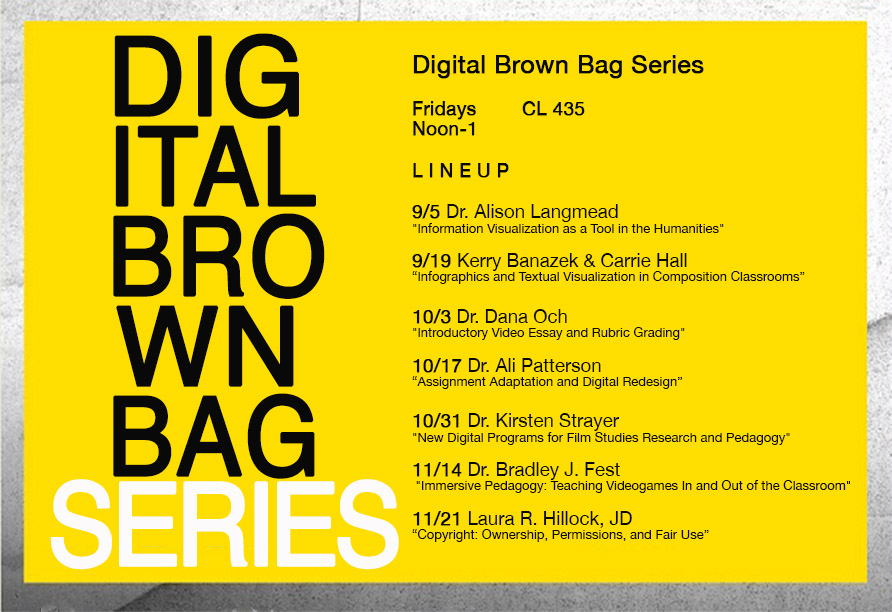
Immersive Pedagogy: Teaching Videogames In and Out of the Classroom

digitalbrownbag

As part of the Digital Brown Bag Series, a series of talks on various ways one might incorporate digital tools into their teaching and scholarship, tomorrow, November 14, from 12:00 – 1:00, I am giving a presentation on “Immersive Pedagogy: Teaching Videogames In and Out of the Classroom” at the University of Pittsburgh in room 435 of the Cathedral of Learning. Here’s a brief description of what I will be addressing:

Teaching videogames present a number of pedagogical challenges and possibilities that are not involved with teaching more traditional media objects. Many things can go wrong when teaching videogames: they can (and do) frequently break down or are incompatible with certain machines; they are hardware dependent, thus limiting the games that can be included in a syllabus; they are actionable rather than passive—they need to be played—meaning that students with less familiarity or skill with videogames can struggle. But videogames also open up a number of pedagogical avenues that are unavailable to other media: they can be radically immersive, collective, and social, reconfiguring the classroom into a virtual space that can extend significantly beyond the physical boundaries of traditional instruction; they provide new ways of looking at and interacting with media objects in the classroom, promoting new pedagogical methods of critical engagement; and they are, inevitably, fun, inviting students to participate in what I call “critical play.” This presentation will discuss some of the logistical, critical, and theoretical challenges presented by teaching videogames, how these challenges might be addressed, and some exciting pedagogical possibilities that are opened up by bringing videogames into the classroom. The presentation will conclude with an interactive demonstration of how one particular videogame, The Stanley Parable (Galactic Café, 2013), might be taught. (This talk largely reflects my experiences teaching Narrative and Technology.)
Daylight Savings Time Links

The extra hour today means I have time to post some links. There are many, as it’s been a while.


Nuclear and Environment

“Lockheed Announces Breakthrough on Nuclear Fusion Energy.”

Matthew L. Wald, “Calls to Use Yucca Mountain as a Nuclear Waste Site, Now Deemed Safe.”

Rizwan Asghar, “Illicit Nuclear Trafficking.”

“Emergency Agencies Practice Response to Nuclear Explosion in Times Square.” (Didn’t DeLillo have something to say about this kind of thing . . . ?)

Jonathan Tirone, “U.S. Said to Join Russia in Blocking Nuclear Safety Moves.”

“Notice to Congress: Continuation of the National Emergency on Russian Fissile Material.”

Darren Boyle, “Inside China’s Top Secret Nuclear Bunker: Cold War Relic Built into a Mountain to Fend off Soviet Attack Is Now a Tourist Attraction.” (Thanks to Terrence Ross for a lot of the above links.)

“Asgard’s Fire,” on thorium reactors.

Ari Phillips, “New Study Details Alarming Acceleration in Sea Rise.”

Continue reading

A Few More October Links

Hyperarchivalism

Jason Schreier, “It Took Two Years To Make Final Fantasy VII‘s Midgar in Minecraft.”

It Took Two Years To Make Final Fantasy VII's Midgar In Minecraft

And more in huge fantasy worlds created in Minecraft: Laura Hudson, “How Fans Created Game of Thrones in a Minecraft Map the Size of LA.”

And I think this may very well be the death-knell of the age of superhero blockbusters (but also a megatext I’ll be writing about in, say, 2022): Dee Lockett, “DC Announces 10 New Superhero Films in Next Six Years, Including Wonder Woman (and Suicide Squad [!?] and Shazam [!?] and Cyborg [!?] . . . this can’t go well).

Continue reading