A new poem of mine, “Two Parts of a Parallax Gap,” just went up in the second issue of Flywheel. This is one of my more footnote-happy poems, and is a bit of a beast. Thanks to Dave Keaton and the editors for publishing it. Check it out.
Of Archival Interest
Archival Photography
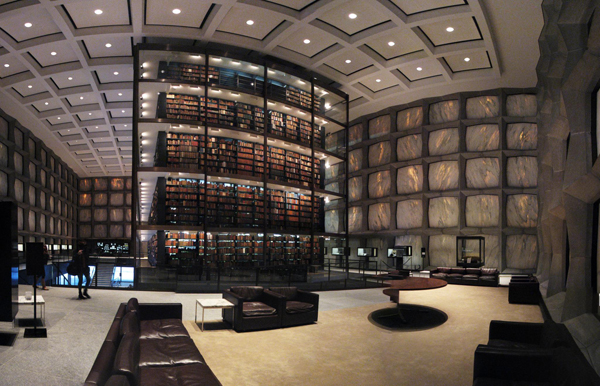
Wow, check out the 25 most beautiful university libraries in the world over at flavorwire. Wow. My univ. library at Pitt, well, let’s just say it didn’t make the list by a long shot. A sample.

Post-ThxGiving Links: DFW Syllabi, Imminent Danielewski Hyperarchivalism, billions and billions of dollars, and the Bomb (as always)
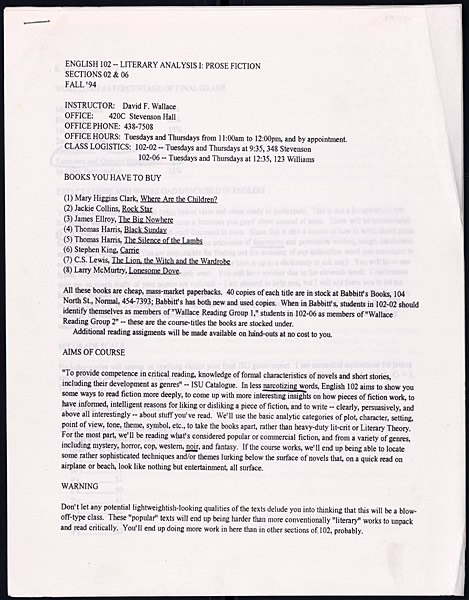
Katie Rophie over at Slate discusses David Foster Wallace’s syllabi: “The Extraordinary Syllabi of David Foster Wallace: What His Lesson Plans Teach us About How to Live.”

The New York Times‘ Julie Bosman informs us that Mark Z. Danielewksi is going to publish a 27 volume serialized novel, The Familiar, appearing every three months beginning in 2014. I wonder how long each volume will be. . . . Also, an interesting interview w/ Danielewski.
From Inside Higher Ed: report finds literary research an inefficient use of university money according to Marc Bousquet, in his article from The Minnesota Review, “We Work.”
George Orwell on the nuclear bomb.
And a pretty great nuclear bibliography.
From a Nuclear Critical Perspective, Firestorm is Bonkers
I’ve been testing out DC’s New 52, now and then wandering down to the comic shop, and today I wondered why the hell I hadn’t picked up the first three issues of The Fury of Firestorm: The Nuclear Men. The book is written by Ethan Van Sciver and Gail Simone, drawn by Yildiray Cinar, in what sometimes looks to be watercolor, and it is crazily nuclear.

Um. Here is the premise: Some corporation, who supposedly runs the world, is after the missing “Firestorm Protocol.” Unbeknownst to the kinda deepish highschool quarterback in who knows USA, the kid who just so happens to have written a fairly scathing article about the jock in the highschool newspaper, who also happens to be a genius level nerd, has been given the missing protocol by its creator as the result of a private msg board. So when the jock confronts the nerd in the library, and they go out in the hallway to settle it, and the evil corporation (who probably isn’t all that evil, I mean, they are chasing the power to become a nuclear man perhaps so it doesn’t fall into the “wrong hands”) attacks to retrieve it, and to save their lives own lives, the nerd and the jock become Firestorm!? And are able, with their powers combined, to create Fury, a big Power Ranger unleashed by their anger at one another!? And their primary conflict has already been drawn along racial lines. And the nerd is black. It is very promising right now in terms of narrative trajectory. Oh yeah. Firestorms’ powers? So far they seem to be able to turn guns into flowers. And shoot nuclear fire from their hands.
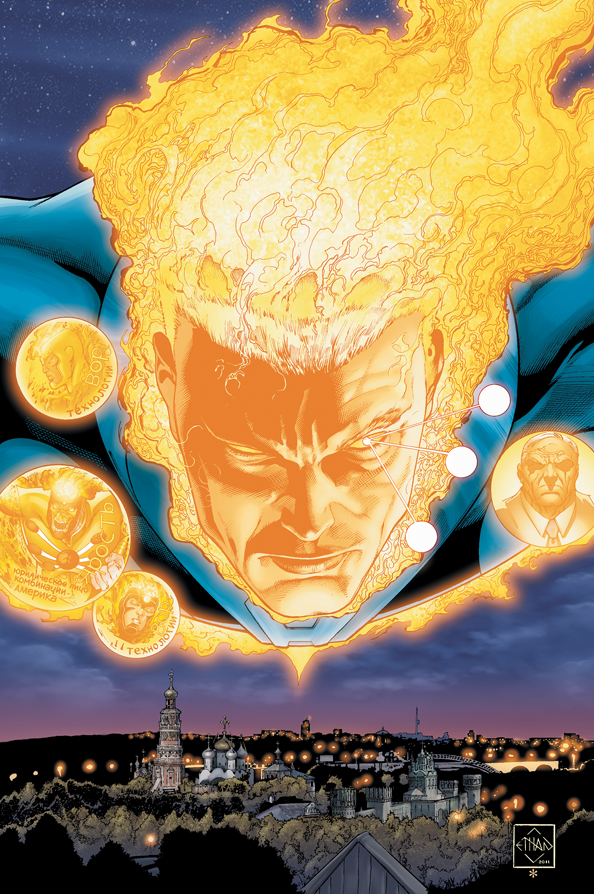
At a certain level it almost doesn’t matter, because this is all really an excuse to post these gorgeous covers. It makes me wanna start a band called The Fury of Firestorm. Oh yeah, and there’s a bunch about the SuperCollider.
Some Links: On the “End” of Postmodernism, Quantum Theory, Apocalypse, and Destroyed Archives
Edward Docx (sounds like a pseudonym) just wrote a piece, “Postmodernism is Dead,” over at Prospect.
At Nature, Eugenie Samuel Reich reports on a major breakthrough in quantum physics. “But the new paper, by a trio of physicists led by Matthew Pusey at Imperial College London, presents a theorem showing that if a quantum wavefunction were purely a statistical tool, then even quantum states that are unconnected across space and time would be able to communicate with each other. As that seems very unlikely to be true, the researchers conclude that the wavefunction must be physically real after all.”
“Why are Apocalyptic Narratives So Popular?” Why, I don’t know. . . .
Occupy Wall Street Archival Destruction.
My colleague Adriana Ramirez is having her students blog for her class “Narrative and Technology: We Might Be Gadgets.” The class just got done playing World of Warcraft (Blizzard: 2004-2011), and I had the great privilege to deliver a guest lecture a few days ago. Check out the blog here.
America’s growing anti-intellectualism.
And a nice discussion of the archival “Etymology” and “Extracts” section of Moby-Dick (which I’m teaching right now).
Excerpt: Pynchon on the Bomb
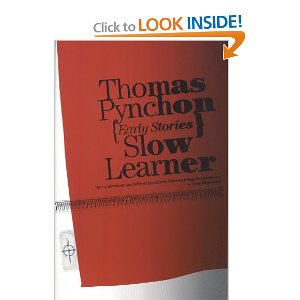
From one of the rare moments Pynchon addresses his own work:
My reading at the time also included many Victorians, allowing World War I in my imagination to assume the shape of that attractive nuisance so dear to adolescent minds, the apocalyptic showdown.
I don’t mean to make light of this. Our common nightmare The Bomb [note the capitalization] is in there too. It was bad enough in ’59 and is much worse now, as the level of danger has continued to grow. There was never anything subliminal about it, then or now. Except for that succession of the criminally insane who have enjoyed power since 1945, including the power to do something about it, most of the rest of us poor sheep [the preterite] have always been stuck with simple, standard fear. I think we all have tried to deal with this slow escalation of our helplessness and terror in the few ways open to us, from not thinking about it to going crazy from it. Somewhere on this spectrum of impotence is writing fiction about it–occasionally, as here, offset to a more colorful time and place. (Thomas Pynchon, “Introduction” in Slow Learner [New York: Little, Brown & Co., 1984], 18-19.)
Slavoj Zizek on Charlie Rose
Seriously, check it out here.
A Few Steps of Deproliferation. . . .
Today it was announced that the United State’s largest nuclear bomb at 9 megatons, the B53, is being disassembled.
President of the Ploughshares Fund, Joseph Cirincione follows up this summer’s piece in The Atlantic by reporting on Congressman Edward J. Markey’s letter to the Super Committee, which calls for massive cuts in the U.S. nuclear budget.
And read Markey’s letter, signed by 65 other members of Congress, here.
Excerpt: Grant Morrison and the Bomb
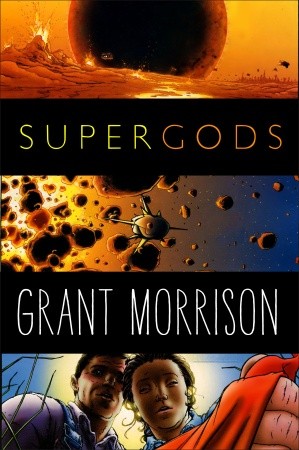
In his excellent new history/study/biography of comic book superheroes, I think Grant Morrison quite convincingly and significantly frames the horizon for understanding superheroes with the bomb. A lengthy excerpt.
Four miles across a placid stretch of water from where I live in Scotland is RNAD Coulport, home of UK’s Trident-missile-armed nuclear submarine force. Here, I’ve been told, enough firepower is stored in underground bunkers to annihilate the human population of our planet fifty times over. One day, when Earth is ambushed in Hyperspace by fifty Evil Duplicate Earths, this megadestructive capability may, ironically, save us all–but until then, it seems extravagant, somehow emblematic of the accelerated, digital hypersimulation we’ve all come to inhabit.
[. . . ]
And the Bomb, always the Bomb, a grim and looming, raincoated lodger, liable to go off at any minute, killing everybody and everything. His bastard minstrels were gloomy existentialist folkies whining hornrimmed dirges about the “Hard Rain” and the “All on That Day” while I trembled in the corner, awaiting bony-fingered judgment and the extinction of all terrestrial life. Accompanying imagery was provided by the radical antiwar samizdat zines my dad brought home from political bookstores on High Street. Typically, the passionate pacifist manifestos within were illustrated with gruesome hand-drawn images of how the world might look after a spirited thermonuclear missile exchange. The creators of these enthusiastically rendered carrion landscapes never overlooked any opportunity to depict shattered, obliterated skeletons contorted against blazing horizons of nuked and blackened urban devastation. If the artist could find space in his composition for a macabre, eight-hundred-foot-tall Grim Reaper astride a flayed horror horse, sowing missiles like grain across the snaggle-toothed, half-melted skyline, all the better.
Like visions of Heaven and Hell on a medieval triptych, the postatomic wastelands of my dad’s mags sat side by side with the exotic, tripple-sunned vistas that graced the covers of my mum’s beloved science fiction paperbacks. . . .
On television, images of pioneering astronauts vied with bleak scenes from Hiroshima and Vietnam: It was an all-or-nothing choice between the A-Bomb and the Spaceship. I had already picked sides, but the Cold War tension between Apocalypse and Utopia was becoming almost unbearable. And then the superheroes rained down across the Atlantic, in a dazzling prism-light of heraldic jumpsuits, bringing new ways to see and hear and think about everything. . . .
The superheroes laughed at the Atom Bomb. . . .
Before it was a Bomb, the Bomb was an Idea.
Superman, however, was a Faster, Stronger, Better Idea (Grant Morrison, Super Gods [New York: Spiegel & Grau, 2011], xiii-xv).
An Excerpt from Gravity’s Rainbow. . .
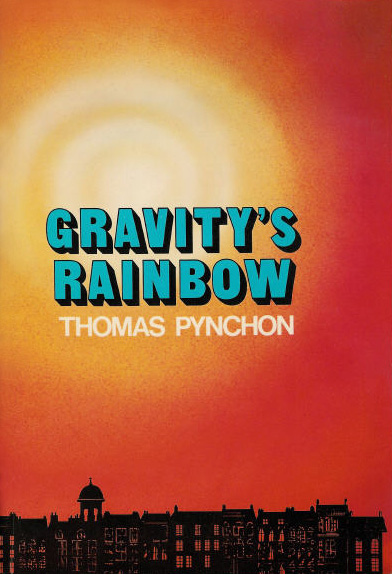
“‘And sometimes I dream of discovering the edge of the World. Finding that there is an end. My mountain gentian always knew. But it has cost me so much.
‘America was the edge of the World. A message for Europe, continent-sized, inescapable. Europe had found the site for its Kingdom of Death, that special Death the West had invented. Savages had their waste regions, Kalaharis, lakes so misty they could not see the other side. But Europe had gone deeper–into obsession, addiction, away from all the savage innocences. America was a gift from the invisible powers, a way of returning. But Europe refused it. It wasn’t Europe’s Original Sin–the latest name for that is Modern Analysis–but it happens that Subsequent Sin is harder to atone for.
‘In Africa, Asia, Amerindia, Oceania, Europe came and established its order of Analysis and Death. What it could not use, it killed or altered. In time the death-colonies grew strong enough to break away. But the impulse to empire, the mission to propagate death, the structure of it, kept on. Now we are in the last phase. American Death has come to occupy Europe. It has learned empire from its old metropolis. But now we have only the structure left us, none of the great rainbow plumes, no fittings of gold, no epic marches over alkali seas. The savages of other continents, corrupted but still resisting in the name of life, have gone on despite everything. . . while Death and Europe are separate as ever, their love still unconsummated. Death only rules here. It has never, in love, become one with. . . ” (Thomas Pynchon, Gravity’s Rainbow [New York: Viking Press, 1973], 722-3).
 The Hyperarchival Parallax