This is pretty cool:
Of Archival Interest
More Apocalypse Photos
io9 has another article on apocalypse art, this time its Vladimir Manyuhin’s apocalyptic photography, where he takes photos of real things and then manipulates them to be post-apocalyptic. Hyperarchival eschatology indeed. Some samples:
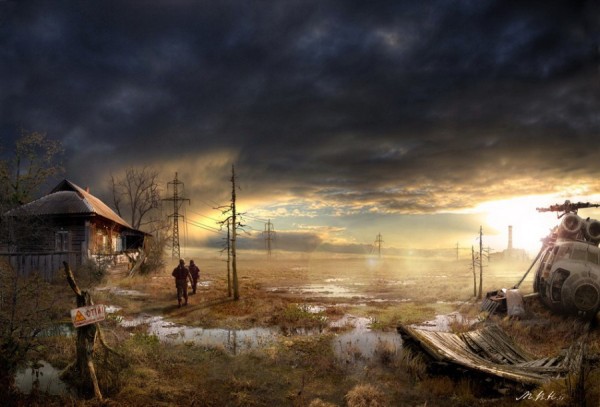
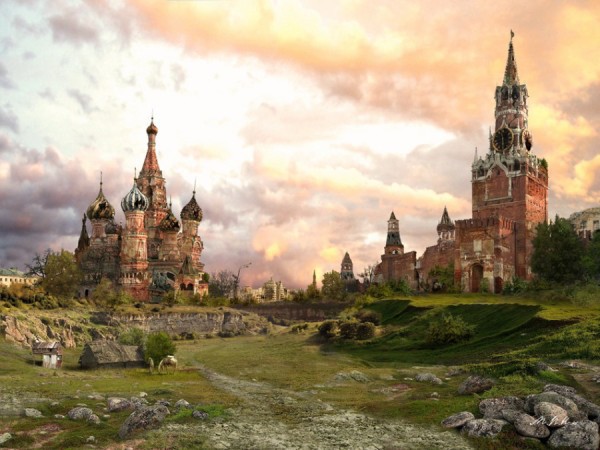

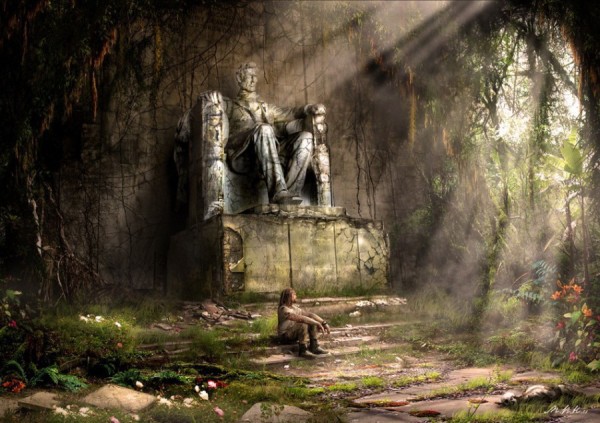
Quite the Eschatological Hyperarchive
Wow, a list of a ton of apocalyptic works (over 1700). Better start reading.
Hyperarchival Leap-Day Eve Links
So, first my good friend Alexander Provan, editor of the excellent Triple Canopy, and accomplished writer in his own right (see him, for example, on our post-nuclear future and Yucca Mountain at The Believer), is interviewed in this fairly interesting article on the future of literacy, print culture, etc (“Post-Print: Digital Publishing Comes of Age”) written by Ian Erickson-Kery over at The Eye.
Uncylopedia: what happens when Wikipedia intentionally gets it wrong. I find this fascinating in the extreme, and pretty much what I (sometimes) mean by “hyperarchival.”
In commemoration of DFW’s 50th b-day, 46 things of his to look at on the internet.
Star Wars Uncut: mashing together homemade scenes of Star Wars into one, gigantic, hyperarchival gem.
(Since I’ve been playing quite a bit of Skyrim recently [and am actually currently planning on writing a bit for it here], “Fuck Forever, and Never Die.” Though I’m not sure really why sex is really part of this conversation, this is a fairly interesting article.)
And from io9: “Rock You Like an Apocalypse: Art that Destroys the World!” A whole smorgasbord of eschatological imagery. A couple examples:


Notice What’s Missing?
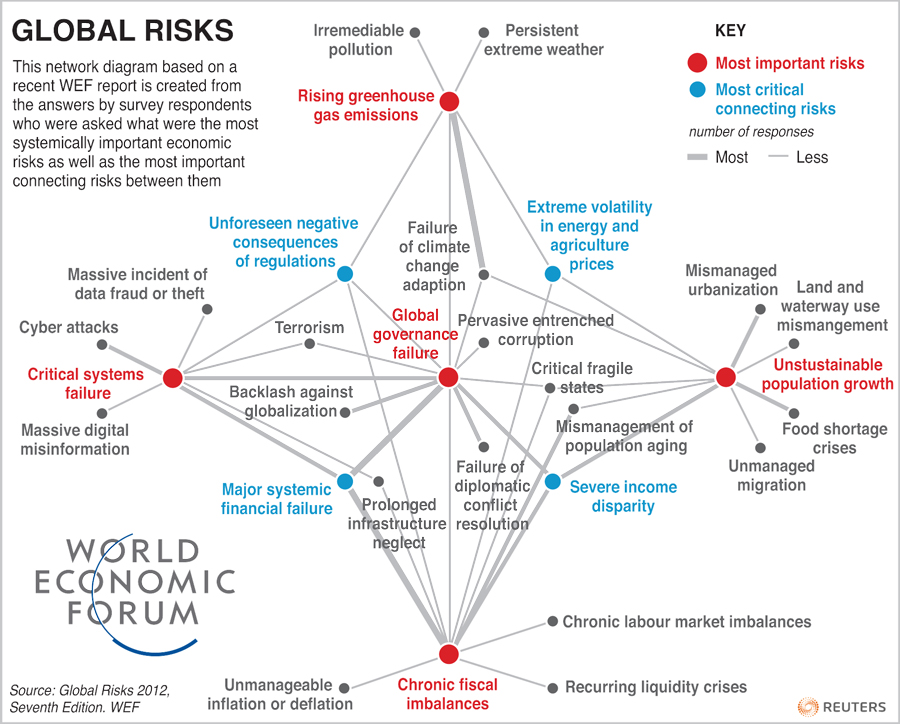
As I’ve been thinking about a lot quite recently, it seems that there is a multiplication of risk projections, and they are tied together in a kind of disaster ecology, but nuclear war (let alone war in general, below) does not appear to be part of the eschatological imagination of the present. Enjoy.
A Couple Things I so Obviously Missed (DFW)
Archives: Hardcore and Otherwise (and Nukes)
So, it looks like the time has come when late-90s–early-00s hardcore is hitting the archival stage. I picked up the quite excellent Building a Better Robot: 10 Years of the Mr. Roboto Project, which, to my mind, reads like a mini handbook to quite a bit of the hardcore/indie scene of the first part of the last decade. Even though I experienced it in Tucson, Pgh doesn’t really seem that far away. . . .
Mr. Al Burian is revolving in the same orbit in his review, “Nicely Dressed Noise,” of the hyperarchival Touchable Sound: A Collection of 7-inch Records from the USA. (Is this is the state of hardcore? needing to emphasize how it is now just an entry into the[/our own personal] archive? Could be worse. They could be mashing up Drive Like Jehu. Oh, wait.)
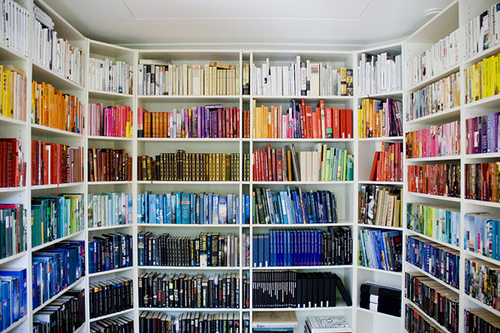
There is a blog that seriously just shows bookshelves. It is called Bookshelf Porn. Ah, bookshelves. A sample.


And nukes: one “minute” closer to the end of the world, and “How to Get a Nuclear Bomb” by William Langewiesche over at The Atlantic from December of 2006.
“Two Parts of a Parallax Gap”
A new poem of mine, “Two Parts of a Parallax Gap,” just went up in the second issue of Flywheel. This is one of my more footnote-happy poems, and is a bit of a beast. Thanks to Dave Keaton and the editors for publishing it. Check it out.
Archival Photography
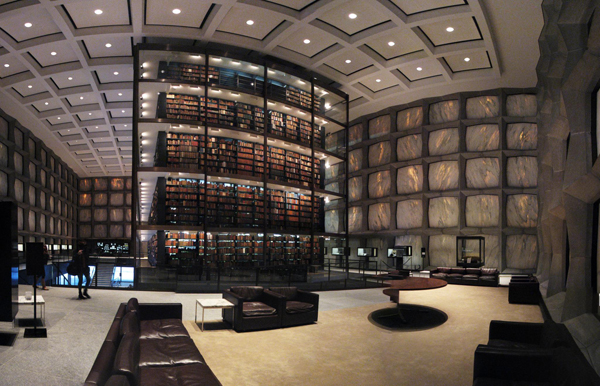
Wow, check out the 25 most beautiful university libraries in the world over at flavorwire. Wow. My univ. library at Pitt, well, let’s just say it didn’t make the list by a long shot. A sample.

Post-ThxGiving Links: DFW Syllabi, Imminent Danielewski Hyperarchivalism, billions and billions of dollars, and the Bomb (as always)
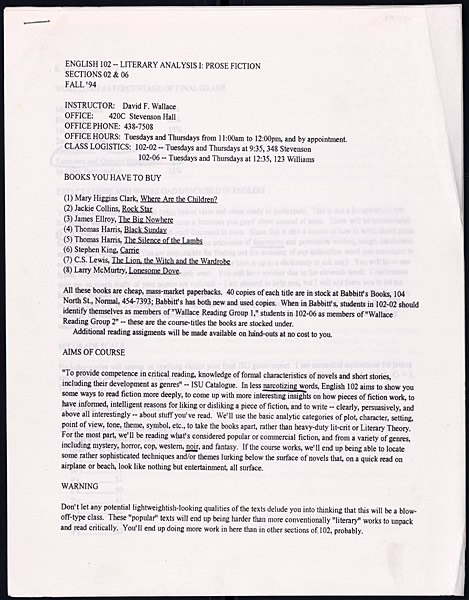
Katie Rophie over at Slate discusses David Foster Wallace’s syllabi: “The Extraordinary Syllabi of David Foster Wallace: What His Lesson Plans Teach us About How to Live.”

The New York Times‘ Julie Bosman informs us that Mark Z. Danielewksi is going to publish a 27 volume serialized novel, The Familiar, appearing every three months beginning in 2014. I wonder how long each volume will be. . . . Also, an interesting interview w/ Danielewski.
From Inside Higher Ed: report finds literary research an inefficient use of university money according to Marc Bousquet, in his article from The Minnesota Review, “We Work.”
George Orwell on the nuclear bomb.
And a pretty great nuclear bibliography.

