Re-Re-Writing American History

It was reported yesterday by Tom LoBianco (via The Huffington Post) that while Governor of Indiana, “Mitch Daniels Sought to Censor Public Universities, Professors.” Daniels, now president of Purdue University, wanted to ban Howard Zinn‘s seminal A People’s History of the United States: 1492-Present (1980). In emails obtained by the Associated Press through the Freedom of Information Act, we know that Daniels wrote the following about Zinn and his classic study of US history:

This terrible anti-American academic has finally passed away,” Daniels wrote. “The obits and commentaries mentioned his book, `A People’s History of the United States,’ is the `textbook of choice in high schools and colleges around the country.’ It is a truly execrable, anti-factual piece of disinformation that misstates American history on every page. Can someone assure me that it is not in use anywhere in Indiana? If it is, how do we get rid of it before more young people are force-fed a totally false version of our history?

Wow.

More Links About the Decline of the Humanities

Max Nisen has written an article titled, “America Is Raising a Generation of Kids Who Can’t Think or Write Clearly,” for Business Insider. He writes:

De-emphasizing, de-funding, and demonizing the humanities means that students don’t get trained well in the things that are the hardest to teach once at a job: thinking and writing clearly. CEOs, including Jeff Bezos, Logitech’s Bracken Darrell, Aetna’s Mark Bertolini, and legendary Intel co-founder Andy Grove emphasize how essential clear writing and the liberal arts are. STEM alone isn’t enough. Even Federal Reserve chair Ben Bernanke recently gave English majors a shout-out. The point is that good writing isn’t just a “utilitarian skill” as Klinkenborg puts it but something that takes a great deal of practice, thought, and engagement with history and what other people have written.

I have to admit I find the argument about CEOs think the humanities are valuable to be missing the point and deeply suspicious. Nisen has followed this piece with a number of other related articles: “These Charts Prove that College is More Important Than Ever,” “11 Reasons to Ignore the Haters and Major in the Humanities,” and “Humanities Grade Inflation is Luring Away Millions of Potential Scientists” (which seems like the opposite of the point). To be honest, however, who is Nisen’s audience with these pieces? All those undergraduates and recent high school grads who read Business Week? I think there’s more going on here than meets the eye.

Freedom of Information and the University on Fire

David Harris Gershon has submitted a concerning report: “NSA Rejecting Every FOIA Request Made by US Citizens.” Specifically regarding PRISM, the letter sent back to Clayton Seymour after his FOIA request is fairly chilling: “we cannot acknowledge the existence or non-existence of such metadata . . . . Therefore, your request is denied because the fact of the existence or nonexistence of responsive records is a currently and properly classified matter in accordance with Executive Order 13526, as set for in Subparagraph (c) of section 1.4″ (emphasis mine).

Gershon unpacks the meaning of the letter: “the NSA is classifying every single bit of data it receives from ordinary American citizens based on the premise that it has been gathered covertly. Meaning: the NSA’s advertised justification for not granting FOIA requests is to protect our country. However, the real justification is the NSA’s covert violation of Americans’ Fourth Amendment right not to be subject to unwarranted searches and seizures (in this case of their personal, digital data).”

And this image seems just too apt regarding my brief post about the decline of the humanities/higher ed the other day.

Reconsidering Southland Tales and an Old Conference Abstract

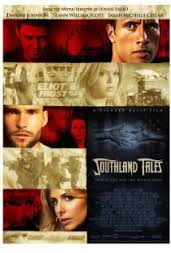
southland tales

Appropriately, as today is 4 July, an old friend directed me to Abraham Riesman’s reconsideration of the absolutely wonderful Southland Tales (2006) and interview with its director Richard Kelly, “The World Ends with a Handshake: Unraveling the Apocalypse of Southland Tales.” (Thanks Robin!)

This is a film I have taught and written about (though before this blog’s time). The incomparable Steven Shaviro talks about it here and in his most recent book. And I guess there’s a pretty decent fan site for it: Fuck Yeah, Southland Tales.

I also presented on Southland Tales at my first academic conference ever, SLSA 2008. Here is an abstract for the paper I gave there (since I’ve never posted it):

Apocalyptic and messianic narratives have traditionally taken place in a stable, teleological temporal space, and for good reason.  The affective impact of their grand narratives have depended upon the necessity for certain forms of meaning to be stable in a world with a distinct beginning and ending.  Richard Kelly’s 2006 film Southland Tales, however, takes reiterating the present, and consequently the past and the future as well, as its dominant structural mode.  From Justin Timberlake’s lip-synched music video of a Killers song, to reversing T.S. Eliot’s famous line: “Not with a whimper but with a bang,” to the division of the protagonist into two distinctly instantiated embodiments, the constant reiteration of various cultural detritus in Southland Tales reveals not so much a postmodern “mash-up” of reference and self-consciousness, as it does a reiteration of Nietzsche’s metaphor of the gateway of the Moment from Thus Spoke Zarathustra.  In other words, Southland Tales offers an alternate history of the present, a view of temporality in which, in Zarathustra’s words, “Must not whatever can happen have happened, have been done, have passed by before?”  This paper will investigate how Kelly’s film reiterates Nietzsche’s critique of the scientific enlightenment through his figure of Zarathustra and the Eternal Return, while simultaneously reiterating the very eschatological messianism that so dominates apocalyptic narratives (and Nietzsche’s own critique) in a manner that emphasizes a much more fluid, synchronic view of history, and hence the unstable present as well.

I will hold off on posting the paper, as it is definitely old graduate work that should not necessarily see the light of day. But all this is making me want to return to Southland Tales, as I do not imagine exhausting the film anytime soon. (This also makes me want to get on Twitter, just so I can follow Richard Kelly.)

What Will Probably be an Ongoing Series Reporting on the (Premature, Exaggerated, and Just Wrong) Reports About the Death of the Humanities and the End of Literature as We Know It With Links

David Brooks’s 20 June 2013 op-ed piece for The New York Times, “The Humanist Vocation,” in which he declares that the humanities are in decline, has sparked a flurry of debate and response. One of these reasons for the flurry of commentary is that the issue is more complicated than Brooks allows for in his quite brief piece (and he’s simply wrong on a few points, see Michael Bérubé below). Another reason for the considerable response is that his discussion of the humanities cuts to the bone for those of us who actually work in the humanities. (Certainly for me, as will be apparent below.)

Brooks’s article accompanied a report released by the American Academy of Arts and Sciences titled The Heart of the Matter, which takes the familiar line of: the humanities have to “retool” to fit the changes presented by our networked, scary world, with its new global economy, etc. This is not a quote,[1] but for anyone who has been following the discussions about the crisis in the humanities/higher education for the last five (or thirty) years, the kind of language The Heart of the Matter employs is familiar in its generality and emptiness, along with its refusal to look at how successful the humanities have been for the last five, ten, thirty, seventy, two-hundred, one-thousand . . . years. Indeed, part of its long-term success is that the humanities teach and emphasize old school things, like reading and writing. And that, despite all claims to the contrary (and with the requisite nods to the many questions posed about reading and writing during the theory boom, as well as to Marshall McLuhan and Friedrich Kittler), reading and writing do not change all that much, and haven’t for a long time.[2] To suggest that the technological changes bombarding us are going to remake the world and the people in it—how we interact and communicate, how we understand our place in the world—is to point out the blatantly obvious. But to suggest that the incredibly slow moving institution of humanistic study needs to rapidly change to meet these “new challenges,” is both to fundamentally misunderstand how the humanities work and to misunderstand the achievements made possible by an institution that is fundamentally stable[3] (i.e., grounded upon things—reading and writing—that do not change all that much[4]). Certainly humanistic study will have to change in some ways in these hyperarchival times, but I am of the mindset that the stability afforded by the humanities also gives them incredible flexibility to respond to and reflect upon the world. If you tend not to think the humanities is incredibly capable in terms of helping us understand, comment upon, change, and, perhaps most importantly, imagine the world . . . then you clearly haven’t studied the humanities, or at least not very well.

And I guess this is the whole point. For it is not just David Brooks that is telling me that my vocation does not matter, my students do as well (which is way worse). It seems easier and easier every semester for my, say, engineering students to inform me—thank you, by the way—that my class does not matter to them, because it will not help them get the job they want. That the stuff we are doing in this class—reading poetry, writing about it—does not matter. These skills do not pertain to their lives. Okay. Sure. I’m not going to try to convince you otherwise. I’m not. In my experience, if this is your attitude, there is only like a 1% chance I’m going to change your mind. And I’m just not interesting, charismatic, personable, or smart enough to do so. I’ve tried. I know. But of course you are able to say how this class does not matter and will not matter for you imagined-engineering-student because . . . you know very little about the humanities (which is why you are here anyway!). You also don’t know much about your own life yet, really.[5] Nor the future. Nor what skills you will actually need. Nor history. Etc. In other words, you are in a unique position. You are sitting in front of me because you do not know these things yet. You know a lot, certainly, and I can only teach you so much, and perhaps you will be able to teach me far more than I could teach you. But I do know a thing or two about literature, and I do know why it might be worthwhile to study. (And I’m certainly learning more every day. It is my job after all.) If you really knew this stuff, you would not need an education, at least from me. To base arguments for or against the humanities on undergraduate enrollment (undergrad enrollment is fine, by the way) as Brooks does, or on what undergraduates think they need, or in the way that undergraduates are now almost universally treated as consumers, again misunderstands the goals of the humanities, and certainly misunderstands the very concept of education. Imagined-engineering-student, you are in my seemingly unimportant classroom for a number of reasons, but one of those is because you cannot possibly know yet how learning to critically think, to closely read, and to carefully write will help you in the future. You can’t. Please stop informing me otherwise. And that way we can get to the really fun stuff. Which is, by the way, humanistic study.

Continue reading

Two Very Different Archives

David Pringle at a website devoted to the work of J.G. Ballard put up a list of the books Ballard read up until age 26. Pretty neat.

And did you hear? It’s official. Commercial art’s primary purpose is to collect data on you. Or at least that’s what Gawker is reporting about Jay-Z’s new album, Magna Carta Holy Grail. “It is not so much an album as a co-branded multimedia content delivery platform, Presented By Samsung™ Galaxy™ . . . . But now another, more unsettling use for the new album has become clear: It’s a massive data-mining operation. Fans used to obsess over album liner notes; now they freak out about terms-of-service.” Art used to be something we put in archives, museums, and libraries. Now it invades our home and puts us in archives. This is hyperarchival realism. Welcome to contemporaneity.

Some Links on the Current Debate About Contemporary Poetry

The July 2013 issue of Harper’s has an article that has sparked considerable amounts of debate in the world of contemporary poetry. Mark Edmundson’s “Poetry Slam: Or, The Decline of American Verse” is being widely responded to. (There’s a link, but you need a subscription or to pick up an actual copy of the magazine.) A smattering of links:

Ron Charles immediately reported on Edmundson’s polemic in The Washington Post with “Why is Modern Poetry So Bad?” (Though his use of “modern” in the title probably signals a certain ignorance of twentieth and twenty-first century poetry . . . .)

The University of Pittsburgh’s own Dawn Lundy Martin has weighed in with “In Defense of-.”

Continue reading

Some Thinking on the Present and Future of Disaster

Some wonderfully bleak things I’ve run across this week: Margaret Ronda’s, “Mourning and Melancholia in the Anthropocene,” in Post45; and I am eagerly waiting for Liam Sprod‘s Nuclear Futurism: The Work of Art in the Age of Remainderless Destruction (Zer0 Books, 2013) to arrive in the mail. Post45 also has a fairly interesting piece from October on Thomas Pynchon: David J. Alworth, “Pynchon’s Malta,” Post45.