Apocalyptexts 5: Notes on Avengers: Age of Ultron, Mad Max: Fury Road, San Andreas, Tomorrowland, and Other Gleefully Thanatical Films
After brewing throughout the late twentieth century and 2000s, over the last five years (2010–15) we have seen the full emergence of a new cinematic cultural dominant: the summer blockbuster megadisaster film. Certainly there is a wonderfully long list of antecedent disaster films, but the summer blockbuster of the second decade of the twenty-first century has significantly raised the size, scale, and frequency of spectacular destruction while simultaneously swelling box office profits. The summer blockbuster of the 2010s—one of the most visible and profitable forms of contemporary popular culture—frequently displays what I, loosely following McKenzie Wark, would call “thanaticism”: “a gleeful, overly enthusiastic will to death.”[1] 2015’s summer blockbusters are exemplary: Avengers: Age of Ultron, Mad Max: Fury Road, San Andreas, and Tomorrowland (and others I am surely leaving out, such as Jurassic World), are terribly thanatic films. Each film, to a different degree, embraces or exploits spectacular representations of destruction (San Andreas). Each is clearly thinking about what disaster means in the age of observable climate change, global risk, and hyperobjects (Avengers). And in their better moments, these films ask their viewers what it means to look at and consume megadeath represented with a glorious abandon.[2] Even more rarely, they also dare to ask what it means that people are making money off such images (Tomorrowland, sort of) and maybe even how to talk about changing things (Mad Max, again, sort of). Concerning these latter two points, 2015 might also be a watershed for the summer megadisaster film in that Mad Max and Tomorrowland are critically self-aware of inhabiting this genre, something at this point not frequently seen outside of parody and satire.
It is hardly surprising, however, that these massively expensive films that gleefully embrace pornographic orgies of destruction were released in 2015 and that they are (for the most part) grossing gobs of money. Over the past few years, the big screen has been inundated by ecstatic thanoptic fury during the summer months. 2012 solidified this trend with The Avengers, Battleship, The Dark Knight Rises, Iron Sky, and Total Recall. 2013: Elysium, Iron Man 3, Man of Steel, Pacific Rim, Star Trek Into Darkness, This Is the End, White House Down, The World’s End, and World War Z. 2014: Aftermath, Dawn of the Planet of the Apes, Edge of Tomorrow, The Giver, Godzilla, Lucy, The Purge: Anarchy, Snowpiercer, SuperMegaDestructionofEveryingEver, Transformers 4: Age of Extinction, and X-Men: Days of Future Past.[3] Such films, diverse as they may be, in varying degrees signal that there has fully emerged a mass-destruction genre unique to contemporaneity, and that, by and large, twenty-first-century disaster films have departed from the twentieth-century postmodern national fantasy of Mutually Assured Destruction (MAD).[4]
I would like to propose a theoretical grab bag of tentative explanations for the extremely successful emergence of what I am calling here the “capitalist megadisaster film.”
First, extending Wark’s discussion of thanaticism, each of these films inhabits—critically, unintentionally, or otherwise—one of the central paradoxes of life in the twenty-first century: that unchecked capitalist production will consume all the carbon resources on the planet, burn them into the atmosphere, and thereby make the planet unlivable. More than merely an update of Sigmund Freud’s death drive,[5] Wark intends thanaticism as an explanatory term that better captures such global economic, environmental, and biological realities than terms such as neoliberalism, postfordism, or late capitalism. Thanaticism is “a social order which subordinates the production of use values to the production of exchange value, to the point that the production of exchange value threatens to extinguish the conditions of existence of use value. . . . Exchange value has to unreel its own inner logic to the end: to mass extinction.”[6] Thanaticism underlies the capitalist megadisaster film. All of these films, knowingly or not, are responses to the despair of contemporaneity: the world is sliding slowly, constantly, and irrevocably toward (a) disaster (that is already occurring), and we appear to be gleefully celebrating this fact. We cannot look away nor can we imagine changing the disaster’s trajectory (with anything less than the intervention of fantasmatic posthuman supergods). Thanaticism is what makes the narratives of Mad Max: Fury Road and Tomorrowland even conceivable as products to be sold to large audiences in the first place.[7] The capitalist megadisaster film is part of the global cultural logic of thanaticism.
Closely related to this, the summer megadisaster blockbuster is also a great example of what Mark Fisher calls “capitalist realism”: “the widespread sense that not only is capitalism the only viable political and economic system, but also that it is now impossible even to imagine a coherent alternative to it.”[8] Following Fredric Jameson’s famous quip that it is easier to imagine the end of the world than the end of capitalism,[9] Fisher locates in such exemplary texts like Alfonso Cuarón’s Children of Men (2006) “the suspicion that the end has already come.”[10] The megadisaster film is one of the principle vehicles for capitalist realism, and the blockbusters of 2015 are exemplary expressions of it.
Third, in a variety of ways these films are all (inherently futile) attempts at totalization, attempts to think the impossible totality of contemporaneity. In this, the capitalist megadisaster film grapples with what Timothy Morton calls “hyperobjects . . . things massively distributed in time and space relative to humans.”[11] Hyperobjects in their size and scale far exceed an individual human’s capacity for knowing or comprehending them. Global warming, the Milky Way Galaxy, the totality of the capitalist system, the internet, plastic, all the carbon dioxide in the atmosphere—these are all hyperobjects. They are massive in physical scale and extend into deep time, and can be both the result of human activity and/or radically nonhuman. The effects of global warming will still be around one million years from now. In tens of thousands of years one of the clearest indicators of previous human existence will be a thin layer of plastic in the geologic record. Objects that exist at these kinds of scales dwarf our ability to concretely know them in anything except the abstract.
Morton suggests that “all those apocalyptic narratives of doom about the ‘end of the world’ are, from [the] point of view [of hyperobjects], part of the problem, not part of the solution. By postponing doom into some hypothetical future, these narratives inoculate us against the very real object that has intruded into ecological, social, and psychic space. . . . The hyperobject spells doom now, not as some future date.”[12] Though I think that Morton is correct—both about what Jacques Derrida would call the to come of apocalyptic futurity, especially as it pertains to cold war nuclear narratives,[13] and about late-twentieth- and early-twenty-first-century environmental catastrophe narratives set close to the present as insufficient engagements with contemporary global risk[14]—I would like to suggest that the megadisaster films of the 2010s are beginning to perceive doom not at some point in the future, but in our present, all around us. As Steven Shaviro has written about our attempts to understand hyperobjects: “We may model [a hyperobject] mathematically and computationally; or else we may encapsulate it in the form of a story. One of the great virtues of science fiction in particular is that it works as a kind of focusing device, allowing us to feel the effects of these hyperobjects—of digital technology, or capitalism, or climate change—intimately and viscerally, on a human and personal scale, contained within the boundaries of a finite narrative.”[15]

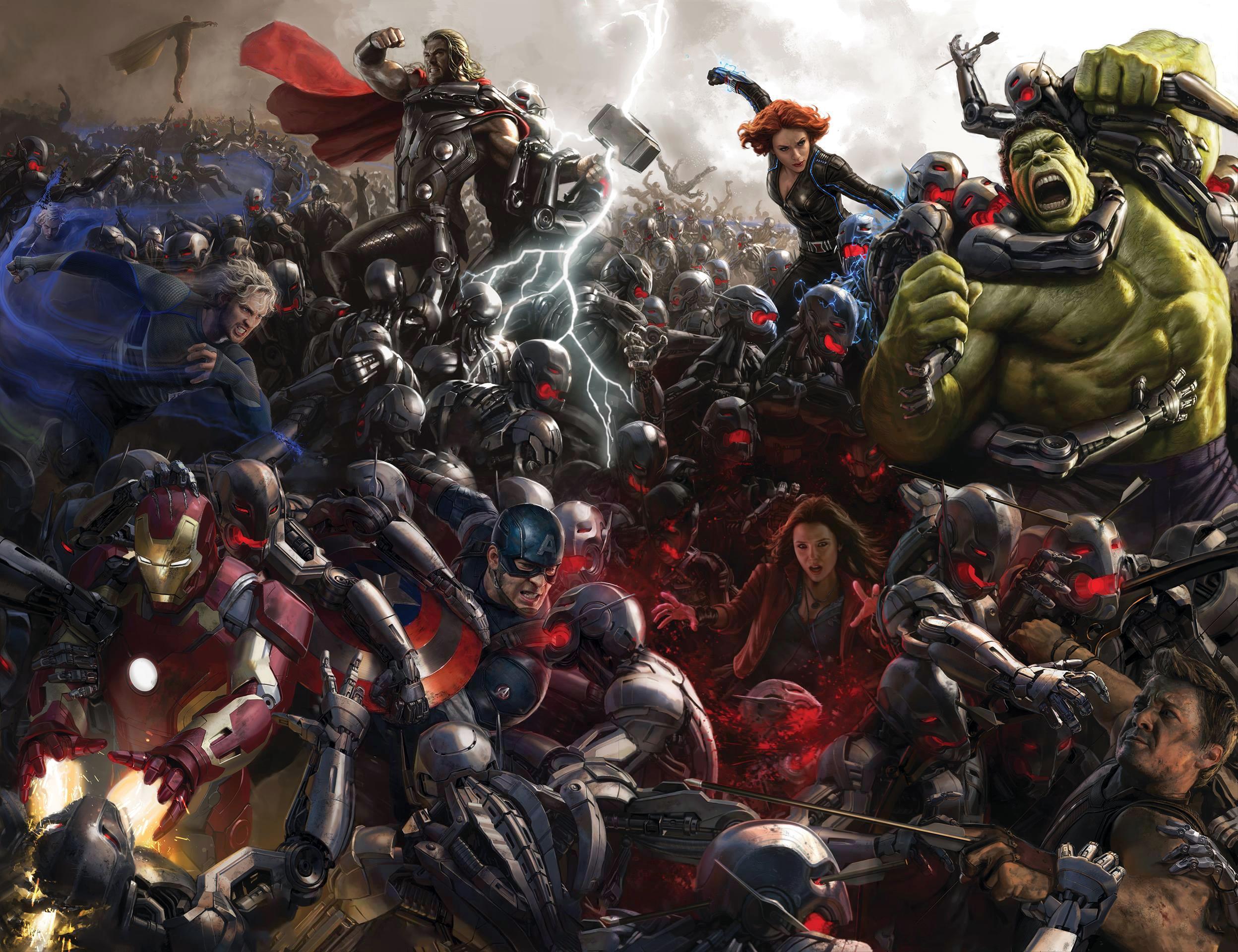
Take, for instance, Joss Whedon’s (intolerably boring) Avengers: Age of Ultron. The film is populated by attempts to grasp hyperobjects on a human scale through narrative.[16] We may not be able to completely grasp the awesome power of all the hydrogen bombs in the world, but The Hulk as an indestructible violent force of nature captured by human technological abilities (or accidents) makes a certain kind of sense. A transcendent posthuman singularity may be so far beyond human knowing that it exceeds the combined brainpower of all the seven billion people on Earth, but The Vision walking around, talking, and fighting bad guys is eminently graspable. All the Avengers arguably stand for, allegorize, and allow us to feel the effects of hyperobjects. Captain America, well, is the United States (in all of its exceptionalist, imperialist glory, while still trying to look like a really nice guy who can, like, “lead”). Hawkeye is humanity just trying to get by without any superpowers in a world that has quickly outpaced him (yes, the species is also a hyperobject). Quicksilver is something like duration, or speed, or the fabric of space-time itself. The Black Widow might be said to stand in for the combined intelligence forces of the US and the Soviet Union during the cold war, now divested of their previous ties and operating black sites without any oversight, obliquely hidden from the world stage—such as Blackwater. The Scarlet Witch has unique access to interiority: emotion, memory, et cetera, so she might be a nice analogue for the immense surveillance powers of the contemporary internet, whether the NSA or Amazon, and its ability to understand and track affect through consumerism. I’ve never been clear on Thor. He is, what, like a god? So he acts like one of the new gods, the emergent posthuman beings of the present (like capitalism [recently] becoming artificially intelligent). And, of course, bankrolling the whole thing is Iron Man, a thinly veiled, walking allegory for neoliberalism and its ideological fantasy of the mythical genius inventor-entrepreneur as the ideal subject of the twenty-first century. And who are they all fighting? Ultron, who takes control of the totality of contemporary digital technology, becoming nothing less than the technological or postmodern sublime. With Avengers we are in the orbit of Northrop Frye’s archetypes.[17] But we are also in the thoroughly un-, post-, or superhuman; we are in the realm of hyperobjects.
There have been a variety of explanations for the rise of the superhero genre in the twenty-first century. Most clearly, CGI has made possible the representation of acts of superhumanity, images impossible before CGI’s digitally rendered dreamscapes. Hollywood has capitalized on these new mimetic capacities in the form of serialized meganarratives like Avengers. Grant Morrison, important writer of superhero comics in their own right, has speculated that superheroes have taken the place of myth in modernity, these myths mirroring those of the Greeks but updated for the needs of the present. Batman can be a dark crime fighter against corruption in the 1930s (or really whenever), a campy psychedelic ironic knowing-smile in the television show of the 1960s, a reflection of cinematic excess in the 1990s, and neoliberal crusader in the 2000s.[18] And Dan Hassler-Forest has convincingly argued that the rise of the superhero genre should be understood as reflecting the post-9/11 policies of the Bush administration.[19]
Tying these three explanations together and extending them, Avengers is a failed attempt to think life in the age of hyperobjects, but one that we should nonetheless take seriously, especially because of its failures. It is easy to read superheroes allegorically, as I just have above, but the emergence of a cinematic form that is so thoroughly allegorical and archetypal should be cause for reflection. As Alexander R. Galloway has suggested recently, there is an “unrepresentability lurking within information aesthetics,”[20] and indeed, we can and should say that there is an unrepresentability lurking within hyperobjects; they are difficult to visualize. But the superhero film allows us to construct allegories for them, which is one way of confronting this kind of unrepresentability. Iron Man is not a hyperobject in himself.[21] Avengers does not represent hyperobjects because it cannot. As Shaviro suggests, the speculative nature of science fiction (SF) allows us to see and feel the effects of hyperobjects. And this is what Avengers does. Some of the effects of hyperobjects, at least in Avengers 1 and 2, are massive battles, destruction, catastrophe, alien invasion, wormholes, nukes, an out-of-control Hulk, an imminent galaxial threat, et cetera. The effects are astounding and beyond any individual’s understanding of the world. So more than anything, what Avengers allegorically makes clear is how the rest of us confront hyperobjects: with huge difficulty. The effect of hyperobjects, at least for this SF text, is dumbfounded awe and paralysis.
Avengers presents a world in which the normal human has little to no ability to affect the world. The struggles and conflicts of contemporaneity take place at a level far above and beyond everyday humanity. Humans are just potential victims; buildings are just potential rubble. Avengers imagines a world of warring hyperobjects, beings so far above and beyond human capacities that the human becomes displaced entirely. The scene where the Avengers “escape” and regroup back to Hawkeye’s family farm makes this clear. Humans (and Hawkeye) have no place here, no capacity to understand or converse with hyperobjects. Hawkeye’s contributions to the film demonstrate that humans can participate within the realm of hyperobjects, they can influence, create, and destroy them. They can even be them. But no matter what, humans are in some fashion ontologically displaced by the presence of these new nonhuman superbeings. Giving these transcendent heroes a safe haven is a cruel joke. They do not need any such succor, for humans, at the end of the day, are left standing in awe of these demigods, dumbfounded, waiting to be saved or destroyed, with no capacity for imagining any other response or way of being. (Hawkeye also displays such a reaction at times.[22])
In many ways, too, this is what the film is explicitly about. Avengers lays bare the despair of humanity in the age of global climate change. In the twenty-first century we are all extras in a superhero blockbuster but with very little say in the matter. Further, Morton suggests that the brute reality of hyperobjects is becoming more and more apparent. Recent books like Naomi Klein’s This Changes Everything: Capitalism vs. the Climate (2014), like Avengers, dramatize that our understanding of the world and experience of reality is increasingly one intimately tied to our attempts to narrate hyperobjects. But we need to tell stories not only about capitalism v. the climate (which we certainly do!), but capitalism v. the climate v. hydrocarbons v. energy v. drought v. terrorism v. DNA v. infectious diseases v. the internet v. the NSA, Google, and Amazon v. the US government v. globalism v. radiation v. inevitable human extinction along the scale of deep time v. corporate speech v. et cetera v. et cetera. With its panoply of inconceivable, nonhuman forces, Avengers is evidence of the desperate need to dramatize some of the complicated conflicts and immense objects that define global modernity.[23] That the film cannot imagine any place for humans except as spectators or cliché cinematic heroes going “above and beyond the call of duty” (like Hawkeye or Black Widow) is only further evidence of the foreclosure of the contemporary utopian imagination.
Given that the totality of Avengers is fifty years of comics and a whole lot else, this is even more cause for alarm. What is being called the Marvel Cinematic Universe is (so far) twelve films, two major television network series, five Netflix series, and another ten films that have been announced! Avengers is a cinematic megatext without equal. It is a narrative world that seems to be exponentially accumulating, almost as if it is an organism of its own, and it has absolutely absorbed the popular imagination of the over-developed world during the past few years, more than any other single text (if its box office success is a measure of such things). If SF can help us to feel the effects of hyperobjects through finite narrative, Avengers also reveals the incapacity for infinitely accumulating serial meganarratives to coherently confront anything except the brute, overwhelming reality of hyperobjects. In the Marvel Cinematic Universe, twenty-first-century thanaticism is merely met with an outpouring of more thanaticism, which is why it is all so profitable. Within the heterogeneity, hybridity, and difference that some see as defining features of contemporaneity,[24] capitalist megadisasters speak a single global language that it seems like most anyone can understand. In the face of the massive global popularity of both the superhero and megadisaster films, the inability for these forms to do anything except politically, psychically, ideologically, conceptually, and economically proliferate thanaticism should give their audiences significant pause.[25]
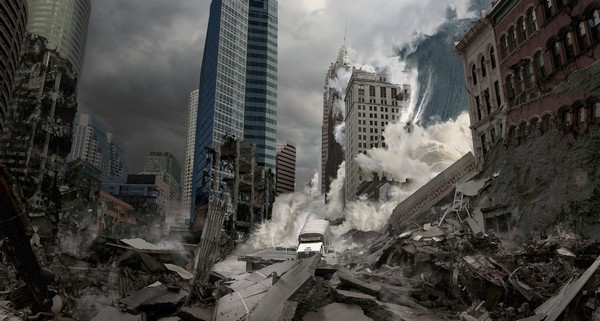
The failure of Avengers to do anything but highlight the brute facts of contemporaneity are even more apparent in San Andreas. An awful film that uses megadeath as mere window dressing for an overwrought, boring, and cliché family melodrama, director Brad Peyton’s San Andreas is the capitalist megadisaster at its most insidious and ideologically dangerous. Like Roland Emmerich’s films before it, San Andreas abandons any coherent engagement with contemporary geology or climate science for cheap crisis and peripeteia. Yes, California is due for another major earthquake, and certainly there are real fears about a major quake that has fascinated the US imaginary at least since Earthquake (1974). But for San Andreas to project such hyperbolic levels of destruction only serves to utterly distract from the concrete realities of contemporary global risk. San Andreas does not even need to shrilly deny climate change by screaming on the floor of the House of Representatives about global warming being a liberal hoax. San Andreas just calmly points toward a different, utterly unrelated disaster, which still bears all the markings of spectacular environmental destruction.[26] By doing so, the realities of global warming are sublimated into a fantasmatic image. And because it still looks like an ecological disaster film, we can ignore that it does not address climate change once.

In this fashion, San Andreas could be considered a baseline norm for how capitalist megadisasters channel the thanaticism of contemporaneity. The film brutally destroys most of metropolitan Los Angeles and San Francisco for the sheer spectacle of doing so rather than for making any point about the need to address the realities of the Anthropocene. Its narrative could be told just as effectively with, like, an-almost-but-not-quite-fatal small house fire or some other real but minor crisis. Nothing in the story it is trying to tell needs a massive earthquake for the narrative’s realization. One might suggest, like Roland Emmerich’s films before it, that the film’s real and only goal is to show destruction, and thus this hackneyed narrative is just a loose vehicle for getting as many falling buildings on-screen as possible. But the intolerable amount of time it spends on the narrative and not on falling buildings suggests the opposite. What if, rather than the actual subject of the film, its massive destruction is just the only way we can understand and represent the banal crises of upper-to-middle class life in the contemporary US? Massive destruction, in this, merely becomes the norm, the constant background radiation of the over-developed world. All activities, no matter how trite or insignificant, can be made meaningful only in terms of the slow violence of the present. How does one address the complexities of dealing with separation, the threat of divorce, and marital reconciliation in 2015? Through billions in property damage and the deaths of hundreds of thousands.[27]
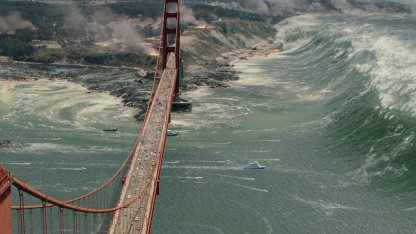
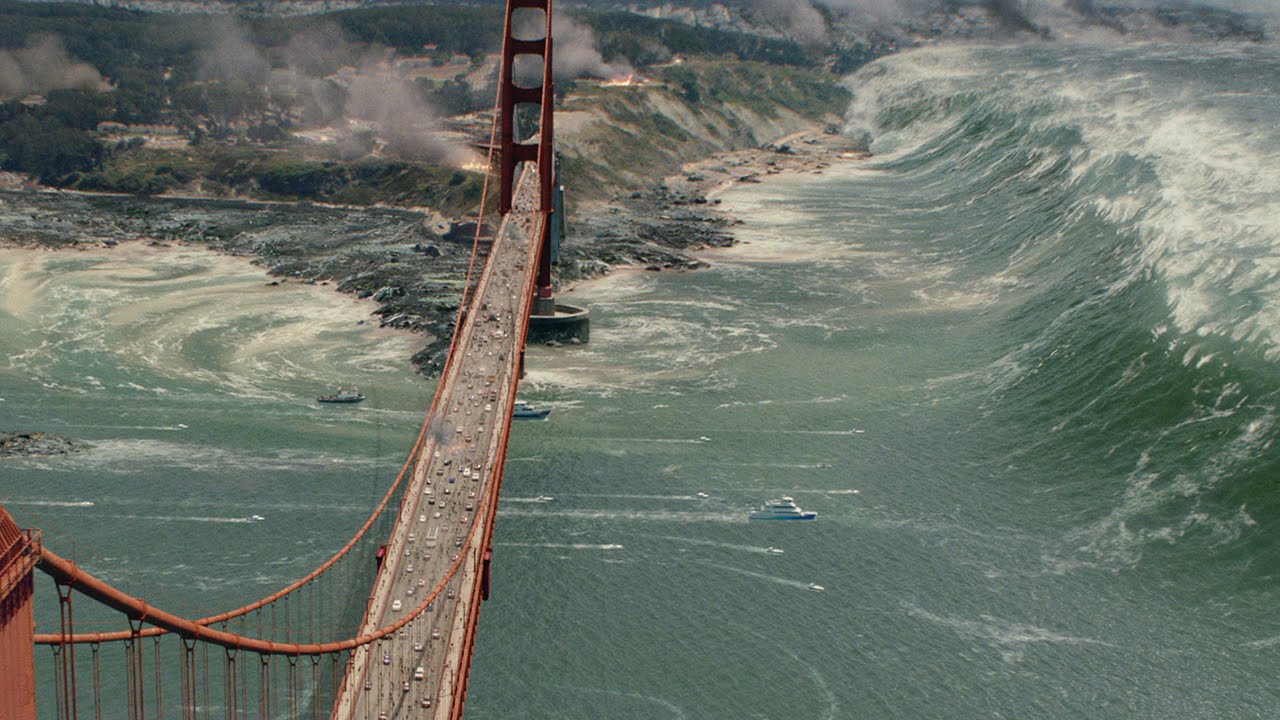
It is the final scene of San Andreas, however, that captures the audacity of the film’s despair best.[28] The final shots show Dwayne “The Rock” Johnson and family, having all survived and lovingly reunited, standing on a hill overlooking a collapsed Golden Gate Bridge, a flooded San Francisco, massive rubble from toppled skyscrapers, and a fleet of ships (and an aircraft carrier!) spearheading the relief effort. The Rock’s wife asks him, “What do we do now?” There is a brief pause here. A pause long enough for me to have thought to myself while watching the movie, “Please don’t say ‘rebuild.’ That would be ludicrous! Did you not see and experience what just happened? That was clearly awful and could have been avoided if, say, one didn’t build massive cities upon fault lines!” But that is precisely what The Rock says: “Rebuild.” I have not seen a cinematic moment that so perfectly captures thanaticism better than this one word uttered by The Rock. Rebuild!
As Mike Davis and many others have made clear at some length, Los Angeles has long been a site of frequent and diverse disaster; geographically, it is a particularly poor place to build a megalopolis.[29] San Francisco, though not as singular a point of potential disaster as the City of Angels, has been hit by major earthquakes multiple times and will continue to be for the foreseeable future. Further, as should be apparent in 2015 with the historic droughts ravaging California, The Golden State will be particularly susceptible to climate change in a variety of ways. At a structural, economic, and civic level, rebuilding hardly seems the answer. Rather than a ringing pronouncement of human fortitude and courage in the face of adversity, the Rock’s incongruous final words signal a radical despair.

San Andreas is capitalist realism through and through because the film cannot possibly imagine any other response to disaster on this scale. Obviously the earthquake is an analogue for the natural disasters that have occurred around the world over the past decade.[30] This kind of film cannot imagine any alternative to this endless series of present and future disasters except the endless reproduction of an order that will produce more disasters ad nauseam. This is thanaticism. This is the audacious despair at the heart of contemporaneity. As Klein points out about what she calls “disaster capitalism,” neoliberalism particularly thrives on crisis, and in this sense, “rebuild” might be considered disaster capitalism’s mantra.[31] Faced with massive destruction, destruction intimately tied to geography and locality, to places that are not all that optimal for building massive cities, the contemporary imagination can do nothing except produce more catastrophe. Not only does it not occur to The Rock that they could rebuild somewhere else, but it certainly does not cross his mind that they might not rebuild but rethink, or even unbuild. Rebuilding guarantees more disaster, which will be profitably put on screen, which will serve to perpetuate the logic of disaster capitalism, which will be put on screen, which will lead to more and more rebuilding. This is the logic of the capitalist megadisaster film in a nutshell. The genre’s thanaticism is unmistakable.
But if Avengers and San Andreas could be said to represent a kind of apotheosis of despair in the capitalist megadisaster genre, I would like to spend the rest of these brief and experimental notes suggesting that Mad Max: Fury Road and Tomorrowland gesture toward the beginning of a filmic imaginary capable of coherently (and even profoundly) confronting the thanaticism of contemporaneity.
I was honestly shocked by how much I liked and how moved I was by Tomorrowland. The thesis of the film is simple: the beautiful, utopian vision of the future that characterized certain strains of the 1950s imaginary, and which gave birth to the section of theme park at Disneyland that is the film’s namesake, is over. We no longer have any vision of a better future. Utopia is nostalgic, retro, base, naïve, gone. One of the theses underlying much of Jameson’s work, especially on SF—that the utopian imagination has been foreclosed by late capitalism—is the thesis of Tomorrowland![32] Further, the film explicitly says that the waning of utopia, the disappearance of a bright and hopeful future, is because of all the capitalist megadisaster films. The massive proliferation and popularity of the spectacle of disaster in the early twenty-first century is the very thing that forecloses the future because these kind of projections shut down our ability to imagine anything else.[33] The film’s answer to this situation is also straightforward. We need to massively reinvest in an anti-eschatological imagination, in humanistic activity, in art.[34] And all that is not even the most uplifting part: Tomorrowland is a children’s film. Who would not want their children being exposed to such a seemingly necessary and (gasp!) hopeful message?

But we should also be skeptical of something that may just ostensibly be a vehicle to increase attendance to a waning section of Disney’s theme parks, which has, for sixty years, been nostalgically profiting off of representing a mythical 1950s moment of American exceptionalism that never existed. For we should not mistake Tomorrowland’s primary purpose: to make sure that whatever sense of the future we have, it will be a Disney® future. The imagination and the future have always been among The Walt Disney Company’s principal products. And a movie about (i.e., promoting) an area of a theme park is baldly selling us this particular mode of utopian imagination. (This is something that Jean Baudrillard warned us of a long time ago about Disneyland.[35]) In Tomorrowland, imagining the future and imagining capitalism are inseparable. Further, a true cynic would suggest that Disney is playing the long game with Tomorrowland. They want people to look back upon the persistence of an area of a theme park devoted to thinking about the future even though we are already in it. Fifty years from now, having an old vision of a positive future to look nostalgically back upon will, I imagine, be quite profitable. That we (perhaps, depending on how bleak the future is) don’t have such a vision of the future right now means that it must be manufactured so that there will be something to be nostalgic for—i.e., 2015, a time when the world had not yet descended into water wars and madness and could still imagine a better world (more on this in a moment).[36]
So, with this mind, it is telling that the movie has proved to be a notably expensive box office flop.[37] Neither utopia nor Disneytopia appears to be very profitable, especially within the regime of the sensible created by thanaticism. Perhaps this signals the utter foreclosure of the imagination: not even Disney can make utopia profitable anymore. But this also means that it is perhaps all the more remarkable that Tomorrowland exists. The film refuses to spectacularly display and profit off of the spectacle of mass destruction (and its violence is fairly kid friendly). Tomorrowland’s rather striking commitment to an anti-eschatological imagination asks us economically, formally, and explicitly to think about a different world, one where utopia rather than apocalypse would be profitable. Few films accomplish such a thing, and it seems like a long time since any film has. For no other reason, Tomorrowland is a notable accomplishment.
Mad Max: Fury Road takes a decidedly different, and less rhetorically obvious approach to both inhabiting and critiquing the capitalist megadisaster film, while pointing a way beyond (and through) its form. To be clear, I think Fury Road is brilliant. I am hard pressed to think of a recent major film that have I enjoyed more and that inspired in me such serious reflection on a variety of things.[38] That such reflection was produced primarily through action sequences with astoundingly kinesthetic, violent, fast, and visceral images—rather than dialogue or exposition—I found absolutely remarkable.[39]

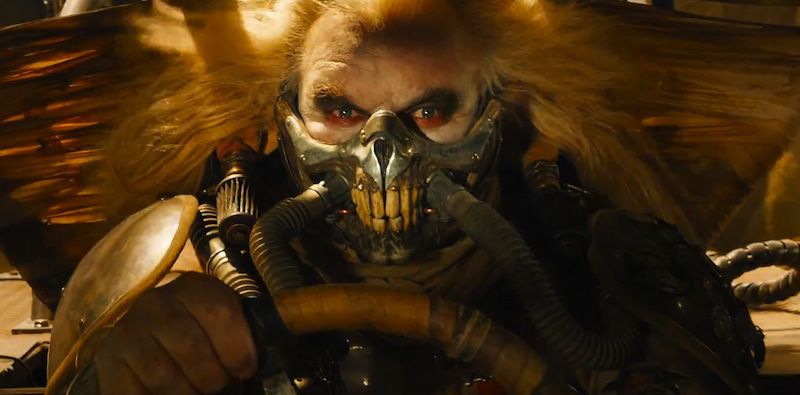
From the moment Fury Road begins, there is something about it that seems inevitable. This is a film that was simply waiting to be made given the aesthetic regime of contemporaneity and the emergence of the capitalist megadisaster film. Spending scant seconds reflecting on the legacy of the first three films, how its world became a postapocalyptic wasteland, and the narrative loosely stretched between Mad Max (1979), Mad Max 2 (1981; The Road Warrior in the US), and Mad Max Beyond Thunderdome (1985), we are thrust into a chase scene that never truly ends until the film’s teleological, orgasmic finish, punctuated by a flaming guitar ballooning out of the 3D screen in one of the most satisfying conclusions to a chase in the history of its form. Unlike Avengers, with its truly staggering amount of “character development,” or San Andreas, with its family melodrama, Fury Road has stripped away everything inessential. George Miller’s masterpiece has dispensed with any need for a dramatic architecture that develops in a traditional fashion. Long conversations between characters have been replaced by Max (Tom Hardy) barely grunting words while clambering over the remains of mid-century Detroit, speeding toward the blasted horizon. Flashbacks last for mere seconds, and instead we get Imperator Furiosa’s (Charlize Theron’s) foot on the gas.[40] Sinister monologues explaining the villain’s aims and motivations have been replaced by singular images of tyrannical despotism.

Mad Max: Fury Road is what a capitalist megadisaster film looks like that no longer even bothers to try to hide its thanaticism.[41] Its cinematic accomplishment rests on the fact that, in the absence of heart-felt embraces and middle-class affect, San Andreas and Avengers would be relatively short films, and probably pretty unwatchable.[42] Fury Road can barely contain itself. Its runtime speeds by with nary a desire for the pace to be slowed, for a moment of respite from its relentless barrage of action. In this, Fury Road wonderfully captures the temporality of the present. Relentless, pounding speed fueled by hydrocarbons, ideology, enframing, and heavy metal, human life is willingly accelerating toward its purposeless, unquestioned telos and demise, and it is doing so ecstatically. It seems practically beside the point to say that such a vision of contemporaneity is a logical apotheosis of the form given the current trajectory of megadisaster cinema.

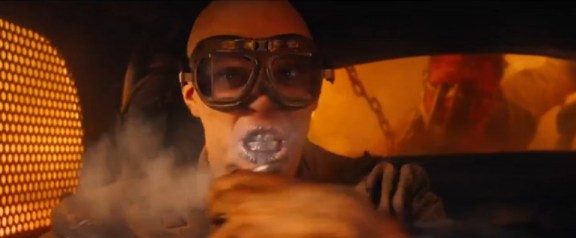
The film’s vision is captured in the War Boys’ mantra: “May you ride eternal, shiny, and chrome!” An automobile death cult devoted to the tyrant, Immortan Joe, the War Boys are thanatics unquestionably loyal to the regime of blood, oil, milk, and water—the fluids that define the society of Fury Road.[43] Afflicted with lymphoma, anemia, and other cancers, using human “blood bags” to stay alive, and motivated by an afterlife in Valhalla, Miller brilliantly fuses together myth and capital with his creation of the War Boys. In recent years, faced with capitalist realism’s inability to imagine any other world than our own, thinkers such as Slavoj Žižek have suggested that “the solution resides in an eschatological apocalypticism which does not involve the fantasy of the symbolic Last Judgment. . . . This is what a proper political act would be today: not so much to unleash a new movement, as to interrupt the present predominant movement.”[44] Žižek’s point is that only a radical, apocalyptic rupture can change the thanatical trajectory of the present. The War Boys’ “eternal, shiny, and chrome,” however, speaks to thanaticism’s potential ability to traverse apocalypse. Even after the end of the world, Miller shows us the persistence of “a gleeful, overly enthusiastic will to death.”
One of the most important fictions that underlies our present neoliberalism is the idea that resources are rather infinite, that capitalism can keep consuming oil without having to regulate its use, without having to change or question itself. The free market will respond to global realities and create the best of all possible worlds. In the Mad Max universe, however, the apocalypse has come and gone but it has not dislodged the inhuman forces of capital, of thanaticism “eternal, shiny, and chrome.” The shiny, gooey interfaces of contemporaneity, the chrome of automotive infrastructure, the eternity of capitalist accumulation, these all persist after the end. The mythological force of “eternal, shiny, and chrome” in Fury Road, its power to shape the imagination of the War Boys, seems hardly ideologically different than the same mythological treatment of the automobile in something like The Fast and the Furious series (2001–15). Consequently, what Fury Road suggests is something even more bleak than Žižek’s thinking: even a revolutionary eschatology, even an apocalypse that disrupts and destroys the structures of our world, even a blasted wasteland without life, water, hope, or resources, even the reversion to violently oppressive feudal patriarchy, even in the face of all this, the thanatical logic of “eternal, shiny, and chrome” persists. Even after the fulfillment and realization of catastrophe, there will be more fantasmatic images of the same.
Part of Fury Road’s brilliance can be located in how it refuses to shy away from such a doomy, deeply cynical vision of human life. Tomorrowland ethically refuses to dwell on spectacular destruction; spectacle is Fury Road’s raison d’être. It takes the fantasmatic logic of disaster film and pushes it (and without too much CGI!) as far as it can go. It does not resist the genre. Fury Road fully inhabits it, celebrating its excess and hyperbole, its fabulous aestheticism and crass (if wildly complex) kinematics,[45] so that it can push through the genre to something else. For at the end of the day, the mantra “eternal, shiny, and chrome” is everywhere contradicted by Fury Road. Nothing is shiny. The automobiles are all mid-twentieth-century cars running on spit and hope, jerry-rigged for Armageddon.[46] Nothing is chrome. The only chrome available comes in a spray-can that poisons as it beautifies. And eternity? Death is everywhere, human society is barely hanging on to a post-biological planet that is about to enter a deep lifeless geologic nonhuman time.
Even more to the point, Fury Road, like Snowpiercer last summer, offers a rather significant vision of democratic, collective, societal transformation precisely because it pushes through (rather than against) its genre. There is no moment of revolutionary rupture, just a slow movement toward a transformation of the dominant regime by devoted revolutionaries capable of imagining a better world. Fury Road, like Tomorrowland, suggests that eschatology, in whatever form it takes, cannot create the conditions for a sustainable, livable future, nor can apocalypse serve as a way of envisioning significant social change.[47] Evan Calder Williams has powerfully suggested that “what we need, then, is an apocalypse.”[48] Fury Road suggests that apocalypse is part and parcel with contemporaneity, that there is no difference between its own radical “salvage punk” ethic and the continual repurposing of the past, aesthetically and otherwise, that defines contemporary culture. By embracing thanaticism, while coherently critiquing it, exposing it for what it is, Fury Road through the capitalist megadisaster quite astoundingly arrives at something new, emergent, unseen, unheralded.
I left Tomorrowland with the profound realization that the crisis of the imagination has now become so widely acknowledged that even Disney is attempting to suggest the need to reinvest in poetics. I left Fury Road with the realization that, no matter how bleak our present and no matter how widespread the cultural logic of thanaticism and its aesthetic regime may be, there is still the possibility for aesthetic emergence, for the imagination, for new ways of thinking about and understanding our world. That a film that is nothing more than a glorified two-and-a-half-hour chase scene was able to accomplish this I find absolutely remarkable. Thus the important word in my title that might distinguish Tomorrowland and Mad Max from Avengers and San Andreas: fabulous. Mad Max is fabulous because it wholly, complexly, and critically embraces the present in all its dumb stupidity and excess, and it does so by never for a moment shying away from the aesthetic.[49] We are hearing on all sides that the humanities are over and done with, that art has no role to play other than as a commodity, that we need reconceive of, say, the English major as job preparation. In such discussions, the importance of what art is and does can often be radically obscured. Mad Max: Fury Road is a testament to the power of the aesthetic to build worlds and to present the possibility of other worlds; it puts the imagination on violent, spectacular, hyperbolic, ridiculous display. Hopefully there are many more fabulous films to come.
Notes
[1] McKenzie Wark, “Birth of Thanaticism,” Public Seminar Commons 1, no. 2 (Summer 2014): http://www.publicseminar.org/2014/04/birth-of-thanaticism/.
[2] Not all the films have such better moments.
[3] N.b. that these are not exhaustive lists, merely the quickest I could generate skimming through summer releases from the past few years. This is also to note that 1) the trend of violent, spectacular, apocalyptic or postapocalyptic film is in no way a new phenomenon in United States or global cinema—i.e., the trend did not “begin” in 2012—only that it seems to have ramped up during the summer months in the past few years, and that 2012 seems as good a place to start as any (2010 or 2011 would be just as good candidates for beginning such a list, but many of those years’ truly postapocalyptic films did not appear during the summer months); and 2) not all of these films might be as spectacularly violent as others, and indeed, some are satires of such violence, but they all, in some fashion or another, revolve in megadisastrous orbit. (In other words, Iron Sky was not seen by many, and it is clearly a spoof on a whole bunch of things and kind of dumb, but it is still participating in the mass-destruction genre.) Also, one of the above films was made up.
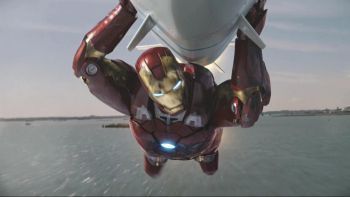
[4] By my count, though nukes frequently appear in such films, when they do appear they are thoroughly removed from their historical context as weapons potentially employed in mass quantities by sovereign states. In The Dark Knight Rises a nuclear weapon (which is not even really a nuke) is used for terrorism; in the first Avengers film, Iron Man redirects a nuclear missile aimed for New York (to kill aliens) through a wormhole to kill aliens (saving New York).
The national fantasies involved with such representations of nuclear weapons differ significantly from the nuclear texts of the cold war. For more on the transforming national fantasies of the post-cold war period, see Donald E. Pease, The New American Exceptionalism (Minneapolis: University of Minnesota Press, 2009). For some of my own further discussion of the ways the post-cold war disaster imaginary has transformed, see Bradley J. Fest, “Apocalypse Networks: Representing the Nuclear Archive,” in The Silence of Fallout: Nuclear Criticism in a Post-Cold War World, ed. Michael Blouin, Morgan Shipley, and Jack Taylor (Newcastle upon Tyne, UK: Cambridge Scholars, 2013), 81–103.
[5] See Sigmund Freud, Civilization and Its Discontents (1930), trans. and ed. James Strachey (1961; repr., New York: W. W. Norton, 1989).
[6] Wark, “Birth of Thanaticism.”
[7] There is evidence that George Miller was developing Mad Max: Fury Road since at least 2002, which makes it all the more telling that it took roughly a decade to get made. Perhaps depicting the despair of the world risk society had not yet registered as a potentially profitable situation for studio executives willing to finance such a film until recently. See Adrian Martin, The “Mad Max” Movies (Sydney: Currency Press and ScreenSound Australia, 2003), 7.
[8] Mark Fisher, Capitalist Realism: Is There No Alternative? (Winchester, UK: Zero, 2009), 2.
[9] “It seems to be easier for us today to imagine the thoroughgoing deterioration of the earth and of nature than the breakdown of late capitalism; perhaps that is due to some weakness in our imaginations. I have come to think that the word postmodern ought to be reserved for thoughts of this kind” (Fredric Jameson, The Seeds of Time [New York: Columbia University Press, 1994], xii).
[10] Fisher, 3.
[11] Timothy Morton, Hyperobjects: Philosophy and Ecology after the End of the World (Minneapolis: University of Minnesota Press, 2013), 1.
[12] Morton, 104. I also cannot help quoting Morton on the doominess of contemporaneity: “Just to go hog-wild Heidegger-style for a moment, doom comes from doom and dooms doom; this doom marks a decisive moment in which humans doom the nonhuman and thus doom the doom of Earth with greater doom” (148).
[13] See Jacques Derrida, “No Apocalypse, Not Now: Full Speed Ahead, Seven Missiles, Seven Missives” (1984), trans. Catherine Porter and Philip Lewis, in Psyche: Inventions of the Other, vol. 1, ed. Peggy Kamuf and Elizabeth Rottenberg (Stanford, CA: Stanford University Press, 2007), 387–409.
[14] I am think especially of the work of Roland Emmerich: Independence Day (1996), Godzilla (1998), The Day After Tomorrow (2004), and 2012 (2009). Though all of these films are ostensibly set in the present, their reliance on massive, unbelievable, unscientific, fantasmatic crises occurring and then destroying massive portions of the globe puts them nearer to the tales of MAD than they are stories that dwell on the disaster of the present. For instance, 2012 does not even posit climate change as the catalyst for global destruction. Rather, it explains its global catastrophe through changes in the sun. One might even go so far as to suggest that the fantasmatic nature of Emmerich’s disaster oeuvre represents a willful obfuscation of the realities of contemporary environmental issues for purely financial gain predicated on spectacular fear-mongering.
[15] Steven Shaviro, “Hyperbolic Futures: Speculative Finance and Speculative Fiction,” Cascadia Subduction Zone 1, no. 2 (April 2011): 4.
[16] I owe thinking about superheroes as hyperobjects to Gerry Canavan’s comments on Pacific Rim in, “Vile Offspring of the Long Postmodern: Capital as Artificial Intelligence,” at the Society for Literature, Science, and the Arts Conference, Notre Dame University, October 2013.
[17] See Northrop Frye, Anatomy of Criticism: Four Essays (1957; repr. with a new foreword, Princeton, NJ: Princeton University Press, 2000).
[18] See Grant Morrison, Supergods: What Masked Vigilantes, Miraculous Mutants, and a Sun God from Smallville Can Teach Us about Being Human (New York: Spiegel and Grau, 2011). On Batman as a stand-in for neoliberalism, see Aaron Bady, “Do Not Go Gentle Into that Dark Knight: Occupy Batman,” New Inquiry (25 July 2012), http://thenewinquiry.com/blogs/zunguzungu/do-not-go-gentle-into-that-dark-knight/. (Also, I wonder what the action figure for “Neoliberal Batman” would look like.)
[19] See Dan Hassler-Forest, Capitalist Superheroes: Caped Crusaders in the Neoliberal Age (Winchester, UK: Zero, 2012).
[20] Alexander R. Galloway, The Interface Effect (Malden, MA: Polity, 2012), 86.
[21] Even if my language above depends upon just such metaphor. It is really quite difficult to discuss hyperobjects without recourse to figurative language.
[22] For a take on Hawkeye that furthers the reading of him as dumbfounded sideline witness to hyperobjects, see Matt Fraction’s recent run on Hawkeye, nos. 1–21 (August 2012-February 2015).
[23] I take this phrase from Arif Dirlik, “Global Modernity? Modernity in the Age of Global Capitalism,” The European Journal of Social Theory 6, no. 3 (Fall 2003): 275–92.
[24] See, for example, Terry Smith, What is Contemporary Art? (Chicago: University of Chicago Press, 2009).
[25] After watching the finale to Season 5 of Game of Thrones (2011–15), one might be tempted to suggest this about contemporary television as well.
[26] The destruction of Los Angeles and San Francisco in San Andreas is indiscernibly different than 2012.
[27] And is this not exceptionalist US individualism at its most absurd?
[28] I owe the phrase “audacity of despair” to a couple different plays upon the title of Barack Obama’s autobiography, The Audacity of Hope (New York: Crown and Three Rivers, 2006). See Donald E. Pease in “Black Orpheus, Barack Obama’s Governmentality,” in “9/11/2011,” special issue, Other Modernities, special no. (2011): 1-28, esp. 28, where he shifts “audacity of hope” to “radical despair”; and David Simon’s blog, The Audacity of Despair.
[29] See Mike Davis, Ecology of Fear: Los Angeles and the Imagination of Disaster (New York: Vintage, 1999).
[30] E.g., Hurricane Katrina (2005), the earthquake in Haiti (2010), the Deepwater Horizon oil spill (2010), the Fukushima meltdown (2011), and Hurricane Sandy (2012).
[31] See Naomi Klein, The Shock Doctrine: The Rise of Disaster Capitalism (New York: Picador, 2007).
[32] See Fredric Jameson, Archaeologies of the Future: The Desire Called Utopia and Other Science Fictions (New York: Verso, 2005). This book is the final chapter in Jameson’s (projected) six volume Poetics of Social Forms.
[33] As Jameson revised his famous quip: “Someone once said that it is easier to imagine the end of the world than to imagine the end of capitalism. We can now revise that and witness the attempt to imagine capitalism by way of imagining the end of the world” (Fredric Jameson, “Future City” [2003], in The Ideologies of Theory [New York: Verso, 2008], 573).
[34] For my further discussion of anti-eschatology, see Bradley J. Fest, “The Inverted Nuke in the Garden: Archival Emergence and Anti-Eschatology in David Foster Wallace’s Infinite Jest,” boundary 2 39, no. 3 (Fall 2012): 125–49. (This is another way of saying Tomorrowland feels like [the end of] my elevator speech: “In order to have a better future we need an anti-eschatological imagination; literature is one mode of articulating such an imaginary.”)
[35] See Jean Baudrillard, Simulacra and Simulation (1981), trans. Sheila Faria Glaser (Ann Arbor: University of Michigan Press, 1994), and America (1986), 2nd ed., trans. Chris Turner (1988; repr., New York: Verso, 2010).
[36] Or rather, in the spirit of the film’s hope, remember back in 2015 when we saved the world with Tomorrowland’s simple message about the imagination?
[37] See Pamela McClintock, “Disney Could Lose $140 Million on Tomorrowland Flop,” Hollywood Reporter, June 10, 2015, http://www.hollywoodreporter.com/news/disney-could-lose-140-million-801244.
[38] And as this particular essay has ballooned far past my initial plans, I will reserve many of these reflections for a later date.
[39] Fury Road, in this, is very much in line with what Steven Shaviro calls “post-cinema” in Post-Cinematic Affect (Winchester, UK: Zero, 2010).
[40] This is to say, of course, that there are a few brief interludes where we get Furiosa’s backstory, but I would like to suggest that her character is developed more powerfully through action than in these brief moments of narrative exposition.
[41] As McKenzie Wark says, “All cinema is anthropocene cinema, but not all cinema knows it. George Miller, it turns out, knew all along” (“Fury Road,” Public Seminar Commons, May 22, 2015, http://www.publicseminar.org/2015/05/fury-road/).
[42] Though I do think it is also inevitable that someone makes a Roland Emmerich film without any of the narrative: just two hours of disaster porn.
[43] On this point, see Wark, “Fury Road.”
[44] Slavoj Žižek, First as Tragedy, Then as Farce (New York: Verso, 2009), 148–49. Žižek develops these points further in Living in the End Times (New York: Verso, 2010).
[45] Cinema plus kinetics.
[46] The film significantly does not have any later model cars, as they would be impossible to keep running without digital computers.
[47] Recall that radical inequality persists in Snowpiercer’s vision of postapocalypse.
[48] Evan Calder Williams, Combined and Uneven Apocalypse (Winchester, UK: Zero, 2011), 5.
[49] I owe this point about the aesthetic dimension of Fury Road to a conversation with Racheal Forlow.