Out of Our Control: Links on Solar Flares and PRISM

Paul Bedard wroate a rather scary account of a recent narrow miss with a solar electromagnetic pulse. In other words, human technological civilization was almost completely wiped out two weeks ago and this is the first we’ve heard of it.

And PRISM is getting more and more coverage.

Via Metafilter: Thanks to the NSA future historians will have a record of everything we did in the early 21st c. Welcome to the hyperarchive.

Googling things like “pressure cooker” or “backpack” will now get you a visit from the police. Welcome to the Orwellian present.

“The NSA’s Massive Call Record Surveillance Barely Accomplishes Anything.” Welcome to total and futile control.

From The Guardian: “Edward Snowden’s Not the Story: The Fate of the Internet Is.”

And James Fallows in The Atlantic, “Why NSA Surveillance Will Be More Damaging Than You Think.” Welcome to the desert of the real.

Ancient Apocalypse

Metafilter has a bunch of interesting links to the Bronze Age Apocalypse. Something took place between 1200 and 1150 BC, or a number of things took place–including natural disaster and barbarian invaders–that basically wiped out ancient civilization:

Every city in a Desolate Crescent from the Aegean to the Sinai was razed to the ground: a bloody, sudden inverse of millenia of building. People lost cities, cultures, names. Gods were forgotten. Traditions died. Empires ended: splintering first into regions, then cities, then smaller. The mightiest and best organized, like Egypt, managed to bend every nerve, staving off collapse for a generation before shattering. Finally, there was a gap: the long total blank that frustrates the hell out of anyone trying to look back. What is known is that everything stopped, with the catastrophe’s survivors left only with legends of a better time and a centuries-long struggle for bare subsistence. This was the Bronze Age Collapse. . . . To imagine the scale, picture this: almost every city in Western Europe and North America destroyed. Not reduced, not scaled down. People-don’t-live-here-anymore-just-ruins destroyed.
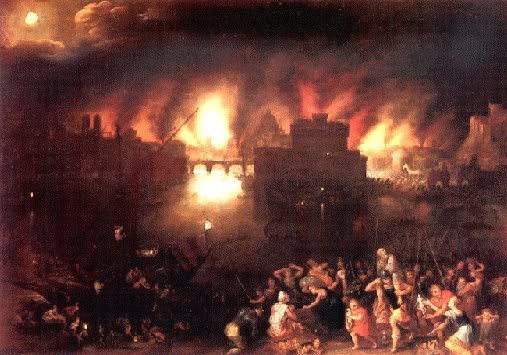
Destruction of Troy

The Destruction of Troy, Jan Brueghel the Elder, ca. 1671-1672.

Reconsidering Southland Tales and an Old Conference Abstract

southland tales

Appropriately, as today is 4 July, an old friend directed me to Abraham Riesman’s reconsideration of the absolutely wonderful Southland Tales (2006) and interview with its director Richard Kelly, “The World Ends with a Handshake: Unraveling the Apocalypse of Southland Tales.” (Thanks Robin!)

This is a film I have taught and written about (though before this blog’s time). The incomparable Steven Shaviro talks about it here and in his most recent book. And I guess there’s a pretty decent fan site for it: Fuck Yeah, Southland Tales.

I also presented on Southland Tales at my first academic conference ever, SLSA 2008. Here is an abstract for the paper I gave there (since I’ve never posted it):

Apocalyptic and messianic narratives have traditionally taken place in a stable, teleological temporal space, and for good reason.  The affective impact of their grand narratives have depended upon the necessity for certain forms of meaning to be stable in a world with a distinct beginning and ending.  Richard Kelly’s 2006 film Southland Tales, however, takes reiterating the present, and consequently the past and the future as well, as its dominant structural mode.  From Justin Timberlake’s lip-synched music video of a Killers song, to reversing T.S. Eliot’s famous line: “Not with a whimper but with a bang,” to the division of the protagonist into two distinctly instantiated embodiments, the constant reiteration of various cultural detritus in Southland Tales reveals not so much a postmodern “mash-up” of reference and self-consciousness, as it does a reiteration of Nietzsche’s metaphor of the gateway of the Moment from Thus Spoke Zarathustra.  In other words, Southland Tales offers an alternate history of the present, a view of temporality in which, in Zarathustra’s words, “Must not whatever can happen have happened, have been done, have passed by before?”  This paper will investigate how Kelly’s film reiterates Nietzsche’s critique of the scientific enlightenment through his figure of Zarathustra and the Eternal Return, while simultaneously reiterating the very eschatological messianism that so dominates apocalyptic narratives (and Nietzsche’s own critique) in a manner that emphasizes a much more fluid, synchronic view of history, and hence the unstable present as well.

I will hold off on posting the paper, as it is definitely old graduate work that should not necessarily see the light of day. But all this is making me want to return to Southland Tales, as I do not imagine exhausting the film anytime soon. (This also makes me want to get on Twitter, just so I can follow Richard Kelly.)
Some Thinking on the Present and Future of Disaster

Some wonderfully bleak things I’ve run across this week: Margaret Ronda’s, “Mourning and Melancholia in the Anthropocene,” in Post45; and I am eagerly waiting for Liam Sprod‘s Nuclear Futurism: The Work of Art in the Age of Remainderless Destruction (Zer0 Books, 2013) to arrive in the mail. Post45 also has a fairly interesting piece from October on Thomas Pynchon: David J. Alworth, “Pynchon’s Malta,” Post45.

Abstract: Infinite Oppenheimers and Postnatural Metahistory: Jonathan Hickman’s Manhattan Projects

Below is an abstract for a paper I will be presenting at the 2013 Society for Literature, Science, and the Arts Conference, taking place October 3-6 a Notre Dame University.

Infinite Oppenheimers and Postnatural Metahistory: Jonathan Hickman’s Manhattan Projects

From the perspective of what number of young scholars and nuclear critics are calling a second nuclear age, I would like to suggest that one site of the “postnatural” can be found in the remarkable cultural intersection between narratives of nuclear history and contemporary ecological understandings of catastrophe and risk. Though there are any number of instances of such aesthetic correspondences and dissonances, for instance the spectacle of cinematic destruction that dominated the last decade, one might do well to look to texts that, parallel to the non-event of Mutually Assured Destruction, eschew moments of narrative disaster. Writer Jonathan Hickman and artist Nick Pitarra’s The Manhattan Projects (Image Comics, 2012- ) is such a text, imagining that work on the atomic bomb at Los Alamos was “a front for a series of other, more unusual, programs.” Hickman’s writing picks up a tradition of re-imagining nuclear history, familiar to any reader of Thomas Pynchon, and adds a superheroic twist: J. Robert Oppenheimer is consumed by his infinite personalities, Enrico Fermi is an alien, F.D.R. is reborn as an A.I., Albert Einstein plays the role of Wolverine, etc. This paper will argue that Hickman’s work emerges from a particular moment in which nuclear, information, and biological sciences are raising a host of interesting questions for contemporary narrative. Hickman’s radically alternative history of twentieth century science and politics emerges from a postnatural perspective whose horizon surpasses the globe, positioning nuclear history within a galactic ecology in order to rigorously problematize the posthuman.

Eco-Disaster and Surveillance, Some Links

So some articles of interest.

At Jacobin, Alyssa Battistoni has followed up her piece on disaster in the wake of Hurricane Sandy with “Back to No Future,” a pretty bleak essay on environmental change and the (lack of a) future.

Jeff Goodel has a piece in Rolling Stone“Goodbye, Miami,” about what (now inevitably) rising sea-levels will do to Miami.

And here’s a number of links re: the ongoing NSA drama.

Philip Bump has reported at The Atlantic Wire that the US has filed espionage charges against Edward Snowden.

Naomi Wolf raises a number of questions about Snowden, and then raises some more.

Falguina A. Sheth writes for Salon, “Snowden’s Real Crime: Humiliating the State.”

And Michael McCanne has a very interesting essay, “Total Information Awareness,” at The New Inquiry.

And linking ecological disaster and surveillance together, Nafeez Ahmed wrote a piece for The Guardian, “Pentagon Bracing for Public Dissent Over Climate and Energy Shocks.”

The Nuclear Uncanny of Robert Longo

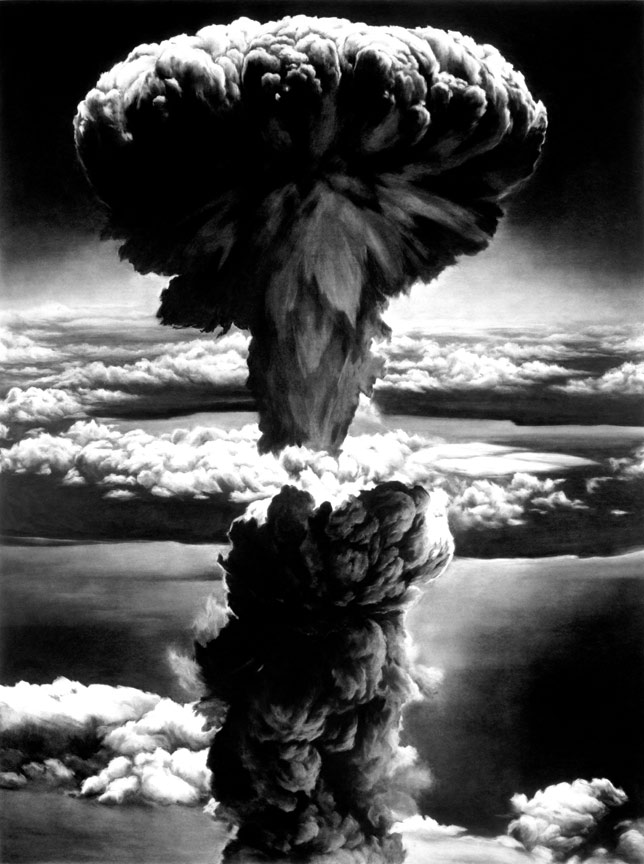
When looking earlier today at a bunch of striking photorealist painting and drawing, I came across the image below. It is a charcoal drawing of the nuclear bombing of Nagasaki by artist Robert Longo. (Strangely enough, in addition to being an artist, he also directed the 1995 film Johnny Mnemonic, based on a William Gibson short story. It was Longo’s only feature film.) He has a whole series of charcoal drawings of nuclear explosions. His website is here. His work is also currently part of a group exhibition, “Disaster: The End of Days,” at the Galerie Thaddaeus Ropac in Paris.

Robert Longo Drawing of Nagasaki