Summer and Fall 2024 Links

I was so busy this fall I fell behind on pretty much everything, so I’m making up for it with a big two-season link post, roughly mid-May until the end of 2024.


Nuclear and Environmental

The Editorial Board of The New York Times, “The President’s Arsenal.”

Elizabeth Kolbert, “When the Arctic Melts” and “Why Hurricane Milton Is a Sign of the New Abnormal.”

Damian Carrington, “Earth’s ‘Vital Signs’ Show Humanity’s Future in Balance, Say Climate Experts” and “‘No Sign’ of Promised Fossil Fuel Transition as Emissions Hit New High.”

Patrick Greenfield, “Trees and Land Absorbed Almost no CO2 Last Year. Is Nature’s Carbon Sink Failing?”

Kathleen Kingsbury, W.J. Hennigan, and Spencer Cohen, “The Last Survivors [of Hiroshima] Speak. It’s Time to Listen.”

Megan Specia and Lynsey Chutel, “Nobel Updates: Peace Prize Is Awarded to Japanese Group of Atomic Bomb Survivors.”

Christopher Kempf, “Disaster Triumphant.”

David E. Sanger, “Biden Approved Secret Nuclear Strategy Refocusing on Chinese Threat.”

William Langewiesche, “The Secret Pentagon War Game That ​Offers a Stark​ Warning for Our Times.”

W. J. Hennigan, “The Price.”

Damian Carrington, “Hopeless and Broken: Why the World’s Top Climate Scientists Are in Despair.”

Continue reading

“2015.10,” “2015.23,” and “2016.10” Reprinted in What We Did during the Apocalypse: The Archive of “The Babel Tower Notice Board”

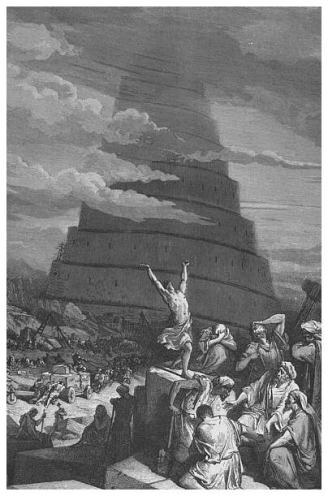
What We Did During the Apocalypse--The Babel Tower Notice Board_Page_001The Babel Tower Notice Board, a pandemic project that existed between August 2020 and December 2021 edited by Richard Capener, was just collected in What We Did during the Apocalypse: The Archive of “The Babel Tower Notice Board” (Hem Press, 2024). I was thrilled then and continue to be thrilled that three sonnets of mine, “2015.10,” “2015.23,” and “2016.10,” are part of that project. Thanks again to Capener for his amazing work on The Babel Tower Notice Board, for his monthly Babel Parish Newsletter–a welcome dispatch during those difficult months–and for his continued great work with Hem Press.

(And “2015.10,” “2015.23,” and “2016.10” will all be collected in my third book of poems, 2013–2017: Sonnets, forthcoming in July from LJMcD Communications.)

Summer and Fall 2023 Links

The links have really gotten away from me. This summer, I was prioritizing finishing up a chapter for Too Big to Read, and this fall the semester just hammered me; I basically haven’t had a single free moment. So, better late than never, huh? Over six months of links. Enjoy.


Nuclear and Environmental

Apocalyptica, a new journal.

Jeff VanderMeer, “Florida’s Environmental Failures Are a Warning for the Rest of the US.”

Lydia Millet, “Biden’s Green Energy Money Is Sugar on a Poison Pill.”

Tina Cordova, “What Oppenheimer Doesn’t Tell You about the Trinity Test.”

Brad Plumer and Elena Shao, “Heat Records Are Broken Around the Globe as Earth Warms, Fast.”

Alexis Pauline Gumbs, “Heat Is Not a Metaphor.”

David Gelles, “Climate Disasters Daily? Welcome to the ‘New Normal.’”

Tom Engelhardt, “Humanity Has Created Too Many Ways of Destroying Itself.”

Kim Tingley, “‘Forever Chemicals’ Are Everywhere. What Are They Doing to Us?”

Azby Brown, “Just Like That, Tons of Radioactive Waste Is Heading for the Ocean.”

Raymond Zhong, “Something Was Messing With Earth’s Axis. The Answer Has to Do With Us.”

Damian Carrington, “Canadian Lake Chosen to Represent Start of Anthropocene.”

Ralph Vartabedian, “A Poisonous Cold War Legacy That Defies a Solution.”

The Washington Post, “Where Dangerous Heat Is Surging.”

Michael Levenson, “Heat Wave and Blackout Would Send Half of Phoenix to ER, Study Says.”

Jessica Hurley, “The Irradiated Body as Postcolonial Lost Edge.”

Hoyt Long and Aarthi Vadde, “We Want Our Catastrophe TV.”

Continue reading

“Something Worth Leaving in Shards: An Interview with Rachel Blau DuPlessis” in boundary 2

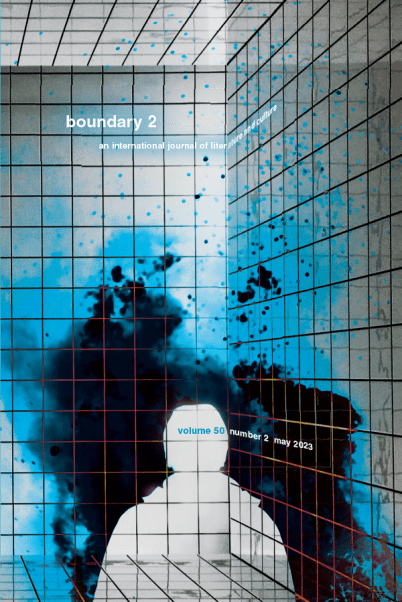
boundary 2, vol 50, no 2, cover image I am honored to say that my interview with the great poet and critic Rachel Blau DuPlessis, “Something Worth Leaving in Shards: An Interview with Rachel Blau DuPlessis,” has just been published in the most recent issue of boundary 2. (This link should provide access for three months.) I am deeply grateful to DuPlessis for corresponding with me during the summer of 2020. In lockdown with no childcare, corresponding with DuPlessis via email to conduct this interview (when I had a spare moment or two to do so) played a large part in keeping me sane during that difficult time. A huge thanks also to Racheal and Aviva, who were right there every day along with me while this interview was being conducted.

Here’s an abstract of the interview:

This interview with poet, essayist, literary critic, and collagist Rachel Blau DuPlessis was conducted via email correspondence between June 11 and August 29, 2020. Author of over a dozen volumes of poetry and half a dozen books in modernist studies, poetics, and feminist criticism, DuPlessis reflects broadly on her career in this interview. She discusses the ongoing role of feminism in her writing and thought, the forms of the fold and the fragment, the relationship between her poetry and criticism, her work in and on the long poem, and her post‐Drafts poetry, including her (at the time) most recent book, Late Work (2020). The interview concludes with a conversation about the relationship between poetry and theorizing practices and a meditation on writing during a global pandemic.

For my writing on DuPlessis: “‘Is an Archive Enough?’: Megatextual Debris in the Work of Rachel Blau DuPlessis.”

And for previous interviews: “Isn’t It a Beautiful Day? An Interview with J. Hillis Miller” and “An Interview with Jonathan Arac.”

Spring 2023 Links

Nuclear and Environmental

Herman Kahn, On Thermonuclear War (1960).

Raymond Zhnog, “For Planet Earth, This Might Be the Start of a New Age.”

Nicholas Kristof, “Cheer Up! The World Is Better Off Than You Think.”

Rebecca Solnit, “What If Climate Change Meant Not Doom–But Abundance?”

Elizabeth Kolbert, “It’s Earth Day—and the News Isn’t Good.”

David Wallace-Wells, “Greta Thunberg: ‘The World Is Getting More Grim by the Day.'”

Mark O’Connell, “Our Way of Life Is Poisoning Us.”

Simon Schama, “Simon Schama on the Broken Relationship between Humans and Nature: ‘The Joke’s on Us. Things Are Amiss.'”

Continue reading

Links in the Time of Coronavirus, Vol. 29: July 16–August 15, 2022

This is the last volume in my “Links in the Time of Coronavirus” series. This is for a few reasons. First and foremost, a new academic year is about to start, and I know I’m going to be busy (especially this coming semester), will again fall behind with posting regularly, and would like to return to putting up just four(ish) link posts per year (one each season: e.g., “Fall 2022 Links”). This will also allow me to be more selective and less encyclopedic in my links and to worry less about capturing the full “fabric” of events as I perceive them (from my obviously limited and privileged subject position). Second, as the CDC has just (quite controversially) considerably reduced COVID-19 guidelines—with the Center for Disease Control’s (CDC) Greta Massetti saying: “‘This guidance acknowledges that the pandemic is not over, but also helps us move to a point where COVID-19 no longer severely disrupts our daily lives,'” adding later that: ‘”We know that COVID 19 is here to stay,'”—it seems as good a point as ever, considering these links began on the occasion of an official body (the World Health Organization) declaring a global pandemic, to stop this series.

For no matter how much we may disagree with the CDC’s decision, Massetti’s latter point seems pretty clearly the case at this point, that COVID-19 is here to stay, and it is this point in particular that has made me to decide to cease grouping my links as part of the “time of coronavirus” series. It appears that there will never now not be a time of coronavirus; from here on out any links I post will always be “in the time of coronavirus.” (When I imagine keeping this series going until we might say it is “not” the time of coronavirus—such a prospect is dauntingly disheartening.) Let me be clear, however: my decision to discontinue this series has nothing to do with thinking that the pandemic is “over,” only that it appears to have made a shift to something that—woefully, unfortunately, perhaps criminally—is just part of the fabric of being human in the twenty-first century; it has become a fact of our lives no matter how much we wish it had all gone differently, wish that we lived in a world/country with a functioning healthcare system and a greater agreement about scientific facts, with a greater capacity to care for each other, to wear masks, to get vaccinated, etc. But we didn’t, we don’t. The current point the pandemic has reached, this point of ubiquity, of defeatism, of “normalization,” of the fact that COVID-19 rarely dominates headlines in this time of search warrants and climate bills, means that it is now time, at least for my practice of putting up links, to move them to another position, another standpoint. See you in “Fall 2022 Links.”


Nuclear and Environmental

Emily Cochrane, “Senate Passes Climate, Health and Tax Bill, with All Republicans Opposed.”

Jack Ewing and Ivan Penn, “Climate Bill ‘Transformative’ for Auto and Energy Industries.”

Kate Aronoff, “Congress Is about to Pass a Historic Climate Bill. So Why Are Oil Companies Pleased?”

Paul Krugman, “Did Democrats Just Save Civilization?”

Continue reading

Links in the Time of Coronavirus, Vol. 23: January 16–February 15, 2022

Screenshot (1)

Nuclear and Environmental

Henry Fountain, “An Extraordinary Iceberg Is Gone, but Not Forgotten.”

Jacob Blumenfeld, “Climate Barbarism: Adapting to a Wrong World.”

Joshua Rothman, “Can Science Fiction Wake Us Up to Our Climate Reality?”


Ukraine

The New York Times, “Moscow Is Pessimistic about Reaching Accord with US on Ukraine, but Talk Continues.”

Julian E. Barnes and Helene Cooper, “US Battles Putin by Disclosing His Next Possible Moves.”

And Max Fisher, “On Ukraine, US, and Russia Wage Signaling War to Avert Actual War.”


Coronavirus

Apoorva Mandavilli, “Yes, Omicron Is Loosening Its Hold. But the Pandemic Has Not Ended.”

Steven Kurutz, “Too Young to Feel So Old.”

Alexander Provan, “The Great Equalizer” (from June 2020).

Continue reading

Links in the Time of Coronavirus, Vol. 20: October 16–November 15, 2021

Nuclear and Environmental (and Apocalyptic)

Alex Traub, “Sunao Tsuboi, 96, Dies; Hiroshima Victim Who Lived to Tell His Story.”

Abigail Curtis, “Every Year, They Hike to Remember the Day the Rapture Didn’t Happen.”


Coronavirus

Shane O’Neill, “Is It Just Us or Does Everyone Have a Cold Right Now?”


Politics and National Security State

Jim Tankersley, “Biden Signs Infrastructure Bill, Promoting Benefits for Americans.”

Carol Rosenberg, “US Military Jury Condemns Terrorist’s Torture and Urges Clemency.”

Dave Philipps and Eric Schmitt, “How the US Hid an Airstrike That Killed Dozens of Civilians in Syria.”

Katie Benner, “Steve Bannon Turns Himself in on Contempt of Congress Charges.”


Hyperarchival

Ian Bogost, “The Metaverse Is Bad.”

Continue reading

Links in the Time of Coronavirus, Vol. 17: July 16–August 15, 2021

(A little late on this one, but August has been quite busy, both personally and professionally.)


Nuclear and Environmental

Brad Plumer and Henry Fountain, “A Hotter Future Is Certain, Climate Panel Warns. But How Hot Is Up to Us.”

Naomi Klein, “Stuck in the Smoke as Billionaires Blast Off.”

National Oceanic and Atmospheric Administration, “June 2021 Was the Hottest June on Record for the US.”

Oliver Milman, “US Set for Punishing Temperatures as Huge ‘Heat Dome’ to Settle over Country.”

Ezra Klein, “It Seems Odd That We Would Just Let the World Burn.”

Liza Featherstone, “How to Live in a Burning World without Losing Your Mind.”

Kat Aronoff, “Playing Nice With the Fossil Fuel Industry Is Climate Denial.”

Katy Lederer and Julian Brave Noisecat, “Infrastructure, Infrastructure! An Interview with Julia Brave NoiseCat.”

Deanna K. Kreisel, “A Deadly Fart That Will Kill Us All: On Climate Grief.”

Kim Stanley Robinson, “Remembering Climate Change . . . a Message from the Year 2071.”

Zach St. George, “He Wrote a Gardening Column. He Ended Up Documenting Climate Change.”

Jonathan Foley, “Seven Reasons Why Artificial Carbon Removal Is Overhyped.”

And Call for Applications: Fellowships at Käte Hamburger Centre for Apocalyptic and Post-Apocalyptic Studies (CAPAS) 2022-23.

Continue reading