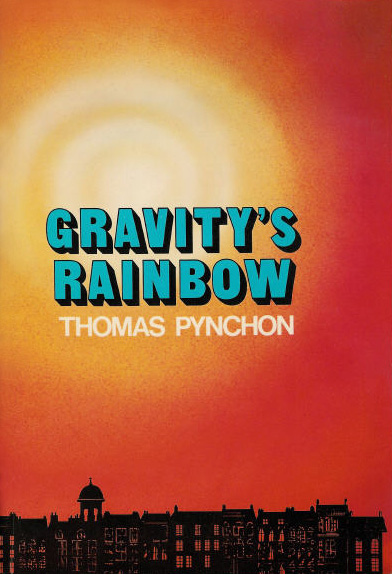
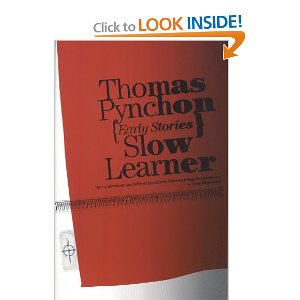
Excerpt: Pynchon on the Bomb

From one of the rare moments Pynchon addresses his own work:

My reading at the time also included many Victorians, allowing World War I in my imagination to assume the shape of that attractive nuisance so dear to adolescent minds, the apocalyptic showdown.

I don’t mean to make light of this. Our common nightmare The Bomb [note the capitalization] is in there too. It was bad enough in ’59 and is much worse now, as the level of danger has continued to grow. There was never anything subliminal about it, then or now. Except for that succession of the criminally insane who have enjoyed power since 1945, including the power to do something about it, most of the rest of us poor sheep [the preterite] have always been stuck with simple, standard fear. I think we all have tried to deal with this slow escalation of our helplessness and terror in the few ways open to us, from not thinking about it to going crazy from it. Somewhere on this spectrum of impotence is writing fiction about it–occasionally, as here, offset to a more colorful time and place. (Thomas Pynchon, “Introduction” in Slow Learner [New York: Little, Brown & Co., 1984], 18-19.)

New Literature: ENGLIT 0635

I just finished designing the course I’m going to be teaching in the Spring at Pitt, New Literature (ENGLIT 0635), which I’ve titled “U.S. Fiction in the Wake of Postmodernism,” and I am quite excited about it! One of the challenges for such a course (whose online course description is incredibly broad, literally any lit. from the past 25 years, not limited to region, country, genre, style, school, etc.), is figuring out what exactly is meant by “new” literature. Consequently, I’m beginning the course where I often end other courses–Don DeLillo’s White Noise–and am taking up very seriously the idea that the lit. we’re reading is, if not precisely “after” postmodernism (not post-postmodernism, a useless term), then at least positioned in its wake–i.e. the pomo is still around, but it has also left, or something. The class will start w/ grounding pomo in fairly “standard” ways, move through Southland Tales, through some “theory” as lit. (informed by DFWs old “Fictional Futures” essay) and end by seriously considering two U.S. novels that have gotten quite a bit of play as of late, Freedom and The Submission. New lit. indeed. Below is the major reading list, followed by the rest. . .

Don DeLillo, White Noise: Text and Criticism, ed. Mark Osteen (New York: Penguin, 1998 [1985]).

Jonathan Franzen, Freedom (New York: Picador, 2011 [2010]). 

Richard Kelly & Brett Weldele, Southland Tales: The Prequel Saga (Anaheim: Graphitti Designs, 2007).

Amy Waldman, The Submission (New York: Farrar, Straus & Giroux, 2011).

David Foster Wallace, Girl with Curious Hair (New York: W.W. Norton & Co., 1989).

Slavoj Žižek, Welcome to the Desert of the Real (New York: Verso, 2002).


And the additional reading:

Jonathan Franzen, “Why Bother” in How to Be Alone: Essays (New York: Farrar, Straus & Giroux, 2002), 55-97.

Walter Benjamin, “The Work of Art in the Age of Mechanical Reproduction” in Illuminations, ed. Hannah Arendt, trans. Harry Zohn (New York: Schocken Books, 1968), 217-253.

Jean Baudrillard, “The Precession of Simulacra” in Simulacra and Simulation, trans. Sheila Faria Glaser (Ann Arbor: The University of Michigan Press, 1994), 1-42.

John Barth, “Lost in the Funhouse” in Lost in the Funhouse: Fiction for Print, Tape, Live Voice (New York: Anchor Books, 1988 [1968]), 72-97.

Fredric Jameson, “The Cultural Logic of Late Capitalism” in Postmodernism; or, the Cultural Logic of Late Capitalism (Durham: Duke University Press, 1991), 1-55.

David Foster Wallace, “E Unibus Pluram: Television and U.S. Fiction” in A Supposedly Fun Thing I’ll Never do Again (New York: Little, Brown & Co., 1996), 21-82.

David Foster Wallace, “Octet” in Brief Interviews with Hideous Men (New York: Little, Brown & Co., 1999), 131-160.

Steven Shaviro, “Southland Tales,” The Pinocchio Theory (weblog), http://www.shaviro.com/Blog/?p=611.

David Foster Wallace, “Fictional Futures and the Conspicuously Young,” The Review of Contemporary Fiction 8.3 (1988): 36-53, http://www.theknowe.net/dfwfiles/pdfs/ffacy.pdf.

Jacques Derrida, “No Apocalypse, Not Now (Full Speed Ahead, Seven Missiles, Seven Missives),” trans. Catherine Porter & Philip Lewis, in Psyche: Inventions of the Other, Vol. 1, ed. Peggy Kamuf & Elizabeth Rottenberg (Stanford: Stanford University Press, 2007), 387-410.

Fredric Jameson, “New Literary History and the End of the New,” New Literary History 39.3 (Summer 2008): 375-87.

Lev Grossman, “Jonathan Franzen: The Wide Shot,” Time 176.8 (Aug. 23, 2010): 42-8, http://www.time.com/ time/magazine/article /0,9171,2010185,00.html.

Michiko Kakutani, “A Family Full of Unhappiness, Hoping for Transcendence,” The New York Times (Aug. 15, 2010), C1, http://www.nytimes.com/2010/08/16/books/16book.html.

Sam Tanenhaus, “Peace and War,” The New York Times Book Review (Aug. 19, 2010), http://www.nytimes.com/ 2010/08/29/books/review/Tanenhaus-t.html?ref=books

B.R. Myers, “Smaller Than Life,” The Atlantic (Oct. 2010), http://www.theatlantic.com/magazine/archive/2010/ 10/smaller-than-life/8212/
A Few Steps of Deproliferation. . . .

Today it was announced that the United State’s largest nuclear bomb at 9 megatons, the B53, is being disassembled.

President of the Ploughshares Fund, Joseph Cirincione follows up this summer’s piece in The Atlantic by reporting on Congressman Edward J. Markey’s letter to the Super Committee, which calls for massive cuts in the U.S. nuclear budget.

And read Markey’s letter, signed by 65 other members of Congress, here.


Excerpt: Grant Morrison and the Bomb

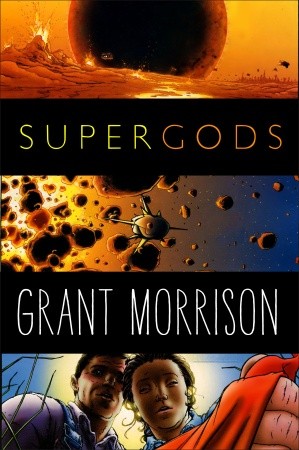
In his excellent new history/study/biography of comic book superheroes, I think Grant Morrison quite convincingly and significantly frames the horizon for understanding superheroes with the bomb. A lengthy excerpt.

Four miles across a placid stretch of water from where I live in Scotland is RNAD Coulport, home of UK’s Trident-missile-armed nuclear submarine force. Here, I’ve been told, enough firepower is stored in underground bunkers to annihilate the human population of our planet fifty times over. One day, when Earth is ambushed in Hyperspace by fifty Evil Duplicate Earths, this megadestructive capability may, ironically, save us all–but until then, it seems extravagant, somehow emblematic of the accelerated, digital hypersimulation we’ve all come to inhabit.

[. . . ]

And the Bomb, always the Bomb, a grim and looming, raincoated lodger, liable to go off at any minute, killing everybody and everything. His bastard minstrels were gloomy existentialist folkies whining hornrimmed dirges about the “Hard Rain” and the “All on That Day” while I trembled in the corner, awaiting bony-fingered judgment and the extinction of all terrestrial life. Accompanying imagery was provided by the radical antiwar samizdat zines my dad brought home from political bookstores on High Street. Typically, the passionate pacifist manifestos within were illustrated with gruesome hand-drawn images of how the world might look after a spirited thermonuclear missile exchange. The creators of these enthusiastically rendered carrion landscapes never overlooked any opportunity to depict shattered, obliterated skeletons contorted against blazing horizons of nuked and blackened urban devastation. If the artist could find space in his composition for a macabre, eight-hundred-foot-tall Grim Reaper astride a flayed horror horse, sowing missiles like grain across the snaggle-toothed, half-melted skyline, all the better.

Like visions of Heaven and Hell on a medieval triptych, the postatomic wastelands of my dad’s mags sat side by side with the exotic, tripple-sunned vistas that graced the covers of my mum’s beloved science fiction paperbacks. . . .

On television, images of pioneering astronauts vied with bleak scenes from Hiroshima and Vietnam: It was an all-or-nothing choice between the A-Bomb and the Spaceship. I had already picked sides, but the Cold War tension between Apocalypse and Utopia was becoming almost unbearable. And then the superheroes rained down across the Atlantic, in a dazzling prism-light of heraldic jumpsuits, bringing new ways to see and hear and think about everything. . . .

The superheroes laughed at the Atom Bomb. . . .

Before it was a Bomb, the Bomb was an Idea.

Superman, however, was a Faster, Stronger, Better Idea (Grant Morrison, Super Gods [New York: Spiegel & Grau, 2011], xiii-xv).

Abstract: “‘Literature has always belonged to the nuclear epoch’?: Interrogating Nuclear Criticism’s Fabulous Textuality”

Below is an abstract for a paper I will be presenting / discussing at a seminar / roundtable at the 2012 Northeastern Modern Languages Association Conference (NeMLA), taking place March 15-18 in Rochester, NY. The panel/seminar will address nuclear criticism, and is titled “Nuclear Criticism and the ‘Exploding Word.'” Michael Blouin at Michigan State is organizing the seminar.

“Literature has Always Belonged to the Nuclear Epoch”?: Interrogating Nuclear Criticism’s Fabulous Textuality

During the brief heyday when nuclear criticism was a visible and viable critical practice—from around 1984 to 1993—one of its principle debates raged around a provocative statement made by Jacques Derrida in the founding document of nuclear criticism, “No Apocalypse, Not Now.” Derrida famously remarked that global nuclear war is “a phenomenon whose essential feature is that it is fabulously textual, through and through.” Critics such as Peter Schwenger, Avital Ronnell, and, to a lesser extent, Richard Klein embraced this statement in quite productive and interesting ways. J. Fisher Solomon, William J. Scheick, and others, though clearly indebted to Derrida, took issue with nuclear criticism’s emphasis on the textuality of the nuclear referent, wanting instead to practice a more ethical nuclear criticism, one that constantly stressed the reality (rather than poststructural textuality) of nuclear weaponry. This debate culminated in Christopher Norris’s Uncritical Theory (1992), a considered response to Jean Baudrillard’s infamous article, “The Gulf War Has Not Taken Place.” Right around the time Roger Luckhurst, Klein, and Ken Ruthven were considering the “future of nuclear criticism,” however, not only did the debate end, but the explicit practice of nuclear criticism disappeared with the end of the Cold War. (Ruthven also suffered the curious fate of publishing the first and ostensibly last study of nuclear criticism in 1993).

As one of the goals of this panel is to seriously take up the question regarding the function of nuclear criticism at the present time, an endeavor I consider to be of paramount importance for a number of reasons, this paper will return to this historical debate in light of our contemporary moment. Rather than situating this debate between the “archive” or “text” and the “real,” however, my aim is to interrogate an equally provocative statement of Derrida’s that, to my knowledge, has not been seriously discussed anywhere: that literature “has always belonged to the nuclear epoch, even if it does not talk ‘seriously’ about it. . . . I believe that the nuclear epoch is dealt with more ‘seriously’ in the writings of Mallarmé, of Kafka, or Joyce, for example, than in present-day novels that would describe a ‘true’ nuclear catastrophe directly and in a ‘realistic’ fashion.” What does Derrida mean by this offhand remark? What could Kafka or Joyce have to do with the “nuclear epoch”? I will argue that for the practice of nuclear criticism to go forward, we must take Derrida’s statement quite seriously, for it points to a more fluid, rigorous, and historically adaptable form of nuclear criticism than what has previously gone under that name. Specifically, I will consider the final scene from the “Cyclops” chapter in James Joyce’s Ulysses (1922), and the “Nausicaa” chapter more generally, as definitively nuclear moments. To do so not only returns us to the past of nuclear criticism’s internal debates, but forces us to ask the serious questions: what is nuclear criticism, what are its current or possible roles, and what is its appropriate critical object? If something as canonically inscribed into the archive and as exhaustively studied as Ulysses can still benefit from the practice nuclear criticism (especially considering it cannot really be called explicitly nuclear at all), then we must take very seriously nuclear criticism’s current possibilities, not only in a world circumscribed by disasters of all kinds, but to imagine a world free from the threat of nuclear annihilation.

An Excerpt from Gravity’s Rainbow. . .

“‘And sometimes I dream of discovering the edge of the World. Finding that there is an end. My mountain gentian always knew. But it has cost me so much.

‘America was the edge of the World. A message for Europe, continent-sized, inescapable. Europe had found the site for its Kingdom of Death, that special Death the West had invented. Savages had their waste regions, Kalaharis, lakes so misty they could not see the other side. But Europe had gone deeper–into obsession, addiction, away from all the savage innocences. America was a gift from the invisible powers, a way of returning. But Europe refused it. It wasn’t Europe’s Original Sin–the latest name for that is Modern Analysis–but it happens that Subsequent Sin is harder to atone for.

‘In Africa, Asia, Amerindia, Oceania, Europe came and established its order of Analysis and Death. What it could not use, it killed or altered. In time the death-colonies grew strong enough to break away. But the impulse to empire, the mission to propagate death, the structure of it, kept on. Now we are in the last phase. American Death has come to occupy Europe. It has learned empire from its old metropolis. But now we have only the structure left us, none of the great rainbow plumes, no fittings of gold, no epic marches over alkali seas. The savages of other continents, corrupted but still resisting in the name of life, have gone on despite everything. . . while Death and Europe are separate as ever, their love still unconsummated. Death only rules here. It has never, in love, become one with. . . ” (Thomas Pynchon, Gravity’s Rainbow [New York: Viking Press, 1973], 722-3).

SLSA, Braid (and the Nuclear. . .)

So I just got back from an excellent meeting of the Society for Literature Science and the Arts (SLSA), in Kitchener, Ontario (a surprisingly good city for a conference), and though I’m vibrating about a host of things, feel completely intellectually and academically reinvigorated, and had a great time w/ my colleagues and c0-panelists Robin Clarke and Sten Carlson, perhaps the thing I most took away from the conference (in terms of this blog) were Patrick Jagoda and N. Katherine Hayles discussing the indie-game, Braid (Jonathan Blow, 2009)–a game I kinda can’t believe I didn’t know about (oops). Sadly, I feel I cannot really spoil why it belongs on this here blog (but maybe I will after I finish playing it), but suffice it to say, it very much deserves some hyperarchivally parallactic attention. Also, it’s available on X-Box Live and is downloadable for like 10 bucks online. It’s totally worth it. So, until I finish playing it and feel like spoiling the ending, here’s a trailer.

If Decadence Signals the End, Then We’ll Experience the End Decadently; Or, the Pornographic Fallout Shelter: What to Do w/ Too Much Money

CBS recently reported that Van Nuys-based porn company Pink Visual is building a “luxury” fallout shelter for the “impending” 2012 global disaster. “Multiple fully stocked bars [and by “fully” I suppose this really means fully; the booze has gotta last for the rest of time. The production of Peppermint Schnapps I don’t think will be a priority in the post-apocalyptic wasteland], an enormous performing stage [cause clearly pole dancing will take your mind off your dead and dying friends and relatives], and a sophisticated content production studio [so that one of the major human endeavors of the early 21st c., according to any scan of the internet, will not cease: the production of pornography].” Orgy at the end of the world.

Would the advertisement go something like this?: Are you despairing that humanity is gone, and the reconstruction of the world is nigh impossible? Have you given up all hope? Can you see no way to go on, to make life meaningful again? Have you always wanted to live in a hedonistic lifestyle of non-stop orgiastic bliss? Do you care more about your own personal pleasure than about anyone else? Do you want to spend millions of dollars merely on the possibility that the world will end and you will somehow be able to make it to California (and survive), where clearly your now worthless money will grant you entrance to the VIP club of the party to end all parties!? Fear not, we have your answer! Spend the rest of your lifetime not trying to eke out a miserable existence among the dregs of an irradiated and potentially cannibalistic humanity, but rather cynically/naively forget the past and future by making, well, porn. Oh, and if the internet goes down, there will still plenty of porn on the networks in-house (or rather, in-fallout-shelter).

This is the worst. Weirdly, their design looks awfully panoptic. Read briefly about this absurdity here.