I am delighted to yet again announce that on Thursday, October 17 at 7:00 p.m. in Anderson Theater at Hartwick College, distinguished critic Anna Kornbluh will be delivering the 2024–25 Babcock Lecture at Hartwick College, which will be titled: “Historical Fictions, Heist Flicks, and other Climate Genres for a Burning World.” Kornbluh’s lecture will be followed by a reading by eminent poet and feminist critic Rachel Blau DuPlessis and is part of the Oneonta Literary Festival.
Historical Fictions, Heist Flicks, and other Climate Genres for a Burning World
In the urgent emergency of climate crisis, is there any time for art? This talk considers some of the pressures on literature and culture at present, exploring the prevailing ways that artists, authors, and critics are conceiving artistic ties to the environment, and proposing some alternative ties with the help of popular genres like historical fiction and heist films.
In addition to this year’s Oneonta Literary Festival, at which Rachel Blau DuPlessis, Ross Gay, Anna Kornbluh, and many others will be speaking, the Hartwick College and the Department of Literature, Media, and Writing will present three readings in the 2024–25 Visiting Writers Series. Readings take place at 7:00 in the Eaton Lounge, Bresee Hall at Hartwick College in Oneonta, New York.
I will be reading on Wednesday, September 24, 2024 from my new book, 2013–2017: Sonnets (LJMcD Communications, 2024).
Libby Cudmore will be reading from her new book, Negative Girl (Datura, 2024), on Wednesday, November 13, 2024.
And Amish Trivedi will be reading, including from his newest book FuturePanic (Co•Im•Press, 2021), on Thursday, April 10, 2025.
For more information, visit the Visiting Writers Series webpage.
In collaboration with SUNY Oneonta’s Department of English, the Community Arts Network of Oneonta (CANO), the Huntington Library, and Oneonta High School, my colleague Tessa Yang and I are co-organizing the Oneonta Literary Festival, which will take place October 17–21, 2024 at various places in and around Oneonta.
For our part, Hartwick College is bringing in Anna Kornbluh to deliver the 2024–25 Babcock Lecture, “Historical Fictions, Heist Flicks, and other Climate Genres for a Burning World,” as part of the festival, along with Rachel Blau DuPlessis, Ross Gay, and Willy Palomo. For more information, please visit the Oneonta Literary festival website at www.hartwick.edu/literaryfestival. (The festival also takes place throughout the year [more info about year-long events here].)
I am honored to say that my interview with the great poet and critic Rachel Blau DuPlessis, “Something Worth Leaving in Shards: An Interview with Rachel Blau DuPlessis,” has just been published in the most recent issue of boundary 2. (This link should provide access for three months.) I am deeply grateful to DuPlessis for corresponding with me during the summer of 2020. In lockdown with no childcare, corresponding with DuPlessis via email to conduct this interview (when I had a spare moment or two to do so) played a large part in keeping me sane during that difficult time. A huge thanks also to Racheal and Aviva, who were right there every day along with me while this interview was being conducted.
Here’s an abstract of the interview:
This interview with poet, essayist, literary critic, and collagist Rachel Blau DuPlessis was conducted via email correspondence between June 11 and August 29, 2020. Author of over a dozen volumes of poetry and half a dozen books in modernist studies, poetics, and feminist criticism, DuPlessis reflects broadly on her career in this interview. She discusses the ongoing role of feminism in her writing and thought, the forms of the fold and the fragment, the relationship between her poetry and criticism, her work in and on the long poem, and her post‐Drafts poetry, including her (at the time) most recent book, Late Work (2020). The interview concludes with a conversation about the relationship between poetry and theorizing practices and a meditation on writing during a global pandemic.
I am particularly proud of this essay, as I wrote it predominantly during the summer of 2020–the height of lockdown–and during which we had no childcare and I couldn’t access the library nor my campus office, including its books. Lots of people to thank, consequently, but particularly Racheal Fest, Courtney Jacobs and James Zeigler for their hard work putting this together during an incredibly difficult year, Rachel Blau DuPlessis, and Dawn Baker, Hartwick’s interlibrary loan librarian. (There are more acknowledgments on the first page of my essay.) This essay is also the second published chapter from my work in progress, Too Big to Read: The Megatext in the Twenty-First-Century. For other related work on megatexts and hyperarchivalism, see:
In the twenty-first century, digital technologies have made it possible for writers and artists to create massively unreadable works through computational and collaborative composition, what the author has elsewhere called megatexts. The ubiquity of texts appearing across media that are quite literally too big to read—from experimental novels to television, film, and video games—signals that the megatext is an emergent form native to the era of neoliberalism. But what happens to other long forms, such as the twentieth-century long poem, when written in an era of megatextuality? Rachel Blau DuPlessis’s work, including Drafts (1987–2013) and Traces, with Days (2017–), readily suggests itself as a case study for thinking through a megatextual impulse in the twenty-first-century long poem. Though her work is plainly indebted to its modernist precursors (H.D., Pound, Williams, etc.) while disavowing at every level of its composition a patriarchal will toward totality, DuPlessis’s various experiments in the long poem are also thoroughly contemporary and respond to the economic, military, political, and environmental transformations of the neoliberal era by drawing upon and producing fragmentary, megatextual debris. This essay positions DuPlessis’s work amidst a larger twenty-first-century media ecology, which includes both the megatext and the big, ambitious novel, and argues that rather than simply (and futilely) resist the neoliberal cultural logic of accumulation without end, DuPlessis hypertrophically uses the megatext’s phallogocentric form against itself in order to interrogate more broadly what it means—socially, culturally, economically—to write a long poem in the age of hyperarchival accumulation.
For this year’s Modern Language Association Convention, to be held virtually from January 7–10, 2021, I organized and will be speaking on a roundtable on Twenty-First-Century Forms, along with Amy Sara Carroll, Racheal Fest, Christian P. Haines, Hyemin Kim, and Eric Loy. I have included the information about the panel and, below that, full abstracts from each speaker.
181. Twenty-First-Century Forms
Thursday, January 7, 2020, 7:00 – 8:15 p.m. (EST)
If the novel and lyric poem have become residual forms, what literary forms are emerging in contemporaneity? Participants explore emergent literary forms of the twenty-first century and their relationship with, instantiation in, or remediation by other (digital) media: film, television, video, graphic narrative, video games, transmedia, or other hybrid, novel, or megatextual forms.
 I am delighted to yet again announce that on Thursday, October 17 at 7:00 p.m. in Anderson Theater at Hartwick College, distinguished critic Anna Kornbluh will be delivering the 2024–25 Babcock Lecture at Hartwick College, which will be titled: “Historical Fictions, Heist Flicks, and other Climate Genres for a Burning World.” Kornbluh’s lecture will be followed by a reading by eminent poet and feminist critic Rachel Blau DuPlessis and is part of the Oneonta Literary Festival.

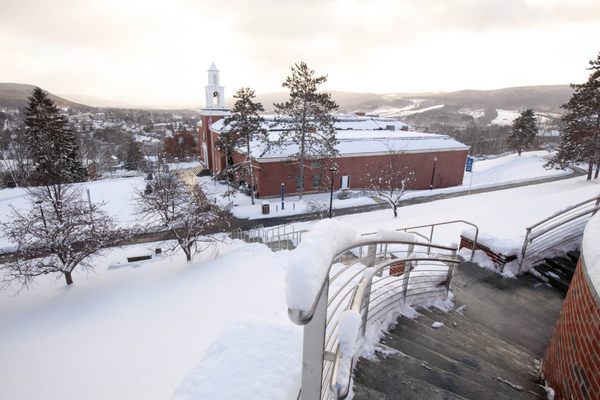 Hartwick College’s unique January Term (J-Term; my first!) is again starting off unconventionally, but I’m excited to be teaching an intensive month-long course on feminist poetry and poetics. The syllabus:

 The Hyperarchival Parallax