MLA 2027 Panels: “Teaching Literary Maximalism: Problems, Practices, Possibilities” and “Real Aesthetic Questions”

At this year’s Modern Language Association Convention in Los Angeles, California (January 7-10, 2027), I will be speaking on a roundtable Teaching Literary Maximalism: Problems, Practices, Possibilities, and a panel, Real Aesthetic Questions. I have included the information and tentative abstracts for each paper below.

23. Teaching Literary Maximalism: Problems, Practices, Possibilities

Thursday, January 7, 2027, 12:00-1:15 p.m.

Presiding: Benjamin Bergholtz (Louisiana Tech U) and Yonina Hoffman (US Merchant Marine Acad.)

Speakers:
Carole Carroll (Lubbock Christian U)
Srirupa Chatterjee (Indian Inst. of Tech., Hyderabad)
Bradley J. Fest (Hartwick C)
Alexander McKee (U of Delaware, Newark)
Stefan H. Uhlig (U of California, Davis)
Yanchang Zhu (Huzhou C)


Teaching Megatexts

In a monograph currently under peer review, Too Big to Read: The Megatext in the Twenty-First Century, I argue that the massive yet discrete textual objects that have appeared across media in the last thirty or so years should be considered a distinct, emergent form, what I call the megatext. From three-million-page conceptual works to massive cinematic universes and gigantic video games, the twenty-first century has seen megatexts appear across media. Megatexts are unreadably large yet concrete aesthetic and rhetorical objects that require incredibly nontrivial effort to completely traverse; they are produced and conceived as singular works and depend upon digital technology and collaborative authorship for their production. In my talk, I will focus on the specific challenges and possibilities presented by devoting an entire semester to studying a text that is “too big to read.”

I will be focusing on two classes of mine at Hartwick College, a small liberal arts college in upstate New York: a senior seminar for English majors in the fall of 2024, ENGL 470 Mark Z. Danielewski’s The Familiar; and an upper division course for English and game development majors I taught in the spring of 2026, ENGL 352 Critical Game Studies. ENGL 470 was devoted to studying Danielewski’s failed megatext, The Familiar (2015–17), and putting it in conversation with other relevant texts, including Lost (2004–10), Anna Kornbluh’s Immediacy (2024), criticism of the novel, and texts chosen by students. ENGL 352 is a course I have taught before, but instead of looking closely at six games over the course of the semester, this spring I will ask students to spend the entire semester playing Final Fantasy XIV (2010–) as a grounding touchstone for the class’s more general introduction to the field of game studies.

My main focus in “Teaching Megatexts” will be on the inherently and necessarily collaborative nature of teaching and learning that occurs between students and instructor when a megatext is brought into the classroom. As I argue in Too Big to Read, megatexts are collaborative both in terms of authorship (they cannot be made by a single person alone) and in terms of criticism and reception (they need to be read, played, and watched collectively; they require collective criticism). As such, the classroom is a perfect place to explore the limits and affordances of collaborative reading, playing, teaching, and learning. In ENGL 470, my class kept a collective blog that asked them to put their readings in conversation with one another and to give group presentations on relevant texts of their choosing that they also assigned to the class. In ENGL 352, students spent time each week teaming up to play Final Fantasy XIV. “Teaching Megatexts” will thus theorize how the classroom changes and what kinds of different pedagogy is necessary when the object of critical analysis grows beyond the ability of any single student (or instructor) to know it in its entirety.


490. Real Aesthetic Questions

Saturday, January 9, 2027, 10:15-11:30 a.m.

Presiding: Nan Z. Da (Johns Hopkins U, MD)

Presentations:

  1. “Acts of Critical Complicity,” Stephen Best (U of California, Berkeley)
  2. “Beauty, Inertia, and Being,” Eleanor Kaufman (U of California, Los Angeles)
  3. “Kafka’s Aesthetics; or, The Aesthetic Questions of the Yiddish Theater,” Matthew Johnson (U of Wisconsin, Madison)
  4. “Light’s Speech: Louise Glück’s The Wild Iris,” Bradley J. Fest (Hartwick C)


Light’s Speech: Louise Glück’s The Wild Iris

What does light sound like? How would it speak? What would it say? How might one bring its presence into language? How might language be luminous? These fundamentally aesthetic questions appear to motivate many of the poems in Nobel Laureate Louise Glück’s Pulitzer Prize–winning collection The Wild Iris (1992). Written at a moment when light speaking via optical pulses along fiberoptic communication cables was about to reconfigure global communication and archival memory, solidifying the formation of what Fest has elsewhere called the optical society, Glück’s poems must strike us, read from our moment of ubiquitous, enrapturing digital luminosity, as wonderfully, importantly aesthetic, as analog and nonarchival, providing moments of seeing, reading, hearing, representing, and imagining light outside and against the twenty-first-century optical regime and its hyperarchival fever. Perhaps even more importantly, light in The Wild Iris is not immaterial or ephemeral but wonderfully material, embodied in plants and soil, traced through earth and sky, while simultaneously still curiously transient in the way only something that is both particle and wave can be, “white light / no longer disguised as matter.”[1] Ultimately arguing that Glück inaugurates something like a luminous poetics or a luminous literary aesthetics that many other contemporary poets across traditions have taken up in The Wild Iris’s wake, this paper will also be the first foray into a larger new book project tentatively titled Literary Light.


For previous essays of mine on megatexts and unreadable texts, see:

“Toward a Theory of the Megatext: Speculative Criticism and Richard Grossman’s ‘Breeze Avenue Working Paper.’”

“‘Is an Archive Enough?’: Megatextual Debris in the Work of Rachel Blau DuPlessis.”

“Reading Now and Again: Hyperarchivalism and Democracy in Ranjan Ghosh and J. Hillis Miller’s Thinking Literature across Continents.”

“Writing Briefly about Really Big Things.”


Notes

[1] Louise Glück, “End of Summer,” in The Wild Iris (Ecco, 1992), 41.
MLA 2025 Panel: Hypergraphia and Hypographia: Literary Maximalism and the Literature of Writer’s Block

At this year’s Modern Language Association Convention in New Orleans, LA (January 9-12, 2025), I will be speaking on a panel discussing Hypergraphia and Hypographia: Literary Maximalism and the Literature of Writer’s Block. I have included the information about the panel and a tentative abstract for the paper I will be presenting below.


65. Hypergraphia and Hypographia: Literary Maximalism and the Literature of Writer’s Block

Thursday, January 9, 2025, 1:45-3:00 pm, Windsor (Hilton Riverside New Orleans)

Presiding: Benjamin Bergholtz (Louisiana Tech U) and Aaron Colton (Emory U)

Presentations:
1. “‘No!—But I Must’: The Blocked Writer in Maximalist Fiction,” Benjamin Bergholtz (Louisiana Tech U) 
2. “The Craft of Writer’s Block: Autofiction, Process, and Pedagogy,” Aaron Colton (Emory U)
3. “Megatextual Kinaesthetics: The Wanderer above the Sea of Elden Ring,” Bradley Fest (Hartwick C) 
4. “Wallace’s Maximalism: Other-Flood and Self-Blockage,” Yonina Hoffman (US Merchant Marine Acad.)


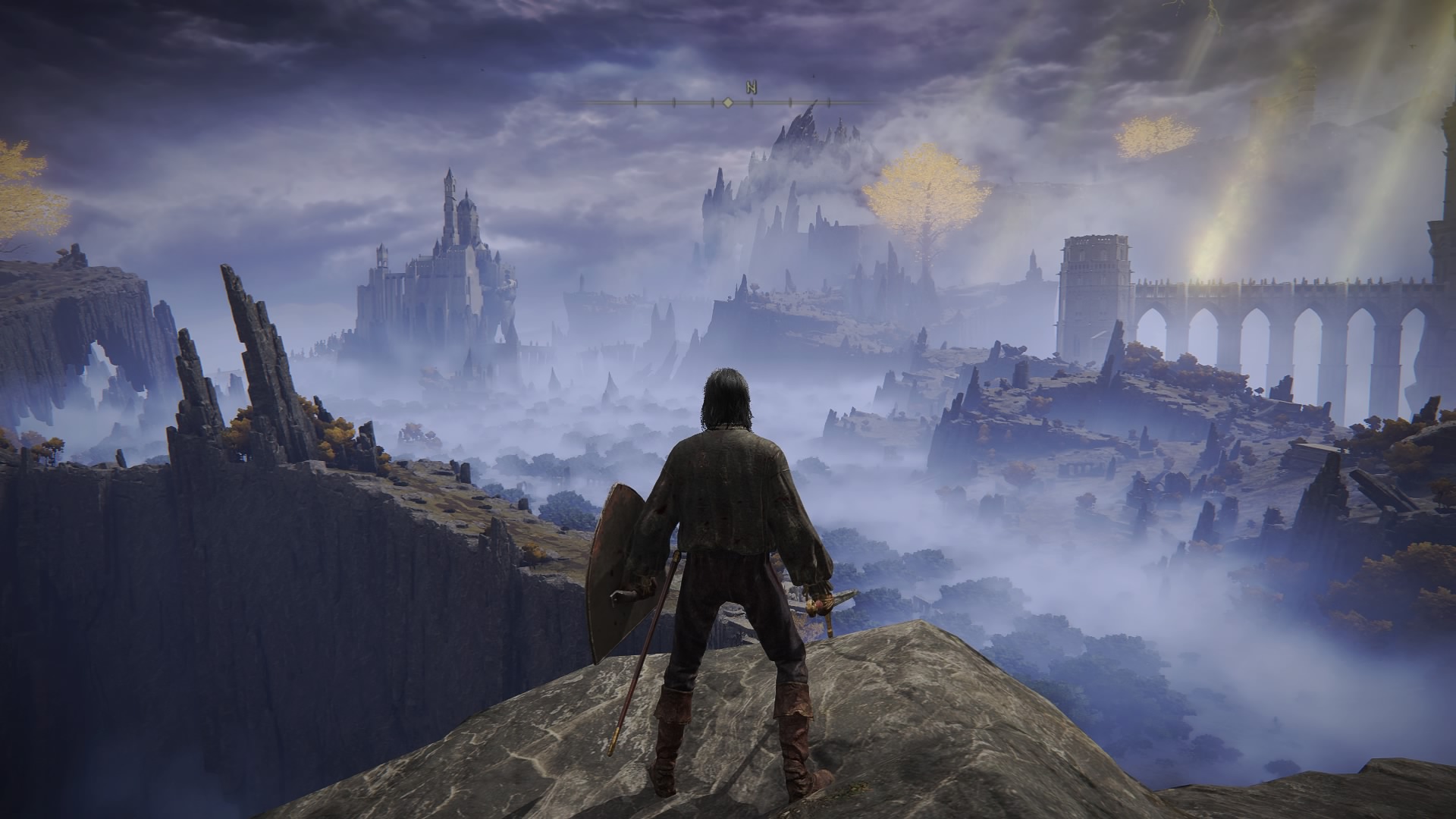
ELDEN RING™_20230207194711

Elden Ring, v. 1.09.1 (Tokyo: Bandai Namco, 2022), PlayStation 4, screenshot by author.


“Megatextual Kinaesthetics: The Wanderer above the Sea of Elden Ring

In the twenty-first century, the maximalist impulse evident in the big, ambitious novel of the twentieth century has expanded toward the creation of massively unreadable works across media, what Fest has elsewhere called megatexts. From experimental literary projects, to popular forms, to transmedia corporate intellectual property, megatexts abound in the twenty-first century and their presence in both avant-garde and corporate cultural production signals that the megatext is an emergent form native to the neoliberal era. Perhaps the most paradigmatic instance of this emerging form is the massive, open-world video game requiring hundreds of hours of playtime to traverse. In the video-game megatext, we see a form striving to create worlds, to build spaces large enough to feel comparable to our own.

In his talk, Fest will focus on FromSoftware’s blockbuster 2022 game Elden Ring as not only a paradigmatic video-game megatext but also the kind of sensorial-conceptual or theoretical text that Patrick Jagoda has recently suggested experimental games can be. Fest will argue that Elden Ring’s open world is an affective, bodily, material sensorium that presents to its players something like what big data feels like, allowing players to experience a haptics of hyperarchivalism, a spatiality of the database. In this way, rather than some monumentally time-sucking waste, Elden Ring might itself constitute a moment of respite, contemplation, and critical engagement with respect to the network society, a moment where the digital realities of contemporaneity, in all their hypermediated and interconnected totality might be critically felt, even if that feeling only occurs as the sensation of a concept.


For previous essays of mine on megatexts and unreadable texts, see:

“Toward a Theory of the Megatext: Speculative Criticism and Richard Grossman’s ‘Breeze Avenue Working Paper.’”

“‘Is an Archive Enough?’: Megatextual Debris in the Work of Rachel Blau DuPlessis.”

“Reading Now and Again: Hyperarchivalism and Democracy in Ranjan Ghosh and J. Hillis Miller’s Thinking Literature across Continents.”

“Writing Briefly about Really Big Things.”

“The Megatext and Neoliberalism.”

“The Time of Megatexts: Dark Accumulation and Mark Z. Danielewski’s The Familiar.”

MLA 2023: Twenty-First-Century Forms

For this year’s Modern Language Association Convention, to be held January 5–8, 2023 in San Francisco, California, I organized and will be speaking on a roundtable on Twenty-First-Century Forms, along with Daniel Burns, Zoe Bursztajn-Illingworth, Kathryn Harlan-Gran, Kevin Pyon, and Elizabeth Sotelo. I have included the information about the panel and, below that, full abstracts from each speaker.

197. Twenty-First-Century Forms

Friday, January 6, 2023, 8:30–9:45 a.m. (PST)

If one might argue that the novel and lyric poem have become residual forms, what literary forms are emerging in contemporaneity? Panelists explore emergent literary forms of the twenty-first century and their relationship with, instantiation in, or remediation by other (digital) media: film, documentary, social media, publishing platforms, transmedia, autotheory, and other hybrid narrative and poetic forms.

Speakers
Dan Burns (Elon University)
Bradley J. Fest (Hartwick College)
Zoe Bursztajn-Illingworth (The University of Texas at Austin)
Kathryn Harlan-Gran (Cornell University)
Kevin Pyon (Pennsylvania State University, Harrisburg)
Elizabeth Sotelo (University of Oregon)

Presiding
Bradley Fest (Hartwick College)

Continue reading

“Twenty-First-Century Forms” at MLA 2023

Richard Grossman, Torah Ball, 2011. Corundum sphere 5″ in diameter inscribed in Hebrew with the Ten Commandments currently buried inside Mount Princeton, Colorado, USA.

Given my ongoing interest in megatexts and other emerging hybrid and transmedia forms, I am organizing a second panel on emergent literary forms of the twenty-first-century for the 2023 Modern Language Association Convention in San Francisco, California (the first was at the 2021 MLA Convention). Please consider submitting an abstract to festb[at]hartwick[dot]edu by March 24, 2022. Here’s the CFP:

Twenty-First-Century Forms

If the novel and lyric poem might be considered residual forms, what literary forms are emerging in the twenty-first century? Panel on emergent literary forms: transmedia, digital, hybrid, remediated, megatexts, other. 250-word abstract, brief bio.

Recording of Twenty-First-Century Forms at MLA 2021

If you attended the virtual 2021 Modern Language Association Conference but were unable to come to the roundtable I organized, Twenty-First-Century Forms, you can watch a recording of it here (I believe for about six weeks). The speakers were (in order): myself, Amy Sara Carroll, Racheal Fest, Christian P. Haines, Hyemin Kim, and Eric Loy. For more information, see my previous post.

Links in the Time of Coronavirus, Vol. 8: October 16–November 15, 2020

The University of Pittsburgh is in the background.

Politics, Economics, and Trump

Jonathan Martin and Alexander Burns, “Biden Wins Presidency, Ending Four Tumultuous Years Under Trump.”

Daniel Strauss and Lauren Gambino, “Kamala Harris Makes History as First Woman of Color Elected US Vice President.”

Bill McKibben, “This Election Isn’t about the Next Four Years. It’s about the Next Four Millennia.”

Naomi Klein, “We Were Told Joe Biden Was the ‘Safe Choice.’ But It Was Risky to Offer so Little.”

Jelani Cobb, “The Election Is a Morality Play in Which Biden Must Defeat Not Only Trump but Trumpism.”

Astead W. Herndon, “Alexandria Ocasio-Cortez on Biden’s Win, House Losses, and What’s Next for the Left.”

Tom McCarthy, “Alexandria Ocasio-Cortez Ends Truce by Warning ‘Incompetent’ Democratic Party.”

Continue reading

MLA 2021: Twenty-First-Century Forms

For this year’s Modern Language Association Convention, to be held virtually from January 7–10, 2021, I organized and will be speaking on a roundtable on Twenty-First-Century Forms, along with Amy Sara Carroll, Racheal Fest, Christian P. Haines, Hyemin Kim, and Eric Loy. I have included the information about the panel and, below that, full abstracts from each speaker.

181. Twenty-First-Century Forms

Thursday, January 7, 2020, 7:00 – 8:15 p.m. (EST)

If the novel and lyric poem have become residual forms, what literary forms are emerging in contemporaneity? Participants explore emergent literary forms of the twenty-first century and their relationship with, instantiation in, or remediation by other (digital) media: film, television, video, graphic narrative, video games, transmedia, or other hybrid, novel, or megatextual forms.

Speakers
Amy Sara Carroll (U of California, San Diego)
Bradley Fest (Hartwick C)
Racheal Fest (State U of New York, Oneonta)
Christian Haines (Penn State U, University Park)
Hyemin Kim (Baruch C, City U of New York)
Eric Loy (U of Rochester)

Presiding
Bradley Fest (Hartwick C)


Continue reading

MLA 2020 Panel: Bad Books

At this year’s Modern Language Association Convention in Seattle (January 9-12, 2020), I will be speaking on a round table discussing Bad Books. I have included the information about the panel and a tentative abstract for the paper I will be presenting below.


338. Bad Books

Friday, January 10, 2020, 1:45-3:00 pm, 617 (WSCC)

Presiding: Eric Loy

Presentations:
1. “Notes on Notes on Notes: Glenn Ligon Reads James Baldwin,” Paul Benzon (Skidmore C)
2. “Books Behaving Badly: The Raison d’Être behind Perec’s La Disparition,” Priya Wadhera (Adelphi U)
3. “Debilitated Forms and Forms of Debility: On Writing a Failed Book,” Sharon Tran (U of Maryland Baltimore County)
4. “The Space of Megatexts: ‘Reading’ Mark Leach’s Marienbad My Love,” Bradley J. Fest (Hartwick C)


The Space of Megatexts: “Reading” Mark Leach’s Marienbad My Love

At over seventeen million words and consisting of seventeen volumes printed in dense eight-point font, the second edition of Mark Leach’s Marienbad My Love (2008; 2nd ed., 2013) currently holds the record as the world’s longest novel and is what I have elsewhere called a megatext. Composed over the course of thirty years using a number of digital techniques, the result is one of the more spatially imposing works of literature to ever sit on a shelf. Because of this, it also appears that no one has really bothered to read it. Whether this is due to some prejudice against self-publication or critics’ perceptions of authorial vanity, the sheer unreadable size of the text has discouraged anyone from taking Leach’s work all that seriously. I believe this is a mistake and this paper aims to seriously consider a remarkable project that rebelliously pushes against the conceptual, temporal, and physical boundaries of the codex novel. The revisions made to the second edition of the text indicate that not only does Leach intend for people to actually read his book, but also that Marienbad My Love is in fact a complex theoretical statement about the novel in the digital age and a meditation on the present and future of literary writing. In this paper, I will argue that accounting for Marienbad My Love’s material size by finding ways to speculatively (and actually) read this unreadable text will encourage us to rethink how we theorize the novel in the twenty-first century.


For previous essays of mine on megatexts and unreadable texts, see:

“Toward a Theory of the Megatext: Speculative Criticism and Richard Grossman’s ‘Breeze Avenue Working Paper.'”

“Reading Now and Again: Hyperarchivalism and Democracy in Ranjan Ghosh and J. Hillis Miller’s Thinking Literature across Continents.”

“Writing Briefly about Really Big Things.”

“The Megatext and Neoliberalism.”

“The Time of Megatexts: Dark Accumulation and Mark Z. Danielewski’s The Familiar.”

Summer 2019 Links

I had the privilege of meeting Richard Siken when I was quite young–an undergraduate at the University of Arizona–and he gave me lots of good advice on the poetry world (and life), conversations I still cherish. Please help him out.

Stroke Recovery Fund for Poet Richard Siken.


Nuclear and Environmental

Alenka Zupančič, “The Apocalypse Is (Still) Disappointing.”

James Livingston, “Time, Dread, Apocalypse Now.

Ted Nordhaus, “The Empty Radicalism of the Climate Apocalypse.”

Jessica Hurley and Dan Sinykin, eds., Apocalypse, special issue of ASAP/Journal.

Frame, Apocalypse.

Brad Plumer, “Humans Are Speeding Extinction and Altering the Natural World at an ‘Unprecedented’ Pace.”

Damian Carrington, “Why The Guardian Is Changing the Language It Uses about the Environment.”

Continue reading