Many September Links

As predicted, I have been quite busy indeed and have not had a chance to post anything over the past couple of weeks. A bunch of fascinating stuff has been happening, a bunch of interesting books are coming out, etc., so I’m sad that I’ve been remiss in my duties. Hopefully this large batch of links will make up for that.


Apocalypse and After

George Dvorsky, “Have Humans Already Conquered the Threat of Extinction?”

Or not. Graham Turner and Cathy Alexander, “Limits to Growth Was Right: New Research Shows We’re Nearing Collapse.”

One of the first reviews of Naomi Klein’s new book, This Changes Everything: Capitalism vs. the Climate.

Jessica Corbett and Ethan Corey, “5 Crucial Lessons for the Left from Naomi Klein’s New Book.”

Eric Holthaus, “New Study Links Polar Vortex to Climate Change.”

Eugene Thacker on Radiolab.

And who knows where to put this one: Alison Flood, “Margaret Atwood’s New Work Will Remain Unseen for a Century.”

Continue reading

The Salaita Affair and Other Links (and New Involvement in Iraq)

There have been many responses by notable people to the Steven G. Salaita issue. Corey Robin has a ton of links on the issue, including a tweet by Glenn Greenwald, and a piece by Peter Schmidt in The Chronicle of Higher Education. Former president of the MLA, Michael Bérubé, has written an open letter to Chancellor of the University of Illinois at Urbana-Champaign, Phyllis Wise. Cary Nelson, former president of the American Association of University Professors, has written a piece defending Wise’s decision. Some background on Nelson. John K. Wilson has criticized UIUC in “Fighting the Twitter Police.” Sarah T. Roberts, “Steven Salaita: The University of Illinois is not an Island.” And here’s a recent piece by Salaita himself on academic freedom, “The Definition of Academic Freedom, for Many, Does Not Accommodate Dissent.”

In other news:

Dwight Garner seems to think that David Shafer’s Whiskey Tango Foxtrot may be the book of the summer in “Maybe There’s a Whole Other Internet.”

In hyperarchival news, Monte Reel reports on “The Brazilian Bus Magnate Who’s Buying Up All the World’s Vinyl Records.”

And I’m starting to get the itch for the new semester:

Joshua Rothman, “What College Can’t Do.”

“Rogeting: Why ‘Sinister Buttocks’ Are Creeping into Students’ Essays.”

And, just breaking, President Obama has announced that he has authorized airstrikes and humanitarian aid in Iraq. The Washington Post has a transcript of the announcement.

August Links

Its been a couple weeks since I’ve posted any links, so there’s a bunch of stuff here.


Disaster, Nuclear, Environment, and Deep Futures

John Oliver on America’s Insecure Nuclear Arsenal.


Willie Osterweil, “The End of the World as We Know It.” On the reactionary politics in ancient apocalypse films.

Josh Marshall, “Disaster Porn, For Once for Real.”

Ross Andersen, “When We Peer Into the Fog of the Deep Future What Do We See–Human Extinction or a Future Among the Stars?”

Radical eco-nihilism. Wen Stephenson, “‘I Withdraw’: A Talk with Climate Defeatist Paul Kingsnorth.”

Paul Kingsnorth, “Confessions of a Recovering Environmentalist.”

Mark Strauss, “Space Junk Is Becoming a Serious Security Threat.”

Robert T. Gonzalez, “Bad News: Scientists Have Measured 16-Foot Waves in the Arctic Ocean.”

Nadia Prupis, “‘There Will Be No Water’ by 2040? Researchers Urge Global Energy Paradigm Shift.”

Continue reading

July Links

(It’s been a few weeks since I’ve posted links, so some of this is already pretty dated, but heck . . it’s also been a jam-packed couple of weeks in the news.)


Nuclear

Nina Strochlic, “Britain’s Nuke-Proof Underground City.”

Forthcoming book: Fabienne Colignon’s Rocket States: Atomic Weaponry and the Cultural Imagination.


Environment

Lindsay Abrams, “The Ocean Is Covered in a Lot Less Plastic Than We Thought–and That’s a Bad Thing.”

James West, “What You Need to Know About the Coming Jellyfish Apocalypse.”

Brad Plumer, “Oklahoma’s Earthquake Epidemic Linked to Wastewater Disposal.”

Continue reading

Notes from the Anthropocene: Insuring the Apocalypse and Other Links

Nuclear

More adventures in nuclear incompetence: Lily Hay Newman, “Air Force Security Failed a Takeover Drill at a Nuclear Silo.”


Climate Change, Catastrophe, and the Anthropocene

We’re doomed. “A Galaxy Far, Far Away . . . Will Hit Ours.”

Lindsay Abrams, “Researchers: The Collapse of Greenland’s Ice Sheet Could Be a Bigger Disaster Than We Thought.”

Ari Phillips, “In Landmark Class Action, Farmers Insurance Sues Local Government for Ignoring Climate Change.” Is that what we need? For the insurance companies to get involved?

Yes. McKenzie Funk, “Insuring the Apocalypse.”

Paul Krugman, “Cutting Back on Carbon.”

On the flooding in the Balkans.

Everything is the worst: Ryan Koronowski, “House Votes to Deny Climate Science and Ties Pentagon’s Hands on Climate Change.”

And scientists agree, we should just start calling climate change “You will be burnt to a crisp and die.”

Continue reading

A Few Links (with some Rimbaud and Melville)

David Hancock Turner has an interesting reflection on Margaret Atwood’s MaddAddam trilogy for Jacobin, titled “After the Flood.” He writes:

Atwood seems to intuit this and her emphasis on prefigurative forms of resistance only seems like a natural response to an overweening corporate dystopia. When the dream of revolutionary transformations seems so distant, why not at least have a taste of utopia in this world rather than toil amidst a rotten society and its artificial politics? Or does the workplace nevertheless remain the fundamental space of struggle, although now too removed or amorphous for us to recognize and rejuvenate its logic?

And what does it mean if Atwood transforms revolutionary praxis from labor activism into sabotage from the elite workers coupled with a strategy of refusal by an eclectic grouping of transients — two tactics we have recently witnessed in our own American society? The apocalypse that inhabits so much of our contemporary imagination is a signifier that the revolution and its classical preconditions are perhaps too difficult to dream.

And here’s an older review by Ursula K. Le Guin of The Year of the Flood (2009) in The Guardian.

My good friend, sculptor Taylor Baldwin, has a great write-up in Beautiful Decay, “Taylor Baldwin’s Assembled Madness.” A sample of his work, a couple of my favorite pieces.[1] [2]

Taylor Baldwin, The Interpret (2010).

Taylor Baldwin, The Interpreter (2010).
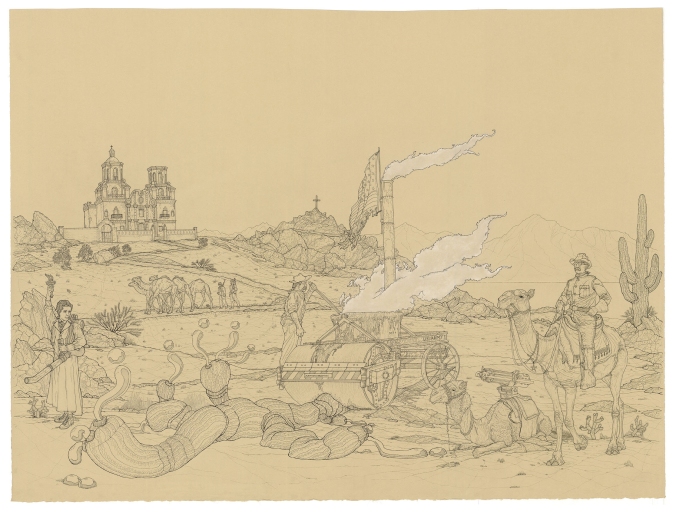
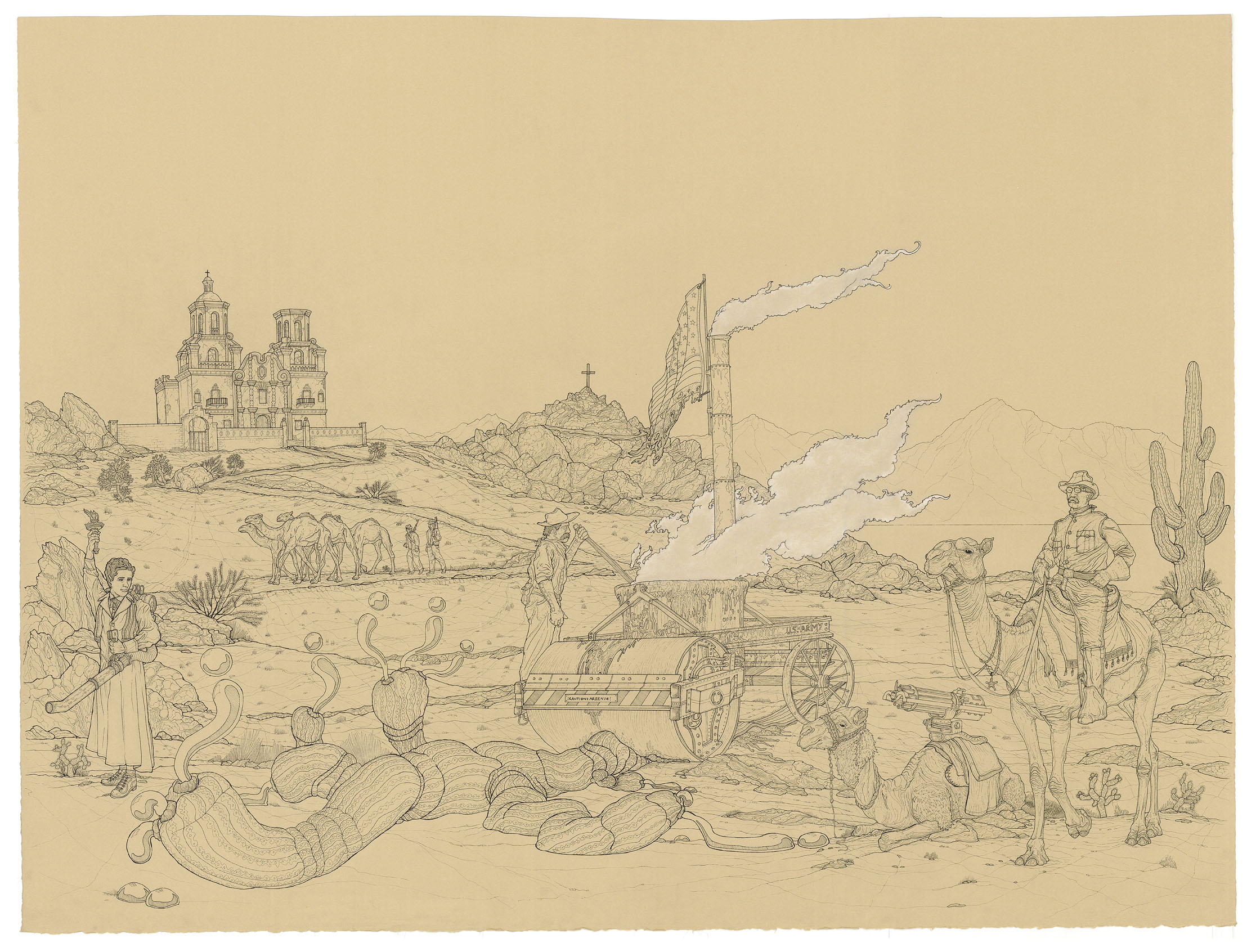
US Infantry Camel Corps (Feat. Emma Lazarus) (2007)

Taylor Baldwin, US Infantry Camel Corps (Feat. Emma Lazarus) (2007)

The Atlantic reports that “LOL and/or Lol! The Internet Has Style Guide Now: Sort Of.” Here’s the style guide at BuzzFeed.

Recent reports on the mega-text: “What You Learn About Tech from Watching all 456 Law and Order Episodes,” by Rebecca J. Rosen for The Atlantic.

And my friend Carolyn Kellogg reports that “Younger Book Dealers are Diving into the Antiquarian Trade” for The Los Angeles Times.


[1] Whenever I see Baldwin’s Interpreter (2010), I am always reminded of a few different lines from things. First: “I have seen the low sun stained with mystic horror, / Lit with long violet weals like actors / In some ancient play, waves unrolling / Their shuddering paddles into the distance. [. . .] And I, a boat lost in inlets’ tangled hair, / Tossed by hurricanes into birdless air, I / Whose water-drunken carcass Coast-Guard / And Hanseatic ships could not have dredged; // Free, on fire, crowned by violet mist, / I dug a hole in a reddening sky like a wall / Smeared with solar lichen and gobs / Of azure snot, irresistible poetic treats. [. . .] Bathed in your weary waves, I can no longer ride / In the wake of cargo ships of cotton, / Nor cross the pride of flags and flames, / Nor swim beneath the killing stare of prison ships” (Arthur Rimbaud, from “The Drunken Boat” (1871), in Rimbaud Complete, trans. and ed. Wyatt Mason [New York: The Modern Library, 2002], 86-88, here’s a different translation).

[2] And second:

To a landsman a calm is no joke. It not only revolutionizes his abdomen, but unsettles his mind; tempts him to recant his belief in the eternal fitness of things; in short, almost makes an infidel of him.

At first he is taken by surprise, never having dreamt of a state of existence where existence itself seems suspended. He shakes himself in his coat, to see whether it be empty or no. He closes his eyes, to test the reality of the glassy expanse. He fetches a deep breath, by way of experiment, and for the sake of witnessing the effect. If a reader of books, Priestly on Necessity occurs to him; and he believes in that old Sir Anthony Absolute to the very last chapter. His faith in Malte Brun, however, begins to fail; for the geography, which from boyhood he had implicitly confided in, always assured him, that though expatiating all over the globe, the sea was at least margined by land. That over against America, for example, was Asia. But it is a calm, and he grows madly skeptical.

To his alarmed fancy, parallels and meridians become emphatically what they are merely designated as being: imaginary lines drawn round the earth’s surface.

The log assures him that he is in such a place; but the log is a liar; for no place, nor any thing possessed of a local angularity, is to be lighted upon in the watery waste.

At length horrible doubts overtake him as to the captain’s competency to navigate his ship. The ignoramus must have lost his way, and drifted into the outer confines of creation, the region of everlasting lull, introductory to positive vacuity.

Thoughts of eternity thicken. He begins to feel anxious concerning his soul.

The stillness of the calm is awful. His voice beings to grow strange and portentous. He feels it in him like something swallowed too big for the esophagus. It keeps up a sort of involuntary humming in him, like a live beetle. His cranium is a dome full of reverberations. The hollows of his very bones are as whispering galleries. He is afraid to speak loud, lest he be stunned; like the man in the bass drum.

But more than all else is the consciousness of his utter helplessness. Succor or sympathy there is none. Penitence for embarking avails not. The final satisfaction of despairing may not be his with a relish. Vain the idea of idling out the calm. He may sleep if he can, or purposely delude himself into a crazy fancy, that he is merely at leisure. All this he may compass; but he may not lounge; for to lounge is to be idle; to be idle implies an absence of any thing to do; whereas there is a calm to be endured: enough to attend to, Heaven knows.

His physical organization, obviously intended for locomotion, becomes a fixture; for where the calm leaves him, there he remains. Even his undoubted vested rights, comprised in his glorious liberty of volition, becomes as naught. For of what use? He wills to go: to get away from the calm: as ashore he would avoid the plague. But he can not; and how foolish to revolve expedients. It is more hopeless than a bad marriage in a land where there is no Doctors’ Commons. He has taken the ship to wife, for better or for worse, for calm or for gale; and she is not to be shuffled off. With yards akimbo, she says unto him scornfully, as the old beldam said to the little dwarf:—“Help yourself.”

And all this, and more than this, is a calm.

(Herman Melville, Mardi and a Voyage Thither [1849], in Herman Melville: Typee, Omoo, Mardi, ed. G. Thomas Tanselle [New York: The Library of America, 1982], 669-670.)

Hyperarchival Realism, Surveillance, and the Control Society

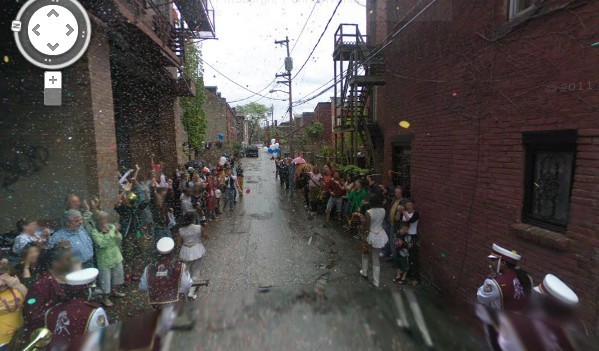
Christine Jun for Dazed Digital has posted an  A-Z list of some incredible contemporary art that engages with technologies of surveillance in “The dA-Zed Guide to Surveillance: Drones in the Sky, Whistleblowers in Jail: How Art is Responding to Big Brother’s Watch.” Of especial note is Robin Hewlett and Ben Kinsley‘s Street with a View, which was done a number of years ago while both were pursuing Master’s of Fine Arts degrees at Carnegie Mellon University, just down the street from me. I have met Ben a few times and had the opportunity to talk with him about this project while he was working on it. A pic (and a link to the Street with a View at Google maps):

Street with a View

I especially appreciate Hewlett and Kinsely’s hyperarchivally realist work here for integrating the archival processes of contemporaneity, the all-surveilling  eye of Google and their maps, the social and local residents of the area, and what in the end is pretty high-concept performance art. Simply wonderful. (And that they somehow got Google to come out and take part, all the better. I also probably should have posted something about Street with a View years ago, but I’m glad being pointed toward Dazed Digital‘s A-Z list reminded me of how excellent this happening was.)

Two Very Different Archives

David Pringle at a website devoted to the work of J.G. Ballard put up a list of the books Ballard read up until age 26. Pretty neat.

And did you hear? It’s official. Commercial art’s primary purpose is to collect data on you. Or at least that’s what Gawker is reporting about Jay-Z’s new album, Magna Carta Holy Grail. “It is not so much an album as a co-branded multimedia content delivery platform, Presented By Samsung™ Galaxy™ . . . . But now another, more unsettling use for the new album has become clear: It’s a massive data-mining operation. Fans used to obsess over album liner notes; now they freak out about terms-of-service.” Art used to be something we put in archives, museums, and libraries. Now it invades our home and puts us in archives. This is hyperarchival realism. Welcome to contemporaneity.

Repackaging the Archive (Part X): The Hyperarchivalism of the NSA’s Prism with Links

In a recently published essay, I have defined the term “hyperarchive” as “an archive whose goal, whether stated or not, can be seen in an attempt to gather together as many documents and texts as it can, regardless of content.”[1] This term clearly applies to the recent revelations about the National Security Agency’s (NSA) data collection. In fact, Prism may well be the best example of a hyperarchive to date (besides the Web). To not at least gesture toward talking about Prism and massive data collection on this blog would constitute gross negligence.

One of the things that this blog consistently tries to demonstrate, draw attention to, and complicate/challenge, is the relationship between technologies of destruction and accumulation, even if only by noting (and sometimes enacting) such relationships with little-to-no commentary. I have refrained from saying much about the recent and developing story about Prism and the NSA,[2] both because it seems too “obvious” and too complex. Prism is an accumulatory technology with clear dangers and evils (which I do not think I have to spell out). Some of these dangers and evils are quite old now, and quite familiar.[3] Others are just emerging, and the potential for misusing the kind of data collected by Prism appears to be limitless. Given the parameters of the hyperarchival impulse of contemporaneity, and the reality of ubiquitous access to massive amounts of information, it is not even vaguely surprising that the NSA has been amassing massive amounts of data. And obviously there is quite a bit wrong with this (part of which is the fact that Edward J. Snowden’s revelation is not surprising).

Glen Greenwald, the writer for TheGuardian who broke this story and has been consistently reporting on it, asked nearly a month ago, “Are All Telephone Calls Recorded and Accessible to the US Government?” Most of us have probably been asking this question for a number of years. The fact that we have been asking this question seriously, for a sustained amount of time,[4] only reinforces the realities of contemporary informatics: that many of us have always tacitly assumed that we were being watched, recorded, etc., pretty much all the time. The fact that we are not much, much more upset about this scandal is probably due to this reality of contemporaneity. Thus Snowden’s whistleblowing is functioning as a confirmation of what everyone always already knew: the emperor is naked, we know, are not pretending otherwise, and don’t seem to mind. This is disturbing, to say the least.[5]

Basically, the issues being raised by the NSA scandal, the implications for thinking about information, surveillance, discipline, and control, issues regarding archives and literature, technology and war, media and communication, contemporaneity and the risk society, immigration, the nation, and the state, are many. I will not dwell on them here, in hopes that thinking about these issues will take the form of an essay (hopefully destined for a more permanent home in a [slightly] different kind of archive). In lieu of more sustained reflection and further remarks, here is a pretty decent smattering of links related to the issue in (more-or-less) chronological order. I imagine I will continue to post links regarding Prism well into the future.

Continue reading