MLA 2025 Panel: Hypergraphia and Hypographia: Literary Maximalism and the Literature of Writer’s Block

At this year’s Modern Language Association Convention in New Orleans, LA (January 9-12, 2025), I will be speaking on a panel discussing Hypergraphia and Hypographia: Literary Maximalism and the Literature of Writer’s Block. I have included the information about the panel and a tentative abstract for the paper I will be presenting below.


65. Hypergraphia and Hypographia: Literary Maximalism and the Literature of Writer’s Block

Thursday, January 9, 2025, 1:45-3:00 pm, Windsor (Hilton Riverside New Orleans)

Presiding: Benjamin Bergholtz (Louisiana Tech U) and Aaron Colton (Emory U)

Presentations:
1. “‘No!—But I Must’: The Blocked Writer in Maximalist Fiction,” Benjamin Bergholtz (Louisiana Tech U) 
2. “The Craft of Writer’s Block: Autofiction, Process, and Pedagogy,” Aaron Colton (Emory U)
3. “Megatextual Kinaesthetics: The Wanderer above the Sea of Elden Ring,” Bradley Fest (Hartwick C) 
4. “Wallace’s Maximalism: Other-Flood and Self-Blockage,” Yonina Hoffman (US Merchant Marine Acad.)
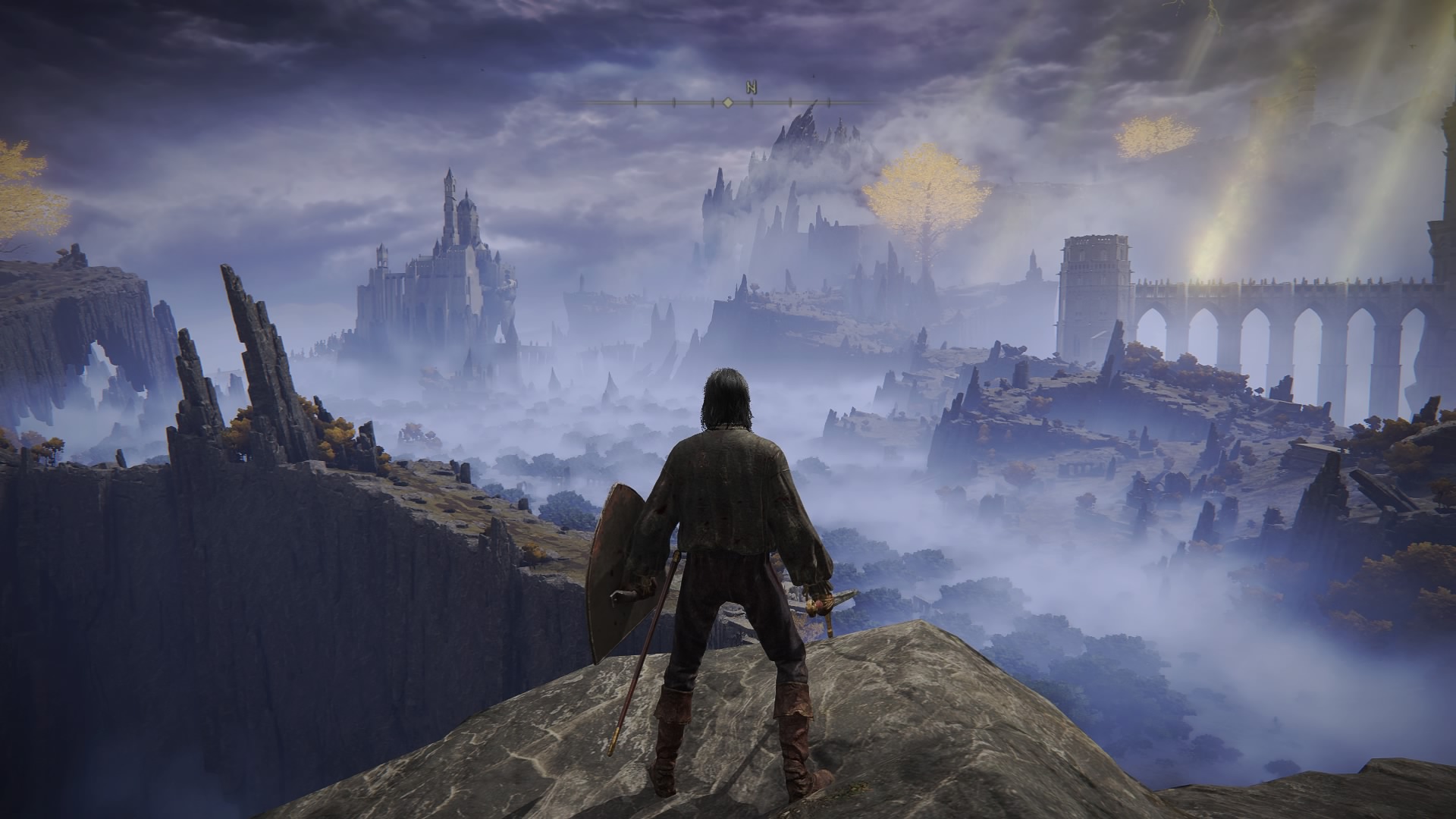
 

ELDEN RING™_20230207194711

Elden Ring, v. 1.09.1 (Tokyo: Bandai Namco, 2022), PlayStation 4, screenshot by author.


“Megatextual Kinaesthetics: The Wanderer above the Sea of Elden Ring

In the twenty-first century, the maximalist impulse evident in the big, ambitious novel of the twentieth century has expanded toward the creation of massively unreadable works across media, what Fest has elsewhere called megatexts. From experimental literary projects, to popular forms, to transmedia corporate intellectual property, megatexts abound in the twenty-first century and their presence in both avant-garde and corporate cultural production signals that the megatext is an emergent form native to the neoliberal era. Perhaps the most paradigmatic instance of this emerging form is the massive, open-world video game requiring hundreds of hours of playtime to traverse. In the video-game megatext, we see a form striving to create worlds, to build spaces large enough to feel comparable to our own.

In his talk, Fest will focus on FromSoftware’s blockbuster 2022 game Elden Ring as not only a paradigmatic video-game megatext but also the kind of sensorial-conceptual or theoretical text that Patrick Jagoda has recently suggested experimental games can be. Fest will argue that Elden Ring’s open world is an affective, bodily, material sensorium that presents to its players something like what big data feels like, allowing players to experience a haptics of hyperarchivalism, a spatiality of the database. In this way, rather than some monumentally time-sucking waste, Elden Ring might itself constitute a moment of respite, contemplation, and critical engagement with respect to the network society, a moment where the digital realities of contemporaneity, in all their hypermediated and interconnected totality might be critically felt, even if that feeling only occurs as the sensation of a concept.


For previous essays of mine on megatexts and unreadable texts, see:

“Toward a Theory of the Megatext: Speculative Criticism and Richard Grossman’s ‘Breeze Avenue Working Paper.’”

“‘Is an Archive Enough?’: Megatextual Debris in the Work of Rachel Blau DuPlessis.”

“Reading Now and Again: Hyperarchivalism and Democracy in Ranjan Ghosh and J. Hillis Miller’s Thinking Literature across Continents.”

“Writing Briefly about Really Big Things.”

“The Megatext and Neoliberalism.”

“The Time of Megatexts: Dark Accumulation and Mark Z. Danielewski’s The Familiar.”

MLA 2023: Twenty-First-Century Forms

For this year’s Modern Language Association Convention, to be held January 5–8, 2023 in San Francisco, California, I organized and will be speaking on a roundtable on Twenty-First-Century Forms, along with Daniel Burns, Zoe Bursztajn-Illingworth, Kathryn Harlan-Gran, Kevin Pyon, and Elizabeth Sotelo. I have included the information about the panel and, below that, full abstracts from each speaker.

197. Twenty-First-Century Forms

Friday, January 6, 2023, 8:30–9:45 a.m. (PST)

If one might argue that the novel and lyric poem have become residual forms, what literary forms are emerging in contemporaneity? Panelists explore emergent literary forms of the twenty-first century and their relationship with, instantiation in, or remediation by other (digital) media: film, documentary, social media, publishing platforms, transmedia, autotheory, and other hybrid narrative and poetic forms.

Speakers
Dan Burns (Elon University)
Bradley J. Fest (Hartwick College)
Zoe Bursztajn-Illingworth (The University of Texas at Austin)
Kathryn Harlan-Gran (Cornell University)
Kevin Pyon (Pennsylvania State University, Harrisburg)
Elizabeth Sotelo (University of Oregon)

Presiding
Bradley Fest (Hartwick College)

Continue reading

“‘Is an Archive Enough?’: Megatextual Debris in the Work of Rachel Blau DuPlessis” in Genre

My essay, “‘Is an Archive Enough?’: Megatextual Debris in the Work of Rachel Blau DuPlessis,” has been published in Genre: Forms of Discourse and Culture 54, no. 1 (April 2021): 139–65. This issue is the first of two special issues on “Big, Ambitious Novels by Twenty-First-Century Women,” edited by Courtney Jacobs and James Zeigler. The second issue will be released in July 2021. I also have an interview with DuPlessis forthcoming in boundary 2. I’ve included an abstract of my essay below, along with a table of contents.

I am particularly proud of this essay, as I wrote it predominantly during the summer of 2020–the height of lockdown–and during which we had no childcare and I couldn’t access the library nor my campus office, including its books. Lots of people to thank, consequently, but particularly Racheal Fest, Courtney Jacobs and James Zeigler for their hard work putting this together during an incredibly difficult year, Rachel Blau DuPlessis, and Dawn Baker, Hartwick’s interlibrary loan librarian. (There are more acknowledgments on the first page of my essay.) This essay is also the second published chapter from my work in progress, Too Big to Read: The Megatext in the Twenty-First-Century. For other related work on megatexts and hyperarchivalism, see:

“Toward a Theory of the Megatext: Speculative Criticism and Richard Grossman’s ‘Breeze Avenue Working Paper.’”

“Reading Now and Again: Hyperarchivalism and Democracy in Ranjan Ghosh and J. Hillis Miller’s Thinking Literature.”

“Coda: Writing Briefly about Really Big Things.”

“The Time of Megatexts: Dark Accumulation and Mark Z. Danielewski’s The Familiar.”
“The Megatext and Neoliberalism.”


Abstract

In the twenty-first century, digital technologies have made it possible for writers and artists to create massively unreadable works through computational and collaborative composition, what the author has elsewhere called megatexts. The ubiquity of texts appearing across media that are quite literally too big to read—from experimental novels to television, film, and video games—signals that the megatext is an emergent form native to the era of neoliberalism. But what happens to other long forms, such as the twentieth-century long poem, when written in an era of megatextuality? Rachel Blau DuPlessis’s work, including Drafts (1987–2013) and Traces, with Days (2017–), readily suggests itself as a case study for thinking through a megatextual impulse in the twenty-first-century long poem. Though her work is plainly indebted to its modernist precursors (H.D., Pound, Williams, etc.) while disavowing at every level of its composition a patriarchal will toward totality, DuPlessis’s various experiments in the long poem are also thoroughly contemporary and respond to the economic, military, political, and environmental transformations of the neoliberal era by drawing upon and producing fragmentary, megatextual debris. This essay positions DuPlessis’s work amidst a larger twenty-first-century media ecology, which includes both the megatext and the big, ambitious novel, and argues that rather than simply (and futilely) resist the neoliberal cultural logic of accumulation without end, DuPlessis hypertrophically uses the megatext’s phallogocentric form against itself in order to interrogate more broadly what it means—socially, culturally, economically—to write a long poem in the age of hyperarchival accumulation.


“Big, Ambitious Novels by Twenty-First-Century Women, Part 1,” Genre 54, no. 1 (April 2021).

James Zeigler, “Introduction: Big Novel Ambition without Apology.”

Maaheen Ahmed and Shiamin Kwa, “‘Kill the Monster!”: My Favorite Thing Is Monsters and the Big, Ambitious (Graphic) Novel.”

Patricia Stuelke, “Writing Refugee Crisis in the Age of Amazon: Lost Children Archive‘s Reenactment Play.”

Katarzyna Bartoszyńska, “Two Paths for the Big Book: Olga Tokarczuk’s Shifting Voice.”

Marjorie Worthington, “‘We’ll Make Magic’: Zen Writers and Autofictional Readers in A Tale for the Time Being.”

Siân White, “A ‘Hair-Trigger Society’ and the Woman Who Felt Something in Anna Burn’s Milkman.”

Bradley J. Fest, “‘Is an Archive Enough?’: Megatextual Debris in the Work of Rachel Blau DuPlessis.”

MLA 2021: Twenty-First-Century Forms

For this year’s Modern Language Association Convention, to be held virtually from January 7–10, 2021, I organized and will be speaking on a roundtable on Twenty-First-Century Forms, along with Amy Sara Carroll, Racheal Fest, Christian P. Haines, Hyemin Kim, and Eric Loy. I have included the information about the panel and, below that, full abstracts from each speaker.

181. Twenty-First-Century Forms

Thursday, January 7, 2020, 7:00 – 8:15 p.m. (EST)

If the novel and lyric poem have become residual forms, what literary forms are emerging in contemporaneity? Participants explore emergent literary forms of the twenty-first century and their relationship with, instantiation in, or remediation by other (digital) media: film, television, video, graphic narrative, video games, transmedia, or other hybrid, novel, or megatextual forms.

Speakers
Amy Sara Carroll (U of California, San Diego)
Bradley Fest (Hartwick C)
Racheal Fest (State U of New York, Oneonta)
Christian Haines (Penn State U, University Park)
Hyemin Kim (Baruch C, City U of New York)
Eric Loy (U of Rochester)

Presiding
Bradley Fest (Hartwick C)


Continue reading

Links in the Time of Coronavirus, Vol. 1: March 11–April 15, 2020

I originally intended in late May 2020, when the spring semester was finally over and I had some time to finish “Spring 2020 Links (Pre-COVID-19),” to post one big link dump for coronavirus-related things. But the hyperarchival barrage of news over the past three months, including everything that has happened in the United States the past three weeks (combined with how little time I still have . . .), has made it clear that it would be better to divide posts into smaller, more manageable bits. So here is everything I came across from March 11-April 15, 2020. More to come soon.

Sheri Fink and Mike Baker, “‘It’s Just Everywhere Already’: How Delays in Testing Set Back the US Coronavirus Response.”

The New York Times, “Coronavirus Map: Tracking the Global Outbreak,” “Coronavirus in the US: Latest Map and Case Count” and “Coronavirus Tips, Advice and Answers to Your New Questions.”

IHME, “COVID-19 Projections.”

Katie Zezima, Joel Achenbach, Tim Craig, and Lena H. Sun, “Coronavirus Is Shutting Down American Life as States Try to Battle Outbreak.”


Coronavirus Think Pieces (General)

Laurie Penny, “This Is Not the Apocalypse You Were Looking For.”

Naomi Klein, “Coronavirus Capitalism–and How to Beat It.”

Frank Pasquale, “Two Timelines of COVID Crisis.”

Ian Bogost, “Now Is the Time to Overreact.”

Arundhati Roy, “The Pandemic Is a Portal.”

Anne Applebaum, “The Coronavirus Called America’s Bluff.”

Dan Kois, “America Is a Sham.”

Continue reading

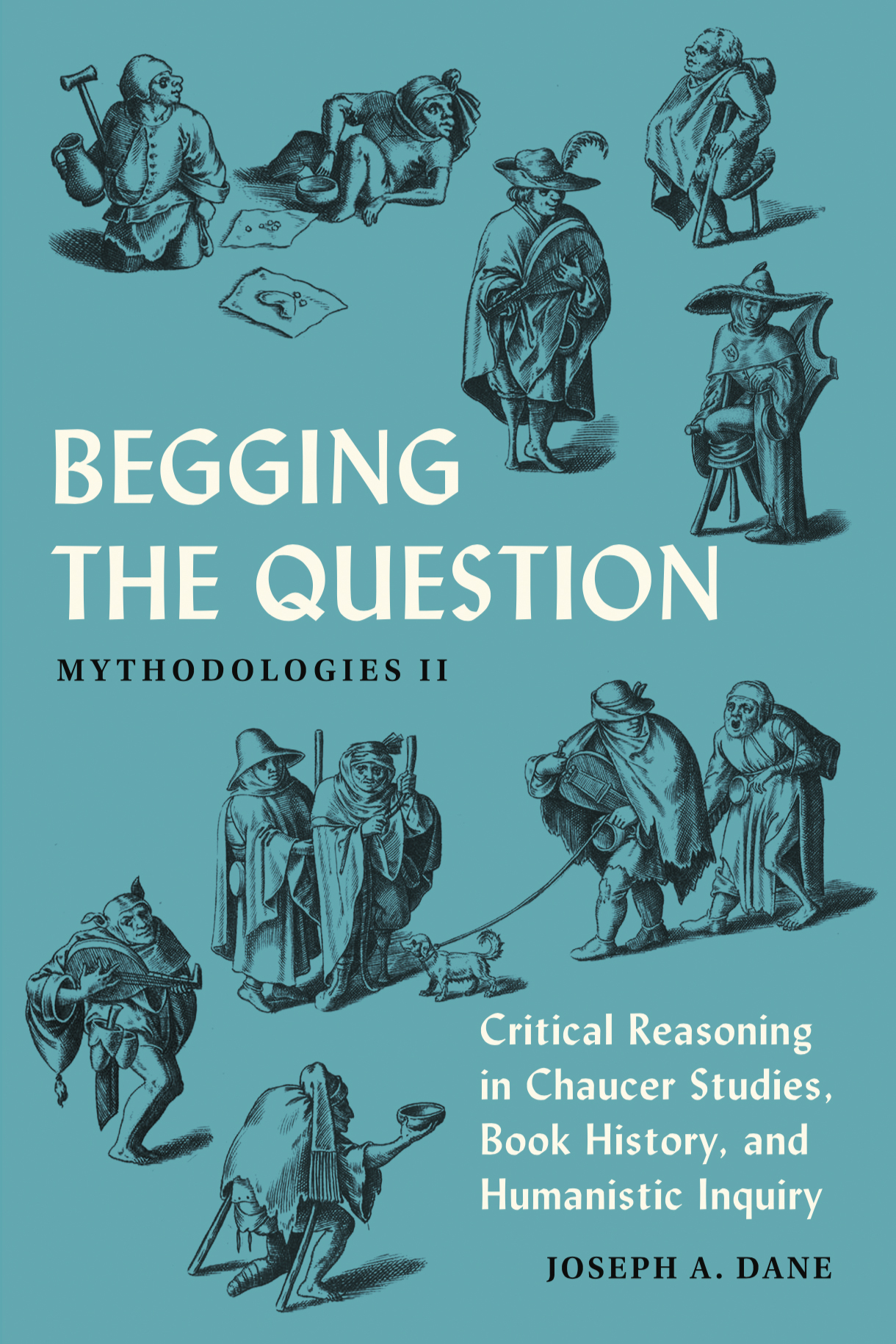
“Writing Briefly about Really Big Things” in Joseph A. Dane’s Begging the Question

I have a collaborative essay, “Coda: Writing Briefly about Really Big Things,” in Joseph A. Dane‘s new book, Begging the Question: Critical Reasoning in Chaucer Studies, Book History, and Humanistic Inquiry (Mythodologies II) (Marymount Institute Press, 2019). Though brief, it speaks to some of the ongoing concerns in my megatext project, particularly how to situate the project in the field and in conversation with others. My thanks to Dane for inviting me to collaborate with him on this and including my piece in his book.

“Reading Now and Again” in CounterText

Publication CoverMy essay, “Reading Now and Again: Hyperarchivalism and Democracy in Ranjan Ghosh and J. Hillis Miller’s Thinking Literature across Continents,” has been published in CounterText: A Journal for the Study of the Post-Literary in the the second of two special issues devoted to Ghosh and Miller’s book. The first issue is available here, and the second has an interview with Miller available from behind the paywall. I’ve included an abstract of my essay below, along with a table of contents.

Abstract:  This review essay approaches Ranjan Ghosh and J. Hillis Miller’s Thinking Literature across Continents (Duke UP, 2016) from a set of questions about what it means to read in the age of hyperarchival accumulation. Written against the background of events in the United States and elsewhere during the fall of 2017, the essay tracks and assesses Ghosh and Miller’s differing methods for approaching literary study in the twenty-first century: undiscriminating catholicity and rhetorical reading, respectively. Through emblematic readings of David Foster Wallace’s novel The Pale King (2011), the videogame Katamari Damacy (2004), and Amy Hungerford’s Making Literature Now (2016), this essay argues that Thinking Literature across Continents self-reflexively models and performs the interested, situated reading practices necessary for continuing the never-ending project of encountering, sharing, accounting for, learning from, and contending with others and their divergent readings, practices that, though many may have lost sight of them today, are fundamental to the project of democracy itself.


“Thinking Literature Across . . . II,” special issue, CounterText, table of contents:

Ivan Callus and James Corby, “Editorial.”

J. Hillis Miller, Ivan Callus, and James Corby, “The CounterText Interview: J. Hillis Miller.”

Bradley J. Fest, “Reading Now and Again: Hyperarchivalism and Democracy in Ranjan Ghosh and J. Hillis Miller’s Thinking Literature across Continents.”

Simona Sawhney, “Boatmen, Wastrels, and Demons: Figures of Literature.”

Jakob Lothe, “The Author’s Ethical Responsibility and the Ethics of Reading.”

Jonathan Locke Hart, “Ideas of Poetics and the Close Reading of Poetry.”

Shaobo Xie, “Does Literature Matter Today? Thoughts of the Outside.”

Kirk Kenny and James Corby, “Screens of Fortune: A Photo-Essay.”

Timothy Mathews, “The Many Hands of Thick Time: William Kentridge at the Whitechapel Gallery.”

Review of The Rocking Chair

My debut poetry collection, The Rocking Chair (Blue Sketch, 2015), just received its first review by Mike Good in volume 53, no. 2 of the Hollins Critic (their website). Though not available online, I was able to access it through my library and the AcademicOne File database, and a print copy looks like it should be available shortly for order.

An excerpt: “The poem’s content reaches often and expansively, shifting from personal narrative, classics, baseball, to philosophy, politics, pop-culture, sci-fi, western, geology, mathematics, and academic double-speak, sometimes in the span of a single sequence. . . . While annotations across a book-length outline of a poem might deter even the most intrepid reader, in the end, Fest’s debut is heartfelt, entertaining, and laugh-out-loud funny. . . . [It] appears to be an invention to tame, preserve, and organize culture’s excess, but evades easy definition” (19).

End of the Semester Links, Spring 2016

Nuclear and Environmental

Justin Gillis, “Scientists Warn of Perilous Climate Shift Within Decades, Not Centuries.”

Ross Andersen, “We’re Underestimating the Risk of Human Extinction.”

Matthew Schneider-Mayerson, “On Extinction and Capitalism.”

Robert Macfarlane, “Generation Anthropocene.”

Will Worley, “Radioactive Wild Boar Rampaging around Fukushima Nuclear Site.”

Rebecca Evans, “Weather Permitting.”

Continue reading

Beginning of the Semester Links

Now that the semester is starting, I will have less time to read things on the internet. So here’s one last link dump for the summer.


Nuclear and Environment

Maria Temming, “Geoengineering Won’t Save Us: Why It Can’t Halt the Effects of Climage Change by Itself.”

Claire L. Evans, “Climate Change Is so Dire We Need a New Kind of Science Fiction to Change It.”

Alan Taylor, “A World without People.”

Bill McKibben, “The Pope and the Planet.”

Mark Soderstrom, “Unequal Universes.”

And Kenneth Chang, “World Will not End Next Month, NASA Says.”

Brandon Shimoda, ed., The Volta, no. 56, and April Naoko Heck, “Dispatch from Hiroshima.”

Sam Stein, “July Was The Hottest Month Ever; Cable News Barely Noticed.”

Continue reading