I am honored to have received this year’s Schachterle Prize from The Society for Literature, Science, and the Arts for my essay, “The Inverted Nuke in the Garden: Anti-Eschatology and Archival Emergence in David Foster Wallace’s Infinite Jest,” which appeared in the Fall 2012 issue of boundary 2. This year’s conference was nothing short of incredible, and it remains one of the most vibrant, stimulating, and humbling conferences I have attended. I will probably post my own paper from the conference in a few days.
David Foster Wallace
A Poem for DFW
Poet Robin Clarke, a friend and colleague, has a tumblr/blog (called burghforoneto), and she recently wrote and posted a fantastic poem for David Foster Wallace. Check it.
The Year of DFW, According to Some
Now that it’s been pointed out by Michael Moats at Fiction Advocate, I’m realizing the gaggle of David Foster Wallace-related stuff that happened in 2012. The great deal of material that has appeared this year that is in some way connected to DFW has inspired Moats to title his (incomplete . . .) encyclopedic recounting of all this stuff, the “Year of David Foster Wallace” (part 2 is here).
Matt Bucher, administrator of the wallace-l listserv, also weighed in with, “Consider the Year of David Foster Wallace.”
To be honest, however, I don’t necessarily see this trend slowing down too considerably in 2013, as, for example, DFW’s name was mentioned a number of times in Joel Lovell’s recent review-essay in The New York Times, “George Saunders Has Written the Best Book You’ll Read This Year” (a book, titled The Tenth of December, that I very much look forward to reading). Bucher also points out that that we will probably be receiving at least 4 more books that revolve in the DFW orbit in 2013.
Though posted in November, I want to draw attention to Chris Osmond also briefly reflecting on DFW’s pedagogy in his blog post, “Hideous Teachers.” Beginning another semester of SC today where my students will be reading DFW (yet again) makes me realize how valuable his writing can be in the classroom.
“The Inverted Nuke in the Garden: Archival Emergence and Anti-Eschatology in David Foster Wallace’s Infinite Jest”
The fall 2012 issue of boundary 2 is now available online. It contains my article, “The Inverted Nuke in the Garden: Archival Emergence and Anti-Eschatology in David Foster Wallace’s Infinite Jest.” (Requires university access.) Here’s a link to the abstract.

Irony, Archives, and (Dubious) Posthumanism
I’m currently discussing DFW’s “E Unibus Pluram: Television and U.S. Fiction”[1] with my freshman English class, and so of course it was quite appropriate that Christy Wampole just wrote an opinion piece in Saturday’s New York Times, “How to Live Without Irony.”
To address this issue, the Wikimedia Foundation is collaborating with JSTOR, a service of the not-for-profit organization ITHAKA, to provide 100 of the most active Wikipedia editors with free access to the complete archive collections on JSTOR, including more than 1,600 academic journals, primary source documents and other works. The authors who will receive accounts have collectively written more than 100,000 Wikipedia articles to date. Access to JSTOR, which is one of the most popular sources on English Wikipedia, will allow these editors to further fill in the gaps in the sum of all human knowledge.
And The New Yorker has a piece by Gary Marcus on “Ray Kurzweil’s Dubious New Theory of Mind.”
[1] There are two things to note about this link: 1) it links to a .pdf of the original Review of Contemporary Fiction piece from 1993, so is (perhaps) slightly different than its final appearance in A Supposedly Fun Thing I’ll Never Do Again (1997), and 2) it is dedicated to “M.M. Karr” (Mary Karr), which takes on all sorts of different significances in the wake of Max’s biography of DFW.
D.T. Max on His DFW Biography
Just found this nice little clip today:
“Then Out of the Rubble”: The Apocalypse in David Foster Wallace’s Early Fiction
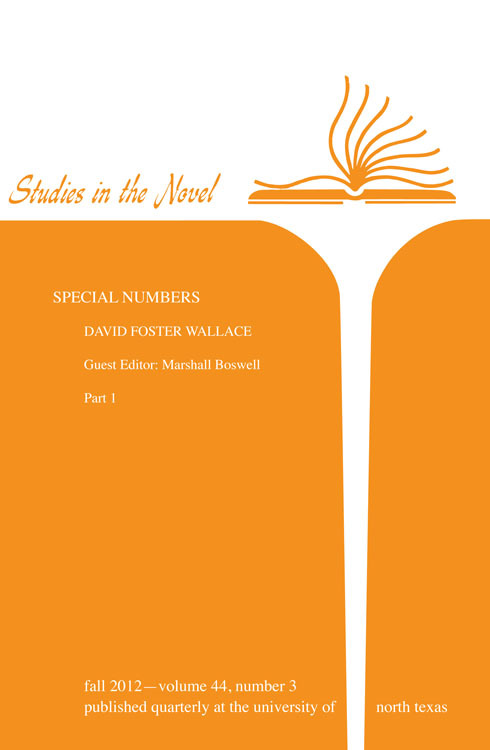
I just received in the mail today the first volume of the two-part special issue Studies of the Novel is devoting to the novels of David Foster Wallace, edited by Marshall Boswell, in which my essay, “‘Then Out of the Rubble’: The Apocalypse in David Foster Wallace’s Early Fiction,” appears. Check it out (esp. if you have Project Muse access). There are some excellent other essays from Allard den Dulk, David Letzler, Adam Kelly, and Philip Sayers as well.
In More Contemporary Nuclear News (and Other Stuff)
Helene Cooper and Mark Landler reported in The New York Times yesterday that, “The United States and Iran have agreed in principle for the first time to one-on-one negotiations over Iran’s nuclear program, according to Obama administration officials, setting the stage for what could be a last-ditch diplomatic effort to avert a military strike on Iran.” Pretty interesting, esp. coming right before the debate, and that “Iranian officials have insisted that the talks wait until after the presidential election [. . .] telling their American counterparts that they want to know with whom they would be negotiating.” Yet another chink of armor for President Obama’s foreign policy CV? A cynical move for tomorrow night’s debate? Very, very interesting.
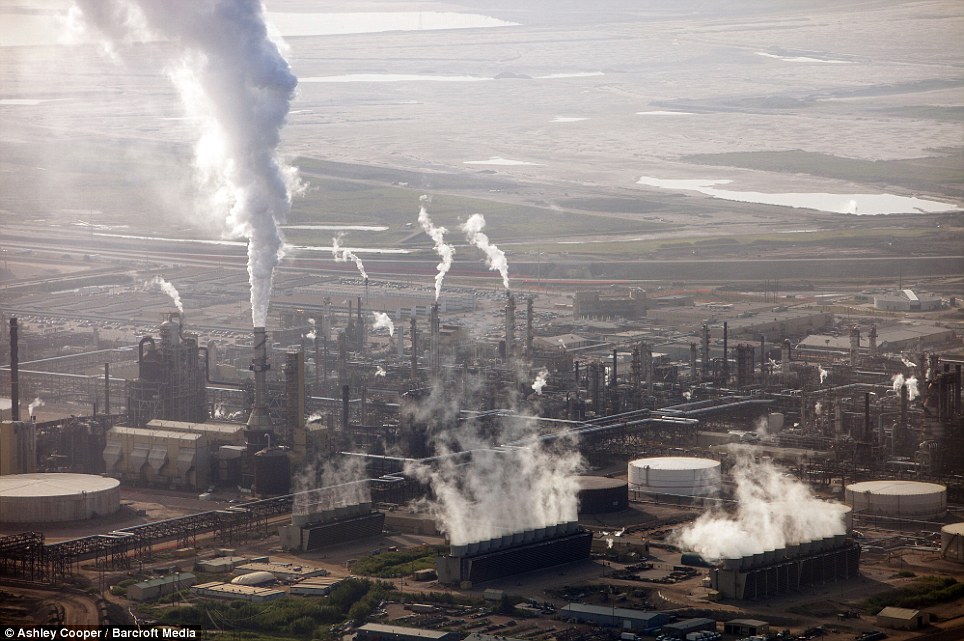
A truly horrifying group of images from the strip mining of Canada’s Tar Sands. A sample:
And a whole class being taught on David Foster Wallace at the John Adams Institute in Amsterdam. (Also, thought I’d relink to this class on DFW taught by Kathleen Fitzpatrick at Pomona College in the Spring of 2009.)
Forthcoming Publications on David Foster Wallace
Two articles I’ve written on David Foster Wallace should be published any day now:
“The Inverted Nuke in the Garden: Archival Emergence and Anti-Eschatology in David Foster Wallace’s Infinite Jest,” boundary 2 39.3 (Fall 2012), was just announced along w/ the rest of the Table of Contents over at boundary 2‘s blog.
And my article, “‘Then Out of the Rubble’: The Apocalypse in David Foster Wallace’s Early Fiction,” Studies in the Novel 44.3 (Fall 2012): 284-303, was just announced on Studies in the Novel‘s website. The abstracts for all the articles of this special issue on Wallace, edited by Marshall Boswell, were also posted.
I’m pretty excited about both of these, and each issue looks to contain some pretty interesting work that I’m eager to read. I will provide links to my articles’ electronic/Project Muse versions when they become available.
Mary Karr on DFW
Poetry magazine published a poem by Mark Karr last month addressing her relationship w/ DFW, “Suicide’s Note: An Annual.” Quite the read. (I’m also randomly teaching her introduction to The Waste Land later this week, “How to Read The Waste Land So It Alters Your Soul Rather Than Just Addling Your Head.”)
 The Hyperarchival Parallax