I’m delighted to have “c o n t e m p o r a n e i t y,” “Silence,” and “Blason IV,” poems from my current project, Postrock, in the first issue of Version (9) (Summer 2021), a magazine exploring theory in contemporary poetry.
Bradley J. Fest
“‘Is an Archive Enough?’: Megatextual Debris in the Work of Rachel Blau DuPlessis” in Genre

Courtney Jacobs and James Zeigler, eds., “Big, Ambitious Novels by Twenty-First-Century Women, Part 1” special issue, Genre 54, no. 1 (April 2021).
My essay, “‘Is an Archive Enough?’: Megatextual Debris in the Work of Rachel Blau DuPlessis,” has been published in Genre: Forms of Discourse and Culture 54, no. 1 (April 2021): 139–65. This issue is the first of two special issues on “Big, Ambitious Novels by Twenty-First-Century Women,” edited by Courtney Jacobs and James Zeigler. The second issue will be released in July 2021. I also have an interview with DuPlessis forthcoming in boundary 2. I’ve included an abstract of my essay below, along with a table of contents.
I am particularly proud of this essay, as I wrote it predominantly during the summer of 2020–the height of lockdown–and during which we had no childcare and I couldn’t access the library nor my campus office, including its books. Lots of people to thank, consequently, but particularly Racheal Fest, Courtney Jacobs and James Zeigler for their hard work putting this together during an incredibly difficult year, Rachel Blau DuPlessis, and Dawn Baker, Hartwick’s interlibrary loan librarian. (There are more acknowledgments on the first page of my essay.) This essay is also the second published chapter from my work in progress, Too Big to Read: The Megatext in the Twenty-First-Century. For other related work on megatexts and hyperarchivalism, see:
“Coda: Writing Briefly about Really Big Things.”
“The Time of Megatexts: Dark Accumulation and Mark Z. Danielewski’s The Familiar.”
“The Megatext and Neoliberalism.”
Abstract
In the twenty-first century, digital technologies have made it possible for writers and artists to create massively unreadable works through computational and collaborative composition, what the author has elsewhere called megatexts. The ubiquity of texts appearing across media that are quite literally too big to read—from experimental novels to television, film, and video games—signals that the megatext is an emergent form native to the era of neoliberalism. But what happens to other long forms, such as the twentieth-century long poem, when written in an era of megatextuality? Rachel Blau DuPlessis’s work, including Drafts (1987–2013) and Traces, with Days (2017–), readily suggests itself as a case study for thinking through a megatextual impulse in the twenty-first-century long poem. Though her work is plainly indebted to its modernist precursors (H.D., Pound, Williams, etc.) while disavowing at every level of its composition a patriarchal will toward totality, DuPlessis’s various experiments in the long poem are also thoroughly contemporary and respond to the economic, military, political, and environmental transformations of the neoliberal era by drawing upon and producing fragmentary, megatextual debris. This essay positions DuPlessis’s work amidst a larger twenty-first-century media ecology, which includes both the megatext and the big, ambitious novel, and argues that rather than simply (and futilely) resist the neoliberal cultural logic of accumulation without end, DuPlessis hypertrophically uses the megatext’s phallogocentric form against itself in order to interrogate more broadly what it means—socially, culturally, economically—to write a long poem in the age of hyperarchival accumulation.
“Big, Ambitious Novels by Twenty-First-Century Women, Part 1,” Genre 54, no. 1 (April 2021).
James Zeigler, “Introduction: Big Novel Ambition without Apology.”
Maaheen Ahmed and Shiamin Kwa, “‘Kill the Monster!”: My Favorite Thing Is Monsters and the Big, Ambitious (Graphic) Novel.”
Patricia Stuelke, “Writing Refugee Crisis in the Age of Amazon: Lost Children Archive‘s Reenactment Play.”
Katarzyna Bartoszyńska, “Two Paths for the Big Book: Olga Tokarczuk’s Shifting Voice.”
Marjorie Worthington, “‘We’ll Make Magic’: Zen Writers and Autofictional Readers in A Tale for the Time Being.”
Siân White, “A ‘Hair-Trigger Society’ and the Woman Who Felt Something in Anna Burn’s Milkman.”
Bradley J. Fest, “‘Is an Archive Enough?’: Megatextual Debris in the Work of Rachel Blau DuPlessis.”
“2016.29” and “2016.30” in Matter
“2016.29” and “2016.30,” more sonnets from my ongoing sequence, have been published in issue 29 of Matter.
“2015.10,” “2015.23,” and “2016.10” in The Babel Tower Notice Board
“2015.10,” “2015.23,” and “2016.10,” sonnets from my ongoing sequence, have been posted to the The Babel Tower Notice Board.
Spring Semester 2021: Syllabi
 During another unconventional spring, I’m revisiting an introductory course I taught frequently at the University of Pittsburgh (ENGLIT 0500 Introduction to Critical Reading) and reprising two creative writing courses. The syllabi:
ENGL 190 Introduction to Textual Analysis and Criticism
Recording of Twenty-First-Century Forms at MLA 2021
If you attended the virtual 2021 Modern Language Association Conference but were unable to come to the roundtable I organized, Twenty-First-Century Forms, you can watch a recording of it here (I believe for about six weeks). The speakers were (in order): myself, Amy Sara Carroll, Racheal Fest, Christian P. Haines, Hyemin Kim, and Eric Loy. For more information, see my previous post.
“2020.01,” “2020.02,” “2020.03,” “2020.04,” “2020.05,” and “2020.06” in Always Crashing
I didn’t get a lot of writing done this year, but some of the little I did is out today near its close. I am thrilled and honored to have the first of my pandemic sonnets—“2020.01,” “2020.02,” “2020.03,” “2020.04,” “2020.05,” and “2020.06”—in the online arm of Always Crashing. I also had important poems from the sonnet project, including the “long sonnet” “2016.36: Preface,” out in issue three of Always Crashing earlier this year. Thanks so much to the editors’ ongoing support of my work and this project.
“2015.09,” “2016.27,” “2018.01,” “2019.01,” and “2019.02” in Call Me [Brackets]
“2015.09,” “2016.27,” “2018.01,” “2019.01,” and “2019.02,” sonnets from my ongoing sequence, are in the fifth issue of Call Me [Brackets], “Chaos.”
“Dead Horse Bay” and “Archives of Winter” in Poetics for the More-than-Human World Anthology
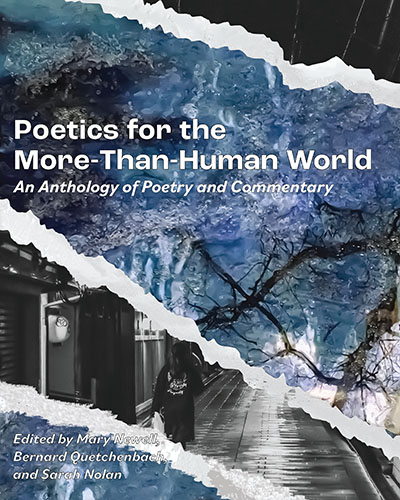 “Dead Horse Bay” and “Archives of Winter,” poems from my current ongoing project, Postrock, have been reprinted in Poetics for the More-than-Human World: An Anthology of Poetry and Commentary, edited by Mary Newell, Bernard Quetchenbach, and Sarah Nolan and published by Spuyten Duyvil.
The anthology was originally published online as a special issue of Dispatches from the Poetry Wars: “Poetics for the More-than-Human World: An Anthology of Poetry and Commentary.” Other contributors include Rae Armantrout, Rachel Blau DuPlessis, Jane Hirshfield, Cynthia Hogue, Angela Hume, Michael McClure, John Shoptaw, Stephanie Strickland, Harriet Tarlo, Edwin Torres, and many, many others.
Fall Semester 2020: Syllabi
This unconventional fall, I’m revisiting two creative writing courses I’ve frequently taught at Hartwick College, though in a hybrid face to face/online mode. The syllabi:

