Delighted to have “2023.26,” “2023.27,” and “2023.28” from my ongoing sonnet sequence in the third issue of Magazine1.
Bradley Fest
Fall Semester 2024: Syllabi

I was so busy this fall semester that I forgot to post syllabi for my classes! Here they are. I’m particularly proud of the work my students did in my department’s senior seminar for this year: ENGL 470 Mark Z. Danielewski’s The Familiar.
ENGL 213 Introduction to Creative Writing
“2023.32” in Cleaver
Thanks so much to Cleaver for publishing another sonnet from my ongoing sequence, “2023.32,” in their forty-eighth issue.
Reading at CANO’s Writers Salon

I recently published a book, 2013–2017: Sonnets (LJMcD Communications, 2024), the first in an ongoing sonnet sequence. I have written the next book in the sequence, 2018–2024: Sonnets, and I’ve started the third, 2024–20XX: Sonnets, and I will be reading poems from these two most recent projects at 7:30 p.m. on Thursday, November 21, 2024 at the Community Arts Network of Oneonta (CANO)’s Writers Salon at the Wilber Mansion on 11 Ford Ave. I promise a poem about the election (writing it right now).
“2023.21,” “2023.22/24,” and “2023.25” in Broken Lens Journal
Thanks so much to Broken Lens Journal for publishing some new sonnets in their ninth issue: “2023.21,” “2023.22/24,” and “2023.25.”
If you’re in Oneonta and want to hear some more poems from the manuscript these come from, stop by CANO’s Writers Salon on November 21.
“2022.11,” “2023.01,” “2023.11,” “2023.12,” “2023.13,” and “2023.14” in Pamenar Online Magazine
I am thrilled to have poems in Pamenar Online Magazine again! Check out: “2022.11,” “2023.01,” “2023.11,” “2023.12,” “2023.13,” and “2023.14.” Thanks to Ghazal Mosadeq for her support and the amazing journal and press she and her team have put together.
If you’re in Oneonta and want to hear some more poems from the manuscript these come from, stop by CANO’s Writers Salon on November 21. I’ll also be reading from 2013–2017: Sonnets on Wednesday, September 25 for Hartwick College’s Visiting Writers Series.
MLA 2025 Panel: Hypergraphia and Hypographia: Literary Maximalism and the Literature of Writer’s Block
At this year’s Modern Language Association Convention in New Orleans, LA (January 9-12, 2025), I will be speaking on a panel discussing Hypergraphia and Hypographia: Literary Maximalism and the Literature of Writer’s Block. I have included the information about the panel and a tentative abstract for the paper I will be presenting below.
65. Hypergraphia and Hypographia: Literary Maximalism and the Literature of Writer’s Block
Thursday, January 9, 2025, 1:45-3:00 pm, Windsor (Hilton Riverside New Orleans)
Presiding: Benjamin Bergholtz (Louisiana Tech U) and Aaron Colton (Emory U)
Presentations:
1. “‘No!—But I Must’: The Blocked Writer in Maximalist Fiction,” Benjamin Bergholtz (Louisiana Tech U)
2. “The Craft of Writer’s Block: Autofiction, Process, and Pedagogy,” Aaron Colton (Emory U)
3. “Megatextual Kinaesthetics: The Wanderer above the Sea of Elden Ring,” Bradley Fest (Hartwick C)
4. “Wallace’s Maximalism: Other-Flood and Self-Blockage,” Yonina Hoffman (US Merchant Marine Acad.)
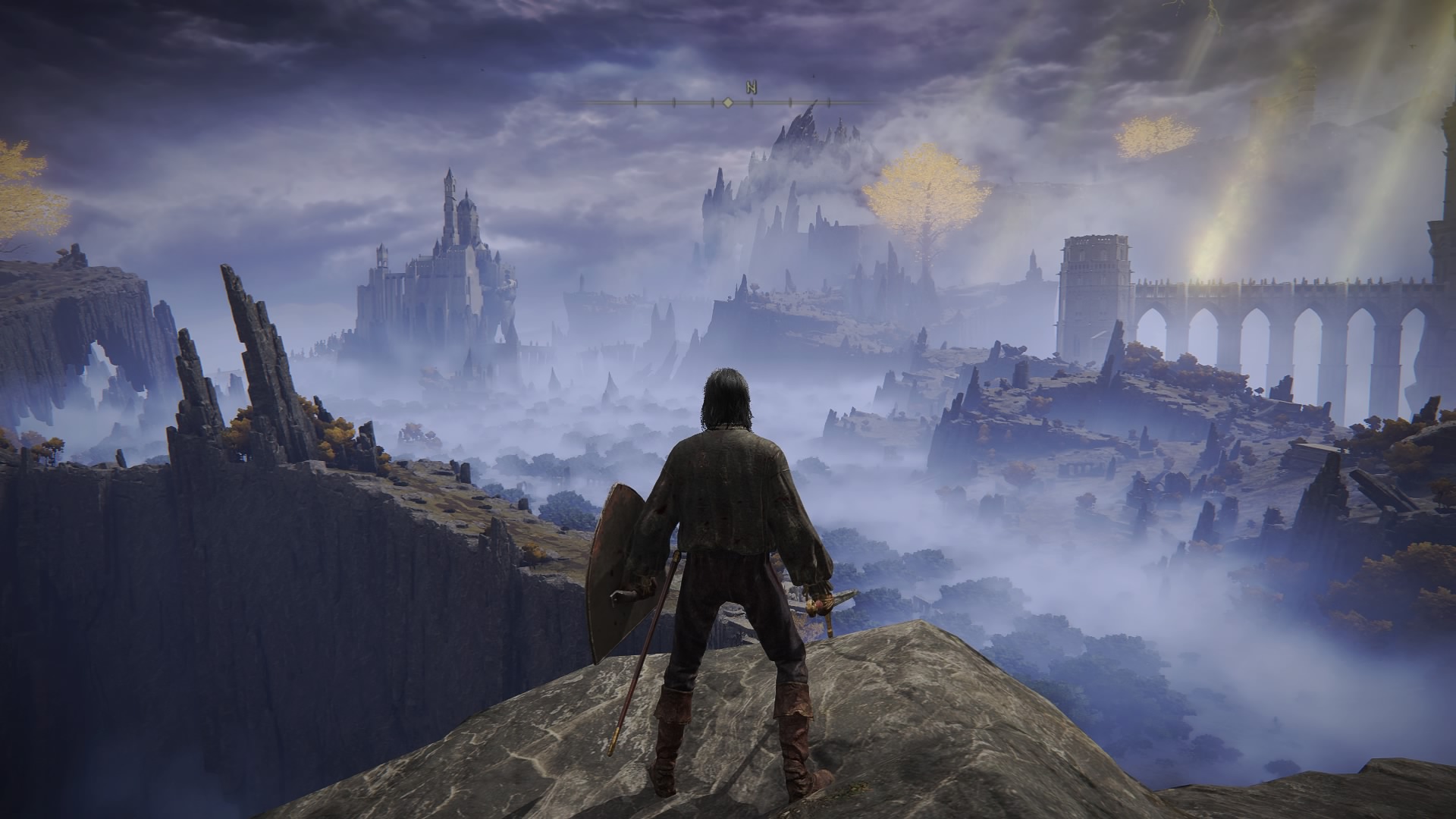
Elden Ring, v. 1.09.1 (Tokyo: Bandai Namco, 2022), PlayStation 4, screenshot by author.
“Megatextual Kinaesthetics: The Wanderer above the Sea of Elden Ring“
In the twenty-first century, the maximalist impulse evident in the big, ambitious novel of the twentieth century has expanded toward the creation of massively unreadable works across media, what Fest has elsewhere called megatexts. From experimental literary projects, to popular forms, to transmedia corporate intellectual property, megatexts abound in the twenty-first century and their presence in both avant-garde and corporate cultural production signals that the megatext is an emergent form native to the neoliberal era. Perhaps the most paradigmatic instance of this emerging form is the massive, open-world video game requiring hundreds of hours of playtime to traverse. In the video-game megatext, we see a form striving to create worlds, to build spaces large enough to feel comparable to our own.
In his talk, Fest will focus on FromSoftware’s blockbuster 2022 game Elden Ring as not only a paradigmatic video-game megatext but also the kind of sensorial-conceptual or theoretical text that Patrick Jagoda has recently suggested experimental games can be. Fest will argue that Elden Ring’s open world is an affective, bodily, material sensorium that presents to its players something like what big data feels like, allowing players to experience a haptics of hyperarchivalism, a spatiality of the database. In this way, rather than some monumentally time-sucking waste, Elden Ring might itself constitute a moment of respite, contemplation, and critical engagement with respect to the network society, a moment where the digital realities of contemporaneity, in all their hypermediated and interconnected totality might be critically felt, even if that feeling only occurs as the sensation of a concept.
For previous essays of mine on megatexts and unreadable texts, see:
“‘Is an Archive Enough?’: Megatextual Debris in the Work of Rachel Blau DuPlessis.”
“Writing Briefly about Really Big Things.”
“The Megatext and Neoliberalism.”
“The Time of Megatexts: Dark Accumulation and Mark Z. Danielewski’s The Familiar.”
Hartwick College Press Release about My New Book
Hartwick College has put out a press release, “Routine, Rejection All Part of the Process, Says Poet,” about my new book, 2013 – 2017: Sonnets.
Book Launch for 2013–2017: Sonnets and Other Fall Readings
In support of my new book, 2013–2017: Sonnets, I will be giving three readings this fall in and around Oneonta, NY.
On Thursday, August 29, 2024 at 7:00 p.m., in collaboration with the Green Toad Bookstore, there will be a book launch for 2013–2017: Sonnets at Roots Public Social Club.
On Wednesday, September 25, 2024 at 7:00 p.m., I will be reading more poems from 2013–2017: Sonnets, along with poems from its (already completed) sequel 2018–2024: Sonnets, at Hartwick College for the 2024–25 Visiting Writers Series.
And on Thursday, November 21, 2024 at 7:30 p.m., I will be reading a range of poems, including a variety of my newest work (including from Postrock), at the Writers Salon at the Community Arts Network of Oneonta (CANO).
2013–2017: Sonnets
Now available! 2013–2017: Sonnets, my third book of poetry and the first volume of my American Sonnet sequence, has been published by LJMcD Communications. It can be ordered through Amazon.
2013–2017: Sonnets is the first volume in Bradley J. Fest’s ongoing sequence of American sonnets, a project concerned with how the distributed networks of the twenty-first century construct and filter time. Continuing the program of poetic assemblage explored in his first two books, these poems were composed consecutively as emergent temporal snapshots documenting certain experiences of what it was like to live precariously in the overdeveloped world between 2013 and 2017. Over the past decade, this ongoing experimental sonnet sequence has become: a complex encounter with time and its twenty-first-century rhythms; a document of artistic maturation; a personal archive of occasions, moments, days; a continually refreshed confrontation with the global computational hyperarchive; a discography of popular music; an extended reflection on contemporary literature, art, and culture; an increasingly multiplex meditation on the sonnet; an historical record of the troubling national situation in the United States; and a work of mourning for a world disappearing into climate emergency. The second volume, currently in progress, begins in 2018.
Eternal thanks to Lachlan J. McDougall for bringing 2013–2017 into the world and to Taylor Baldwin for the cover image.

