Notes from the Anthropocene: Insuring the Apocalypse and Other Links

Nuclear

More adventures in nuclear incompetence: Lily Hay Newman, “Air Force Security Failed a Takeover Drill at a Nuclear Silo.”


Climate Change, Catastrophe, and the Anthropocene

We’re doomed. “A Galaxy Far, Far Away . . . Will Hit Ours.”

Lindsay Abrams, “Researchers: The Collapse of Greenland’s Ice Sheet Could Be a Bigger Disaster Than We Thought.”

Ari Phillips, “In Landmark Class Action, Farmers Insurance Sues Local Government for Ignoring Climate Change.” Is that what we need? For the insurance companies to get involved?

Yes. McKenzie Funk, “Insuring the Apocalypse.”

Paul Krugman, “Cutting Back on Carbon.”

On the flooding in the Balkans.

Everything is the worst: Ryan Koronowski, “House Votes to Deny Climate Science and Ties Pentagon’s Hands on Climate Change.”

And scientists agree, we should just start calling climate change “You will be burnt to a crisp and die.”

Continue reading

The West Antarctic Ice Sheet Collapse and Other Portents of Doom

Climate Change

The New York Times on the collapse of the West Antarctic Ice Sheet.

Paul Krugman, “Points of No Return.”

Eyder Peralta, “New Report Finds Climate Change Already Having Broad Impact.”

Gerry Canavan on “Dystopia, Anti-Utopia, and the End of the World.”

Peter Frase, “Adjusting to the Apocalypse.”

A very interesting piece at Jacobin reflecting on an analogy between abolitionists and environmentalists: Matt Karp, “A Second Civil War.”

Roger Peet, “A Radical Approach to the Climate Crisis.”

Martin Lukacs, “New, Privatized African City Heralds Climate Apartheid.”

Julie Beck on John Oliver’s “Statistically Representative Climate Change Debate.”

Saskia Sassen, “Countdown to Oblivion: The Real Reason We Can’t Stop Global Warming.”

Mike Wall, “To Combat Climate Change, Humanity Must Act Now, NASA Chief Says.”

Brad Plumer, “Five Horrifying Maps of America’s Massive Drought.”

And “Picture This: U.S. Cities Under 12 Feet of Sea Level Rise.” An example:

The Back Bay in Boston under 12 Feet of Sea Level Rise

The Back Bay in Boston under 12 Feet of Sea Level Rise

But don’t fret, “This Couple is Making Roads Out of Solar Panels, and They Actually Work.”

And Michelle Nijhuis, “How to Laugh at Climate Change.”

Continue reading

The National Security State and Dystopian Narcissism

Today’s sentencing of Bradley Manning to 35 years in prison has provoked considerable outrage. Birgitta Jónsdóttir addresses this nicely in her piece for The Guardian, “Bradley Manning’s Sentence: 35 Years for Exposing the Truth.”

And Rob Goodman has a very compelling piece on “dystopian narcissism” for The Chronicle of Higher Education titled, “The Comforts of the Apocalypse.” Dystopian narcissism is the selfish belief that your time, your civilization, your world is somehow unique in its proximity to the end times, to the disaster, to the apocalypse. As Goodman writes: “We’re virtually guaranteed to witness the end of nothing except our lives, and the present, far from fulfilling anything, is mainly distinguished by being the one piece of time with us in it.” I’ve been saying this for years. (Though perhaps the Doomsday Argument would disagree, as perhaps would Nick Bostrom [here and here and here and here] .)

Ancient Apocalypse

Metafilter has a bunch of interesting links to the Bronze Age Apocalypse. Something took place between 1200 and 1150 BC, or a number of things took place–including natural disaster and barbarian invaders–that basically wiped out ancient civilization:

Every city in a Desolate Crescent from the Aegean to the Sinai was razed to the ground: a bloody, sudden inverse of millenia of building. People lost cities, cultures, names. Gods were forgotten. Traditions died. Empires ended: splintering first into regions, then cities, then smaller. The mightiest and best organized, like Egypt, managed to bend every nerve, staving off collapse for a generation before shattering. Finally, there was a gap: the long total blank that frustrates the hell out of anyone trying to look back. What is known is that everything stopped, with the catastrophe’s survivors left only with legends of a better time and a centuries-long struggle for bare subsistence. This was the Bronze Age Collapse. . . . To imagine the scale, picture this: almost every city in Western Europe and North America destroyed. Not reduced, not scaled down. People-don’t-live-here-anymore-just-ruins destroyed.
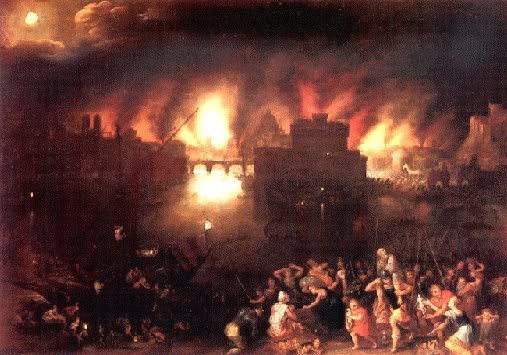
Destruction of Troy

The Destruction of Troy, Jan Brueghel the Elder, ca. 1671-1672.

Notes on This is the End

This is the End 2013

So, let’s get this out of the way quickly. This is the End (dir. Evan Goldberg and Seth Rogen, 2013) is a terrible movie. (I had a previous inkling that it was going to be pretty wretched.) It is adolescent (if self-consciously so), puerile (viz. Satan’s giant phallus), and misogynist, among its other sins. Perhaps most damning: it is poorly imagined. There are a number of other ways that actors playing themselves in a movie about the end of the world at James Franco’s house could have gone. Seriously. This is a brilliant premise[1] but This is the End is embarrassing.

Despite this pretty damning opinion, the spirit of The Hyperarchival Parallax’s subtitle obliges me to give this onanistic bropocalypse its due. For if nothing else, the film is somewhat fun. This is largely due to the constant metafiction the film is engaged in: Michael Cera is a degenerate, the Back Street Boys exist(ed) (right!?), Aziz Ansari is not generally liked, etc. And this is funny/interesting b/c each actor plays themselves.[2] (Or at least it is supposed to be [and often is] funny.)

But the true failure of This is the End lies in never asking itself what its basic premise means.[3] Namely, what does it mean to make a film about the “Christian” Apocalypse with a cast of goofballs (who made it big for whatever reason) playing themselves in 2013? Yes, the film is self-aware about how indulgent of a film it is (is it really though?), but if you are going to parody the currently (very) popular craze with representing megadeath and mass-destruction[4]—and in a time of danger, a time of surveillance, climate change, war, revolution, torture, and disaster—without once asking why one might make such a film nor why such a film might be interesting, timely, or important at this late and exhausted date in 2013 . . . this is a mistake.

To my mind, This is the End is a product of the 2013 orgy of disaster (see fn. 3) finally turning in on itself. And it is about time. (Whatever one may think about David Foster Wallace’s irony or sincerity) This is the End is very necessarily ironic in this time of serious-ass superhero movies destroying significant amounts of urban real-estate over and over. But it is not ironic enough. There are too many dick and fart jokes, and not enough acknowledgment of what it is and what it is doing: that it is metafiction satirizing contemporaneity and its multiplying disastrous projections of national fantasy. This is the End, if nothing else, emphasizes that we should be wary of the sincere expression of eschatological national fantasy at the present time.

[1] It really is. Though I will refrain from speculating too much how differently this film could have gone, it is a tempting activity.

[2] Though this is also to assuredly stress that the film could have benefitted from a quick refresher course on John Barth, Thomas Pynchon, Cynthia Ozick, David Foster Wallace, etc. Maybe especially Wallace’s “Westward the Course of Empire Takes its Way” (1989).

[3] Its other true failure rests upon its mistaken idea that, at the end of the day (literally), experiencing the end of the world w/ your friends would be kinda fun.

[4] It appears that every week a new film that imagines really massive destruction or post-apocalyptic waste will come out for the remainder of the summer. (In fact, there are a number of them playing right now!) In 2013 (just off the top of my head) we’ve seen: Olympus has Fallen (dir. Antoine Fuqua), which imagines a terrorist attack on the White House; there is the forthcoming White House Down (the new Roland Emmerich joint), also imagining a terrorist attack on the White House; there will be the xenocide of Ender’s Game (Gavin Hood); the nepotism of After Earth (M. Night Shyamalan); the (weirdly) promising looking Elysium (Neil Blomkamp); Oblivion (Joseph Kosinski) . . . ; Pacific Rim (Guillermo del Toro), which looks like it will bomb; The World’s End (Edgar Wright), another eschatological buddy-movie; World War Z (Marc Forster), Brad Pitt’s “adaptation” of Max Brook’s compelling and interesting novel of the same name (2006) (that came out today and according to Vanity Fair the film looks to be wanting); and of course finally there is Man of Steel (dir. Zack Snyder, 2013), a film I’m still puzzling over, which imagined something like two trillion dollars in damage to downtown Metropolis. There are many more such films coming out this year.

Quite simply, 2013 is the year of disaster porn. It’s everywhere. It even comes in the guise of children’s fantasy. Transformers (1984-1987) and Action Comics (1939- ) have been repurposed into visions of Armageddon and mega-death. Think about this for a second.

More selfishly, this summer blockbuster movie season is yet another reminder that a critic of the writing of the disaster will never be out of work. We are in the age of frequent, diverse, ubiquitous, and excessive disaster. It is multiplying. This is the point. The multiplication of real or imagined disaster scenarios in contemporaneity requires its own archive. Trying to deal with the reality of this requires what I have been and will continue to call hyperarchival realism.

Creating Jobs Today to Ensure an Apocalyptic Tomorrow

I’m sure this would be even funnier to me if I had a bit more knowledge of the current discussions going on about the AFL-CIO, but it’s still pretty biting. The blog is NotAFL-CIO, and the post is “AFL-CIO Executive Council Endorses Comprehensive Doomsday Policy for Working Families”:

Sean McGarvey, President of the AFL-CIO’s Building and Construction Trades Department and Co-Chair of the American Doomsday Institute (ADI), noted that environmental concerns were overblown: “Yes, these technologies will destroy life as we know it, but we see enormous opportunities for working families in the emerging evacuation, resettlement, and cryogenic industries of the future.”

I suppose this satire is relevant no matter the organization.

Apocalypse Forever

I just received (from R. for xmas) and am looking forward to reading Craig Child’s Apocalyptic Planet: Field Guide to the Everending Earth, which I imagine will fit nicely w/ this Wikipedia entry on the far future. The number of catastrophic things that have happened and will happen to the earth really dwarfs most anthropic notions of time, disaster, and crisis.

And on the other side of this spectrum, check out The Long Now Foundation.

Apocalypse as Fantasy

Heather Havrilesky has an article published today on Vulture titled, “Why TV Apocalypses Are Really Wish-Fulfillment Fables.” There is some (psychoanalytic) ground being retread here, but I can’t help but smile at the following statements: “Cormac McCarthy’s The Road at first appears bereft of wishful thinking — that is, until you recognize that solitude and scorched horizons are this author’s ideal tromping ground”; and, referring to NBCs Revolution: “This is the apocalypse with a full-time stylist, on heavy antibiotics.”

Video Game Eschatology

See this fantastic article from Berfrois  by Jesse Miksic, “Digital Disquiet: How 8- and 16-bit Games Taught me the Power of Dread.”

Literature has examined the burdens of immortality (Melmoth, Dorian Gray, Tuck Everlasting), and films have reflected upon death’s brutal banality (Antonioni, Haneke). But film and literature can’t do this. Even the most shocking torture-porn or the most unexpected termination (Marvin in Pulp Fiction) don’t amount to the meaninglessness of a main character’s life in these golden-age electronic games. Even when they’re bizarre, or out of left field, movie-deaths at least register as events and turning points in the narrative flow. In the nihilistic early side-scrollers, your death was one of hundreds, endlessly repeatable, and the world was indifferent to it. Everyone else else came back in the appointed role in every cycle, just like you.