Physicists say they have come up w/ a method for determining whether or not we live in a simulation. Didn’t Nick Bostrom already address this?
“Cyber-Pearl Harbor” and a Thomas Pynchon Talk
Reported today in The New York Times, “Defense Secretary Leon E. Panetta warned Thursday that the United States was facing the possibility of a ‘cyber-Pearl Harbor’ and was increasingly vulnerable to foreign computer hackers who could dismantle the nation’s power grid, transportation system, financial networks and government.”
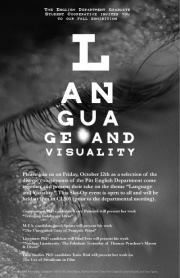
Also, today I will be giving a (hopefully quite) short talk entitled “Nuclear Luminosity: The Fabulous Metahistorical Textuality of Thomas Pynchon’s Mason & Dixon” for the Univ. of Pittsburgh English Grad Student Scholarship Collective Fall Symposium, Language & Visuality. The event will be taking place in CL 501 @ 1pm. In addition, Kerry Banazek-PhD in Comp/Rhet, Jacob Spears-MFA, and Katie Bird-Phd in Film will be speaking.
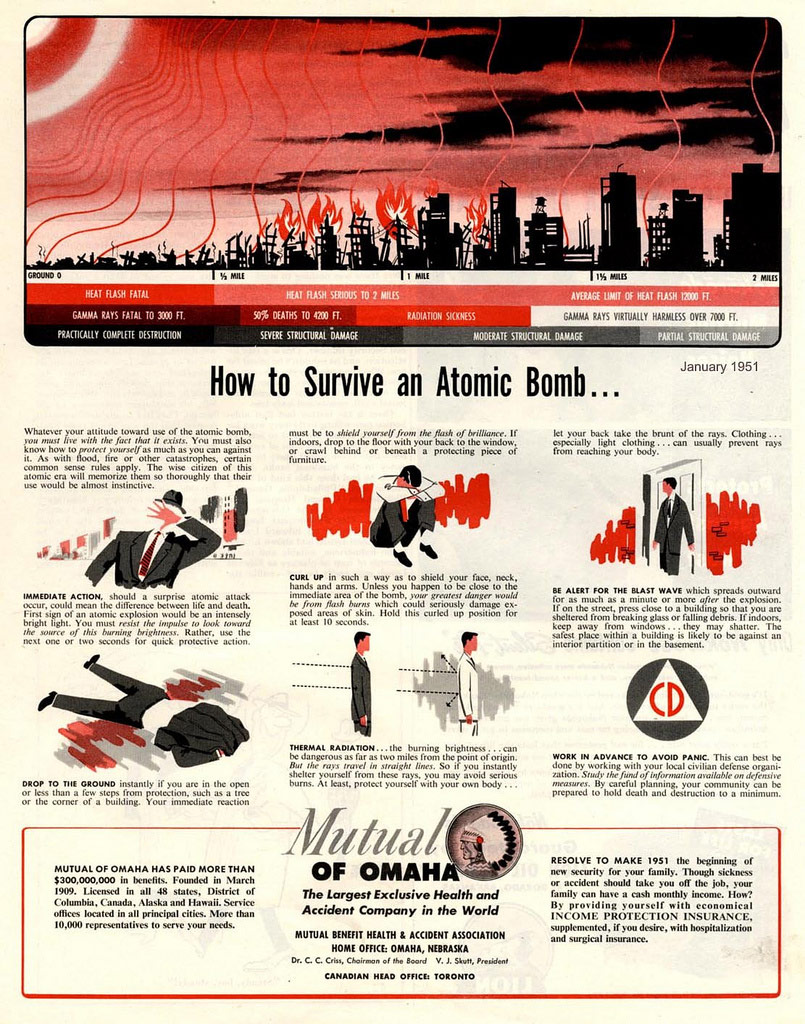
Surviving an Atomic Bomb
This’ll surely work:
Archives Require Eneregy (Just Not THAT Much)
In something that’s been making the rounds recently, James Glanz writes in the NY Times about how data centers waste vast amounts of energy in, “Power, Pollution and the Internet.”
Mary Karr on DFW
Poetry magazine published a poem by Mark Karr last month addressing her relationship w/ DFW, “Suicide’s Note: An Annual.” Quite the read. (I’m also randomly teaching her introduction to The Waste Land later this week, “How to Read The Waste Land So It Alters Your Soul Rather Than Just Addling Your Head.”)
Jonathan Franzen’s Liberté
A student from my New Literature class last spring, “US Fiction in the Wake of Postmodernism,” just sent me this picture of a giant advertisement for the French translation of Jonathan Franzen’s Freedom.

Infinite Atlas
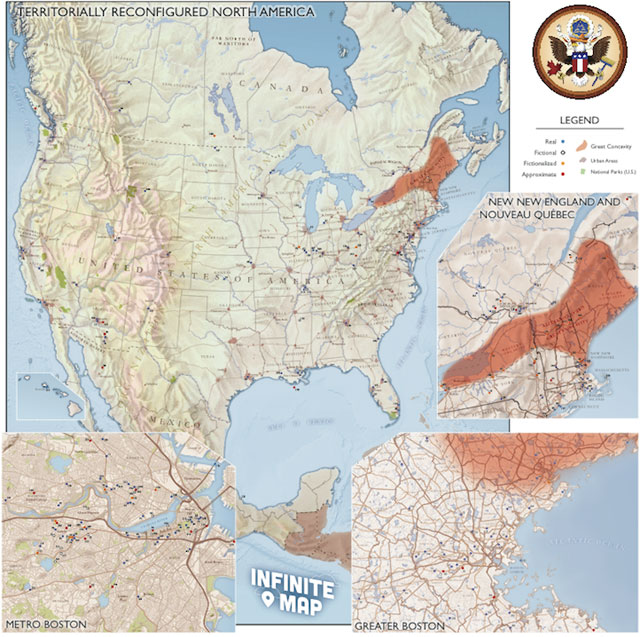
A few months ago I reported about how William Beutler was photographing locations around Boston that appear in Infinite Jest. I don’t know why I haven’t yet linked to his next project, Infinite Atlas, but its pretty amazing, mapping every single geographic location mentioned in the novel. Cool. And a map of ONAN and “Territorially Reconfigured North America”:
DFW Excerpt: “These are tense linguistic times”
My Freshman Composition course just wrapped up a lively discussion of DFW’s “Authority and American Usage” (originally published in Harper’s as “Tense Present”), and though I think I probably wanna do some different stuff w/ it next time . . . here’s a lovely excerpt:
The insecurities that drive [Politically Correct English], [Academic English], and vocab-tape ads are far from groundless, though. These are tense linguistic times. Blame it on Heisenbergian uncertainty or postmodern relativism or Image Over Substance or the ubiquity of advertising or PR or the rise of Identity Politics or whatever you will–we live in an era of terrible preoccupation with presentation and interpretation, one in which the relations between who someone is and what he believes and how he “expresses himself” [DFW’s fn.: (Notice the idiom’s syntax–it’s never “expresses his beliefs” or “expresses his ideas.”)] have been thrown into big-time flux. In rhetorical terms, certain long-held distinctions between the Ethical Appeal, Logical Appeal ( = an argument’s plausibility or soundness, from logos), and Pathetic Appeal ( = an argument’s emotional impact, from pathos) have now pretty much collapsed–or rather the different sorts of Appeals now affect and are affected by one another in ways that make it nearly impossible to advance an argument on “reason” alone. (David Foster Wallace, “Authority and American Usage,” in Consider the Lobster and Other Essays [New York: Little, Brown and Company, 2006], 116, my emphases.)
Perhaps We’re Not Bound to Our Solar System After All
So, Matt Peckham in Time Magazine has reported that NASA is “Actually Working on a Faster-Than-Light Warp Drive.” No, really. And it’s brilliant:
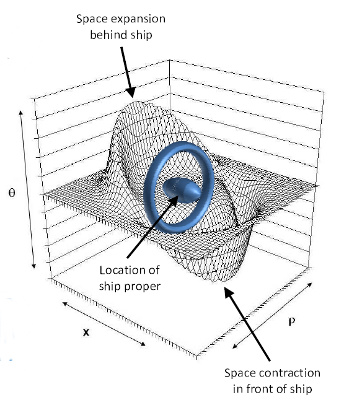
“By placing a spheroid object between two regions of space-time — one expanding, the other contracting — Alcubierre theorized you could create a “warp bubble” that moves space-time around the object, effectively re-positioning it. In essence, you’d have the end result of faster-than-light travel without the object itself having to move (with respect to its local frame of reference) at light-speed or faster.”
Basically, rather than accelerate an object, this method simply changes the very fabric space-time (wow). And it doesn’t violate Einstein’s special theory of relativity. And they’re gonna start lab experiments too. The assured extinction of the species when the Sun goes Red Giant on us, now looks less eschatological. Alpha Centauri or bust by 2100.
Also, this is weirdly reminiscent of the last few pages of Thomas Pynchon’s, Against the Day [2006], in which the Chums of Chance skyship, the Inconvenience, becomes capable of time travel:
Inconvenience herself is constantly having her engineering updated. As a result of advances in relativity theory, light is incorporated as a source of motive power–though not exactly fuel–and as a carrying medium–though not exactly a vehicle–occupying, rather, a relation to the skyship much like that of the ocean to a surfer on a surfboard–a design principle borrowed from the Æther units that carry the girls to and fro on missions whose details they do not always share fully with “High Command.” (1084)
Destroying the Entire Internet . . . ?
No. As George Dvorsky over at io9 reports in “Could Someone Really Destroy the Whole Internet,” the very things that make the Internet possible make it resistant to total destruction. Phew. (That is, unless you’re in this terrible looking new show. I watched the pilot, and its one of those: we stuck it in a post-apocalyptic future, but honestly, we will not have a single plot point that wouldn’t work just fine in another, less apocalyptic universe. But this way we get to have Wrigley Field covered in vines. And seriously, when I google, “revolution,” this is the first thing that comes up? We’re done for.)

 The Hyperarchival Parallax