Two more sonnets from my ongoing sequence, “2015.05” and “2015.06,” were just published in no. 16 of Epigraph Magazine. A .pdf of the issue can be found here.
Hartwick College Issues a Press Release about The Shape of Things
Hartwick College, where I am currently assistant professor of English, has issued a press release in which I am quoted as saying various things about my new book, The Shape of Things (Salò, 2017).
The Shape of Things
The Shape of Things, my second book of poetry, is now available and shipping from Salò Press. Order it here if you’re in the UK and here if you are anywhere else. I am very proud of this book.
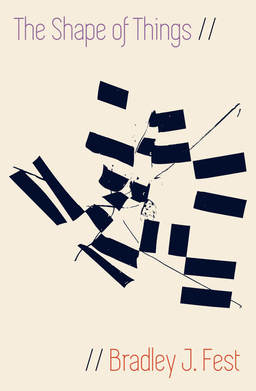 Bradley J. Fest’s second volume of poetry, The Shape of Things, continues his project of poetic assemblage. Written in an age of ubiquitous algorithmic surveillance and increasingly catastrophic climate change, these poems both describe the shape of things in the overdeveloped world and endeavor to challenge the widespread feeling that the imagination has been foreclosed in the twenty-first century. An ambivalent hyperarchive, the collection draws influence from a number of seemingly incompatible lyric registers, including the language of contemporary theory. The Shape of Things culminates in an eponymous long poem that asks if a poiesis of “network being” is possible and suggests that there might be some other way to dance to the sounds of our present.
If Whitman and Adorno had a knife fight on the ruins of the floor of the New York Stock Exchange, The Shape of Things would be the perfect voice over. Which is to say, though it’s not a pretty scene, there’s pleasure and beauty to be found in the action and music of the syntax and in following the wild movements of this poet’s mind. Truly original, dazzlingly smart and game for anything, Fest writes of lives and desires torn apart by the neoliberal security state. Jolting between paranoiac rage and orgasmic bliss, between all- out negation and Wordsworthian swoon, these poems describe the awful implications of a contemporary moment in which “we have made ourselves a gallows of a house.”
–Sten Carlson, author of Fur & After
To call The Shape of Things “post-apocalyptic” would be a mistake: its poignant present tense anxiety unfolds in the apocalypse now. Ataris and hunter-gatherers lean together over the edge of time, commingling in harrowing yet pleasurable ways. But this is no book of “detached mirth.” Hear in Fest’s singing the quiet pathos of humans and machines out of time. While Fest’s human creatures have lulled themselves into submission—”There may be something (virtually) / on fire. More likely our expectations are being met . . .”—his work nudges middle class late capitalist culture awake into the disturbing awareness that “a prolonged adolescence is the shape of things.”
–Robin Clark, author of Lines the Quarry
Fall Semester 2017: Syllabi
 I am beginning my first semester teaching English and creative writing at Hartwick College tomorrow. Here are the syllabi for my three classes.
ENGL 213: Introduction to Creative Writing
Summer 2017 Links
Nuclear and Environmental
Nearing midnight: “Military solutions are now fully in place,locked and loaded,should North Korea act unwisely. Hopefully Kim Jong Un will find another path!”
Mehdi Hasan, “The Madman with Nuclear Weapons Is Donald Trump, Not Kim Jong-un.”
David Wallace-Wells, “The Uninhabitable Earth.”
NUKEMAP by Alex Wellerstein, and “Global Hiroshima: Notes from a Bullet Train.”
Elizabeth Kolbert, “Au Revoir: Trump Exits the Paris Climate Agreement.”
Fiona Harvey, “World Has Three Years Left to Stop Dangerous Climate Change, Warn Experts.”
Damian Carrington, “Arctic Stronghold of World’s Seeds Floods after Permafrost Melts.”
Benjamin Powers, “An Abandoned US Nuclear Base in Greenland Could Start Leaking Toxic Waste Because of Global Warming.”
The Shape of Things Available for Pre-Order
 My second volume of poetry, The Shape of Things, is now available for pre-order from Salò Press. It will begin shipping September 1, 2017.
Fall Semester 2017
I am looking forward to my first fall semester at Hartwick College. I’ll be teaching three classes: Introduction to Creative Writing (ENGL 213); Reading Modern Poetry (ENGL 250); and Creative Writing: Poetry (ENGL 312). This semester is especially exciting because I will be returning to the creative writing classroom, and, I mean, look at all this poetry:

I’ll post syllabi when they’re complete. No class blogs this semester, but probably soon, especially if I do something new this spring.
“2016.19” Nominated for Best of the Net
I am honored that Masque & Spectacle has nominated my poem “2016.19” for Best of the Net.
It’s also pretty great to be nominated by Masque & Spectacle along with the work of an old friend: Rachel Nagelberg’s “Do Androids Dream of Dick?”
Reading at Hemingway’s Summer Poetry Series on June 13, 2017
I recently read at the Hemingway’s Summer Poetry Series, and you can listen to (and download) it here. I read “We’re Just Like Yesterday’s Headlines,” “Throw Out Your Life,” and “The Shape of Things I,” all from my forthcoming collection, The Shape of Things, due out soon from Salò Press.
You can also hear the other poets here: Nikki Allen, Jennifer Jackson Berry, Jason Irwin, Sharon Fagan McDermott, Kayla Sargeson. It was a really nice evening filled with wonderful verse. Thanks all.
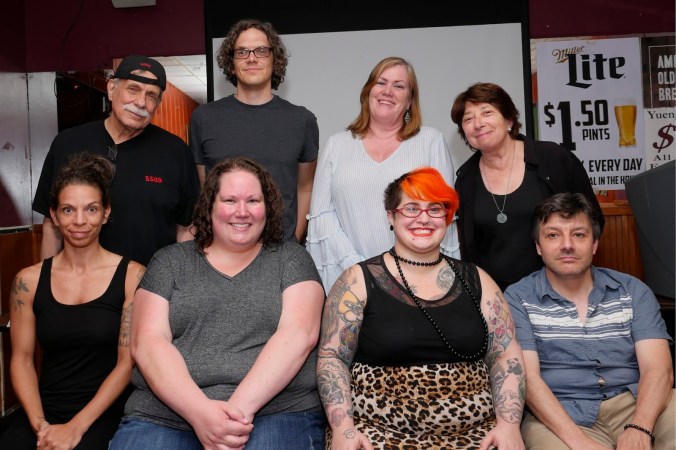
Poets who read at Hemingway’s Summer Poetry Series, June 13, 2017. Back row, left-to-right: Jimmy Cvetic, Bradley J. Fest, Sharon Fagan McDermott, and Joan Bauer; front row, left-to-right: Nikki Allen, Jennifer Jackson Berry, Kayla Sargeson, and Jason Irwin.
Guest Appearance on The Jabsteps: Talking about the 2017 NBA Finals
With Salvatore Pane still out of town, I made another guest appearance on The Jabsteps. In episode 58, “How Much Is There to Actually Say about These NBA Finals,” I talk with Geoff Peck about the 2017 NBA Finals and the seemingly inevitable Warrior’s victory (and generational dominance); I also help clarify “the desert of the real.”

