The second poem in my “Archives” series, “Archives of Autumn,” is out in The Decadent Review. Winter and spring are forthcoming.
Poetry
“Archives of Summer” in The Decadent Review
The first poem in a short series, “Archives of Summer,” is out today in The Decadent Review. Further poems—“Archives of Autumn,” “Archives of Spring,” and a reprint of “Archives of Winter”—will appear in The Decadent Review as the year progresses. The “archive” poems are some of the final unpublished poems from my recently completed manuscript, Postrock.
2022–25 Cora A. Babcock Chair in English at Hartwick College
I am thrilled and honored to announced that for the next three years (2022–25), I will be the Cora A. Babcock Chair in English at Hartwick College. This position will support continued work on my current scholarly book project, Too Big to Read: The Megatext in the Twenty-First Century, the publication of my just completed poetry manuscript, Postrock, and my next two books of poetry, 2018–202X: Sonnets and Synthwave.
For a glimpse into this work in progress, see my recent essay, “‘Is an Archive Enough?’: Megatextual Debris in the Work of Rachel Blau DuPlessis,” and some select poem(s) from Postrock and from 2018–202X: Sonnets.
I also get to host an annual Babcock Lecture for the duration of the appointment [stay tuned].
Significant Others x Always Crashing: A Shadow Text Reading Series
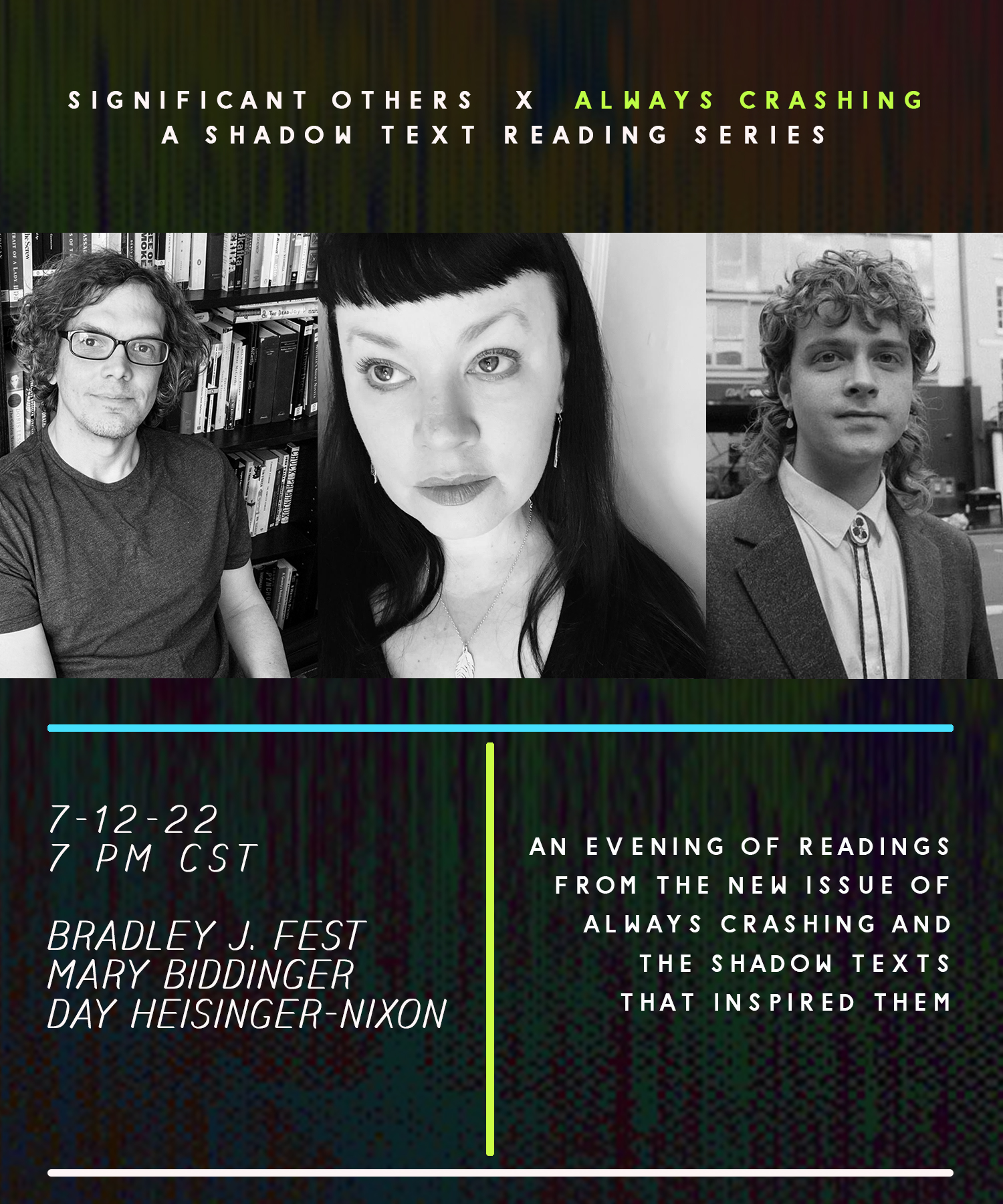
On July 12, 2022 at 8:00 p.m. (EDT), as part of the Significant Others Reading Series—a “series dedicated to new books and the shadow texts that inspired them”—I’ll be giving an online reading of some of my sestinas from the latest issue of Always Crashing along with some of the poems in their background radiation. Mary Biddinger and Day Heisinger-Nixon will also be reading. Get the link to the reading here and order the issue here.
“Sestina I,” “Sestina II,” “Sestina III,” and “Aubade and After” in Always Crashing
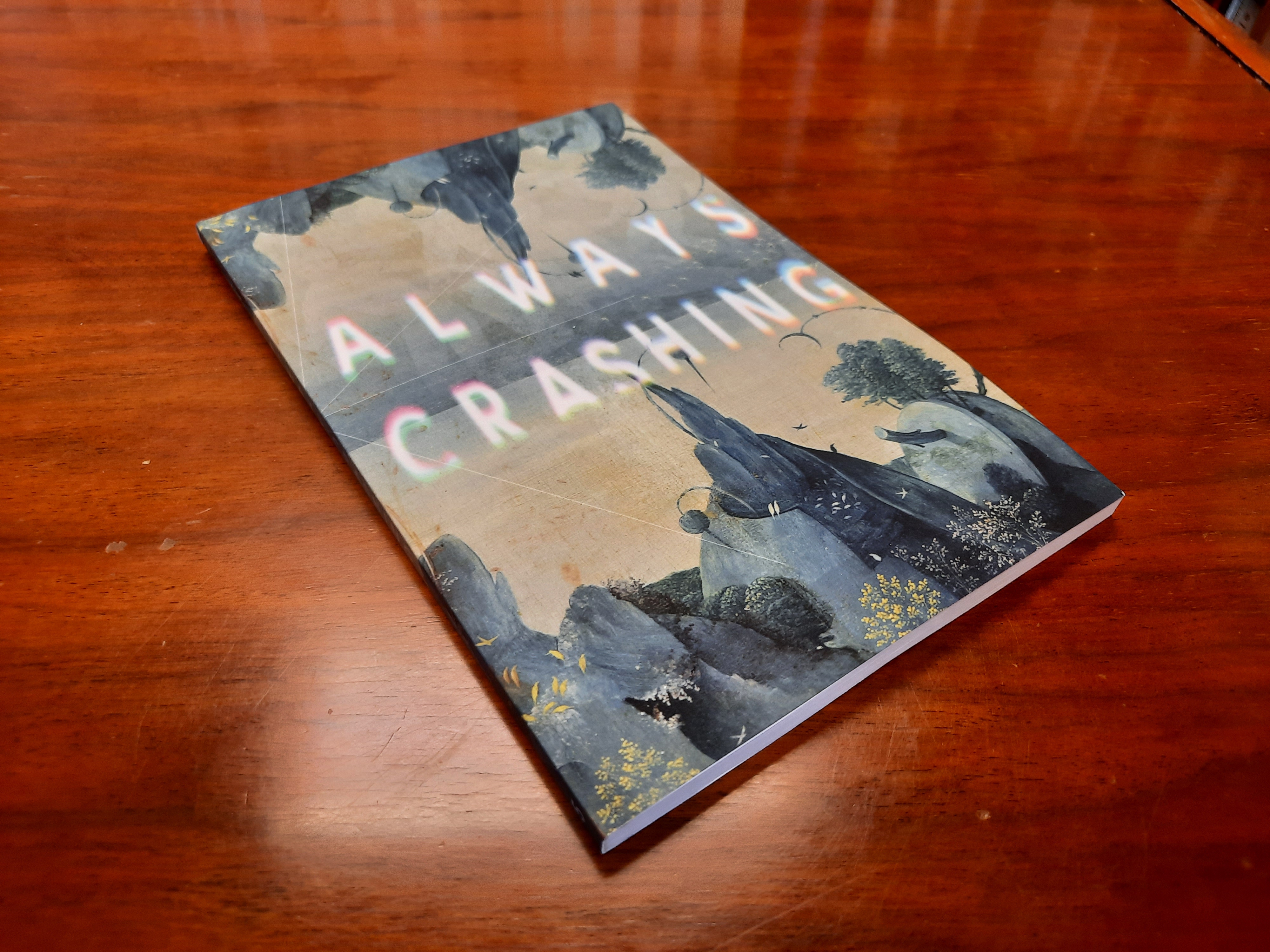
Some new poems are in the fifth issue of Always Crashing: “Sestina I,” “Sestina II,” “Sestina III,” and “Aubade and After,” all part of a project I’m in the process of finishing up this summer. I’m absolutely delighted and honored to again appear in the pages of this excellent journal.
“2020.12,” “2021.01,” “2021.02,” “2021.03,” and “2021.04” in Version (9) Magazine
The most recent sonnets in my ongoing sequence–“2020.12,” “2021.01,” “2021.02,” “2021.03,” and “2021.04”–are in the third issue of Version (9) Magazine.
Links in the Time of Coronavirus, Vol. 23: January 16–February 15, 2022
Nuclear and Environmental
Henry Fountain, “An Extraordinary Iceberg Is Gone, but Not Forgotten.”
Jacob Blumenfeld, “Climate Barbarism: Adapting to a Wrong World.”
Joshua Rothman, “Can Science Fiction Wake Us Up to Our Climate Reality?”
Ukraine
The New York Times, “Moscow Is Pessimistic about Reaching Accord with US on Ukraine, but Talk Continues.”
Julian E. Barnes and Helene Cooper, “US Battles Putin by Disclosing His Next Possible Moves.”
And Max Fisher, “On Ukraine, US, and Russia Wage Signaling War to Avert Actual War.”
Coronavirus
Apoorva Mandavilli, “Yes, Omicron Is Loosening Its Hold. But the Pandemic Has Not Ended.”
Steven Kurutz, “Too Young to Feel So Old.”
Alexander Provan, “The Great Equalizer” (from June 2020).
Links in the Time of Coronavirus, Vol. 21: November 16–December 15, 2021

Nuclear and Environmental
The New York Times, “Postcards from a World on Fire.”
Keith Collins, Josh Williams, Denise Lu, “Before and after the Tornado: Devastation in a Historic Neighborhood.”
David E. Sanger and William J. Broad, “As China Speeds Up Nuclear Arms Race, the US Wants to Talk.”
Graham Readfearn, “Ocean Scientists Call for Global Tracking of Oxygen Loss That Causes Dead Zones.”
April Anson, “American Apocalyptic: A Conversation with Jessica Hurley.”
Douglas Dowland, review of Infrastructures of Apocalypse: Literature and the Nuclear Complex, by Jessica Hurley.
Matt Williams, “A Sun-Like Star Just Blasted Out a Flare That Would Be Devastating If It Happened Here.”
And Ben Smith, “A Comedy Nails the Media Apocalypse.”
The Visiting Writers Series at Hartwick College, Spring 2022
This spring, Hartwick College and the Department of English will present the last two readings of the 2021-22 Visiting Writers Series. All readings take place at 7 p.m. in Eaton Lounge, Bresee Hall at Hartwick College in Oneonta, New York.
Admission to the readings is free and the events are open to the public. Attendees and all campus visitors must be vaccinated for COVID-19 and will be required to provide either their vaccination card or the New York State Excelsior Pass. Any visitor requiring an exception to this requirement must complete this form and receive prior approval from the College. Masks are required in all College buildings.
Krys Malcolm Belc will read on Wednesday, March 2, 2022.
Michael Peters will read on Wednesday, April 13, 2022.
For more information, visit the Visiting Writers Series webpage.
“2020.07,” “2020.08,” “2020.09,” “2020.10,” and “2020.11” in Version (9) Magazine
The most recent sonnets in my ongoing sequence will appear across two issues of Version (9) Magazine, a journal “fostering . . . space for . . . texts that relate to the world of theory” (they previously published some other poems of mine).[1] “2020.07,” “2020.08,” “2020.09,” “2020.10,” and “2020.11” are in volume 1, issue 2. “2020.12,” “2021.01,” “2021.02,” “2021.03,” and “2021.04” will appear in early 2022 in the magazine’s third issue.
—
[1] Editors, foreword to Version (9) Magazine 1, no. 2 (Autumn 2021): 6, https://version9magazine.com/e-book-autumn-2021/.

