The 2024–25 Babcock Lecture: Anna Kornbluh, “Historical Fictions, Heist Flicks, and other Climate Genres for a Burning World”

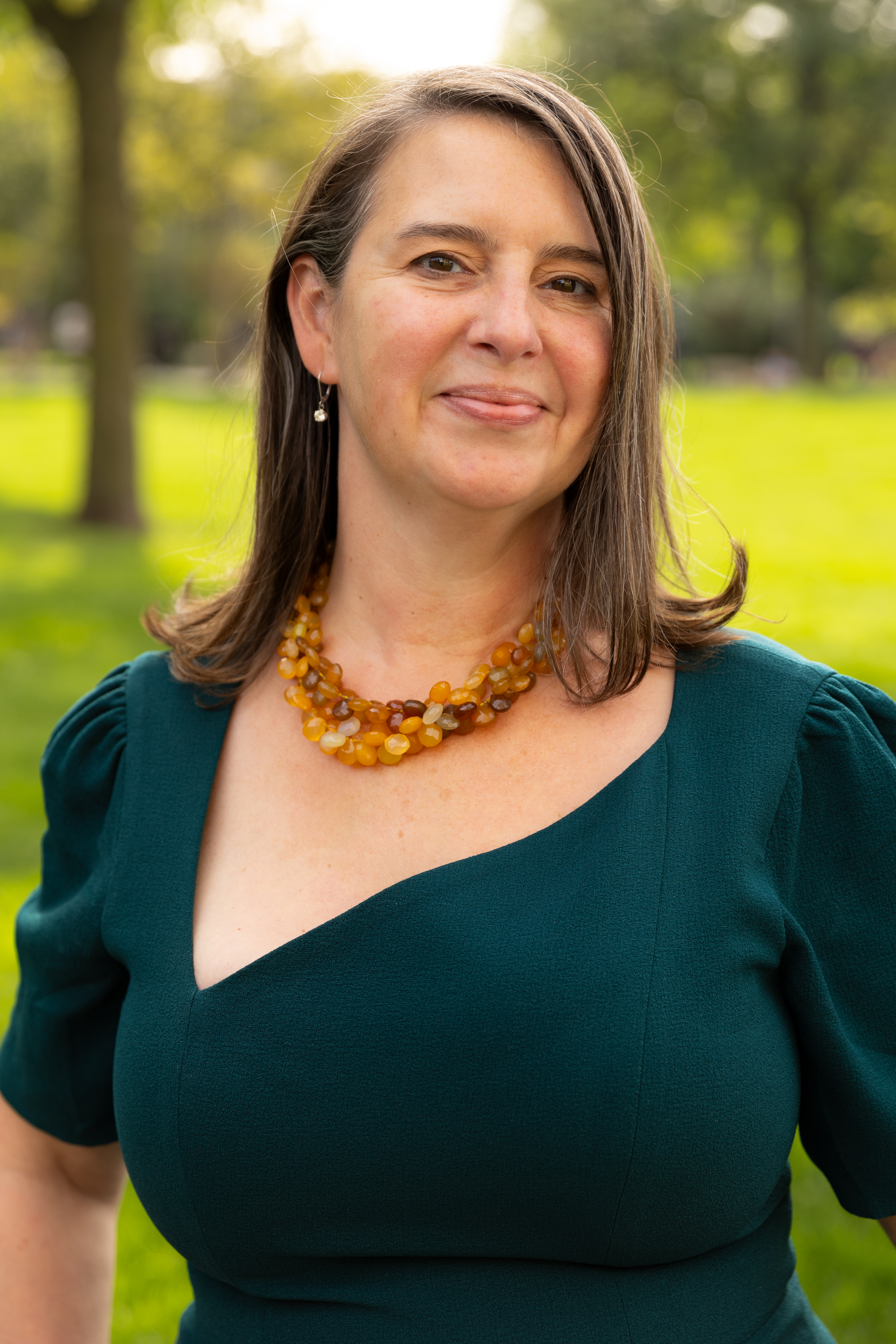
Kornbluh, Anna--HeadshotI am delighted to yet again announce that on Thursday, October 17 at 7:00 p.m. in Anderson Theater at Hartwick College, distinguished critic Anna Kornbluh will be delivering the 2024–25 Babcock Lecture at Hartwick College, which will be titled: “Historical Fictions, Heist Flicks, and other Climate Genres for a Burning World.” Kornbluh’s lecture will be followed by a reading by eminent poet and feminist critic Rachel Blau DuPlessis and is part of the Oneonta Literary Festival.


Historical Fictions, Heist Flicks, and other Climate Genres for a Burning World

In the urgent emergency of climate crisis, is there any time for art? This talk considers some of the pressures on literature and culture at present, exploring the prevailing ways that artists, authors, and critics are conceiving artistic ties to the environment, and proposing some alternative ties with the help of popular genres like historical fiction and heist films.


Anna Kornbluh
 is professor of English and a member of the United Faculty bargaining team at the University of Illinois, Chicago, where her research and teaching focus on the novel, film, and critical theory. She is the author of Realizing Capital: Financial and Psychic Economies in Victorian Realist Form (Fordham University Press, 2014), Marxist Film Theory and “Fight Club” (Bloomsbury, 2019), The Order of Forms: Realism, Formalism, and Social Space, and Immediacy, or, The Style of Too Late Capitalism, which was recently published by Verso. She has edited special issues for b2o: an online journalCriticismMediations, and Syndicate, and is a frequent guest on The American Vandal and other podcasts. She is the founder of the V21 Collective and InterCcECT (Inter Chicago Circle for Experimental Critical Theory) and is the Director of Graduate Studies at UIC.
2013–2017: Sonnets

Now available! 2013–2017: Sonnets, my third book of poetry and the first volume of my American Sonnet sequence, has been published by LJMcD Communications. It can be ordered through Amazon

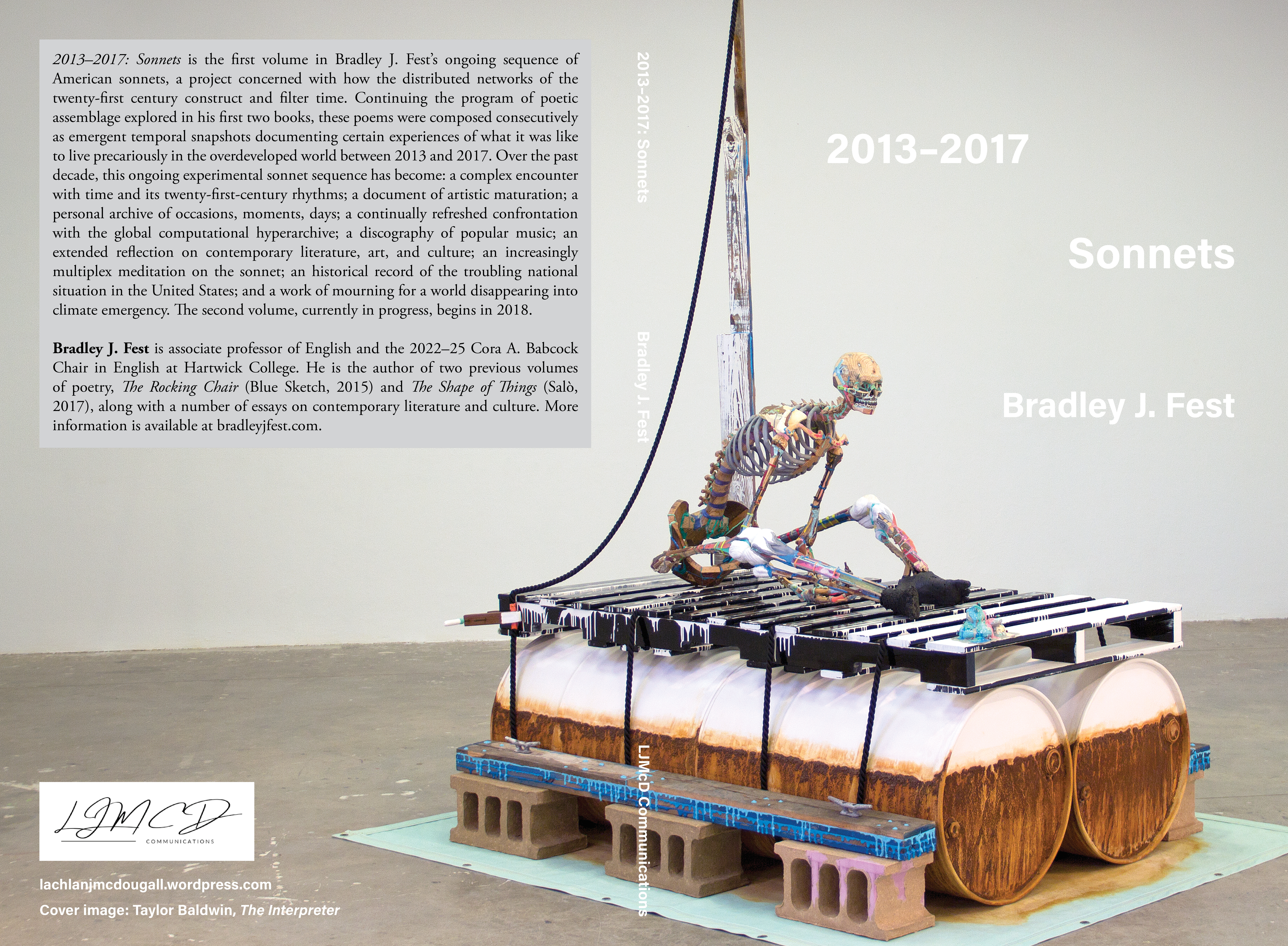
Fest, Bradley J--Cover for 2013-2017--cover

2013–2017: Sonnets is the first volume in Bradley J. Fest’s ongoing sequence of American sonnets, a project concerned with how the distributed networks of the twenty-first century construct and filter time. Continuing the program of poetic assemblage explored in his first two books, these poems were composed consecutively as emergent temporal snapshots documenting certain experiences of what it was like to live precariously in the overdeveloped world between 2013 and 2017. Over the past decade, this ongoing experimental sonnet sequence has become: a complex encounter with time and its twenty-first-century rhythms; a document of artistic maturation; a personal archive of occasions, moments, days; a continually refreshed confrontation with the global computational hyperarchive; a discography of popular music; an extended reflection on contemporary literature, art, and culture; an increasingly multiplex meditation on the sonnet; an historical record of the troubling national situation in the United States; and a work of mourning for a world disappearing into climate emergency. The second volume, currently in progress, begins in 2018.

Eternal thanks to Lachlan J. McDougall for bringing 2013–2017 into the world and to Taylor Baldwin for the cover image.

Fest, Bradley J--Cover for 2013-2017--spread

“2015.10,” “2015.23,” and “2016.10” Reprinted in What We Did during the Apocalypse: The Archive of “The Babel Tower Notice Board”

What We Did During the Apocalypse--The Babel Tower Notice Board_Page_001The Babel Tower Notice Board, a pandemic project that existed between August 2020 and December 2021 edited by Richard Capener, was just collected in What We Did during the Apocalypse: The Archive of “The Babel Tower Notice Board” (Hem Press, 2024). I was thrilled then and continue to be thrilled that three sonnets of mine, “2015.10,” “2015.23,” and “2016.10,” are part of that project. Thanks again to Capener for his amazing work on The Babel Tower Notice Board, for his monthly Babel Parish Newsletter–a welcome dispatch during those difficult months–and for his continued great work with Hem Press.

(And “2015.10,” “2015.23,” and “2016.10” will all be collected in my third book of poems, 2013–2017: Sonnets, forthcoming in July from LJMcD Communications.)

“Something Worth Leaving in Shards: An Interview with Rachel Blau DuPlessis” in boundary 2

boundary 2, vol 50, no 2, cover image I am honored to say that my interview with the great poet and critic Rachel Blau DuPlessis, “Something Worth Leaving in Shards: An Interview with Rachel Blau DuPlessis,” has just been published in the most recent issue of boundary 2. (This link should provide access for three months.) I am deeply grateful to DuPlessis for corresponding with me during the summer of 2020. In lockdown with no childcare, corresponding with DuPlessis via email to conduct this interview (when I had a spare moment or two to do so) played a large part in keeping me sane during that difficult time. A huge thanks also to Racheal and Aviva, who were right there every day along with me while this interview was being conducted.

Here’s an abstract of the interview:

This interview with poet, essayist, literary critic, and collagist Rachel Blau DuPlessis was conducted via email correspondence between June 11 and August 29, 2020. Author of over a dozen volumes of poetry and half a dozen books in modernist studies, poetics, and feminist criticism, DuPlessis reflects broadly on her career in this interview. She discusses the ongoing role of feminism in her writing and thought, the forms of the fold and the fragment, the relationship between her poetry and criticism, her work in and on the long poem, and her post‐Drafts poetry, including her (at the time) most recent book, Late Work (2020). The interview concludes with a conversation about the relationship between poetry and theorizing practices and a meditation on writing during a global pandemic.

For my writing on DuPlessis: “‘Is an Archive Enough?’: Megatextual Debris in the Work of Rachel Blau DuPlessis.”

And for previous interviews: “Isn’t It a Beautiful Day? An Interview with J. Hillis Miller” and “An Interview with Jonathan Arac.”

2013–2017: Sonnets Will Be Published by LJMcD Communications in July 2024

Fest, Bradley J--Cover for 2013-2017--600 resolution--coverI am absolutely thrilled to announce that 2013–2017: Sonnets, the first volume of my ongoing sonnet sequence, will be published by LJMcD Communications in July 2024. I’ll update this page with more information when I have it, but for now, here’s a description of the book:

2013–2017: Sonnets is the first volume in Bradley J. Fest’s ongoing sequence of American sonnets, a project concerned with how the distributed networks of the twenty-first century construct and filter time. Continuing the program of poetic assemblage explored in his first two books, these poems were composed consecutively as emergent temporal snapshots documenting certain experiences of what it was like to live precariously in the overdeveloped world between 2013 and 2017. Over the past decade, this ongoing experimental sonnet sequence has become: a complex encounter with time and its twenty-first-century rhythms; a document of artistic maturation; a personal archive of occasions, moments, days; a continually refreshed confrontation with the global computational hyperarchive; a discography of popular music; an extended reflection on contemporary literature, art, and culture; an increasingly multiplex meditation on the sonnet; an historical record of the troubling national situation in the United States; and a work of mourning for a world disappearing into climate emergency. The second volume, currently in progress, begins in 2018.

Also, thanks much to my very good friend Taylor Baldwin for the amazing cover image: The Interpreter (2010).

“Archives of Spring” in The Decadent Review

The final poem in my “Archives” series, “Archives of Spring,” is out in The Decadent Review. The whole series can be accessed hereEnormous thanks to Dimitri Kaufman, editor of The Decadent Review, for presenting these poems in such a wonderful fashion over the past year. And if you want links to each individual other poem, here they are: “Archives of Summer,”Archives of Autumn,” and “Archives of Winter.”