“Cyber-Pearl Harbor” and a Thomas Pynchon Talk

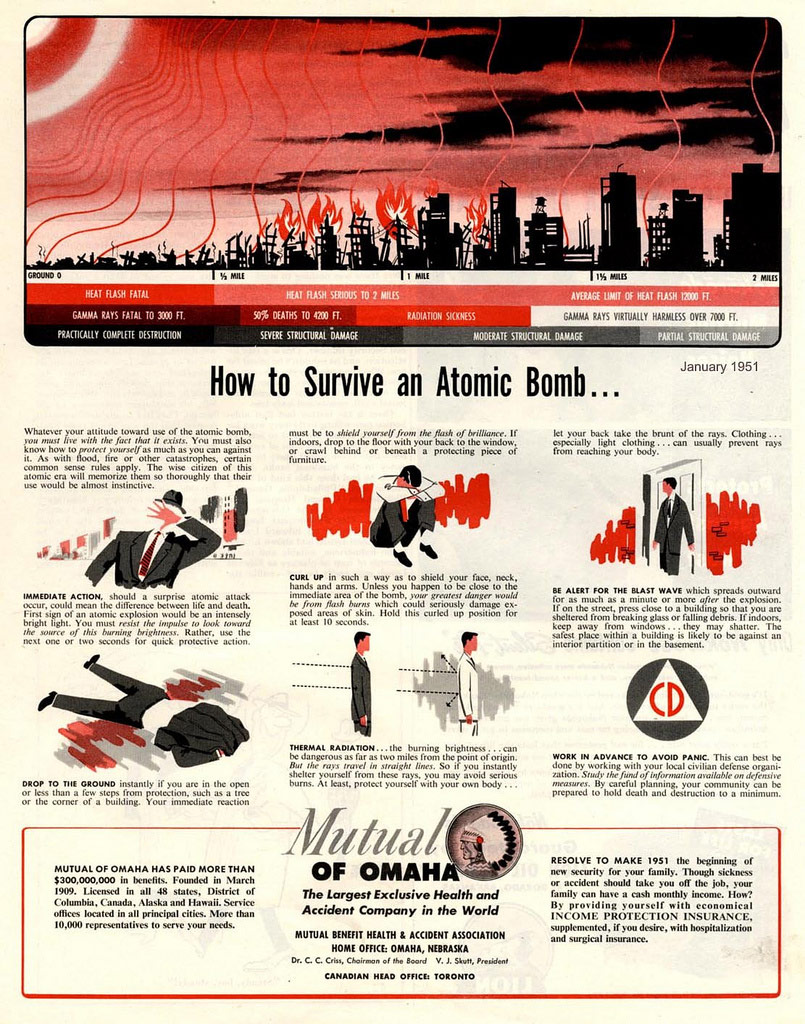
Reported today in The New York Times, “Defense Secretary Leon E. Panetta warned Thursday that the United States was facing the possibility of a ‘cyber-Pearl Harbor’ and was increasingly vulnerable to foreign computer hackers who could dismantle the nation’s power grid, transportation system, financial networks and government.”

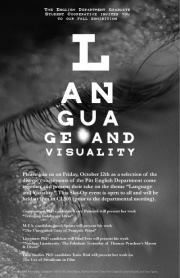
Also, today I will be giving a (hopefully quite) short talk entitled “Nuclear Luminosity: The Fabulous Metahistorical Textuality of Thomas Pynchon’s Mason & Dixon” for the Univ. of Pittsburgh English Grad Student Scholarship Collective Fall Symposium, Language & Visuality. The event will be taking place in CL 501 @ 1pm. In addition, Kerry Banazek-PhD in Comp/Rhet, Jacob Spears-MFA, and Katie Bird-Phd in Film will be speaking.

DFW Excerpt: “These are tense linguistic times”

My Freshman Composition course just wrapped up a lively discussion of DFW’s “Authority and American Usage” (originally published in Harper’s as “Tense Present”), and though I think I probably wanna do some different stuff w/ it next time . . . here’s a lovely excerpt:

The insecurities that drive [Politically Correct English], [Academic English], and vocab-tape ads are far from groundless, though. These are tense linguistic times. Blame it on Heisenbergian uncertainty or postmodern relativism or Image Over Substance or the ubiquity of advertising or PR or the rise of Identity Politics or whatever you will–we live in an era of terrible preoccupation with presentation and interpretation, one in which the relations between who someone is and what he believes and how he “expresses himself” [DFW’s fn.: (Notice the idiom’s syntax–it’s never “expresses his beliefs” or “expresses his ideas.”)] have been thrown into big-time flux. In rhetorical terms, certain long-held distinctions between the Ethical Appeal, Logical Appeal ( = an argument’s plausibility or soundness, from logos), and Pathetic Appeal ( = an argument’s emotional impact, from pathos) have now pretty much collapsed–or rather the different sorts of Appeals now affect and are affected by one another in ways that make it nearly impossible to advance an argument on “reason” alone. (David Foster Wallace, “Authority and American Usage,” in Consider the Lobster and Other Essays [New York: Little, Brown and Company, 2006], 116, my emphases.)