Labor Day Links

Lois Weiner has a very interesting piece in Jacobin, “This Labor Day, Thank a Teacher,” on how teacher’s unions are revitalizing the labor movement.

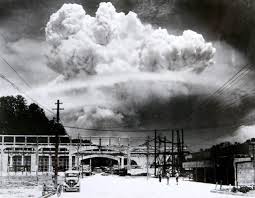
The levels of radiation leaking out of Fukushima are considerably higher than was previously reported.

And there may be a bigger surveillance system then PRISM, as reported on in The New York Times by Scott Shane and Colin Moynihan in “Drug Agents Use Vast Phone Trove, Eclipsing the N.S.A.’s.”

Hyperarchival Realism, Surveillance, and the Control Society

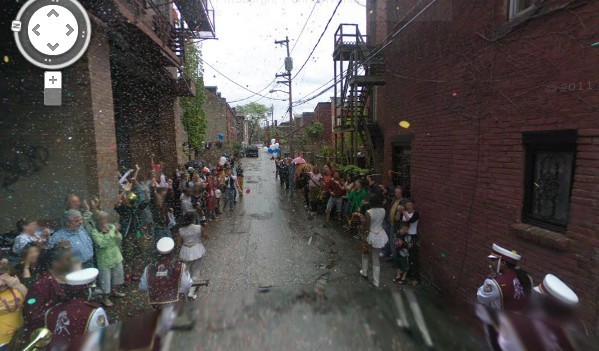
Christine Jun for Dazed Digital has posted an  A-Z list of some incredible contemporary art that engages with technologies of surveillance in “The dA-Zed Guide to Surveillance: Drones in the Sky, Whistleblowers in Jail: How Art is Responding to Big Brother’s Watch.” Of especial note is Robin Hewlett and Ben Kinsley‘s Street with a View, which was done a number of years ago while both were pursuing Master’s of Fine Arts degrees at Carnegie Mellon University, just down the street from me. I have met Ben a few times and had the opportunity to talk with him about this project while he was working on it. A pic (and a link to the Street with a View at Google maps):

Street with a View

I especially appreciate Hewlett and Kinsely’s hyperarchivally realist work here for integrating the archival processes of contemporaneity, the all-surveilling  eye of Google and their maps, the social and local residents of the area, and what in the end is pretty high-concept performance art. Simply wonderful. (And that they somehow got Google to come out and take part, all the better. I also probably should have posted something about Street with a View years ago, but I’m glad being pointed toward Dazed Digital‘s A-Z list reminded me of how excellent this happening was.)

Fukushima Over Two Years Later

In “Fukushima: Vast Amounts of Radioactive Water Creeping Towards Sea,” Mari Yamaguchi has reported for Talking Points Memo that “deep beneath Fukushima’s crippled nuclear power station a massive underground reservoir of contaminated water that began spilling from the plant’s reactors after the 2011 earthquake and tsunami has been creeping slowly toward the sea. Now, 2 1/2 years later, experts fear it is about to reach the Pacific and greatly worsen what is fast becoming a new crisis at Fukushima: the inability to contain vast quantities of radioactive water.”

Humanities and Economics

Economist and former dean at Princeton Christina Paxson has written an interesting article for the New Republic, “The Economic Case for Saving the Humanities.” Therein she asks if the humanities are “worth it” economically and argues that

support for the humanities is more than worth it. It is essential. . . . It is really important we get this right. A mountain of empirical evidence indicates a growing inequality in our society. There is no better way to check this trend than to invest in education. And there is no better way to invest in education than to invest fairly, giving attention to all disciplines and short shrift to none.

Even though many of us may take Paxson’s argument wholly for granted already–that those of us who think about the issue a bit realize that of course the humanities have significant bearing on economics–the threats to the humanities largely boil down to their perceived lack of economic viability. If this perception can be combated, we may see other criticisms fall away.
The National Security State and Dystopian Narcissism

Today’s sentencing of Bradley Manning to 35 years in prison has provoked considerable outrage. Birgitta Jónsdóttir addresses this nicely in her piece for The Guardian, “Bradley Manning’s Sentence: 35 Years for Exposing the Truth.”

And Rob Goodman has a very compelling piece on “dystopian narcissism” for The Chronicle of Higher Education titled, “The Comforts of the Apocalypse.” Dystopian narcissism is the selfish belief that your time, your civilization, your world is somehow unique in its proximity to the end times, to the disaster, to the apocalypse. As Goodman writes: “We’re virtually guaranteed to witness the end of nothing except our lives, and the present, far from fulfilling anything, is mainly distinguished by being the one piece of time with us in it.” I’ve been saying this for years. (Though perhaps the Doomsday Argument would disagree, as perhaps would Nick Bostrom [here and here and here and here] .)

Fall 2013

Here are .pdfs of syllabi for classes I will be teaching this fall at the University of Pittsburgh:

Reading Poetry (ENGLIT 0315)–“American Poeisis: Imagining the Twentieth Century”

Introduction to Critical Reading (ENGLIT 0500)–“Light and Darkness in the Twentieth Century”

Narrative and Technology (ENGLIT 0399)–“Narrating Nuclear, Information, and Biological Technology”

And my Narrative and Technology students will be keeping a class blog. Check it out here.

Anticipating Thomas Pynchon’s Bleeding Edge

Thomas-Pynchon_Bleeding-Edge-Cover

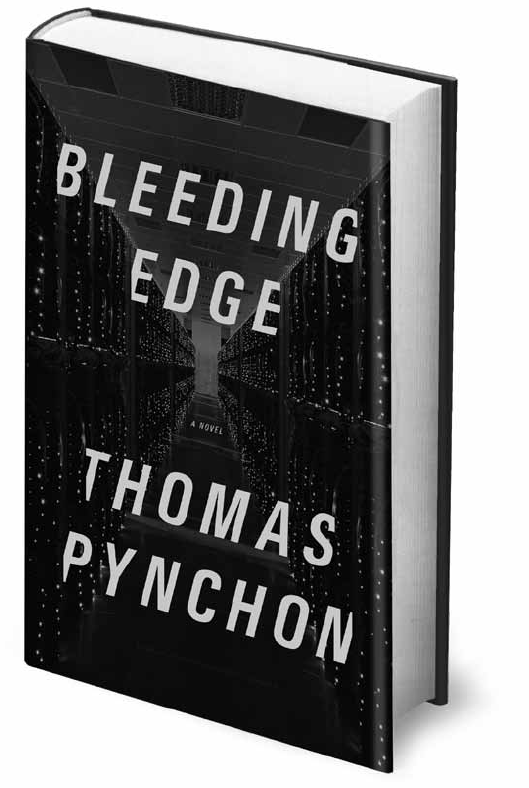
As the publication date of Thomas Pynchon’s new novel, The Bleeding Edge is only now a month away (17 September 2013), I thought I might post a number of links previewing it.

Slate has a few brief comments on Pynchon, but more importantly, the first page of the novel, which features a wonderful description of early-2000s New York.

J.K. Trotter wrote a fairly extended piece for the Atlantic in June, “Thomas Pynchon Returns to New York, Where He’s Always Been.”

Library Journal has a brief preview, as does The Examiner.

The New Yorker celebrates the fiftieth anniversary of the publication of V. (1963).

There is what appears to be the first review of the novel (though I’m skeptical).

A panel at MLA 2014 has already been announced that will discuss Bleeding Edge.

And even Grantland is in on the hype.

I myself will be putting in my pre-order any day now.

For further info on Pynchon, see the always wonderful thomaspynchon.com, Spermatikos Logos, and the Pynchon wiki.