Reconsidering Southland Tales and an Old Conference Abstract

southland tales

Appropriately, as today is 4 July, an old friend directed me to Abraham Riesman’s reconsideration of the absolutely wonderful Southland Tales (2006) and interview with its director Richard Kelly, “The World Ends with a Handshake: Unraveling the Apocalypse of Southland Tales.” (Thanks Robin!)

This is a film I have taught and written about (though before this blog’s time). The incomparable Steven Shaviro talks about it here and in his most recent book. And I guess there’s a pretty decent fan site for it: Fuck Yeah, Southland Tales.

I also presented on Southland Tales at my first academic conference ever, SLSA 2008. Here is an abstract for the paper I gave there (since I’ve never posted it):

Apocalyptic and messianic narratives have traditionally taken place in a stable, teleological temporal space, and for good reason.  The affective impact of their grand narratives have depended upon the necessity for certain forms of meaning to be stable in a world with a distinct beginning and ending.  Richard Kelly’s 2006 film Southland Tales, however, takes reiterating the present, and consequently the past and the future as well, as its dominant structural mode.  From Justin Timberlake’s lip-synched music video of a Killers song, to reversing T.S. Eliot’s famous line: “Not with a whimper but with a bang,” to the division of the protagonist into two distinctly instantiated embodiments, the constant reiteration of various cultural detritus in Southland Tales reveals not so much a postmodern “mash-up” of reference and self-consciousness, as it does a reiteration of Nietzsche’s metaphor of the gateway of the Moment from Thus Spoke Zarathustra.  In other words, Southland Tales offers an alternate history of the present, a view of temporality in which, in Zarathustra’s words, “Must not whatever can happen have happened, have been done, have passed by before?”  This paper will investigate how Kelly’s film reiterates Nietzsche’s critique of the scientific enlightenment through his figure of Zarathustra and the Eternal Return, while simultaneously reiterating the very eschatological messianism that so dominates apocalyptic narratives (and Nietzsche’s own critique) in a manner that emphasizes a much more fluid, synchronic view of history, and hence the unstable present as well.

I will hold off on posting the paper, as it is definitely old graduate work that should not necessarily see the light of day. But all this is making me want to return to Southland Tales, as I do not imagine exhausting the film anytime soon. (This also makes me want to get on Twitter, just so I can follow Richard Kelly.)

Some Thinking on the Present and Future of Disaster

Some wonderfully bleak things I’ve run across this week: Margaret Ronda’s, “Mourning and Melancholia in the Anthropocene,” in Post45; and I am eagerly waiting for Liam Sprod‘s Nuclear Futurism: The Work of Art in the Age of Remainderless Destruction (Zer0 Books, 2013) to arrive in the mail. Post45 also has a fairly interesting piece from October on Thomas Pynchon: David J. Alworth, “Pynchon’s Malta,” Post45.

Abstract: Infinite Oppenheimers and Postnatural Metahistory: Jonathan Hickman’s Manhattan Projects

Below is an abstract for a paper I will be presenting at the 2013 Society for Literature, Science, and the Arts Conference, taking place October 3-6 a Notre Dame University.

Infinite Oppenheimers and Postnatural Metahistory: Jonathan Hickman’s Manhattan Projects

From the perspective of what number of young scholars and nuclear critics are calling a second nuclear age, I would like to suggest that one site of the “postnatural” can be found in the remarkable cultural intersection between narratives of nuclear history and contemporary ecological understandings of catastrophe and risk. Though there are any number of instances of such aesthetic correspondences and dissonances, for instance the spectacle of cinematic destruction that dominated the last decade, one might do well to look to texts that, parallel to the non-event of Mutually Assured Destruction, eschew moments of narrative disaster. Writer Jonathan Hickman and artist Nick Pitarra’s The Manhattan Projects (Image Comics, 2012- ) is such a text, imagining that work on the atomic bomb at Los Alamos was “a front for a series of other, more unusual, programs.” Hickman’s writing picks up a tradition of re-imagining nuclear history, familiar to any reader of Thomas Pynchon, and adds a superheroic twist: J. Robert Oppenheimer is consumed by his infinite personalities, Enrico Fermi is an alien, F.D.R. is reborn as an A.I., Albert Einstein plays the role of Wolverine, etc. This paper will argue that Hickman’s work emerges from a particular moment in which nuclear, information, and biological sciences are raising a host of interesting questions for contemporary narrative. Hickman’s radically alternative history of twentieth century science and politics emerges from a postnatural perspective whose horizon surpasses the globe, positioning nuclear history within a galactic ecology in order to rigorously problematize the posthuman.

Nuclear Pasts and Presents

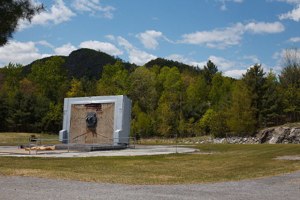
Mark Frauenfelder, founder of Boing Boing, has reported about this little gem he found on Realtor.com: 87 Hale Hill Lane, Lewis, NY 12950. Or, to be less precise, an old missile silo that has been converted into a home. It’s on sale for only $750,000. Scott Garner (who I assume is the listing agent) has explicitly advertised it as: “Live in the Launch Control Center of this Cold War Missile Silo.”

missile silo

On the phenomenon of old missile silos and bunkers being repurposed, see photographer Richard Ross‘s Waiting for the End of the World (New York: Princeton Architectural Press, 2004), a fairly wonderful photo-essay on the subject. Sarah Vowell also interviews Ross in the book.

silo

The Nuclear Uncanny of Robert Longo

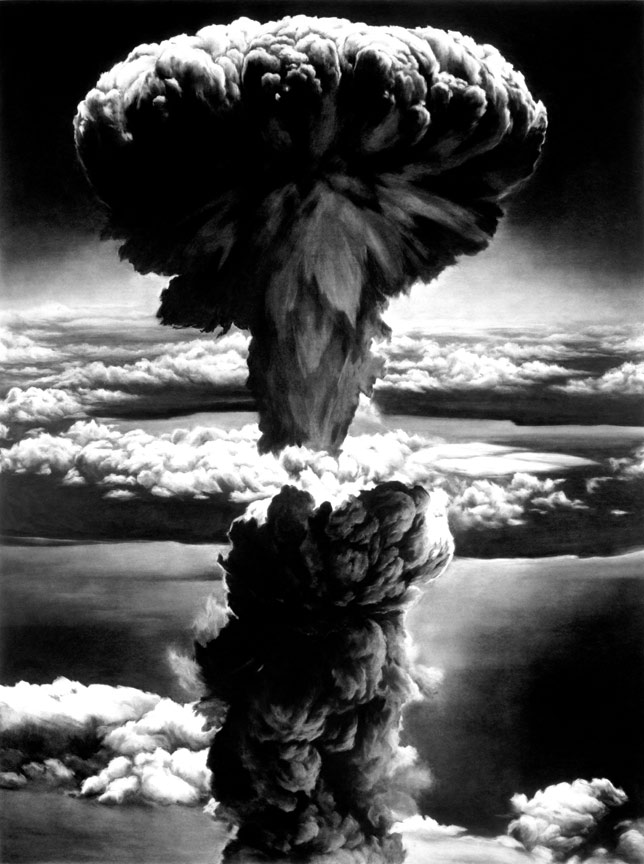
When looking earlier today at a bunch of striking photorealist painting and drawing, I came across the image below. It is a charcoal drawing of the nuclear bombing of Nagasaki by artist Robert Longo. (Strangely enough, in addition to being an artist, he also directed the 1995 film Johnny Mnemonic, based on a William Gibson short story. It was Longo’s only feature film.) He has a whole series of charcoal drawings of nuclear explosions. His website is here. His work is also currently part of a group exhibition, “Disaster: The End of Days,” at the Galerie Thaddaeus Ropac in Paris.

Robert Longo Drawing of Nagasaki

Nuclear Morale Crisis?

On 8 May 2013, Michael R. Gordon for The New York Times and others reported that “The Air Force removed 17 officers assigned to standing watch over nuclear-tipped Minuteman missiles after finding safety violations, potential violations in protecting codes and basic attitude problems.” This has caused the AP  to ask “Is There a Morale Crisis in the US Nuclear Force?” Well, yes. And it is history and those damned politicians’ faults. If they just stopped trying to reduce the nuclear arsenal, morale would be higher. An excerpt:

Bruce Blair, a former missile launch officer and now a national security scholar at Princeton University, said Friday that morale has dropped in part because the ICBM mission that originated in 1959, deterring the Soviet Union from attacking the U.S. or Europe, is less compelling than it was generations ago.

“This dead-end career is not the result of shrinking nuclear arsenals, but rather because the Cold War ended decades ago and because so few senior commander jobs exist within the missile specialty,” Blair said. “Most crews can’t wait to transfer out of missiles into faster-track careers such as space operations, but the Air Force doesn’t make it easy.”

[Air Force Secretary Michael] Donley came close to blaming the White House for any malaise. He said that when officers see “the national leadership” contemplating more nuclear reductions “this does have a corrosive effect on our ability to maintain focus on this mission.” He also said “critics or others” contribute to this when they suggest getting rid of the ICBM force entirely.

Yeah, because this should all be our primary concern with regard to nuclear weapons: that the morale of soldiers stays high. I don’t know what to say.

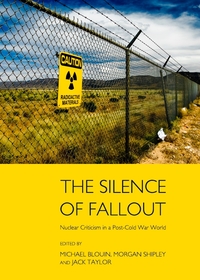
“Apocalypse Networks: Representing the Nuclear Archive” in The Silence of Fallout: Nuclear Criticism in a Post-Cold War World

Silence of Fallout Cover

Michael J. Blouin, Morgan Shipley, and Jack Taylor have edited a great collection of essays on nuclear criticism, The Silence of Fallout: Nuclear Criticism in a Post-Cold War World (this links to the publisher page). I have an essay in the collection, “Apocalypse Networks: Representing the Nuclear Archive,” that any reader of this blog would probably find quite interesting. And of course there are a number of other interesting essays by accomplished scholars and nuclear critics. You can preview the table of contents, the preface, and the introduction here. And the book is now readily available for order from Amazon and of course other places. (Probably the quickest way to get it would be going directly to CSP’s site.)

I’ve included the Table of Contents below:

Preface, John Canaday

Introduction: The Silence of Fallout, Michael J. Blouin, Morgan Shipley, and Jack Taylor

Chapter One: “What Works”: Instrumentalism, Ideology, and Nostalgia in a Post-Cold War Culture, Jeff Smith

Chapter Two: Specters of Totality: The Afterlife of the Nuclear Age, Aaron Rosenberg

Chapter Three: Queer Temporalities of the Nuclear Condition, Paul K. Saint-Amour

Chapter Four: Apocalypse Networks: Representing the Nuclear Archive, Bradley J. Fest

Chapter Five: Cut to Black: Nuclear Criticism in a Post-September 11th America, Joseph Dewey

Chapter Six: The Pixilated Apocalypse: Video Games and Nuclear Fears, 1980-2012, William Knoblauch

Chapter Seven: Depictions of Destruction: Post-Cold War Literary Representations of Storytelling and Survival in the Nuclear Era, Julie Williams

Chapter Eight: Allegories of Hiroshima: Toward a Rhetoric of Nuclear Modernism, Mark Pedretti

Chapter Nine: War as Peace: Afterlives of Nuclear War in David Foster Wallace’s Infinite Jest, Jessica Hurley

Chapter Ten: The Hunger Games: Darwinism and Nuclear Apocalypse Narrative in the Post-9/11 World, Patrick B. Sharp

Chapter Eleven: Legacy of Waste: Nuclear Culture After the Cold War, Daniel Cordle

Chapter Twelve: In a dark wud: Metaphors, Narratives, and Nuclear Weapons, John Canaday

Weaponizing the Weather

Jacob Darwin Hamblin has an essay up on Salon titled, “We Tried to Weaponize the Weather.” He writes:

The years between the first hydrogen bomb tests and the Limited Test Ban Treaty in 1963 saw more than just increased anxiety about the effects of nuclear testing on weather. They also saw increased interest in large-scale, purposeful environmental modification. Most climate modification enthusiasts spoke of increasing global temperatures, in the hopes that this would increase the quantity of cultivated land and make for fairer weather. Some suggested blackening deserts or snowy areas, to increase absorption of radiation. Covering large areas with carbon dust, so the theory went, would raise temperatures. Alternatively, if several hydrogen bombs were exploded underwater, they might evaporate seawater and create an ice cloud that would block the escape of radiation. Meteorologist Harry Wexler had little patience for those who wanted to add weather and climate modification to the set of tools in man’s possession. But by 1958 even he acknowledged that serious proposals for massive changes, using nuclear weapons as tools, were inevitable. Like most professional meteorologists, in the past he had dismissed the idea that hydrogen bombs had affected the weather. But with the prospect of determined experiments designed to bring about such changes, he warned of “the unhappy situation of the cure being worse than the ailment.”

Oh the things we’re learning about the terrible ideas people had during the first nuclear age.