On a bit of a personal note, yesterday I defended my dissertation, “The Apocalypse Archive: American Literature and the Nuclear Bomb.” As I move now toward turning it into a book, the first thing I’m gonna change will probably be the title. Onward toward more nuclear criticism and hyperarchival realism.
Nuclear Criticism
Repackaging the Archive (Part IX): Concluding Robert Jordan’s Wheel of Time after Twenty Years and Some Notes on the Mega-Text

We’re a team of sparkle horses lashed to capitalism.
—Bardo Liere Parté, “Index of Petty Tragedies”
I am both embarrassed and proud to report that I recently concluded reading Robert Jordan’s The Wheel of Time (1990-2013). I have been reading this series of novels for the past twenty years. And I have not been alone in this activity.
Spanning fourteen volumes and nearly twelve-thousand pages,[1] Jordan’s text is quite the literary achievement in terms of longevity, scope, and length. The Wheel of Time of time is, quite simply, one of the longest fantasy epics ever written. And I imagine that it will continue to capture the popular imagination in a number of ways going forward. If George R. R. Martin’s projected seven volumes of A Song of Fire and Ice (1991- ) can be made into a wildly successful television show on Home Box Office, the sky’s the limit for The Wheel of Time. It does not seem too early to think about it as a text that should be taken seriously by literary scholars interested in emerging long forms, dispersed (or distributed) narratives, and the contemporary hyper-commodification of narrative.
The Wheel of Time raises questions about literary “authorship” and the novel-as-mega-text, and it resides between the two extreme poles of the mega-text: works by a single author on one end of the spectrum; and on the other, emergent texts like massively multiplayer online games and works of the multitude. Jordan’s tragic death in 2007, and the subsequent completion of the series by Brandon Sanderson, invokes not only questions about the death of the author, but the work of the multitude, as The Wheel of Time positions itself between these poles in a number of interesting ways, and will continue to do so for the foreseeable future.
Sanderson’s final three novels, The Gathering Storm (2009), Towers of Midnight (2010), and A Memory of Light (2013), though satisfyingly faithful to Jordan, and perhaps refreshingly concise, resemble Jordan almost too well.[2] One always got the sense with Jordan that his imagination had been run through some fantasy-narrative generating algorithm that just produced endless serialization, and Sanderson is nothing if not evidence that this type of narrative production (in the full sense of the term) can be outsourced. At the end of the day, The Wheel of Time is best understood as a narrative machine whose clear goal is to produce a considerable amount of money by selling thick volume after thick volume once every couple years for twenty-three years. When D.H. Lawrence once called Walt Whitman a machine, he had no idea. The Wheel of Time is an immense narrative machine. And its terms are drawn firmly by the conditions of late capitalism.
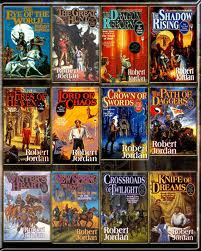
And I mean that in a number of ways. First and foremost, though surely not on par with Tim LaHaye and Jerry B. Jenkins’s Left Behind (1995-2007) and Harry Potter (1997-2007) in terms of commercial success and in the number of volumes sold, which wildly outrank Jordan in those categories, The Wheel of Time has still consistently debuted at number one on The New York Times best seller list, has sold over forty-five million copies, and is obviously one of the richest intellectual properties (IPs) available in terms of its potential for further commercialization and capitalization. Even Sanderson’s ending which, I suppose, is one I won’t spoil, leaves the door open to further narrative.[3] I will be surprised if there is not considerably more Wheel of Time ahead that will appear across a range of different media.[4] In short, it will become a text written by an unnameable many. Sanderson is probably only the first in a long line of Jordan surrogates.
But I wish this wasn’t the case. I hope they let it stand as a book / text that can only be read (despite all the text’s obvious and insidious problems, of which there are many). I know there is no way this will happen. We inhabit the small period of time when we can say that The Wheel of Time is principally a series of books rather than a dispersed set of (not always fully related) texts on diverse media platforms. There is yet no television show, no movie, no MMORPG. So for the moment it is an excellent example of a “single” author mega-text. (Sanderson is so faithful to Jordan that one might suggest he does Jordan better than Jordan, and more concisely.) And since it is such a large, exhaustive, encyclopedic text whose principal attraction is precisely its massive proliferation and accumulation, it is a good site to begin sketching some thoughts about how single author mega-texts function.
In a previous post on Mass Effect 3 I defined the mega-text as something that required incredibly non-trivial effort and time to experience or complete. I have been reading Jordan’s novels since the end of fifth grade. I consider this to be a non-trivial amount of time. I continued reading because I had become wholly absorbed in the series’ telos; like many, I had to know how it ended. I reached a moment when I had been reading The Wheel of Time for so long that I couldn’t not keep reading. This wasn’t a kind longue durée page-turner. It was like a job. (Once one gets in the habit of repeating a task, it becomes second nature.) Regardless of how much my literary taste may have matured or changed, once every couple years I found myself wrapped around a new Wheel of Time book for a day or two, tearing through its 900+ pages. Reading it became ritualistic, familiar, a way of marking the passage of the years. A way of reflecting. But I also constantly had to ask myself why I continued reading this interminable, never-ending tale that only seemed to accumulate narrative threads rather than resolve those threads. It was maddening.[5] By the time I received another volume I would have forgotten much of the narrative arc. So rather than be engrossed, I would often be confused, forgetful, dislodged. It became a way of remembering and pointing to a larger (often personal) and multiplicitous past, briefly and captivatingly glimpsed in the threads of narrative repetition and familiarity. Most recently, The Wheel of Time is yet more proof that I am indeed getting old. Time passes. The body wastes away. And I imagine I am not alone with such feelings. Twenty-three years is a long time to wait to learn how a story ends. The mega-text, quite simply, requires and produces different temporalities of reading.
Another reason The Wheel of Time is such an effective narrative machine resides in its affect. Its plot is compelling. That is its whole raison d’être. The series accumulates narrative threads from the perspective of messiahs, apostles, prophets, wizards (Aes Sedai), etc., etc., quite readily. With its hundreds of (often compelling) POV characters, it positions the reader as “agent” of the novel’s world’s history, a multiplicitous omni-subject urged to connect itself affectively to the dramatic sweep of the narrative network, to inhabit multiplicitous “subject” positions within the history of the series’ world. And the networked scope of the work is very much part of what produces The Wheel of Time’s particular brand of literary pleasure.
Jordan’s epic offers up a vast history that is often developed in excruciating and exacting detail. This often means that the emotional texture of Jordan’s prose is formulaic, with consistently flummoxed wooly-headed men being stared down by some bemused woman with her arms crossed beneath her breasts.[6] Each novel’s structure is fairly similar and repetitive, with some kind of “boss fight” at the end of nearly every volume.[7] And of course there are the necessary “twists” and peripeteia that upset the direction(s) of the narrative arc(s). More than anything, the series’ narrative is achingly, mind-numbingly teleological. At a certain point, the pleasure of Sanderson’s ending was that nothing was surprising, that it was predictable. Sanderson fulfilled his contract with Tom Doherty Associates as well as with the reader.
Consequently, a reading of The Wheel of Time as a fervently conservative, end-of-history-era document engaged in nostalgically imagining a strange Medieval version of a neo-liberal economic paradise, clearly suggests itself given the text’s sense of a monolithic, eschatological history. The (evangelical) Christian overtones of the reborn messiah figure lording over multiple nations in order to hasten and prevent the destruction of the world, thereby fulfilling “history,” is blatantly in line with Reagan-era neoconservatism, 1990s-2000s American neo-evangelism, and the national fantasy attending the closing days of the Cold War (there is a thoroughly “evil empire” who of course will get defeated.[8]) If there is any gesture toward other traditions, say, Eastern spirituality—i.e., the yin-yang duality of the male and female halves of the “one power” (which I think can / should be read as the mechanical / electronic harnessing of the universe’s forces along the lines of Henry Adams’s dynamo or the atomic bomb)—this spirituality is thoroughly orientalist, a result of mining other cultural traditions for their exoticism. The hegemony of European modes of living and their contrast to the more “exotic” cultures in Jordan’s world also reinforce the novels’ Eurocentrism, fully locating the West as the principal site of (its) history.[9] Further, many aspects of the books appear to be as almost perfect allegories for the displacement of 1990s conservative ideology onto this space of fantasy. The entire series is pushed by the inhuman weaving of “the pattern” (the force of the “free market”) toward the destruction (production) of the Dark One (profit). Rand al’Thor, the novel’s antichrist / messiah, known as the Dragon Reborn,[10], [11]rather than having as his principal activity the epic “task” of adventuring, largely spends his time dealing with bureaucracy and procedure, organizing men, putting them to work. By the final book, A Memory of Light, he is more like some kind of abstract idea or concept than he is anything resembling a rounded “character.” He is a messiah-as-American-CEO. Surrounded by advisors telling him otherwise, he still boldly sets forth on a path of radical individualism. And like any good technocrat, he grew up in humble surroundings, never asking for the mantle of leadership or responsibility to be placed upon him, while refusing to bend under the weight of his monolithic(ally normative[ly boring]) responsibility. He is the hybrid character that would be produced if the fantastic worlds of Ayn Rand and J.R.R. Tolkien crossbred.
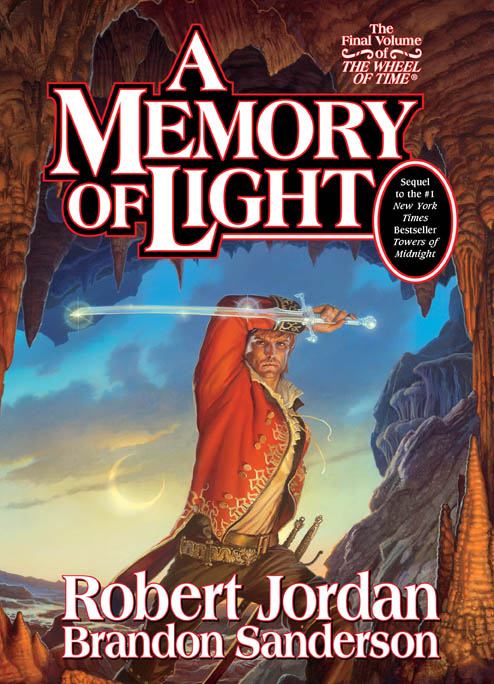
One of the clearest things about how one should approach The Wheel of Time is that the series is everywhere marked by a will to project a world, to create or textually become a world. And this is one of the principal locations where its conservative project can be seen. The world of The Wheel of Time is its primary “character,” its primary concern, rather than the humans inhabiting that world. In fact, Jordan’s perspective on human interaction and social realities is fairly adolescent. This is probably unsurprising given that one can probably assume that TOR Books is aware that a significant portion of its readership are (or at least once were, like myself many years ago) male adolescents. So, rather than the creation of a world in order to more fully imagine the limits and possibilities of the human, this mega-text formally requires the reification of its human subjects, limiting their range of emotion and expression to the capacities of a geeky adolescent. That the series continually emphasizes the network of connections between the denizens of its world only reinforces the sense that reading The Wheel of Time can be like scrolling through your thirteen year-old nephew’s Facebook feed. Everything the characters think or say, regardless of its significance, is exhaustively and repetitively provided. Through the reification of the human in Jordan’s space, communication in this brand of the mega-text becomes principally mere information, hyperarchivally accumulating in order to absorb (and commercially collect) the reader(’s parent’s hard-earned cash).
Projecting or creating a world is often one of the principle features of the mega-text. These worlds can serve progressive or critical functions, like the world(s) Thomas Pynchon creates between V. (1963) and Inherent Vice (2009),[12] or they can, like Jordan’s text, endlessly reproduce the prevailing cultural logic of the text’s contemporary moment. In other words, there is nothing inherently progressive or liberating about the mega-text. It can serve less noble ends as easily (and perhaps more easily) than it can be a vehicle for critique. There is nothing inherently avant-garde or experimental about the mega-text. Jordan’s oft-commented upon drawing out of the series, its floundering in narrative complication and extension, especially (during the decade!) between A Crown of Swords (1996) and Knife of Dreams (2005),[13] is one of the best examples of the hyperarchival impulse of contemporaneity as realized in literary narrative. For a while, the series seemed to only be interested in endlessly accumulating itself, gathering more and more words and pages, despite its obvious eschatological thrust. It took Jordan’s death, a distinct and incontrovertible end, for someone to actually finish the series (something one might suggest Jordan simply could not do while he was alive). In this way, The Wheel of Time perfectly displays the underlying logic of the mega-text-as-commodity. It both must be teleological (apocalyptic) while always deferring the end in the service of profit, only ending when it no longer is profitable to not end. It can only end after the end; the mega-text in Jordan’s sense is always already post-apocalyptic. In this sense, The Wheel of Time’s serial nature is somewhat different than television or the comic book, though obviously similar. It had to have a sense of an ending, from page one, but it could only become a mega-text while deferring this ending, while simultaneously knowing that someday it must end. (In this sense, it also shares much with the nuclear imagination in terms of the continual deferral of an eschatological projection that [sometimes] seems “inevitable.”)
Perhaps more than anything, however, The Wheel of Time might now be considered a touchstone for the mega-textual novel. Obviously this claim can be argued with, and I hope it is, but in sheer scope and size, it will stand monumentally over the fantasy genre for a number of years. Though I don’t imagine it will ever replace Tolkien as fantasy’s primary referent, Jordan is surely trying to outdo The Lord of the Rings (1937-1949) in a number of ways, and the comparisons between the two will continually be drawn. George Martin will rival Jordan, but he would have to write for another decade (or more, probably) to equal The Wheel of Time’s scope. For the moment, The Wheel of Time is the mega-textual novel par excellence of contemporaneity. And I hope these brief notes begin to point toward some of the ways of engaging with the text that might prove critically productive. The Wheel of Time has so clearly captured a certain segment of the American imaginary precisely because of its size (and little else), and it is so clearly an outgrowth of our current moment’s hunger for accumulating text, information, and data, that to ignore its logic would be a major oversight for thinking about how literature works in the twenty-first century.
[1] It’s fifteen volumes if you count New Spring (2013). This is also to note that hopefully I will be posting more original material / critical writing to this blog now that I have finished the first draft of the dissertation. So stay tuned. There are a number of critical projects I have in the works that this seems the best venue for, including some thoughts on Fallout: New Vegas (2010).
[2] Jordan did leave behind considerable notes, and Sanderson claims that Jordan composed a manuscript of the last chapter, so the words are all his at the series’ end.
[3] Even if the fact that the series finally ended is the occasion for writing this post . . . one could easily imagine that, after the monumental adaptation of The Wheel of Time that goes from 2017-2032 (much like is happening with Star Wars [1977-?] right now), in 2042 they’ll make the first MMOARG, or whatever, as The Wheel of Time 2. Nerds of the future beware. I’m predicting the hyperinternetwhatevermachine is going to explode with impotent nerd rage about “authenticity” or whatever.
[4] Jordan’s IP has already tentatively started to cross-pollinate with other media. There was a Wheel of Time computer game published in 1999. Wizards of the Coast released The Wheel of Time Role Playing Game in 2001. During the heyday of Magic: The Gathering and collectible card games, there was a short-lived Wheel of Time: Collectible Card Game (2000). There has been a comic book series, published by Dynamite Entertainment, The Wheel of Time: The Eye of the World (2005- ). And there are reports of a video game in development by Red Eagle Games.
Most significantly, however, it has been reported that Jordan’s estate has optioned the rights to the Universal Entertainment Corporation. (The National Broadcasting Company has no idea what kind of goldmine it’s sitting on here.) Unlike Martin, Jordan is pretty PG-13, and thus perfect for primetime network drama. The scope of the narrative would probably permit a relatively small budget, at least at first (The Eye of the World [1990] occurs primarily in the countryside, and the first book’s ability to be filmed on a modest budget I have to imagine was on Jordan’s mind. Jordan might not be much to speak of as a prose stylist, but he repeatedly proved himself a shrewd businessman). I also imagine that there is a significant potential for a Wheel of Time massively multiplayer online game.
[5] I distinctly remember conversations in a warehouse one summer with another Jordan aficionado about how it would never end. I hope he enjoyed the series’ conclusion(s). This is also way of thanking all those I read and talked about The Wheel of Time with during middle school (the early 1990s).
[6] One might suggest that were Jordan’s prose any more rich or engaging (i.e., at all), this would distract from the absorptive quality of the narrative.
[7] In this way it readily suggests a video game adaptation.
[8] Even from the opening pages of the text can I imagine that this “spoiler” surprises anyone.
[9] I.e., the appearance of the Sharans in the last book, one of the few people / places in the series that was frequently referred to but never represented, is a particularly acute instance of Jordan’s orientalism. They appear seemingly randomly, without the (endlessly articulated) motivations of other events. They have nothing resembling the history of the nations the main characters inhabit. And their ahistorical existence means that they can readily be killed by the forces of “light” without worrying about their essential humanity (as opposed to killing the inhuman Trollocs or Myrddraal, inhuman monsters who have nothing resembling subjectivity). This is also probably the place to note that The Wheel of Time of course has an extensive wiki.
[10] Don’t worry I have neither the time nor the space nor the inclination to start talking about the plot, which is probably revealing in that the details of the events in the book, at the end of the day, are both superfluous and encyclopedic, normative and exhaustive, interesting and super boring. It also may necessitate a new way of talking about “reading,” because “close reading” (or “distant reading”) do not really work here. Perhaps a term like “patient reading” is in order—i.e., to critically approach The Wheel of Time simply requires the patience to read twelve-thousand pages (no matter how “entertaining” they might be).
[11] I should also note that Jordan is highly conservative in terms of gender and sexuality (though Sanderson addresses this a bit in the final books, which is appreciated), and is at times a bit misogynist. (I.e., Rand has three wives and continually misunderstands them. Then they’re frustrated by his inability to understand, which frustrates him, ad nauseum. There are very few relationships in the book that resemble real adult relationships.
[12] Who knows how Bleeding Edge (2013?) might (or might not) complicate this.
[13] Jordan’s titles were (laughably) unimaginative. If he had stayed alive indefinitely and kept writing (without finishing, ever), he would eventually have had to arrive at a title that read: The Noun of Nouns.s
More North Korea (Nuclear) Sabre Rattling: An (In)Appropriately Ridiculous Response
As io9 reports, North Korea “has released a four-minute propaganda clip depicting the White House under attack. Entitled, ‘Firestorms Will Rain on the Headquarters of War,’ the video is yet another example of the disturbing — and seemingly inexplicable — rhetoric that’s suddenly pouring out of Pyongyang.”
I’m tempted to think that this video should be read in the long tradition of hurriedly making a film based upon a forthcoming blockbuster in order to release the derivative film before said blockbuster so that the derivative film can capitalize on the attention leading up to the release of the blockbuster. (I tried to find a more elegant way of putting this, but have clearly failed). For example, Deep Impact (1998) was clearly made in order to benefit from Armageddon (1998), which came out two months later, and the terrible Skyline (2010) was made anticipating (the also not good) Battle Los Angeles (2011). (I wrote about Skyline a while ago.) Other examples are too numerous to list, but there are many.
The above is clearly anticipating Olympus has Fallen (2013), which will be released tomorrow. If you have seen the trailer (below), Olympus has Fallen portrays the destruction of iconic Washington DC monuments w/ better special effects than the Capitol Building in the crosshairs right before the 3:00 mark of the above video (an understatement). N. Korea should have taken a page from The Asylum, a “studio” wholly devoted to this kind of anticipatory capitalization (i.e, they released Transmorphers [2007] on video a week before Transformers [2007] appeared), and might have gone ahead and titled the above video: Asgard has Fallen (which basically captures the gist of what they were going for in their original title anyway.)
(And is it any coincidence that Morgan Freeman steps in as the President in Olympus has Fallen, reprising his presidentiality from Deep Impact? Is it not the case that Olympus has Fallen capitalizes on Freeman’s initial anticipatory capitalization in Deep Impact? And since now there actually is a black president, does not Freeman’s role in OhF work through a kind of anticipatory capitalization après la lettre? And doesn’t the trailer below also look awful? Like Olympus has Fallen is itself an anticipatory capitalization on a film that does not exist yet? That this summer there will be a film called Valhalla in Flames or The Fall of Valhalla [or maybe Valhalla Rising] that is just way better than OhF? I think there’s a recursive loop here. I will stop writing so as not to fall into it.)
Nukes and Zombies
The title probably says it all. This is a report on Stanford doctoral student, Angela Becerra Vidergar, and her work.
The Real Cuban Missile Crisis
Benjamin Schwartz over at The Atlantic writes that “everything you know about the Cuban Missile Crisis is Wrong,” in “The Real Cuban Missile Crisis.”
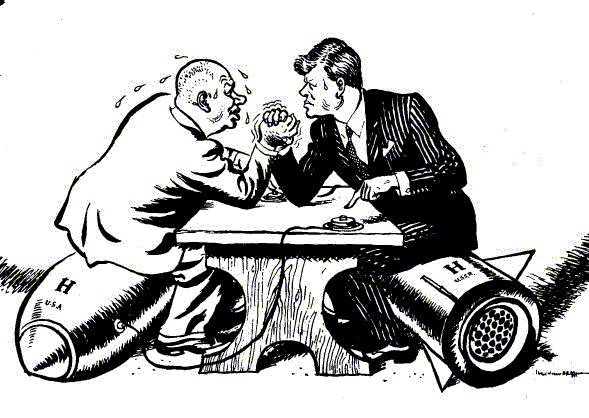
Forthcoming: The Silence of Fallout: Nuclear Criticism in a Post-Cold War World
I just sent along my corrected proofs for a chapter, titled “Apocalypse Networks: Representing the Nuclear Archive,” which will appear in The Silence of Fallout: Nuclear Criticism in a Post-Cold War World, to be published this spring by Cambridge Scholars Publishing, and edited by Michael J. Blouin, Morgan Shipley, and Jack Taylor. You can check out a description of the book here. And the book is available for pre-order on Amazon, Barnes & Noble, and many other booksellers. I am quite excited for this collection, which will include contributions from a number of notable scholars and nuclear critics, including Paul K. Saint-Amour, Daniel Cordle, and John Canaday.
“The Inverted Nuke in the Garden: Archival Emergence and Anti-Eschatology in David Foster Wallace’s Infinite Jest”
The fall 2012 issue of boundary 2 is now available online. It contains my article, “The Inverted Nuke in the Garden: Archival Emergence and Anti-Eschatology in David Foster Wallace’s Infinite Jest.” (Requires university access.) Here’s a link to the abstract.

Forthcoming Publications on David Foster Wallace
Two articles I’ve written on David Foster Wallace should be published any day now:
“The Inverted Nuke in the Garden: Archival Emergence and Anti-Eschatology in David Foster Wallace’s Infinite Jest,” boundary 2 39.3 (Fall 2012), was just announced along w/ the rest of the Table of Contents over at boundary 2‘s blog.
And my article, “‘Then Out of the Rubble’: The Apocalypse in David Foster Wallace’s Early Fiction,” Studies in the Novel 44.3 (Fall 2012): 284-303, was just announced on Studies in the Novel‘s website. The abstracts for all the articles of this special issue on Wallace, edited by Marshall Boswell, were also posted.
I’m pretty excited about both of these, and each issue looks to contain some pretty interesting work that I’m eager to read. I will provide links to my articles’ electronic/Project Muse versions when they become available.
Archiving Every Bomb the United States Has EVER Dropped
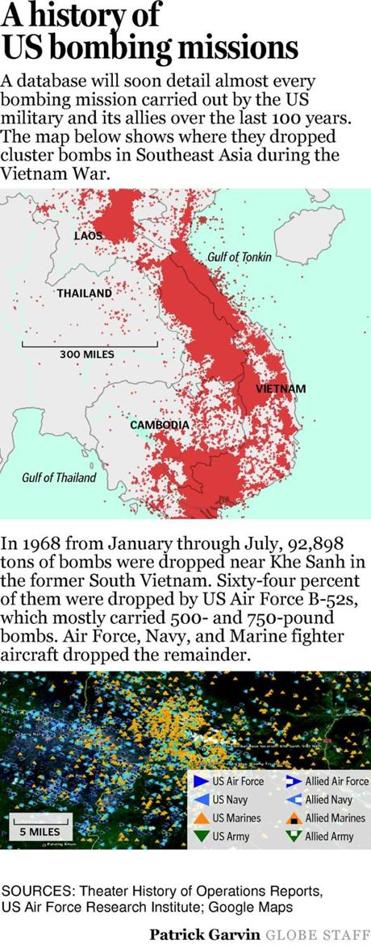
Bryan Bender at the Boston Globe reports how Lieutenant Colonel Jenns Robertson has assembled a report on every bomb the US has ever dropped since WWI(!!!), “a compilation that, at the click of a mouse and a few keystrokes, reveals for the first time the sheer magnitude of destruction inflicted by the US and its allies from the air in the last century.” Going by the name: Theater History of Operations Reports (or THOR), this hyperarchive of US military violence is truly staggering. “One particularly relevant example: From October 1965 to May 1975, at least 456,365 cluster bombs were dropped on Vietnam, Laos, and Cambodia, according to the records analyzed.”
Repackaging the Archive (Part VII): CIV II and Nihilism
Only in extinction is the collector comprehended.
—Walter Benjamin, “Unpacking my Library: A Talk about Book Collecting”

So Jesse Miksic’s article and a recent account of a decade playing Sid Meier’s Civilization II (Microprose, 1996), Alexis Madrigal’s “Dystopia: What a Game of Civilization II Looks Like After 10 Years” in The Atlantic, have got me thinking about the profound melancholy one can access in video games, a melancholy that other forms of media simply cannot produce. As Miksic points out, part of this is simply a result of time and repetition, of the experience of continually dying, of the near-catastrophic levels of frustration produced by, say, getting to the end of Ninja Gaiden (Tecmo: 1988), and finally beating the boss only to learn there is another (and another) and immediately dying. Or, more recently, inspired by Madrigal’s article I spent some time playing Civilization II the past few days, and experienced something I perhaps never had when playing in my youth. If you actually put the game on an even relatively low difficult setting (“prince”),[1] one can access an acute and nearly overwhelming sense of their ultimate futility, like, to do anything.
Having guided my group of Spanish imperialists into a prominent global position (this isn’t the futile part, but the opposite. . .), every other nation in the game decided that I was the big, bad aggressor, and weren’t having it. Shortly, in the span of a few turns, I found myself at war with the entire planet. I was behind technologically, if ahead in other ways. Mine was a pre-nuclear military. And Greece, Japan, America, the Russians, and the Vikings all indiscriminately nuked me to an appropriate level of global obsolescence, whereby they proceeded to turn their attentions away from me and nuked each other. I had fought back only b/c there was no choice. A war on five fronts and a production line churning out tanks only to have them quickly destroyed. The scenario was beyond my abilities. After the dust had cleared, and I was in a state of détente with everyone but the Greeks, I found myself still a large civilization, but unable to do anything about the quickly heating planet. I finally launched some nukes at the Greeks, thereby ending my war w/ them, but it was more an act of revenge and frustration than strategic. (I have no trouble admitting such petty human emotions as jealousy, envy, and hatred. . . for a computer.) The Americans were quickly decimating them anyway. I could see that the game could very easily go toward the nightmare scenario described by Madrigal, or else my defeat and erasure from the planet. In another game, I hadn’t even attacked anyone when I got nuked.
The experience of getting nuked in Civilization II, esp. if you have not nuked anyone yet, can be deeply unsettling. There is a brutal game-theory logic to it: if someone doesn’t have nukes, nuke them, they can’t fire back. Last night, my Athens (I was playing the Greeks), a high seat of learning and culture—I had built many Wonders of the World There—got nuked out of the blue, decimating the city, raising the temperature of the globe, causing famine all over. I had it. I shut off the computer, sick of being so utterly destroyed, with so little agency over anything (I also could probably be a better player). No matter what I did, no matter my peaceful nature, utter destruction, or, what’s even worse, a very obvious continuing inability to do much of anything in the face of a thousand year war marked by broken treaties, collapsing governments, and untold (virtual) suffering, appeared to be the only world I could provide the denizens of my “civilization.” Sadly, this seems to be how best to describe reality.
Perhaps a better title for the game would be Endless Total War. It has obviously been critiqued, and rightly so, for its reinforcement of: a progressive, teleological sense of history and its implicit celebration of Western imperialism. But I feel like the deep logic revealed by playing the game, even for a little while, is the manner in which it continually emphasizes the utter depravity and violence implicit in the course of empire. The world and history, as it is “represented” by Civilization II, is simply horror-show. Any of the “higher” activities of humanity, especially “culture,” get subsumed into the universal violent antagonism the game never relents in emphasizing.[2] Constructing Michelangelo’s Sistine Chapel is just a means to further global domination. Da Vinci, a means of issuing new “versions” of troops: legionnaires 2.0, howitzer redux. Religion is represented as a tool of pacification. Shakespeare a means to an end. Abraham Lincoln a genocidal maniac. Eleanor Roosevelt a demagogue.
Civilization II is, quite literally, nihil unbound.
[1] I never did as a kid, preferring the hubristic grandiosity of conquering the world, building all the wonders, launching the space-ship, not using nukes for some sort of weird ethical reason (even though I slaughtered nations indiscriminately), and etc. winning. I was obviously more well-adjusted as a teenager.
[2] It must also be noted, I was playing the “bloodlust” setting, where you can’t win by going to the stars. We aren’t going to the stars.
 The Hyperarchival Parallax