End of the Semester Links, Fall 2018

Nuclear and Environmental

Fourth National Climate Assessment.

Deconstructed, “Will the US Ever Give Up Its Nukes?”

“Trump Says US Will Withdraw from Nuclear Deal with Russia.”

Wilfred Wan, “The Nuclear Threat Is Rising: Europe Cannot Just Stand and Watch.”

Will Steffen, et al, “Trajectories of the Earth System in the Anthropocene.”

Kate Aronoff, “‘Hothouse Earth’ Co-Author: The Problem Is Neoliberal Economics” and “With a Green New Deal, Here’s What the World Could Look Like for the Next Generation.”

Kim Stanley Robinson, “To Slow Down Climate Change, We Need to Take On Capitalism.”

Continue reading

June 2018 Links

Nuclear and Environmental

Joshua Miller, “Ed Markey’s Career-Long Fight against Nuclear Weapons.”

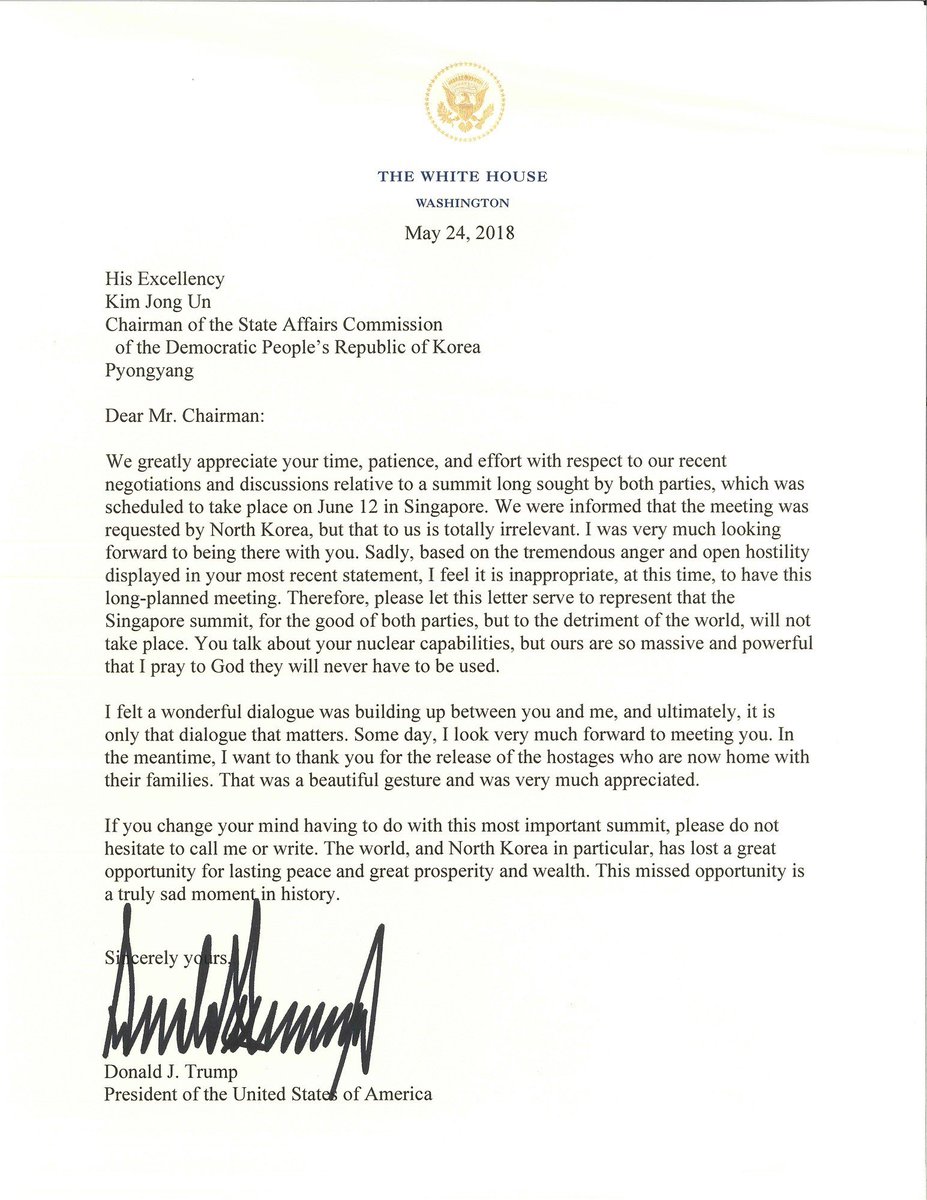
Donald J. Trump’s letter to Kim Jong-un.

Avery Anapol, “Lindsey Graham: War with North Korea Would Be ‘Worth It’ in the Long Run.”

Anton Troianovski, “Putin Claims Russia Is Developing Nuclear Arms Capable of Avoiding Missile Defenses.”

Kim Stanley Robinson, “Empty Half the Earth of Its Humans. It’s the Only Way to Save the Planet.”

Ursula K. Heise, “Climate Stories” and Kate Marshall, “The Readers of the Future Have Become Shitty Literary Critics,” reviews of The Great Derangement, by Amitav Ghosh.

Kate Aronoff, “Denial by a Different Name.”

Continue reading

“Reading Now and Again” in CounterText

Publication CoverMy essay, “Reading Now and Again: Hyperarchivalism and Democracy in Ranjan Ghosh and J. Hillis Miller’s Thinking Literature across Continents,” has been published in CounterText: A Journal for the Study of the Post-Literary in the the second of two special issues devoted to Ghosh and Miller’s book. The first issue is available here, and the second has an interview with Miller available from behind the paywall. I’ve included an abstract of my essay below, along with a table of contents.

Abstract:  This review essay approaches Ranjan Ghosh and J. Hillis Miller’s Thinking Literature across Continents (Duke UP, 2016) from a set of questions about what it means to read in the age of hyperarchival accumulation. Written against the background of events in the United States and elsewhere during the fall of 2017, the essay tracks and assesses Ghosh and Miller’s differing methods for approaching literary study in the twenty-first century: undiscriminating catholicity and rhetorical reading, respectively. Through emblematic readings of David Foster Wallace’s novel The Pale King (2011), the videogame Katamari Damacy (2004), and Amy Hungerford’s Making Literature Now (2016), this essay argues that Thinking Literature across Continents self-reflexively models and performs the interested, situated reading practices necessary for continuing the never-ending project of encountering, sharing, accounting for, learning from, and contending with others and their divergent readings, practices that, though many may have lost sight of them today, are fundamental to the project of democracy itself.


“Thinking Literature Across . . . II,” special issue, CounterText, table of contents:

Ivan Callus and James Corby, “Editorial.”

J. Hillis Miller, Ivan Callus, and James Corby, “The CounterText Interview: J. Hillis Miller.”

Bradley J. Fest, “Reading Now and Again: Hyperarchivalism and Democracy in Ranjan Ghosh and J. Hillis Miller’s Thinking Literature across Continents.”

Simona Sawhney, “Boatmen, Wastrels, and Demons: Figures of Literature.”

Jakob Lothe, “The Author’s Ethical Responsibility and the Ethics of Reading.”

Jonathan Locke Hart, “Ideas of Poetics and the Close Reading of Poetry.”

Shaobo Xie, “Does Literature Matter Today? Thoughts of the Outside.”

Kirk Kenny and James Corby, “Screens of Fortune: A Photo-Essay.”

Timothy Mathews, “The Many Hands of Thick Time: William Kentridge at the Whitechapel Gallery.”

“Isn’t It a Beautiful Day? An Interview with J. Hillis Miller” in Reading Inside Out

Shortly following the completion of my dissertation, in the summer of 2013 I had the great honor and privilege to interview one of the preeminent literary critics of the twentieth and twenty-first centuries, J. Hillis Miller. That interview was published as “Isn’t It a Beautiful Day? An Interview with J. Hillis Miller” in the fall 2014 issue of boundary 2.

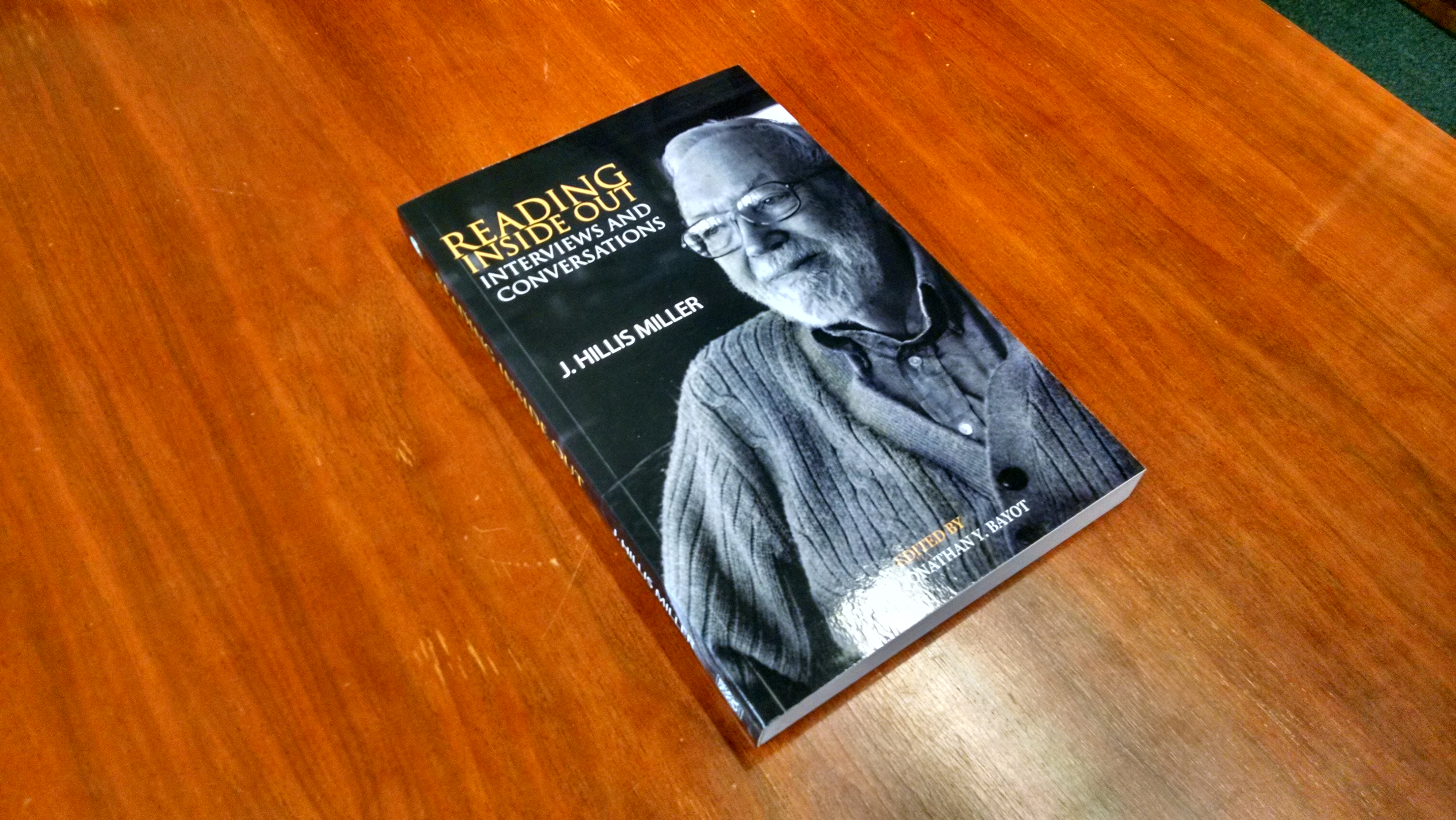
The interview has been reprinted in Reading Inside Out: Interviews and Conversations, a collection of interviews with Miller spanning the latter part of his career, edited by David Jonathan Y. Bayot and recently published by Sussex Academic Press. (The book is also available at a fairly reasonable price on Amazon.com.) In the table of contents below, I’ve provided links to where the other interviews in the volume were originally published (to the best of my ability).


Reading Inside Out: Interviews and Conversations, by J. Hillis Miller

Table of Contents

David Jonathan Y. Bayot, “Preface.”

J. Hillis Miller, “Introduction.”

Imre Salusinszky, “Criticism in Society” (1987).

Gary A. Olson, “Rhetoric, Cultural Studies, and the Future of Critical Theory” (1994).

Fengzhen Wang and Shaobo Xie, “Stay! Speak, Speak. I Charge Thee, Speak” (2002).

Julian Wolfreys, “The Degree Zero of Criticism” (2004) and “Why Literature? A Profession” (2005).

Anfeng Sheng, “Literary Studies in Contexts” (2006).

Constanza del Río Álvaro and Francisco Collado-Rodríguez, “On Literature and Ethics” (2006).

Éamonn Dunne, “For the Reader to Come” (2010).

Éamonn Dunne, Michael O’Rourke, Martin McQuillan, Graham Allen, Dragan Kujundžić, and Nicholas Royle, “You See You Ask an Innocent Question and You’ve Got a Long Answer” (2014).

Bradley J. Fest, “Isn’t It a Beautiful Day?” (2014).

Christopher D. Morris, “A Critical Story So Far” (2015).

“Too Big to Read: The Megatext in the Twenty-First Century,” Lecture at Hartwick College

As part of Hartwick’s Faculty Lecture Series, I will be giving a talk on May 2, 2018 at 12:20 pm in the Eaton Lounge of Bresee Hall at Hartwick College in Oneonta, New York. The title of my lecture is “Too Big to Read: The Megatext in the Twenty-First Century,” and I will be presenting preliminary chapter from my work in progress of the same name.

In this new project, I am investigating the impact of massive textual accumulation on contemporary literary production and reception. With the increasing space made available by digital technology, texts are being created that are simply gigantic, unthinkably large compared to the previous century’s storage capacities. For instance, conceptual artist Michael Mandiberg recently printed out the entirety of Wikipedia in over seven thousand bound volumes, at some point in the near future Richard Grossman will publish a three-million-page “novel,” Breeze Avenue, and 2016 saw the appearance of No Man’s Sky, a videogame containing eighteen quintillion planets. I argue that with the appearance of such massively unreadable cultural artifacts—texts that are, quite literally, too big to read—the digital age has seen the emergence of a new transmedia form: what I call the megatext. I define megatexts as unreadably large yet concrete aesthetic and rhetorical objects that are produced and conceived as singular works and that depend upon digital technology and collaborative authorship for their production. Using the working paper for Grossman’s forthcoming Breeze Avenue as a case study, this lecture will present a theory of speculative criticism for approaching these massive texts. Drawing upon Timothy Morton’s concept of the hyperobject and suggesting that megatexts have roots in literary postmodernism, this talk will explore some of the ways that megatexts respond to the conditions of the Anthropocene and open up new spaces for imaginative reading, creation, and understanding in contemporaneity.


For a (longer) published version of this lecture, see “Toward a Theory of the Megatext: Speculative Criticism and Richard Grossman’s ‘Breeze Avenue Working Paper,” in Scale in Literature and Culture, ed. Michael Tavel Clarke and David Wittenberg (New York: Palgrave Macmillan, 2017), 253-80.

For other parts of this work in progress, see “The Megatext and Neoliberalism” and “The Time of Megatexts: Dark Accumulation and Mark Z. Danielewski’s The Familiar,” both available on my academia.edu page. I also have a forthcoming short essay discussing this project: “Writing Briefly about Really Big Things,” in Begging the Question: Chauceriana, Book History, and Humanistic Inquiry (Mythodologies II), by Joseph A. Dane (Los Angeles: Marymount Institute Press, forthcoming 2018).

February 2018 Links

Nuclear and Environmental

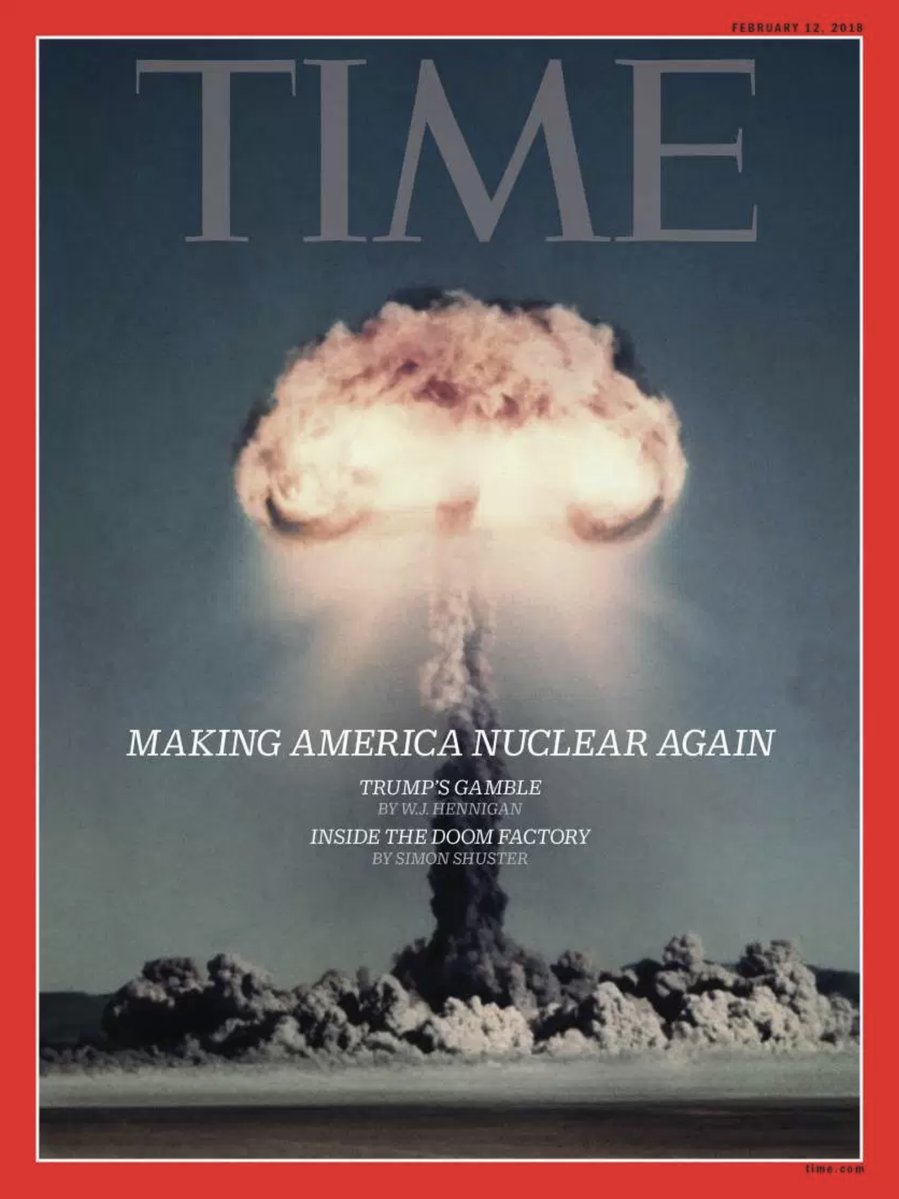
Tim Fernholz, “US Nuclear Tests Killed Far More Civilians than We Knew.”

Democracy Now, “Daniel Ellsberg Reveals He Was a Nuclear War Planner, Warns of Nuclear Winter and Global Starvation.”

Daniel Bessner, “On the Brink.”

Alastair Tancred, “A Nuclear First Strike of North Korea Is ‘Tempting’, Says Legendary US Diplomat Henry Kissinger as Kim Jong-un Warns Trump Is Pushing Toward War.”

“Senator Markey Blasts Trump Administration’s Reckless Nuclear Posture Review.”

Helena Feder, “The Realism of Our Time: Interview with Kim Stanley Robinson.”

Continue reading

Special Issues of CounterText on Ranjan Ghosh and J. Hillis Miller’s Thinking Literature across Continents

I have written an essay, “Reading Now and Again:  Hyperarchivalism and Democracy in Ranjan Ghosh and J. Hillis Miller’s Thinking Literature across Continents,” which will appear in the spring issue of CounterText: A Journal for the Study of the Post-Literary, the second of two special issues devoted to Thinking Literature across Continents (Duke UP, 2016). I’ll provide more information about this essay at a later date.

In the meantime, the first issue of CounterText addressing Ghosh and Miller‘s book (vol. 3, no. 3) is now available. Additionally, a conversation between Marjorie Perloff, Charles Bernstein, and the two authors opening the special issue is available from behind the journal’s paywall.


“Thinking Literature Across . . .,” special issue, CounterText, table of contents:

Marjorie Perloff, J. Hillis Miller, Charles Bernstein. and Ranjan Ghosh, “The CounterText Conversation: Thinking Literature. . . .”

Maria Margaroni, “Dialogics, Diacritics, Diasporics: Ranjan Ghosh, J. Hillis Miller, and the Becoming-Now of Theory.”

Georges Van Den Abbeele, “Literary Intransigence: Between J. Hillis Miller and Ranjan Ghosh.”

Claire Colebrook, “Crossing Continents.”

Steven Yao, “How Many Ways of Thinking Literature across Continents?”

Pramod K. Nayar, “Literature/Ethics/Reading.”

Susana Onega, “Thinking English Literature and Criticism under the Transmodern Paradigm.”

Lene M. Johannessen, “Poetics of Peril.”

Adrian Grima and Ivan Callus, “Irreverent and Inventive Mamo.”

Juann Mamo, Nanna Venut’s Children in America: Two Chapters from the First English Translation,” trans. Albert Gatt.

Ivan Callus, “Literature, Journalism, and the Countertextual: Daphne Caruana Galizia, 1964–2017.”

Mario Aquilina, review of Essayism and the Return of the Essay, by Brian Dillon.

“Toward a Theory of the Megatext” in Scale in Literature and Culture

The first essay from my new project on unreadably large texts, “Toward a Theory of the Megatext: Speculative Criticism and Richard Grossman’s ‘Breeze Avenue Working Paper,'” has been published in Scale in Literature and Culture (Palgrave Macmillan, 2017), edited by Michael Tavel Clarke and David Wittenberg. The book includes essays by Bruno Latour and Mark McGurl. You can find the entire collection here through Springer Link if you have institutional access, or individual essays via the links below. The book is also available on Amazon. I’m happy to send along a copy of my essay to anyone who is interested (festb[at]hartwick[dot]edu).

Table of Contents for Scale in Literature and Culture

Michael Tavel Clarke and David Wittenberg, Introduction.

Scale: History and Conception

Zach Horton“Composing a Cosmic View: Three Alternatives for Thinking Scale in the Anthropocene.”

Derek Woods, “Epistemic Things in Charles and Ray Eames’s Powers of Ten.

Bruno Latour, “Anti-Zoom.”

Scale in Culture

Mark McGurl, “Making It Big: Picturing the Radio Age in King Kong.

Joan Lubin, “The Stature of Man: Population Bomb on Spaceship Earth.”

Aikaterini Antonopoulou, “Large-Scale Fakes: Living in Architectural Reproductions.”

Scale in Literature

Melody Jue, “From the Goddess Ganga to a Teacup: On Amitav Ghosh’s Novel The Hungry Tide.

Oded Nir, “World Literature as a Problem of Scale.”

Bradley J. Fest, “Toward a Theory of the Megatext: Speculative Criticism and Richard Grossman’s ‘Breeze Avenue Working Paper.'”

Jeffrey Severs, “Cutting Consciousness Down to Size: David Foster Wallace, Exformation, and the Scale of Encyclopedic Fiction.”

Mark Z. Danielewski on Facebook Live and “The Time of Megatexts”

Note: it appears that Danielewski had to postpone the Facebook Live event due to technical difficulties. I’ll be posting again when it has been rescheduled.

Mark Z. Danielewski will be appearing on Facebook Live to talk with the members of The Familiar (Volume 1-5) Book Club about his remarkable novel, The Familiar (2015-). He has distributed my recent conference paper, “The Time of Megatexts: Dark Accumulation and Mark Z. Danielewski’s The Familiar,” in advance. I invite you to read my essay and join in what should be an interesting conversation.