Now that one of the more tense periods of the Cold War is over fifty years behind us, quite a bit of interesting information about the more speculative military activities of the United States during the late-1950s and early-1960s is getting declassified and coming to light. Among the more absurd revelations, it was reported in November of 2012 that “the United States planned to blow up the moon with a nuclear bomb in the 1950s as a display of the country’s strength during the Cold War space race.” In his recent book, Arming Mother Nature (2013), Jacob Darwin Hamblin discusses how in 1958 President Dwight D. Eisenhower commissioned a special committee on weather modification. The committee discussed a number of purposeful modifications to the environment, including “increasing global temperatures, in the hopes that this would increase the quantity of cultivated land and make for fairer weather . . . and melt[ing] the polar ice cap by exploding nuclear weapons on it, thus raising the global sea level.” For those of us who have seen some of the recent photos of this summer’s radically diminished polar ice caps, the postnatural imagination of this earlier period of US history is both chillingly prescient and deplorably, laughably short-sighted.

I begin with such anecdotes for a number of reasons. Among these is an attempt to emphasize the historicity of this year’s SLSA conference theme. Though the “postnatural” is clearly timely, as by all sane accounts we are now living in the Anthropocene, an epoch of observable and often catastrophic climate change, a time when the possibility of reversing or even mitigating humanity’s effects on the environment is looking increasingly impossible, I would also like to stress that there is a long twentieth century history of the postnatural imagination, and that this imagination has been intimately tied to the development of nuclear weaponry in a number of instances. These recently declassified speculative responses to the Cold War are only the most obvious examples of a conception of human technological prowess able to dominate not only our immediate ecological existence, but our extra-global, lunar environment as well. And indeed, we might trace a genealogy of the postnatural from well before the atomic explosions at Alamogordo, Hiroshima, and Nagasaki. For instance, reflecting on the 1900 World’s Fair in Paris, Henry Adams famously wrote in TheEducation (1916) that with the construction of what he called the “dynamo,” “Man has translated himself into a new universe which had no common scale of measurement with the old.” Or recall H. G. Wells’s prophetic imagining of nuclear war in his 1914 novel, A World Set Free. Or as Martin Heidegger wrote in his 1951 essay, “The Thing”: “Man stares at what the explosion of the atom bomb could bring with it. He does not see that the atom bomb and its explosion are the mere final emission of what has long since taken place, has already happened.” One might easily write a literary, philosophical, and military history of the long postnatural twentieth century.
But I also begin anecdotally with these fantastic yet very serious Cold War proposals because they are precisely the type of thing one might find in the true subject of my talk today, The Manhattan Projects (2012- ).
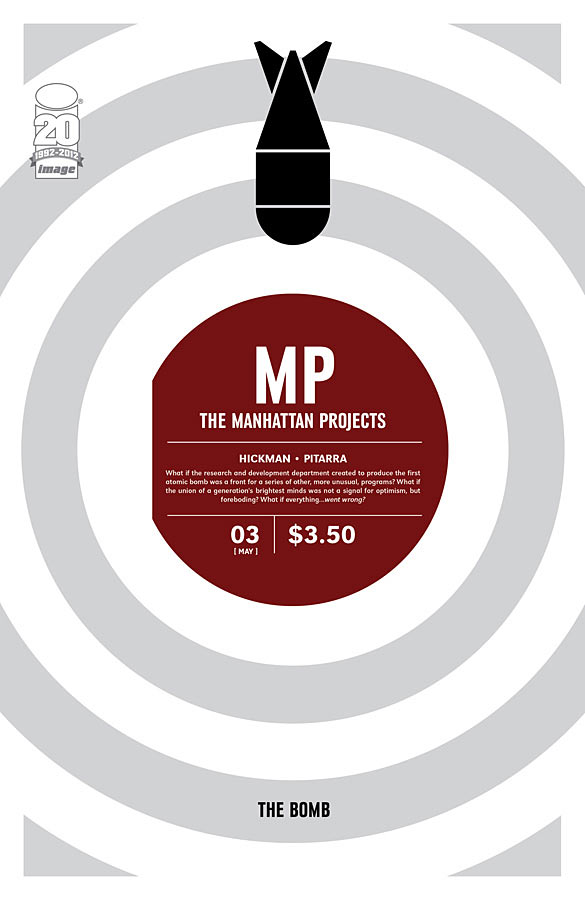
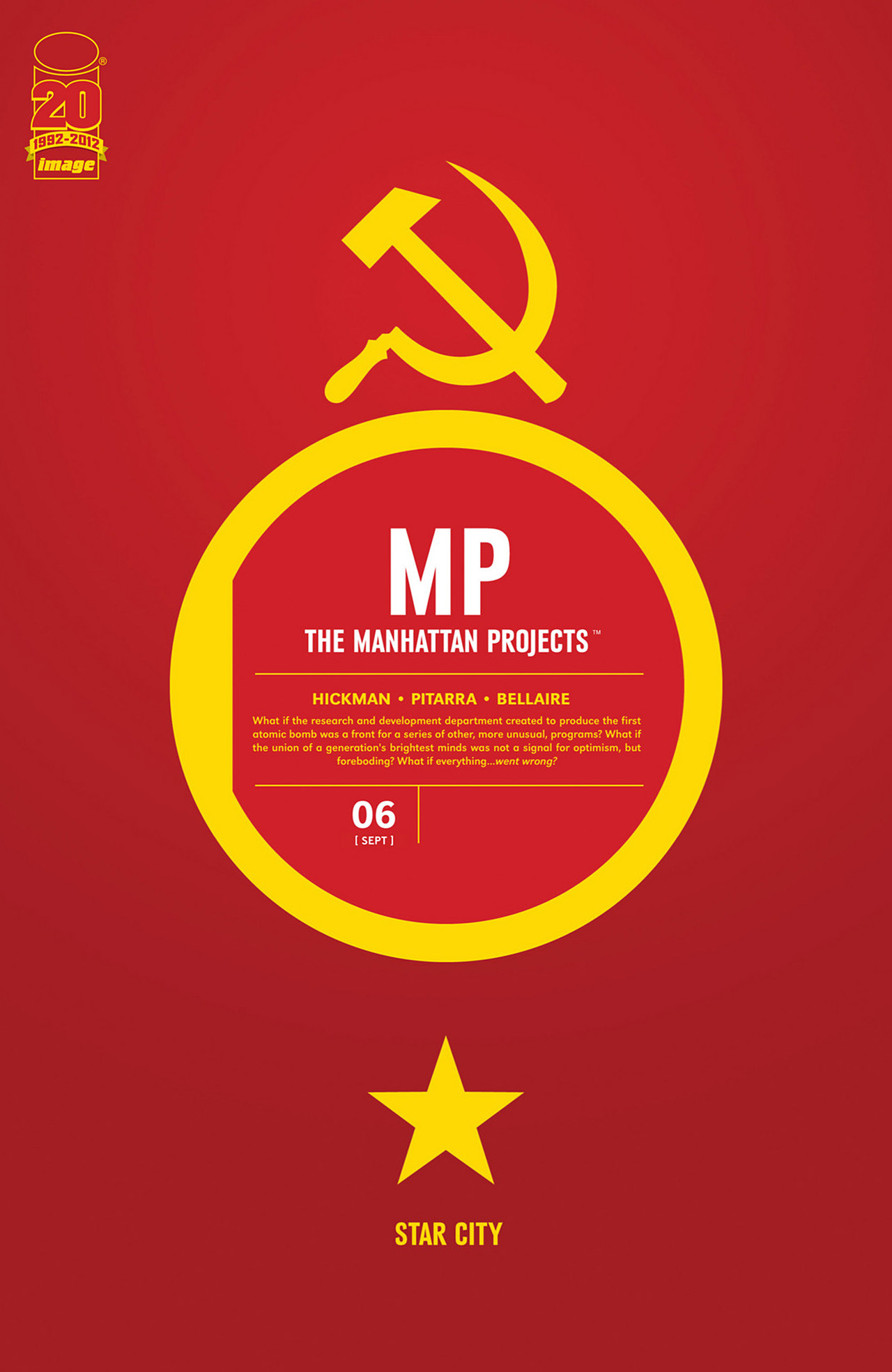
First appearing in March of 2012 and still continuing today, The Manhattan Projects is a serial comic book published by Image Comics, written by Jonathan Hickman and illustrated by Nick Pitarra. The premise of the comic is announced on the cover of each and every issue: “What if the research and development department created to produce the first atomic bomb was a front for a series of other, more unusual, programs? What if the union of a generation’s brightest minds was not a signal for optimism, but foreboding? What if everything . . . went wrong?” Or as director of the Manhattan Project Lieutenant General Leslie Groves puts it in the series’ first issue: “We’re protecting the country’s secrets. The problem with these secrets is many of them are wrapped in conspiracy, and nothing tickles like curiosity and mystery. . . . So we hide our most important lies underneath a more tolerable one: ‘That the Manhattan Project is a research and development program tasked with building and deploying the world’s first atomic bomb.’”
Despite the radically alternative, fantasmatic history that The Manhattan Projects is principally concerned with, and perhaps even in spite of the comics’ insouciant humor, it is an incredibly timely text, and one that I think deserves significant critical attention. It has emerged from a contemporary moment in which the limitations of human scientific and technological capability to effect environmental change are becoming clearer. The acknowledgement of these limitations are exacerbated, on the one hand, by the knowledge that climate change was itself wrought by human science and technology, and on the other, by the continuing intransigence of certain US politicians to even acknowledge the present global ecological crisis. By reimagining a grand meta-narrative woven together by densely mixing science, history, and politics together, The Manhattan Projects asks us to reconsider our current relationship to the long postnatural twentieth century and to see that the realities of the contemporary human condition have perhaps long been hidden underneath more tolerable fictions.
One of the most important of these reconsiderations is the series’ engagement with nuclear technology. Rather than concern itself with the dominant specter of the first nuclear age, what critic Donald E. Pease calls the “national fantasy” of Mutually Assured Destruction, The Manhattan Projects acknowledges a truth about the Cold War that has really only become possible in its wake. The Manhattan Projects, by fantastically reimagining nuclear history, dramatizes certain realities of that history that are so often overlooked in the face of apocalyptic nuclear fantasy, a fantasy that still dominates cinema and literature today, albeit often in different forms. The comic acknowledges that the true legacy of nuclear technology for our present post-Cold War contemporaneity is less the bomb’s potential destructive effects, its speculative futurity in an apocalyptic conflict between global superpowers, but rather a number of more insidious, subtle effects. Principal among these is how the comic takes for granted and is deeply concerned with the unstoppable inevitability of technological advance, and that from its position in the wake of the nuclear history the comic is reimagining, technology might very well be considered an emergent property of human activity, something that Manuel DeLanda explores in his early book, The War in the Age of Intelligent Machines (1991). (For instance, as Edward Snowden’s revelations about the National Security Agency made clear this past summer, it seems that if something is simply possible, it will be done, regardless of whether or not it is something that should be done.) The comic also asks us to pause over a number issues intimately tied to a potential alterative history of nuclear weaponry, a history exemplified in the anecdotes that I opened my talk with. The Manhattan Projects acknowledges that the legacy of the Cold War should be located in nuclear war’s failure to occur, and that it is precisely the non-event of global nuclear warfare and the efforts made to prevent such warfare that have shaped so much of our world today: from ARPAnet and information technology, to the space race, to trying to control the climate, to attempting to master biological life itself. The Manhattan Projects complexly explores how contemporary scientific discourse, current notions about human technological mastery, the “enframing” of the world as “standing reserve,” and a wide array of political and ideological forces are the result of the lasting impacts of the Cold War. And if nothing else, The Manhattan Projects asks us to recall that we are still living in an epoch defined by nuclear weaponry, something we might do well to call, as a number of critics are doing, a “second nuclear age.”
Unlike other notable alternative histories, novels like Philip K. Dick’s The Man in the High Castle (1962), Kim Stanley Robinson’s The Years of Rice and Salt (2002), or Philip Roth’s The Plot Against America (2004), The Manhattan Projects eschews narrative and scientific realism in favor of a fantastic, fabulous metahistory closer to something like Thomas Pynchon’s Mason & Dixon (1997). The comic understands the development of nuclear technology as a small aspect of a grander alternative history, a madcap, maximalist approach to a speculative postnatural past in which the only bounds to science were the limits of the imagination. In its fourteen published issues, The Manhattan Projects has radically rewritten history, particularly the role that science has played in the twentieth century. The comic’s principal characters are prominent scientists and politicians who are depicted as hyperbolic, at times monstrous caricatures of their historical counterparts.
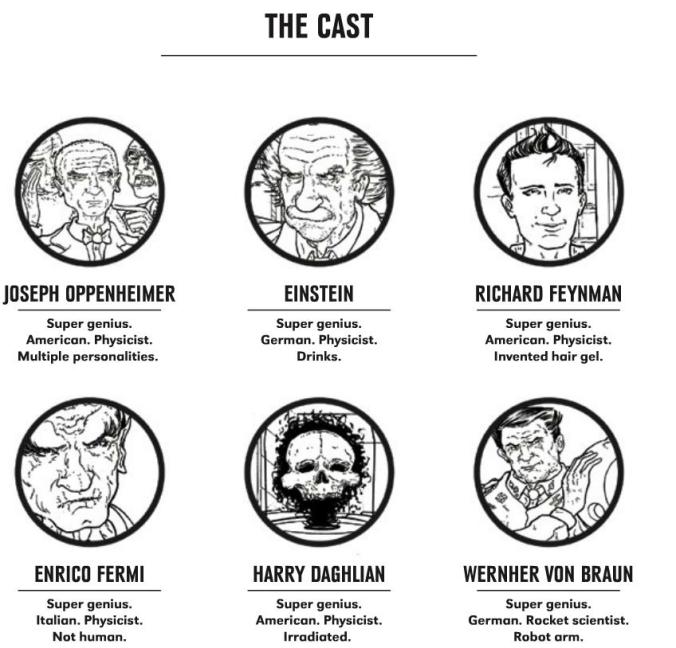
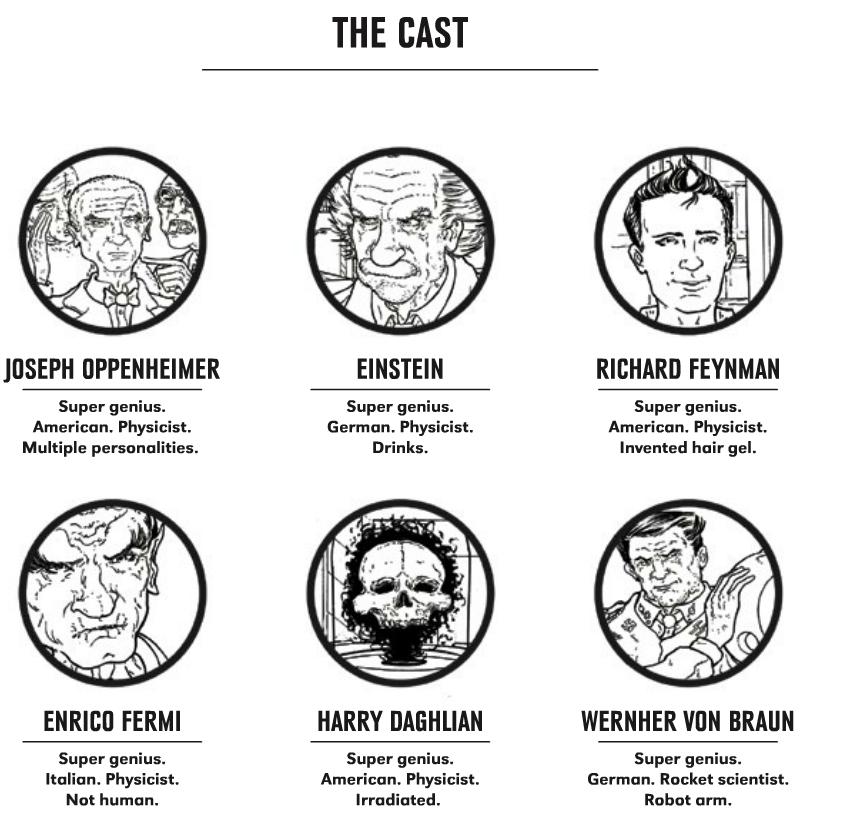
For instance, J. Robert Oppenheimer, the series’ true villain, is imagined to have had a twin brother Joseph who, upon learning of Robert’s invitation to participate in the Manhattan Project, kills Robert, literally eats his body and brain, and thereby absorbs the knowledge and personality of Robert, leading to a fracturing of Joseph’s personalities that approaches infinity. Enrico Fermi, another father of the atomic bomb, is an alien who has been sent to disrupt humanity’s efforts at space exploration and colonization. Harry Daghlian, who in real life was irradiated in an accident with what became known as the “demon core,” and who died twenty-five days later, in The Manhattan Projects has survived as a fleshless, irradiated skeleton housed in a containment suit. Franklin Delano Roosevelt is reincarnated as a rogue artificial intelligence. Albert Einstein has been replaced by another version of himself from an alternate dimension, going on to become what one early reviewer called the series’ version of Wolverine (from X-Men fame).

German scientist responsible for the V-2 rocket and later a key figure in US ballistic missile development, Werhner Von Braun is a cyborg with a robotic arm, and after a conflict with a cabal led by crazed Masonic Priest Harry S. Truman, has his legs and eyes replaced with technological prostheses. President John F. Kennedy is a drunk, drug-addled frat boy. And Richard Feynman, the series’ protagonist, is a self-absorbed pretty-boy, whose journal entries are interspersed throughout the series, giving the proceedings an intellectual and historical heft that give many glimpses into the deep, complex history that Hickman has imagined for the comic.
At first glance, the actual Manhattan Project, and the development and deployment of the nuclear bomb appear to play only a tangential role in the series. In issue three, in a radically condensed version of historical events, the comic portrays the bombing of Hiroshima. With Oppenheimer sitting in his office, President Truman gets a phone call from Groves informing him of the existence of the bomb and that the Enola Gay is en route to its target, giving the President mere minutes to decide whether to drop the bomb on Hiroshima. Truman screams into the phone, “Don’t drop the bomb. . . . Terminate the operation. Call the plane back. . . . No! No! ABORT THE MISSION.”
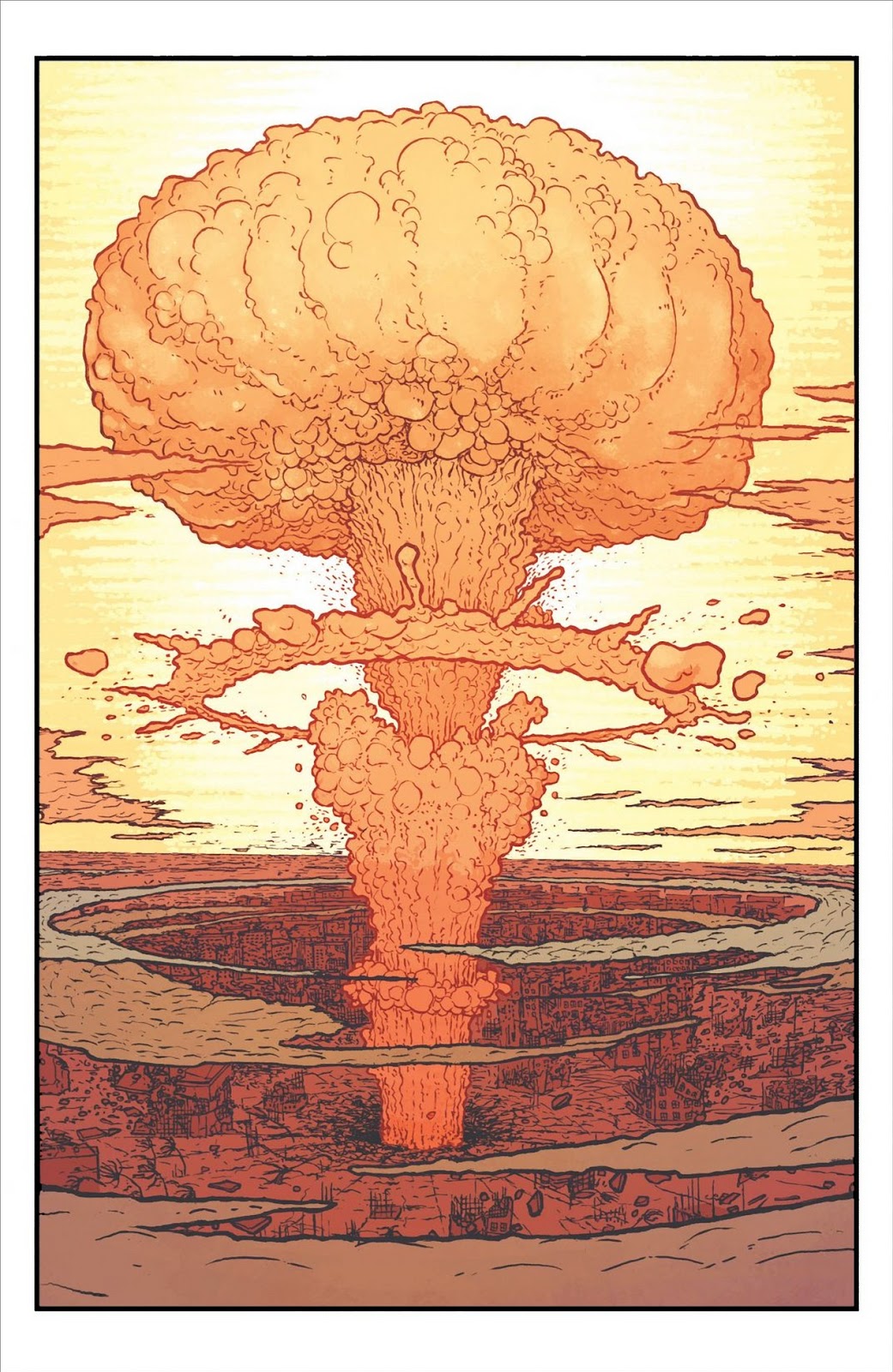
Groves pretends not to hear Truman and drops the bomb anyway. The final page of the issue shows a striking, sublime mushroom cloud with no text.
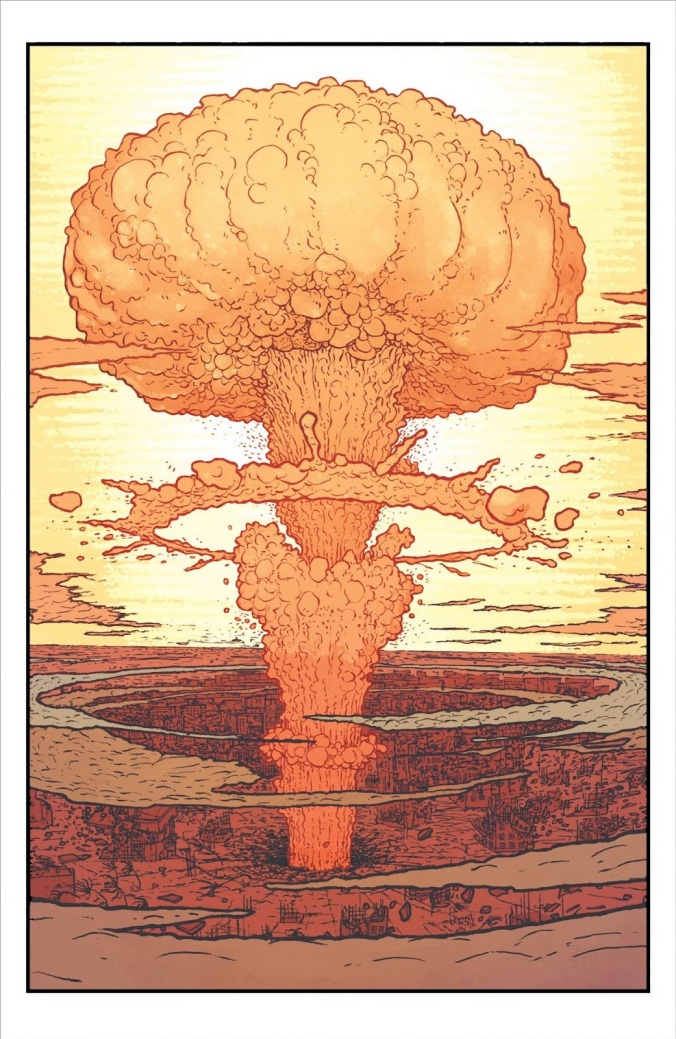
Though this image is the centerpiece of the trade-paperback volume collecting the first five issues of the series, it should also be noted that by the next issue, Hiroshima has been seemingly forgotten, the scientists of the Manhattan Projects already moving on to other concerns. The implications are fairly clear. The bomb’s target here is elsewhere. As certain historians read the true motivation behind the bombing of Nagasaki to have been a show of force and a deterrent against the Soviets, as well as something that would prevent Russian military involvement in the Pacific theater, in The Manhattan Projects this bomb’s true “target” is elsewhere. In order to enable the continued secrecy of the more strange activities of the Manhattan Projects, Hiroshima here is both inevitable—something closely corresponding to the “decision” to drop the bomb in the first place—and a cover; it functions merely as the visible, public achievement of the Manhattan Project, thereby effectively covering up the deeper conspiracy the comic narrates. Implicit in this treatment of nuclear war, a treatment that radically departs from many of its other narrative representations in the last seventy years, is an acknowledgment that after the initial horrific destruction of Hiroshima and Nagasaki, the bomb quickly comes to serve ends that are largely not motivated by military strategy, but rather by politics and ideology. Certainly this is not a new insight into the cultural role the bomb played during the Cold War, but it is to suggest that in The Manhattan Projects the bomb’s ideological function is its primary role, something that we can also perhaps assert in the aftermath of the Cold War.
There are other aspects of the comic that should be noted which revolve in nuclear and postnatural orbits. In issues four and five, the Manhattan Projects scientists make contact with an alien hivemind race and send emissaries through a galactic portal to meet their leader. Acting upon the order of Groves, an unnamed scientist cracks open Dahglian’s radiation containment suit, thereby irradiating all of the aliens and consequently eradicating their entire race, as their collective hivemind communicates the radiation to their entire species. As an ominous demon named Raal who appears from seemingly nowhere in the wake of this annihilation says, “But by all measurements, the first extraplanetary odyssey initiated by your world ending in the genocide of a species. . . . Not the best way to make your mark in the cosmos.” Here Dahglian, who is a personification and physical instantiation of nuclear technology, unintentionally realizes nuclear science’s genocidal horizon. If the nuclear threat in the comic dissipates on earth, it in no way undercuts or changes the genocidal, eschatological thrust of human scientific endeavor, here extrapolated to intergalactic dimensions. In other words, even in the absence of the threat of Mutually Assured Destruction, the ultimate result of human technology ends in the unintentional eradication of a species, clearly mirroring the massive current extinction event attending global climate change.
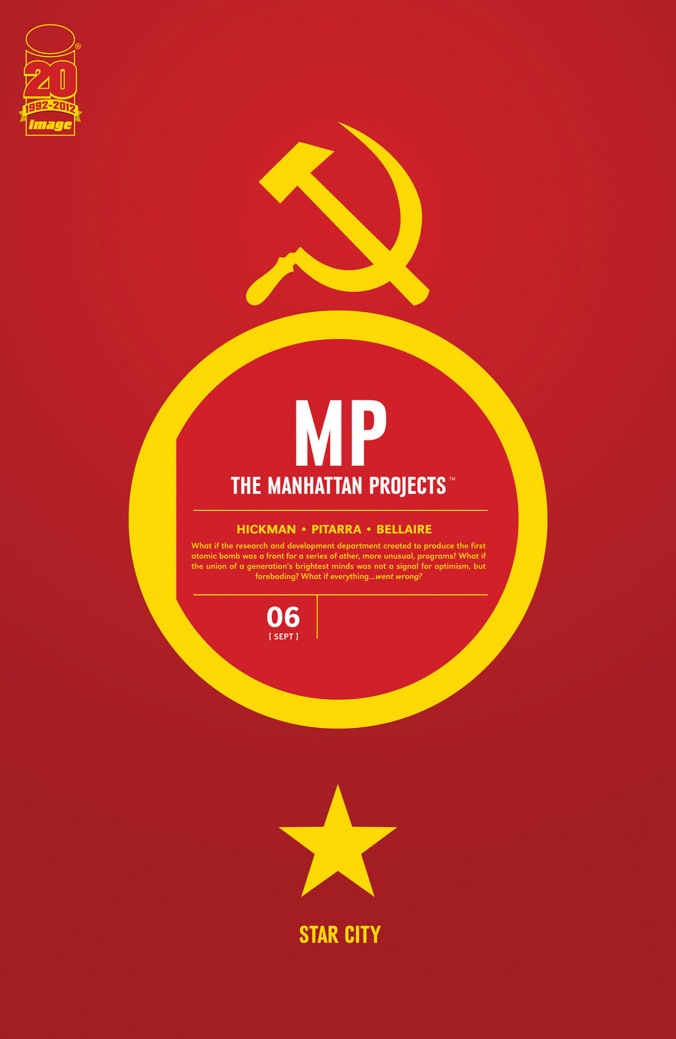
But perhaps the most clear reflection on the more subtle and insidious legacies of the Cold War is how, in issues six and seven, the Manhattan Projects and the Soviet Union’s own secret research facility, Star City, band together. Under the cover of a continuing Cold War, both projects unite, hoodwinking their respective governments into continuing the massive funding of their research in order to pursue the goals and dreams of their respective scientists. As Feynman muses to Einstein in the closing pages of issue seven, a space station they have constructed “says [to him] look at what we’ve achieved. It says sleep well . . . because we are in control, and those dreams you are having . . . we are the men who can make them real. It says we’ve won, Doctor.” Einstein, however, being the voice of reason responds, “Are you really foolish enough to think that Richard? That we have won . . . ? Because we have not—not yet. This is just ze beginning of the oldest story in ze world.”Einstein’s words are prophetic, in that the powers that be, “These lords of commerce. These KINGS. These DICTATORS. These PRESIDENTS,” discover the ruse being propagated by the Manhattan Projects and attack their facility, killing and injuring many of the scientists. But I would also like to suggest that his words resonate on other frequencies. Namely, that this “cooperation” between the US and USSR that Hickman so fantastically imagines looks, in the wake of the Cold War, like perhaps a more accurate description of nuclear and technological development in the twentieth century. In other words, the arms race, in motivating each side to massively fund and escalate research and development, and in the absence of any deployment of that research, essentially acted in tandem, the result being rapidly developing technology. In the absence of this kind of conflict (or “cooperation”), the funding to undertake the very kinds of scientific endeavors that current US public discourse about science so prides itself on, would perhaps hardly have existed as we now know it today. Here, as throughout The Manhattan Projects, the fantastic fiction and radical alternative metahistory it creates captures the unacknowledged realities and legacies of the Cold War.
Though a final assessment of The Manhattan Projects may be a bit premature in that the series looks to continue for a while yet, the timeliness of its simultaneous critique and celebration of twentieth century science can be seen in the concluding scene of the fifth issue, immediately following the annihilation of the aliens. In a revision of Robert Oppenheimer’s famous words about the first nuclear explosion at Alamogordo, staring into the gateway connecting earth to anywhere else in the galaxy, flanked by his infinite personalities, Joseph Oppenheimer says, “Yes, indeed. We have become death, destroyers of worlds.”
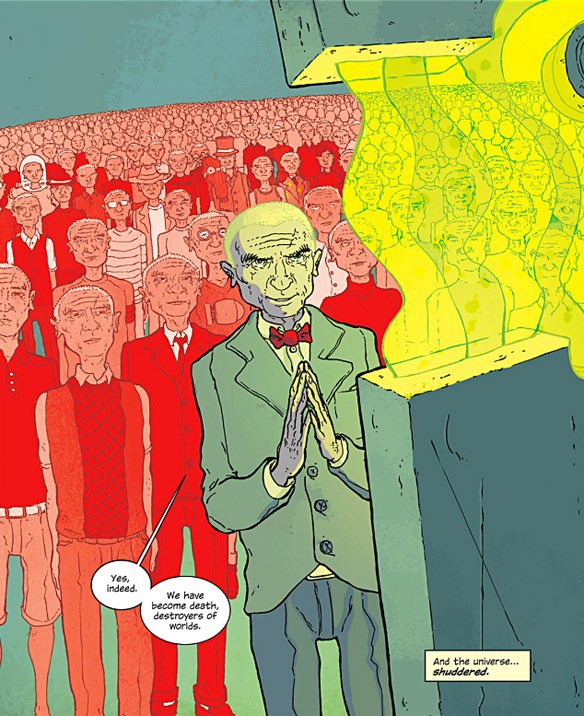
What this moment gestures toward is what the entirety of The Manhattan Projects concerns itself with: that the destructive forces captured by and introduced into the world by Robert Oppenheimer have become multiple and indefinite. No longer is the threat to human existence on earth singular, taking the form of the fantasy of global nuclear annihilation. Rather, the contemporary realities of global risk have multiplied, expanding into a diverse array of potential ecological, posthuman, economic, and archival catastrophes. Further, as Ulrich Beck’s work has so importantly pointed out, the imaginative projection of risk now cannot be coherently separated from the reality of risk. In the twenty-first century, the eschatological horizon of the species has kicked loose of its nuclear origins and multiplied; Oppenheimer has multiplied, and one of the horrors of the postnatural condition may very well be the dawning realization that this multiplication may be infinite, that our ability to imagine various horrific futures both shapes and is shaped by this multiplying horizon. In the wake of the long twentieth century that saw the dissolution of any coherent barrier between humans and their global and extra-global environment, the figure of the infinite Oppenheimer, who is the still largely unrealized evil of the series, is a remarkably apposite figure for the contemporary postnatural condition. If our future depends upon articulating better projections of global risk informed by a more rigorous sense of our postnatural past, then The Manhattan Projects holds out a glimmer of hope that perhaps the human imagination has not yet been made obsolete by the inhuman forces unleashed by the twentieth century.
Henry Adams, The Education (1916), in Henry Adams: Novels, Mont Saint Michel, The Education (New York: Library of America, 1983), 1068.
See Ulrich Beck, World at Risk (2007), trans. Ciaran Cronin (Malden, MA: Polity, 2009).




 The Hyperarchival Parallax