Two Mondays ago (NBC’s replacement for the original Law and Order [kidding]) The Event proposed as one of its plot points that whatever extraterrestrial or extra-dimensional people the US government had been holding captive since WWII were actually responsible for the atomic bomb, the Manhattan Project, and such. The Event is an interesting show so far, and perhaps lives up to its advertisement as what offspring 24 and Lost would have if they decided to copulate (neither show was on NBC, btw). But to be frank, the idea that nuclear technology wasn’t possible w/o the intervention of some advanced species, that we were “given” nukes to bolster some people’s (i.e. the “aliens’”) attempt to overcome their own state of being unheimlich, is tiresomely crazy. Yes, I tend to like concepts like Stargate or Battlestar Galactica that propose humans are not actually indigenous to Earth (or whatever), and yes, I appreciate alternate histories of all sorts, but to take away from humans their greatest accomplishment ever—the ability to destroy themselves in their entirety—is going too far.
An alternate history like this—that the US government, Oppenheimer, and all the rest—were not actually responsible for nuclear technology appears to me like a particularly insidious form of delusional revisionism. Not only does history easily refute this narrative point in The Event—if we allow it, the show makes the entire 20th-C. following it a colossal joke. Which it isn’t. SF has mined the depths of “what ifs” (take Philip K. Dick’s Man in the High Castle, for example), but it rarely makes us completely un-responsible. To suggest that human history is a whim of some advanced species is to suggest that nothing we do has any consequence whatsoever. And to do this is to completely degrade the very cultural artifact we ourselves are watching w/ pleasure (or at least b/c it isn’t as shitty as our day-to-day lives). In other words, a show that desperately wants our viewership, a show that is staking a claim on a now not-so-populated ground (read: there ain’t much SF on network TV no more), is suggesting that the very human history it is attempting to explore is not of our making, is a show desperately desiring to be cancelled after one season.
In a recent CNN report, 7 US Air Force personnel came forward and claimed to have seen UFOs hovering over nuclear missile sites, and in some cases shut down some of the systems in the missiles. Read this amazing absurdity here. Basically, this reveals what I knew all along: that the US and USSR could never have actually destroyed each other, b/c our benevolent alien overlords would have prevented it. No way the Cold War and the threat of MAD (Mutually Assured Destruction), and the various political and historical realities prevented this nuclear conflagration; it was the aliens!
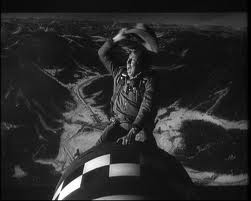
This weekend Pittsburgh Filmmakers and Pittsburgh’s local nuclear disarmament organization Remembering Hiroshima 2010, along w/ other events, are showing 3 films for an Atomic Weekend just down the street from me at the Melwood Screening Room. I’m gonna try to attend a few of the events, but def. Kurosawa’sI Live in Fear, a film I’ve been meaning to see for awhile. I had no idea this organization existed in the burgh, and I am very happy to see that it does and that it appears to be quite busy and active w/in the community. Please show your support. (And of course they’re also showing Dr. Strangelove.)
I just recently attended the annual Science Fiction Research Association Conference held this year in Carefree, AZ,[1] where I delivered a paper entitled: “Tales of Archival Crisis: [Neal] Stephenson’s Reimagining of the Post-Apocalyptic Frontier.” I argued for the existence of a significant and unnoticed sub-genre of SF therein by way of Stephenson’s Anathem: what I call the tale of archival crisis. Though I cannot present that paper here, primarily for reasons that I still have some work to do on it and b/c I want to develop it into a slightly longer piece, I had the great luck to stumble across Pandorum (Christian Alvart, 2009) one night at the conference,[2] via the instant play available on Netflix, and was shocked at the resonance it had w/ my more general theoretical constructions of the tale of archival crisis.[3] It, mixed w/ the rather disappointing Living in the End Times, by Slavoj Žižek—my primary reading recently during various decadent kinds of vacation—has unavoidably occasioned some kind of brief commentary (following).
Pandorum is the kind of (excellent) B-SF-movie[4] that I was surprised to see Steven Shaviro has yet to comment upon.[5] And in lieu of his perhaps much more perspicuous take on it, I submit that it captures many of the features of what I call the “tale of archival crisis” very well. In short, Pandorum is a film in which the archive mutates/evolves, and this change threatens the very survival of the human species. In other words, the archive itself produces an apocalyptic-type crisis.
Pandorum is set in a far future where, of course, humans have “exhausted” the earth, have found another planet, and sent an ar/-chive/-k to populate it. This ship is filled w/ tens-of-thousands of cryogenically frozen humans who have been injected w/ something that causes their mutation/evolution to speed up exponentially[6]; in addition to this, the ship holds the “entirety” of the earth’s biological archive (i.e. DNA, seeds, animals, etc. etc. [one can imagine]). But (again, of course) things have gone terribly wrong. (Spoilers.) For whatever (dumbass) reasons, they’ve only left 3 people in charge of the ship at any time, and one of these people (for reasons that remain scientifically unclear[7]) has gone batshit insane, and killed the other two on duty w/ him. The film explains this man in mythological terms—i.e. he took total control of the ship, became a sort of god, but got bored so went back into cryo-sleep.
So, the film opens w/ two men awakening from cryo-sleep and, of course, it induces temporary amnesia.[8] One of these men is the god-man reawakened, but we don’t “know” that till the end. (There’s all sorts of hallucination, psycho-camera-work in between.) The other is our necessary hero/messiah/whatever. All this aside, there are 3 striking things about this film:
1) Near the end of the film, shortly after we have learned that the earth has been utterly destroyed, the characters open the observation windows and cannot help but see an inky blackness. Dennis Quaid’s character (the god-man) immediately assumes that all creation has been wiped away, that this little ship is the only thing left. I’m not sure if horror has ever been so effectively boiled down to its pure “essence” than in this scene.
2) Ben Foster’s (the hero’s) character, Bower, drops into a pit of mutated, sleeping demi-humans, who are usually engaged in constantly cannibalizing everything in sight b/c of the general lack of any food-stuffs on the ship, but at this moment are sleeping. These “humans,” b/c of the injection for exponential adaptation and evolution they’ve received, have quite effectively “adapted” to the ship. Their sense of smell is incredible, so Foster has to drape himself in the skin of their cannibalized victims in order to cross their mass of (orgiastically) sleeping bodies.
3) We learn near the end of the film that, though this journey was only supposed to take b/t 100-200 years, they’ve been asleep/traveling for nearly 1000. Meaning: plenty of time for evolution and whole new cultural paradigms have been provided for these “humans” to pretty much change into an apocalyptic threat b/c of their archival nature—i.e. they “awake” on occasion from the vast farms of cryogenically frozen humans and “contribute” to the various species’ changes that take place in the film.
Some things should be clear about the above information. What is encountered in Pandorum is humanity itself encountered as archive. Both in their spatial orientation—they’re stored cryogenically for populating another planet—and at the very root of their genetic code—they can adapt to whatever their surroundings are, and if they inhabit a dark, far-past its expiration-date-ship, they’ll develop cannibalism to its nth degree. In addition, the universe itself, for the brief moment when they think creation has been deleted, can be seen as archival—in terms of the “archival remainder”: what is left after the archive has been deleted (meaning everything has been deleted) is merely this part-of-no-part, this piece of humanity left to experience its horrific dying gasps. Lastly, to traverse the ground[9] of the posthumanity that develops in the film, one must quite literally cover themselves in the archive of the dead, in the skin of those who have gone before.
So it is no wonder that the final scene of the film is the hero “ejecting” the archive from this thoroughly apocalyptic archival-formulation, b/c he’s realized they’re all actually at the bottom of the ocean on the planet they meant to go to in the first place. So when we get a wide-digital-shot of archives of human beings breaching the surface, with the implied semi-utopian reading that paradise has not only been found, but achieved, we should be skeptical. What has been released is nothing less than the part-of-no-part, the ineluctable remainder of the archive that just “happened” to be saved from the very logic of the archive itself. In other words, the archive of Pandorum has virtually no hopeful limits. The film makes very clear that when you categorize, inject, and “break-down” human beings into their constituent parts (reify them), only their end is assured. Consequently, the film’s ending is thoroughly ambiguous, b/c to take it as hopeful, we would have had to ignore the entirety of the film, and only participate in whatever ideological illusions still hold today. We should emerge from its fantasmatic archive-destroying-the-human-species-images w/ another thought in mind entirely: perhaps the only solution is to eject our archive into the void, eject the totality of human “knowledge” (and other stuff) into the void, b/c we’re absolutely doomed (unless we all become bartleby[10]), and that is the only hope we have. And this, of course, is depressing. Thank you Pandorum.
[2] After watching Allison de Fren’s excellent, disturbing, and timely Mechanical Brides (2010, unfinished), which I excitedly hope is finished and released sometime soon to the general public (i.e. festivals take note).
[3] As in: I just finished a piece delimiting exactly what is going on in Pandorum. Synchronicity like this should be outlawed.
[4] Btw, one of the arguments used during this conference was that SF represented a significant amount of the highest grossing films of all time, an argument that, if any sort of critical work was applied, would clearly be seen to be an over-generalization at best, and a total ignorance of the really interesting SF that is being made today that doesn’t really gross anything at worst. In other words, you SF scholars cannot justify yourself by referencing how much Harry Potter Whatever made, but should be consciously and responsibly investing yourselves in the actual interesting and relevant SF that is pecuniarily worthless. Sorry, this sort of polemic could not help but be occasioned by this gathering.
[5] In other words, I finished watching the film and immediately went to The Pinocchio Theory expecting to see something interesting on it. It wasn’t there, so in lieu of this imagined document, see his excellent discussion of Gamer (Mark Neveldine & Brian Taylor, 2009), here.
[6] I.e. going to a new planet necessitates quick adaptation.
[7] Suffice it to say that “being in space for inordinate, hopeless amounts of time,” is enough to drive one insane.
[8] I.e. it is thus very easy for the film to insert instantaneous memory recovery at appropriate narrative moments.
In a quite busy part of Galakrond there is a toon[1] who appears from time to time. On her first day of existence, the following things happened to her:
She attempted to form a macro that said: “I would prefer. . . I would prefer. . . I would prefer,” and then, understanding that this macro worked, said, “I would prefer not to.” This, of course, was after she entered a vale full of aggressive elementals where she was wounded by one who had bested her blood-ally. “Her skill in defense rose to 4.” She discovered Azure Wash where a letter was waiting from a friend (though a friend she could never meet.) She went to the inn to ponder awhile her next action, for the letter contained 100 gold. After having taken a short nap, she re-emerged. On the road to somewhere, she was attacked by a giant fern; her defense increased to 5 and then she died; she was resurrected. To go to Odesyus’ Landing or to The Exodar?[2] She died afk; she was resurrected. There were horses loaded w/ supplies in an encampment walled by spiked logs. (She thought: “Power work is never over.”[3]) She “followed” him. She was on a boat; they danced. She told him to wait around, for he was about to see something he’d never seen before. He followed and didn’t leave for quite a while. . . . She arrived in Stormwind and went to the auction house to buy new clothes. Newly outfitted, she sat in the door of the AH[4] and said, many times, “I would prefer not to.”
For awhile there this draenei mage (lvl 1) remained. Wearing a beat-up hat, a rust-colored shirt, and what appeared to be Capri Pants, she kept saying the same thing over and over; no one would respond to her (in any meaningful way). Even her recent travelling companion got fed up and left. Soon after that, she disappeared. She has been spotted only occasionally and randomly since, but has not been observed to move nor say anything except, “I would prefer not to.”
The Scrivener in the Doorway: The Commentary
The brief narrative presented in “Thescrivener in the Doorway,” with a few emendations and a bit artistic-license on my part given to the recounting of events, well, actually happened. After an excellent conversation one evening w/ a good friend about the totalizing reification of the player/subject that takes place when one plays World of Warcraft, I came home eager to institute a literary—and recently politically celebrated—hack into the game. I wanted to exploit the very structure of being-in-the-game. And the “Thescrivener” is what resulted from this.
What is quite clear from playing WoW[5] for any amount of time is this: one is paying about $20 a month for the privilege of working. Though WoW can be fun, exciting, challenging, carnivalesque, etc.—pretty much like any really good (video) game—most often it really isn’t any of those things. Quite often, in fact, it can be quite boring. And, like a lot of really mindless jobs that lack any real skill, it is ridiculously, obscenely repetitive.
Scott Rettberg puts it nicely: “World of Warcraft is both a game and a simulation that reinforces the values of Western market-driven economies. The game offers its players a capitalist fairytale in which anyone who works hard and strives enough can rise through society’s ranks and acquire great wealth. Moreover, beyond simply representing capitalism as good, World of Warcraft serves as a tool to educate its players in a range of behaviors and skills specific to the situation of conducting business in an economy controlled by corporations. While it’s certainly true that some students are failing out of college, some marriages are falling apart, bodies are slipping into flabby obesity as a direct result of World of Warcraft addiction,[6] in a larger sense the game is training a generation of good corporate citizens not only to consume well and to pay their dues, but also to climb the corporate ladder, to lead projects, to achieve sales goals, to earn and save, to work hard for better possessions, to play the markets, to win respect from their peers and customers, to direct and encourage and cajole their underlings to outperform, and to become better employees and perhaps, eventually, effective future CEOs. Playing World of Warcraft serves as a form of corporate training.”[7]
What is really insidious about WoW, is that the game wholly depends upon what Rettberg so accurately calls a “capitalist fairytale.” The game requires players who are producers and consumers. W/o people actively pursuing their individual goals, their unique professions,[8] and exploiting their individual talents, the fabric of the game is entirely hollow. To really advance in the world, to make it into further “end game” content requires synergistic cooperation b/t many actors. Of course one can play WoW w/o interacting w/ others, but this greatly limits one’s experience and the possibilities presented w/in its world. The capitalist fairytale the game so wholly relies upon is that there is a kind of one-to-one relationship b/t time spent in the game and money made, w/o the interference from banking trusts, stock markets, unstable import and export taxes, union laws, governmently mandated hourly wage, etc. It is an Adam Smith wet-dream. B/c WoW purports an entirely circumscribed, self-enclosed and self-sufficient world, it presents the illusion of an economy totally divorced from “real” economies in the “real” world. And of course, nothing could be further from the truth. It is brilliant, really. Blizzard is ultimately playing on the most basic interpellations of the postmodern, late-capitalistic subject. To make money, they’ve structured an economy (more than even a game) that directly plays upon the subject’s position w/in that economy. To “enjoy” the game, one has to participate whole-hog in the economy: one has to be a productive, dedicated, not-easily-distractible worker. One has to act, to participate. Always.[9]
This constant imperative to act should not be surprising, either, as all video games rely on this imperative for the realization of their game-space and their unfolding. The quite distinct thing about WoW, however, is that in terms of narrative, the game is wholly non-teleological. Yes, there is a loose, flimsy framework of a narrative that structures one’s course through the game, and one is constantly interacting w/ narrative when one performs various tasks and quests. The fact, however, that one can kill the Lich King (or whatever) again and again and again, ad infinitum, provides no narrative closure to the game. Furthermore, the sudden appearance of your toon in the world, cannot really be said to constitute a “beginning” either. Where the “middle” is, where the moment of conflict or resolution is, can also be shown to be almost entirely lacking. Instead, Blizzard, by making the game primarily about one’s economic relationship to the world and its inhabitants, has effectively inserted the myth of capitalist teleology as the game’s goal—i.e. the “good” life, when one has all the goods one could want, and of course Blizzard has been very good about making this goal eminently unreachable.[10] There is always something more one could do, procure, purchase, achieve, etc.[11] You know, like “real” life.
Despite this totalizing imperative to act and participate that the game presents, WoW has also been a singular phenomenon in presenting chances for play and creation w/in the parameters of the game that the creators could not really have (easily) anticipated. There are many examples of this subversive or anti-gaming, machinima creations being perhaps the most notable (and interesting). (There are many of these, but I urge you to consider the following, as to document the sheer archival accumulation of WoW-related cultural production would be a dauntingly thankless task indeed.):
The thing about all the “alternate” ways of “playing” WoW, is that they are all wholly permitted, and oftentimes even sanctioned by both the game logic and Blizzard itself. B/c it is a World (something that I will assume here as a given, though not one I have the space to develop), a massive space w/ strictly defined rules of action, the possibilities for exploiting the game and its algorithm are equally massive (and, even now, probably mostly unexplored). In other words, b/c the game is so non-teleological and “infinite,” play can easily appear to step outside the imperative to act, and the imperative to act w/in the economy.
What should be immediately apparent about both these videos, however, is that they took a massive amount of time to put together and an incredible amount of logistical cooperation b/t participants. Yes, they are modes of play not strictly w/in the parameters of the game, but their sheer ubiquity and availability on the interwebs, how they further the appeal of this already addictively appealing game, and how they continue to reproduce Blizzard’s ideological project of presenting a World in which one can “do anything,” in which “anything is permitted” (as long as you play by the rules, which are both quite clear and completely hazy simultaneously)—all of this ultimately only reinforces this imperative to act. Even when one is playing the game in ways not defined by the game, one is still acting w/in the game, and, perhaps most importantly, contributing to the game’s economy (as well as Blizzard’s bottom line). In other words, there is, fairly strictly, no outside-the-game(’s economy). The only way to avoid the totalization the game imposes upon its reified participants, and many people have quit the game for precisely these reasons, is simply to not play. Yes or no. Act or not. Participate or not. These binaries all boil down to: either one is playing WoW or one isn’t.
If one grants me the preliminary claim that WoW does in fact constitute a World, then the analogue for the “real” world would be: one either is or isn’t. The only way not to play the world is to commit suicide. This would be equivalent to not playing WoW.
Though this may be a slightly hyperbolic and extreme analogy to draw, players who have quit the game have often done so by annihilating their character so as to make it less attractive to come back to the game for themselves. Once one is in the World of WoW, oftentimes the only way out is simulated suicide (deleting your character, giving away all your gold and possessions, etc.).[12] Yes, for many people, it is probably quite easy to simply stop playing, but because your character remains w/in Blizzard’s database (one suspects forever, or at least until WoW 2 comes out. . . .), there is always the possibility of coming back. One’s avatar is still a possibility w/in the game-space, even if one hasn’t played in years. Thus the self-annihilation that so often takes place: the fact of an avatar’s continued, or possibility of existence is too tempting. (Though I realize the analogue b/t deleting one’s character and suicide is perhaps a bit of a stretch, the biggest reason this analogue suggests itself is that one has to actively delete one’s character—it will never disappear on its own.)
Consequently, WoW presents a very curious “truth” (or aporia). In short: to be in the World is to act in the World. And of course this is something presented by any World. What makes WoW (perhaps) so interesting, is that it reveals not merely the potential impossibility of the political effectiveness of the Bartlebian stance w/in such a structured, controlled, networked, and totalized world such as WoW, but it simultaneously reveals what is so often overlooked in much of the recent commentary on “Bartleby, the Scrivener”: that the ultimate outcome of his stance is death.
In terms of WoW, we might understand this as the “30 minute Bartleby” problem. To understand this problem, first let me give you a bit of background on my thinking about Thescrivener.[13]
Initially I had it in mind that Thescrivener[14] could be rigged up to simply sit in front of the auction house, answering “I would prefer not to” to any request made of her. I quickly realized I had neither the time, patience, nor know-how[15] to make this happen, so instead I hardwired a macro to button 8 (quite easy to do) that would cause Thescrivener to “say”: “I would prefer not to” anytime I pushed it. The main reason for this is that it also became quickly apparent that I could not just leave her to sit “unattended”: it would log me out.
The implications of this last sentence are, of course, significant. If one could simply log into World of Warcraft and let their character just sit, not act, the servers could quickly jam. It would be an efficient, manageable hack to make—i.e. simply convincing so many people to log on at once that it would overload the system (I’ve been in Dalaran, I know what happens. . . ). People wouldn’t even have to do anything. They could log on and go to work for weeks. Furthermore, it would be totally w/in the parameters and rules of the game. So, to maintain optimum bandwidth efficiency, Blizzard automatically logs you out after a pre-determined length of inactivity, about 30 min. W/r/t my plan for a Bartlebian “hack,” this would ruin the basic fundamental idea of the toon: that it would only respond. Not addressed specifically, it would just sit there, in front of the auction house, robotically-(im-)mobile, but only for a short time, before disappearing (since ultimately, a low-lvl toon sitting in the auction house entrance is a thoroughly uninteresting thing, and not a lot of people would bother to address Thescrivener, esp. if she wasn’t bothering anyone).
Not feasibly and quickly being able to find or make what would ultimately make her a “bot,”[16] I realized that I could still make her say “I would prefer not to” quite easily, and so, if I ever “choose” to inhabit her on that particular server, I simply cause my character to sit there, saying “I would prefer not” to at my whim. This toon has a single purpose in the world, and it is to utter this phrase. Furthermore, since her active refusal to participate is not automated, she more clearly resembles her name-sake—i.e. Bartleby, though perhaps in- or non-human, is not presented as an automaton in “Bartleby.” She is what I affectionately call my “Bartleby alt.”
For those perhaps unfamiliar w/ Herman Melville’s short story “Bartleby, the Scrivener,” let me provide a (very) brief synopsis. Bartleby, a clerk, has recently been hired by the narrator. Over the course of the story Bartleby stops really acting at all, let alone doing the work he was hired to do, replying to all questions regarding his actions with his famous formula: “I (would) prefer not to.” This ultimately causes the narrator to leave his offices, since Bartleby has ceased to move from them. As a result, Bartleby is thrown in jail for not vacating the premises. In jail he ceases to eat and dies.
The “30 Minute Bartleby” problem might be understood as follows: b/c WoW logs a character off after 30 min. of inactivity, the entirety of “Bartleby, the Scrivener,” indeed, of Bartleby’s entire life is boiled down into a half-hour. The Bartlebian act of preferring not to act in the game[17] results in the player’s disappearance (though not death—you cannot really] die in WoW[18]). The stakes of this problem are many, but I would like to submit a somewhat lengthy reading of “Bartleby, the Scrivener” by Gilles Deleuze so as to also gesture toward all the other people who have chimed in on Bartleby:
“The formula I PREFER NOT TO excludes all alternatives, and devours what it claims to conserve no less than it distances itself from everything else. It implies that Bartleby stop copying, that is, that he stop reproducing words; it hollows out a zone of indetermination that renders words indistinguishable, that creates a vacuum within language [langage]. But it also stymies speech acts that a boss uses to command, that a kind friend uses to ask questions or a man of faith to make promises. If Bartleby had refused, he could still be seen as a rebel or insurrectionary, and as such would still have a social role. But the formula stymies all speech acts, and at the same time, it makes Bartleby a pure outsider [exclu] to whom no social position can be attributed. This is what the attorney glimpses with dread: all his hopes of bringing Bartleby back to reason are dashed because they rest on a logic of presuppositions according to which an employer “expects” to be obeyed, or a kind friend listened to, whereas Bartleby has invented a new logic, a logic of preference, which is enough to undermine the presuppositions of language as a whole.”[19]
The reason I call the “30 Minute Bartleby Problem” a problem, is b/c the effects of Bartleby’s formula are simply not possible in 30 min. The formula requires the persistence of its inflexibility to be repeated over and over again for it to begin to operate. Esp. if I decide that I will only say this into the game-space of WoW as a response, 30 min. simply isn’t enough time for someone to bother to interact w/ your sitting toon.[20]
Considering all the other reasons that Bartleby’s formula is inapplicable to true revolutionary inaction in WoW, the simple fact of the game logging you out is the most important. B/c of this aspect of the game, it (perhaps unlike the world) does not permit Bartleby—he is an impossible figure. Giorgio Agamben argues that Bartleby opens up a third option to Hamlet’s yes or no to being[21]; WoW, however, firmly removes this third option. To illustrate, I would now like to turn to a little self-reflexive exegesis of the narrative that began this discussion. The narrative presented is, more-or-less, a faithful representation of some of the actions that took place while I attempted to present Bartleby into WoW. It is austere, sure, but considering that the subject was Bartleby, I felt that austerity was of the essence. (See the beginning of this post for the tale.)
The first action, the forming of a macro, directly places us w/in gamic action. Sure, I could sit there and type “I would prefer not to” every time anyone addressed me, but automating this response stripped down Bartleby to a kind of pure action: hitting number 8. (This is perhaps similar to the manner WoW shares some of the basic structures of the real world, but they are like a pale shadow, where only their framework is necessary.) Pressing the 8 button on my keyboard was as close, easy, and repetitive of an action I could come up w/, since I cannot say (only “text”)[22] this response.
The narrative then immediately takes us to the fact that this macro was only formed after the fact of some action—i.e. it was not the ur-moment of Thescrivener’s experience of the game-world, in the same way Bartleby didn’t start off saying “I would prefer not to.” More to the point, however, is that I had to move in the world, travel to my intended location—the steps of the AH. I’m a Draenei mage, so this required getting on a boat, among other things.
The very next thing that happens is that Thescrivener gets attacked by an elemental. I did nothing to provoke this whatsoever, beyond getting w/in a certain radius of the elemental. Usually, sticking to the roads prevents random encounters, but this is not always the case. This reveals two things: 1) The world of WoW will accost you. No matter how much you remain inactive, at some point (I also have PvP[23] enabled), the world will impose an aggressive action upon you. 2) In the case of the specific aggressive action taken toward myself, the result of this, even w/o fighting back, is that your character’s stats will improve. My “defense rose to 4.” This is incredibly significant, b/c even when you’re not trying to improve or advance in the game, you cannot help not advancing.
Thescrivener then goes to a mailbox, where she has received, from Slothrop (my main toon), 100g. The reasons for my doing this are important. I wanted her to have a significant enough amount of money so that her lack of participation in the economy could at least have an effect: keeping 100g out of circulation. Also, ontologically, it is fascinating that you can send another version of yourself, an other (self), something immediately through the mail—a total non-diegetic act—but never the twain selves shall meet in the World. They are ontologically prevented from doing so. Also, to be sure, despite the “purity” of my Bartleby experiment, for an experiment is surely all that it really was, I wanted her to look the part. A mage in a robe a Bartleby does not make.
The next thing that happens, is that Thescrivener is attacked again, though this time she dies (one rule: she never, ever attacks anything). Here is where trying to draw an analogy b/t WoW and the real world hits really shaky ground. Yes, I could leave her dead, but if I did so long enough (a week) the game would resurrect me. The only way to truly die would be to delete her character, and that would of course be an action, and far closer to suicide than any other kind of death (suicide is a thoroughly non-Bartlebian action).
The next detail of the narrative is perhaps one I just felt to be amusing: “Odesysus’ Landing or Exodar.” One of the redeeming features of WoW to me is the sheer hyperarchival nature of the game’s content. Literary, pop-cultural, and other references abound.[24] So I couldn’t help but feel a bit like Odysseus here, carrying the oar of Bartleby into a land where it may be mistaken for a winnowing fan.
Nor is the insertion of the quote: “Power work is never over,” merely an insignificant detail. In all honesty, I was listening to Daft Punk’s Discovery at the time, and, from this simple detail it should be made obvious that, no matter what the experience of Thescrivener be for other characters, for “me,” it would always be one of mediation—things would be going on around me, acting would be occurring (in the real world).
And this insertion of Daft Punk’s tongue-in-cheek celebration of the capitalist work-ethic, even if those workers be robots, reveals the essential problem of the rest of the text.
In short, I had to get to Stormwind. To not act in what I felt was a particularly illustrative manner at the door of the AH—the very gate of the economy—required all this other stuff. A dude started hitting on me, which was interesting b/c I’d never really experience this as a male toon,[25] so I danced w/ him. He started blowing me kisses, I was my coy Bartleby self until—the controller me not able to help myself—I told him, follow me and I’ll show you something you’ve never seen before. He did. All the way to the door of the AH. He stuck around for a while, despite the fact that all I was doing was “spamming.”[26] But this is my last experience of anyone interacting w/ The Scrivener. She is invisible to others. Her preferring not to is completely impotent.
And this is where I understand the recent invocation of this act as the one politically necessary right now by the likes of Hardt and Negri, and Žižek: within WoW, for this action to have any real effect, many, many more people would have to actively not participate in this manner. Given enough people, it would clog the game. Its logic would be pushed to a breaking point. Perhaps, even at some point, Blizzard would have to take action despite the fact that sitting around doing nothing in the game is not only permitted e, it is at times necessary for the game to function at all, for example, waiting around for people. But, not to get utopian here, even a small group of people committed to Bartlebian play would have influence on the social network of people interacting (all over the world) with the game.
Now, the craziest part of Bartlebian play, is that one can make a “Bartleby alt” that would not significantly impact how one played the game in other ways. No one has to know that Thescrivener and Slothrop are related. Indeed, no one at the time of this writing does. I can play the Bartleby alt or not, but I have one. If I want to play big, mean,[27] active Slothrop, I can. And potentially, no one would be the wiser (except Blizzard).
What should be clear about Thescrivener is that, b/c I’ve chosen one method of play for her, she is immediately and clearly thrust into many of the basic structural, algorithmic, and formal aspects of the game which, used w/ some amount of collective direction, could result in real effects w/in the World of WoW. What these might in fact be, at the moment, remain unclear, for having a goal toward which such inaction is directed would defeat the whole purpose. The stance, however, even only taken when one feels like it (prefers to), remains a total one. It needs no goal. It justifies itself by its own radicality—to be simultaneously participating, even giving the perception that one would participate if they so preferred to, while actively not participating (rather than passively), neither saying no nor yes, but “I would prefer not to” (what. . . ?). Though in theory all games give us just this type of Bartlebian possibility, even games as simple as Pong or Super Mario Bros., WoW is a singular example in that it provides an environment to experiment w/ the very real possibilities of the gesture.
As with what might result in the game world from such a stance by necessity remains unclear, I will save how any of this affects or could affect the “real” world for another time, or else let someone else take up this question, for to fully precede with such an analysis would require more rigor than this forum affords, but suffice it to say, this stance intervenes directly into the apologia that began this essay, but has subsequently been removed. Simply put, the shame/nerdiness one feels from the many instances of cultural criticism about participating in such virtual action as WoW affords,[28] is radically upset and complicated by having a “Bartleby alt.”
On the one hand, one feels even nerdier and more embarrassed for realizing that they’re using this game for such a ridiculous pursuit (like trying to create a virtual Bartleby). On the other, it is mildly, to use a quotidian phrase, “empowering”; I feel like I am making criticism into an action w/in the game, and WoW gives me the chance to do this in a fairly large World (as opposed to other games). Though this ultimately may be more terror-inducing in regard to what is called, and for good reason in this context, a “control society”; and I might have to reassess the fact that I have to use the word “feels” in the previous sentence, for I am surely doing this virtually, even if it is still real; the Bartlebian stance does open a horizon for a clear, code-based exploit. WoW has squirreled away in it the very thing that might upset its smooth functioning (like its permissiveness re: add-ons); also, and this is of singular significance, no rules are broken.
Perhaps, if nothing else, the thing that is opened up by this discussion is simply the awareness that WoW, like so many time-sucking entertainments, jobs, families, social groups, etc., contains w/in it the possibility for a kind of criticism, and a kind of criticism unique to its formal aspects. Rather than immediately and unproblematically dismiss WoW upon its many glaring and obvious drawbacks, faults, and problems (which are myriad), what a game like WoW produces as an important site of cultural debate, revolves precisely around what is going on (or not) when we immerse ourselves into an online World. If many of the questions we ask are the same, and the stakes of problems posed remain equally significant, perhaps the question to ask is of a different, more clearly aesthetic nature: what happens when Entertainment becomes a World and vice versa? I will, however, refrain from answering this question in here, for various and complicated reasons, but let it be said that it will be answered one day. . . .
And of course all of this is to suggest, as this post is indeed titled “Prelude to Cataclsym,”–Cataclysm being the forthcoming expansion pack in which a major, apocalyptic-type event takes place in the world (simply unprecedented really. . .)–all this is to suggest that there are many more things to explore w/r/t Archivization and Apocalyptics in WoW. . . .
[1] Note: what follows will contain liberal use of a specific lexical lingo.
[2] This must have been where he brought the oar, for there are surely many men chopping trees.
[5] The common acronym for World of Warcraft (Blizzard Entertainment, 2004-10).
[6] Note Rettberg’s: “I am nearly certain that the term ‘addiction’ will be unpopular with my fellow players, because the popular media have used the term while terrifying us with stories of teenage World of Warcraft players (these stories are typically set in China, and like horror movies, the victims are always teens) literally dying because they forgot to eat while playing a MMORPG. While I’m sure that at least one of these stories is true, I doubt it’s a widespread phenomenon. Your child can and likely will survive World of Warcraft. Intelligent adults can spend hours a day play [sic] MMORPGs without becoming pale-faced, sunken-eyed, self-destructive shadows of their former selves. While playing World of Warcraft has the hallmarks of psychological addiction, it may in fact also be a kind of cure. Like MOOs, MUDs, and many other types of online activities, World of Warcraft is a social activity, a cure for the deadly human disease of loneliness. Nonetheless, we can crave human contact in a particular type of structured way just as much as we can crave a cigarette” (Scott Rettberg, “Corporate Ideology in World of Warcraf,” Digital Culture, Play, and Identity: A World of Warcraft Reader, eds. Hilde G. Corneliussen & Jill Walker Rettberg [Cambridge: The MIT Press, 2008], 34-5, n. 3.).
[8] Tailoring, hunting, leatherworking, mining, herbalism, alchemy, inscription, enchanting, engineering, and jewel-crafting. One can select two of these professions. Cooking, fishing, and first aid are available to all. (Archaeology is also forthcoming. . . .)
[9] Furthermore, the in-game economy has direct a relationship to the “real” economy, as in-game gold is bought and sold on the internet; there are the semi-mythical MMORPG farms in places like China; the individual unit currency (gold) even has real market value, and is, in fact, more valuable than some national units of currency in terms of real-world money! None of this is novel or striking to say, however, as these are fairly widely-known and well-documented in-game-to-real-world economic relations. My purposes here, as should be apparent, are differently directed.
[10] For instance, my quite reachable goal in the game, getting to 80, obviously presented itself as an illusory one at best, for certain aspects of the game are still unavailable to me until I get better gear, which translates into: I need to spend a lot more time working to be able to purchase or procure the necessary items to continue playing the game, to continue advancing along its pseudo-narrativistic lines. Anyone who wants to send me gear, w/o compensation, feel free, but realize that though this act may be slightly subversive to the in-game economy (something for nothing), you should concomitantly realize that whatever you send me is the result of many hours of your labor.
[11] For example, there is the supposedly accurate account of one player who has earned every single in-game achievement (see here), but this is really so fantastically impossible—i.e. it really would take a herculean amount of time spent playing the game, probably to the detriment of virtually anything else—that it stands out as a news item in something like Wired. It is remarkable that someone could achieve everything there is to in the game.
[12] See WoW Detox for firsthand accounts of such activity.
[13] The avatar I’ve created to enact a Bartlebian stance. Her name in the game is “Thescrivener.”
[14] See Herman Melville, “Bartleby, The Scrivener,”Piazza Tales (New York: Modern Library, 1996 [1856]), 21-68. Slavoj Žižek, Giorgio Agamben, Gilles Deleuze, Jacques Derrida, and Antonio Negri and Michael Hardt, among others; all have things to say about Bartleby, for those interested.
[16] A toon who has been given certain software commands to make it endlessly do one activity, like farming leather from wolves. This is also highly against the rules. Though I’m not sure Blizzard would really look down on my activity—they’re still making their 20 bucks. The problem would be, of course, if many, many more people started a “Bartleby alt” . . .
[17] Of course, a “pure” Bartlebian stance is not available if one is already paying for WoW, this goes unsaid—and also suggests something about the impossibility of a pure Bartlebian stance in any world.
[18] Another significant complication of the Bartlebian stance.
[19] Gilles Deleuze, “Bartleby; or, the Formula,” Essays Critical and Clinical, trans. Daniel W. Smith & Michael A. Greco (Minneapolis: University of Minnesota Press, 1997), 173. For another, slightly more extreme take, Giorgio Agamben says: “In the place of the Prince of Denmark’s boutade, which reduces every problem to the opposition between to be and not to be, Being and non-Being, the scrivener’s formula suggests a third-term that transcends both: the “rather” (or the “no more than”). This is the one lesson to which Bartleby always holds. And, as the man of the law seems to intuit at a certain point, the scrivener’s trial is the most extreme trial a creature can undergo” (“Bartleby, or On Contingency,” Potentialities: Collected Essays in Philosophy, trans. & ed. Daniel Heller-Roazen [Stanford: Stanford University Press, 1999], 259).
[20] One of the reasons for this is also that many inactive toons are the results of their controller being away from the computer—i.e. the Bartlebian stance in WoW, unlike in the real world—may imply there is no one there to respond at all.
[23] Player versus Player. I am on a PvE (Player versus Environment) server, where, if one so chooses, other characters cannot attack yours without you agreeing to a duel. This is also the default setting of this world. You can, if you so choose, turn off this restriction, and players from the opposing forces can slaughter you w/o compunction, esp. if you’re a lowly lvl 1 mage. (That said, since the AH is in a fairly populated area, w/o reinforcements it would be very difficult for someone to kill me w/o getting killed in turn by someone else.)
[24] For instance, the other day I played a quest called: “Crank it to 11. . . ,” or something like that.
[25] There are of course many interesting things to say about how gender is constructed in WoW.
[26] Writing stupid, senseless text over and over into the chat channels. It is my belief, however, that my kind of spamming is slightly more interesting/serious.
[27] Seriously, he’s killed so many animals he might as well be the entire U.S. whaling fleet b/t the years 1840-60.
[28] Btw, most of these critiques focus on the inaction, sitting at your computer for hours on end—like we don’t do that anyway. . . .
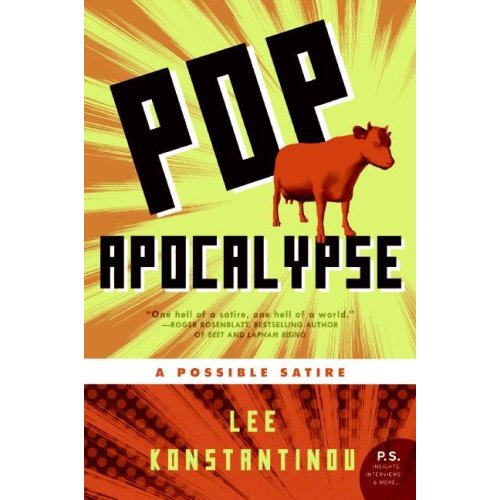
Another great quote from Lee Konstantinou’s Pop Apocalypse:
“Given the strategic interests of the Freedom Coalition, and the total certainty of the Foresight System’s battle scenario analysis and forecast, we have concluded that you, the peoples of the TransArabian Caliphate and the Federation of Imamates, have two objective choices in this geopolitical situation. Please select one of the following two options.
“If you would like the Dome of the Rock to be fully bulldozed and the Third Temple built in its place, please phone: +234343 3432 09232.
“If you would like your civilization destroyed and the radioactive moonscape of your remaining lands occupied by an army of infidel invaders, please phone: +234343 3432 09233” (249).
Perhaps the best part, is how close the phone numbers are. . . .
I’ll probably be writing something up about Lee Konstantinou’s recent Pop Apocalypse(New York: Ecco, 2009), but I cannot pass up posting this fantastic passage, in all of it’s self-conscious Bond-villain glory:
“Stan seems suddenly bored with Eliot. ‘Well, okay, I don’t have a lot of time, but here’s the elevator-talk version. Given the current geopolitical situation, the Apocalypse I just outlined to you will happen, one way or another. This year, next year, whenever. Take that as a given. If it happens by accident or is initiated by people who do not claim their intellectual property rights, then the world will just get nuked and no one will make a cent off the whole thing. Now, if some person or group figures out that there’s money to be made off the destruction of the world, then that person or group will be within reach of an unprecedented business opportunity. Again, given the geopolitics of the matter, this is really low-hanging fruit.
“‘It is, therefore, immoral not to take advantage of this knowledge, because if the end of the world doesn’t come about by accident, then some other, more malicious group will take advantage of this knowledge. On behalf of our investors, we’re obligated to take every step we can to ensure that we corner the Apocalypse market before anyone else does. And we’re prepared to use part of our profit, after dividends are paid out, in a very charitable way. We’re not only going to be the most profitable corporation in history but also the greatest philanthropists the world has ever known. As good corporate citizens, we have an obligation to the whole world community. We’ll help rebuild things, pick up the pieces of our sad and broken world. Make sure these kinds of unstable geopolitical situations can’t happen again'” (180).
Recently I’ve noticed a disturbing and yet curious trend in my writing, and specifically in my academic writing (though I’m surely guilty of it on this here blog as elsewhere). I’ve been using the phrase: “I cannot help but think that. . .”[1] followed by an assertion, usually an interpretation of some sort, far too much. As in: I want to start off virtually every sentence (including the one that will follow this one) w/ “I cannot help but think. . . .” I cannot help but think that my use of the phrase “I cannot help but think” is somehow important, maybe even interesting, while simultaneously something I cannot help but think is me being lazy, a crutch, a tried-and-true verbal formulation that, well, gets my thinking down onto paper (easily). It has been so bad recently that I’ve actually had to go back through whole documents, searching for “cannot help” and deleting or reformulating sometimes far too many sentences for me to be comfortable w/ my own ability to write—as in: I can’t (write, that is [again]). (Wow, look at that, even here I’m developing a new one: as in, I just wrote “as in” above. Will this ever stop? As in: will I ever get to a place where my prose flows freely w/o so much language that could easily be thrown away?) We all have these verbal and grammatological tics (lord knows I have had them, currently do, and will for the foreseeable future). You know (again), those little stylistic quirks that aren’t quite necessary but always seem to be suggesting themselves. The ones you use over and over again, almost unconsciously. These short, relatively meaningless phrases that allow our thinking to transition from one syntactical unit to another[2]. . . I cannot help but to use them (though I could have written: “I cannot avoid them.” What the hell). And I’m usually perfectly aware of myself when I’m writing like this, even if it takes me a while to recognize it; and yet I cannot help (again) to use them. In the past some of these have been, for myself, a gross and almost embarrassing reliance on the phrases: kinda, with regard to, furthermore, basically, in short, vis-à-vis, grounds,[3] namely, and yet, articulates, in other words, i.e., formulates, expresses, etc. etc.[4] This list could go on and on, and if I were to be exhaustive in this list, I might perhaps (another one, “perhaps,” that is) come to the horrifying realization that I am a robot. Yes, you heard me right, a robot (or perhaps [sheesh, again] an anthrobot[5]). I may very well be nothing more than a preprogrammed vocabulary who does nothing other than stitch together whatever amorphous rules of English expression I may have a shaky grasp upon in order to attempt to articulate (sheesh) whatever it is I am “thinking.”
I know that the usefulness/quantity of these types of words is largely to facilitate understanding, that they serve as moments to pause, breathe, signal the importance or lessen the impact of a statement. They mirror verbal speech—i.e. no one speaks in (H.) Jamesian prose nor Derridean deconstruction (or maybe they do, and I just have the wrong friends [or the right friends. . .]). These grammatological tics serve to mark, at the same time, that writing is trying to mirror spoken language while calling attention to the very construction of its inscription. But for all that, they feel like cheating to me, like inserting something that I know will make the sentence “flow” (or break. . .) w/o having to think terribly rigorously about how I’m using language. Perhaps this is b/c—at least I console myself w/ this fiction—that I’m trying to be “clear” (i.e. a bunch of unnecessary words eases the readers eyes and ears. . .), but is it really b/c I am lazy, uninventive, un-attentive, and—the real kick-in-the-pants—stupid? That I should get in another racket while I’m still young and have something to sell the world?[6] Or is it something else? I cannot help but think that this most recent tic—and there will be others, I’m sure—is significant in some way, that it signals something, and that what it signals is precisely (maybe) how these types of tics work.
So I’m sitting there at any of my various word processing machines (sometimes, though not often including the pen), attempting to communicate,[7] or whatever, something I’ve been “thinking” about, attempting to use words to encapsulate something I’m not terribly sure is a purely linguistic phenomena (thinking)—though this is also to say that I’m not terribly sure it isn’t purely linguistic. . . get back to me—and though the words might be struggling to get to the page, when they do come, I can’t help but think that they are midwifed in some way by the “I cannot help but think,” that they are eased into the world by this specific sort of nonsense.[8] In other words (again), “I cannot help but think” functions precisely as it says: I am thinking, I am attempting to write that thinking down, and it is the interaction b/t these two things is happening on an automatic level that I cannot understand. I literally cannot help it. I don’t know how.
Taken purely in-and-of-itself the phrase “I cannot help but think” might even be said (shit, again) to be (mildly) ontologically profound. I am. I cannot help but to be.[9] I am the thing that thinks. I being I, I thinks, regardless of whether I want to or not.[10] I cannot help but think. What I’m thinking is what I’m attempting, oh so poorly, to convey to you. My not being able to telepathically mind-meld w/ you, I’m forced into this other thing,[11] this action of thinking for a long, anxiety producing, and never static time cannot help but find its way onto the page, into this form. Writing “I cannot help but think” becomes the grossest and most accurate tautology for the whole process. I’ve tried helping it, really I have, thinking that is; and furthermore, I’ve tried thinking other things, at length and laboriously. Anyone familiar w/ academic labor (a few people), or thinking (hopefully everybody), knows what I’m talking about. I’ve thought a lot, and this is where I wind up. I can’t help it. I can doubt it, question it, revise it, etc. etc., but ultimately, this is what I’m writing down, so this is what I cannot help but do. Yes, I could do otherwise, but then I couldn’t help but think whatever it is this otherwise would be; it would amount to the same thing. I suppose this is why Zen Buddhism is so attractive—it is attempting to not think. Perhaps a good mantra for it would be “I can but help think.”[12] End of sentence, document, oeuvre, writing. Of course my overly-Westernized sensibility realizes this is a contradiction and paradox in-and-of-itself: thinking about not thinking, trying to help but not think is still a thinking, which, I guess, is the whole damn point and why I failed so miserably those times I tried to meditate (for real, and at a meditation center). But writing is in absolute contradistinction to this. One cannot write the not thinking. This is not an experience that can be conveyed. It simply doesn’t work.[13]The minute you try to help explain not thinking by putting it in writing, there is a thinking. (This is also why surrealism and Dada ultimately fail, btw [perhaps, damn, again!].) Surely to be able to help thinking, to not do it, is a complex, respectable, and fascinating goal, even if I’m not sure it can be reached, but it does me no good when writing, esp. when I “have” to write something.[14]
So I cannot help but think that I should refrain from using “So I cannot help but think that” ever again. (Of course I will use it again. I’ll be writing a long time, hopefully, and it will inevitably pop up. The nature of my thinking is that I will have forgotten ever having written this, and it, or any number of other grammatological tics will seep like Tracy did into the soil the other night in the Heroes[15] finale into my writing.) In other words, it is an ultimately meaningless, empty, needless, and tautological phrase. In fact (again), its real evil might be that it obscures and prevents thinking at all. “Better” thinking. “Better” prose. For it is a fact that I’ve just now spent a few hours writing about this rather than the writing I should be doing. It, quite literally, has prevented writing and thinking. Even if one takes writing as an emergent self-articulation of thinking onto the page, we don’t need to hear about it, have it crammed down our throats (or in my case, I’m doing the cramming). So, in the interest of verbal tic-ery and its proponents everywhere, I’m in the market, on the search, w/ my ear to the ground for a new throwaway phrase to heedlessly put into my writing. Right now I’m thinking about “viz.,” but am open to other suggestions. Perhaps “It should be freaking obvious that. . .,” or “anyone who isn’t Sarah Palin would clearly comprehend that. . .,” but those would be perhaps slightly inappropriate and would wear out quickly. For now I’m simply left w/ the hope that one day I will have developed and cultivated such a large fecal mountain of these types of phrases that they will go unnoticed, but for now I’m only left w/ the hope that I can be aware of them, delete them when they occur too often, and reconcile myself to them like I have so much else, viz. if you can’t help but mobilize the “can’t help but think(s)” of the world, why not join’em at their orgy and whatever it is that occurs afterward. (Seriously [yet another one, I can’t stop], what happens after the orgy?)[16]
[1] It should be understood here that “I cannot help but think” also stands in for all the variations on this phrase: i.e. “this cannot help but to suggest,” and others.
[2] Whatever I say (or don’t) about language below, I firmly believe that we don’t think syntactically. Though I can only “believe” this, like having faith in my own statement “I cannot help but think. . . .” What if I could help it. And isn’t this really the whole point?
[4] And, sad to say, my poor students probably bear the brunt of these throw-off grammatical tics in the comments they receive from me more than anyone else. For this, I apologize (even if I don’t see it changing. . .).
[6] Another (empty) consolation I tell myself: every writer ever has asked themselves this question—not consoling at all.
[7] It should also be noted that (again!, look how similar this is to note 1, which was actually written after this note!) I have similar, if wholly different tics, when it comes to poetic composition, as opposed to prose. That said (again), I will not tell anyone what these are, though they’re obvious, for the thought of uttering that type of candid statement about my own poetics is one that makes me mildly nauseous, in that I’d-be-nauseous-at-myself sort of way, which, of course (another), I already am.
[8] This is also the moment I’m realizing that this entry perhaps has no place on this blog whatsoever, is overly self-indulgent (like anything I do isn’t!), and really would be of no interest to anyone whatsoever. Which, of course, is also to say that (look how many words I just used that were wholly unnecessary in this sentence already, and then, to top it off, I wrote a whole gaggle of more words that were unnecessary in this parenthetical [something, btw, I’ve grown perfectly accustomed to and comfortable w/ tic-wise w/r/t myself, so now just bask in my ability to make an aside about an aside about an aside], and am still doing it!). . . even this self-indulgent footnote is a product of my anxiety over feeling self-indulgent about my anxiety about writing about my self-indulgent interests and anxieties, in a place where I try to attempt to understand the nature of the expression of anxiety w/r/t the biggest cause of anxiety of them all: the end of the world. In other words, anxiety, for me, is a fundamental aspect of any eschatological formulation (again), and consequently, perhaps fits quite well, considering the degree of anxieties which are in play here, w/in The Hyperarchival Parallax which is above all about the anxiety over the (over-)accumulation or destruction of writing, of the archive, anyway. Furthermore (again), the reason this is even being written in the first place is a result of the anxiety I’m feeling about not writing something else that is decidedly not self-indulgent though does make a fair use of “I cannot help but think” and is thus producing this anxiety, both the anxiety of what I’ve written and the anxiety of not continuing to write it; and at this point everything is probably getting pretty boring for anyone reading this (here, a link to something else! Okay, that one probably is absolutely the wrong thing to be linking to here [look esp. at the post “Does Nietzsche’s Grocery List Constitute Writing?”], so here! Couldn’t have said it better myself.), which, of course, is producing more anxiety. Perhaps what I’m trying to say is (again), that instead of whatever I’m suggesting “up there” (wink, wink to all ya’ in the know down here), these grammatological tics are really a way of coping w/ the anxiety of writing, or something.
[10] I’ve found solutions, but they’re largely chemical (I think), and have much more to do w/ memory, or more precisely a memory lacking, than thinking. Or perhaps I should be valiantly striving to go Rimbaud’s way: Je est un autre.
[11] I know there ain’t much terribly profound here, but I cannot help but think I have to say it anyway.
[13] You may feel free to disagree w/ me here, and even show me an example of what you would call such a writing, but again, my overly Westernized mind would simply respond: “prove no thinking was involved,” or even worse, “of course thinking was involved, I’m reading someone’s writing.” Actually, I’m kinda fascinated by this. Maybe I take it back.
[14] I.e. I cannot help but think that there would have been an adverse reaction had I handed in my PhD project exams w/ simply the line: “I can but help think.” (I still think there is a far better way of formulating this, of writing this, of expressing it, but that’s sorta the point. It doesn’t spring to mind (unlike “I cannot help but think”). I cannot help but to think that helping to think cannot but help to be put in writing, which of course is a “cannot help but think.” But again, if anyone can formulate [literally, third time, what is wrong w/ me] it better, esp. b/c out of the context of this writing it actually doesn’t make much syntactic or grammatical sense (again, the point), get in touch; even if it just sounds cool. Btw, one of my more-favorite blogs, if only b/c it is by a PhD student at pretty much the same place I’m at, studying, disturbingly, many of the same things I am, has a recent post on the whole doubt/anxiety/writing/etc. thing, that I’m perhaps merely expressing after the fact of my most recent and specific submersion into that realm. Please check out “Winter Snows, Doubts, and Donna Harraway,” at Jason Ellis’ Dynamic Subspace.
[15] Lord, how I hate how that show is always promising in for its futurity rather than its present.
[16] I’m stealing this from somewhere. I can’t help but think it’s Baudrillard.
This is a fantastic clip critiquing the over-use, over-saturation, and ridiculousness of apocalyptic rhetoric in the media from Stewart the other night. Both him and Colbert have a long tradition of throwing barbs at the eschatological hyperbole of the media, but this one is simply amazing. And it is esp. appropriate for both this here blog, the weather outside (how frightful it is),[1] and the fact I wrote on this exact thing a couple of days ago. Enjoy.
Vodpod videos no longer available.
Not to be outdone, the Baltimore local news also got involved. I don’t know which is better. Fox et al or this attempt at emulating their apocalyptic and absurd fear mongering.
All I know is, the snow outside ain’t going anywhere, but, then again, neither is the media. It has to make you wonder how they would react in the face of an actual apocalyptic scenario. It wouldn’t be anything like the movies. But then again, how much more ridiculous could they get. They might have to get all calm and, idk, objective.
[1] Esp. according to the woman I talked to (completely randomly) on the street yesterday. She, quote, “hate(d) this shit.” Why I appeared to be an appropriate person to express this to, is perhaps unimportant, but it is to emphasize that everyone is thinking exactly how frightful the weather is and feel that they have to inform whomever may walk by immediately. (As if I’m gonna say, “What the hell are you talking about. This is delightful!”) That said, I firmly agreed w/ her, and said so. There is something remarkable about how weather, and more importantly talking about it, creates socialization and connection b/t two people who would never talk to one another otherwise. This whole week I’ve been experiencing smiles, knowing looks, and a sense of community wholly lacking at other points in the year. We all agree on one thing, and it brings us together: we hate this shit, and yet. . . , I think there is something good in this agreement. This is also one of the reasons I like sports. Esp. in pgh, one always has a common ground from which to begin a conversation w/ a stranger. Usually talking about the weather is banal to the extreme, the old cliche, that thing that, strangely, causes disconnection b/t people. But when the unusually strong snowstorm hits the ‘burgh, its like the freaking Superbowl (of conversation starters–and of course the SB coincided w/ this past weekend). Of course this is great and all, but lord I miss the desert. At least there the weather didn’t shut down a city, even if it was just as much a part of the conversation. And it is always apocalyptic, though one never hears about “heat-wave-ageddon,” or “four-months-w/o-rain-Judgment-Day.” Though that would be hilarious.