I caught the 1984 Reagan v. Mondale foreign policy debate on CSPAN tonight, and was floored by the nuke-speak. I was too young to see this originally, and it is quite interesting, esp. w/ the hindsight of 28 years. The 1988 debate is also pretty fascinating w/r/t nuclear policy.
Eschatological Anxiety
Forthcoming Publications on David Foster Wallace
Two articles I’ve written on David Foster Wallace should be published any day now:
“The Inverted Nuke in the Garden: Archival Emergence and Anti-Eschatology in David Foster Wallace’s Infinite Jest,” boundary 2 39.3 (Fall 2012), was just announced along w/ the rest of the Table of Contents over at boundary 2‘s blog.
And my article, “‘Then Out of the Rubble’: The Apocalypse in David Foster Wallace’s Early Fiction,” Studies in the Novel 44.3 (Fall 2012): 284-303, was just announced on Studies in the Novel‘s website. The abstracts for all the articles of this special issue on Wallace, edited by Marshall Boswell, were also posted.
I’m pretty excited about both of these, and each issue looks to contain some pretty interesting work that I’m eager to read. I will provide links to my articles’ electronic/Project Muse versions when they become available.
Are we All Just Living in a Simulation(/Archive)?
Physicists say they have come up w/ a method for determining whether or not we live in a simulation. Didn’t Nick Bostrom already address this?
“Cyber-Pearl Harbor” and a Thomas Pynchon Talk
Reported today in The New York Times, “Defense Secretary Leon E. Panetta warned Thursday that the United States was facing the possibility of a ‘cyber-Pearl Harbor’ and was increasingly vulnerable to foreign computer hackers who could dismantle the nation’s power grid, transportation system, financial networks and government.”
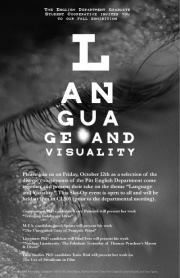
Also, today I will be giving a (hopefully quite) short talk entitled “Nuclear Luminosity: The Fabulous Metahistorical Textuality of Thomas Pynchon’s Mason & Dixon” for the Univ. of Pittsburgh English Grad Student Scholarship Collective Fall Symposium, Language & Visuality. The event will be taking place in CL 501 @ 1pm. In addition, Kerry Banazek-PhD in Comp/Rhet, Jacob Spears-MFA, and Katie Bird-Phd in Film will be speaking.
Perhaps We’re Not Bound to Our Solar System After All
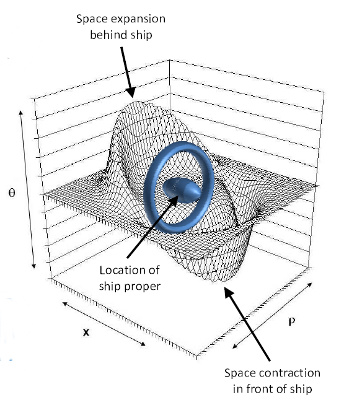
So, Matt Peckham in Time Magazine has reported that NASA is “Actually Working on a Faster-Than-Light Warp Drive.” No, really. And it’s brilliant:
“By placing a spheroid object between two regions of space-time — one expanding, the other contracting — Alcubierre theorized you could create a “warp bubble” that moves space-time around the object, effectively re-positioning it. In essence, you’d have the end result of faster-than-light travel without the object itself having to move (with respect to its local frame of reference) at light-speed or faster.”
Basically, rather than accelerate an object, this method simply changes the very fabric space-time (wow). And it doesn’t violate Einstein’s special theory of relativity. And they’re gonna start lab experiments too. The assured extinction of the species when the Sun goes Red Giant on us, now looks less eschatological. Alpha Centauri or bust by 2100.
Also, this is weirdly reminiscent of the last few pages of Thomas Pynchon’s, Against the Day [2006], in which the Chums of Chance skyship, the Inconvenience, becomes capable of time travel:
Inconvenience herself is constantly having her engineering updated. As a result of advances in relativity theory, light is incorporated as a source of motive power–though not exactly fuel–and as a carrying medium–though not exactly a vehicle–occupying, rather, a relation to the skyship much like that of the ocean to a surfer on a surfboard–a design principle borrowed from the Æther units that carry the girls to and fro on missions whose details they do not always share fully with “High Command.” (1084)
Destroying the Entire Internet . . . ?
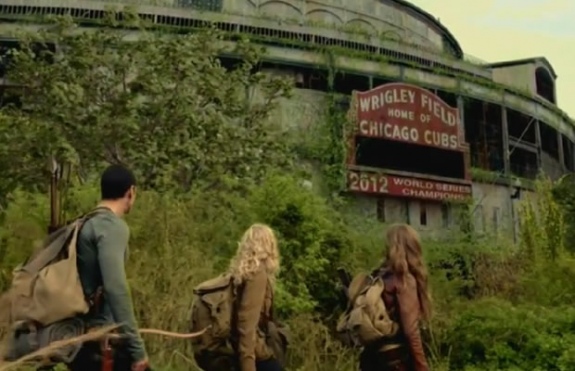
No. As George Dvorsky over at io9 reports in “Could Someone Really Destroy the Whole Internet,” the very things that make the Internet possible make it resistant to total destruction. Phew. (That is, unless you’re in this terrible looking new show. I watched the pilot, and its one of those: we stuck it in a post-apocalyptic future, but honestly, we will not have a single plot point that wouldn’t work just fine in another, less apocalyptic universe. But this way we get to have Wrigley Field covered in vines. And seriously, when I google, “revolution,” this is the first thing that comes up? We’re done for.)
Jimmy Carter’s Strategies for Nuclear War
At Foreign Policy, William Burr writes in “How to Fight a Nuclear War” about President Jimmy Carter’s plans for the apocalypse:
With other recently declassified material, PD-59 shows that the United States was indeed preparing to fight a nuclear war, with the hope of enduring. To do this, it sought a nuclear force posture that ensured a “high degree of flexibility, enduring survivability, and adequate performance in the face of enemy actions.” If deterrence failed, the United States “must be capable of fighting successfully so that the adversary would not achieve his war aims and would suffer costs that are unacceptable.”
Perhaps even more remarkable than this guidance is the fact that, although the Obama administration is conducting a review of U.S. nuclear targeting guidance, key concepts behind PD-59 still drive U.S. policy to this day.
It is Really Hot
The Summer of Disaster; or, the New Dust Bowl
Stephanie Pappas for Discovery News reports that “More of America is a Disaster than Not”: “The Secretary of Agriculture has declared 218 more U.S. counties to be drought disaster areas, bringing the total number of American counties designated as disaster areas (mainly due to drought) to more than 50 percent.”


Archiving Every Bomb the United States Has EVER Dropped
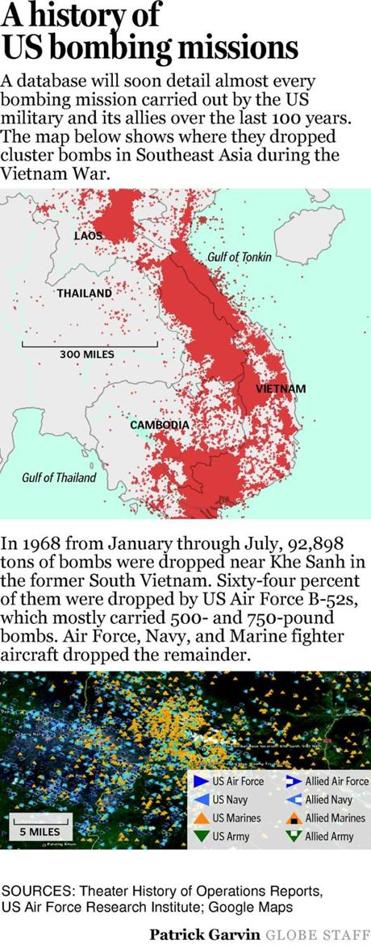
Bryan Bender at the Boston Globe reports how Lieutenant Colonel Jenns Robertson has assembled a report on every bomb the US has ever dropped since WWI(!!!), “a compilation that, at the click of a mouse and a few keystrokes, reveals for the first time the sheer magnitude of destruction inflicted by the US and its allies from the air in the last century.” Going by the name: Theater History of Operations Reports (or THOR), this hyperarchive of US military violence is truly staggering. “One particularly relevant example: From October 1965 to May 1975, at least 456,365 cluster bombs were dropped on Vietnam, Laos, and Cambodia, according to the records analyzed.”
 The Hyperarchival Parallax