The Apocalypse in Recent News

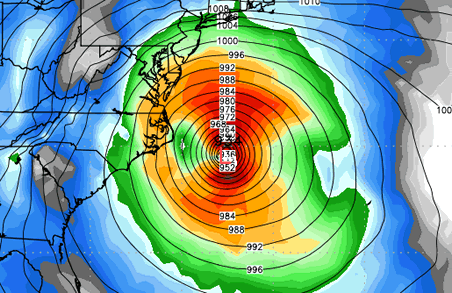
James Atlas wrote a piece, “Is this the End?” in Sunday’s New York Times discussing narrative eschatology with regard to Sandy and rising oceans and the sustainability of NYC: “Last month’s ‘weather event’ should have taught us that. . .  in 50 or 100 or 200 years, there’s a good chance that New York City will sink beneath the sea.”

(In his I think monthly column “Easy Chair”) Thomas Frank has an article on “the 2012 canon of doom” in December’s issue of Harper’s, titled (cleverly . . .) “Appetite for Destruction.”

Disaster Capitalism & Sandy

Thanks to R. for drawing my attention to Andrew Martin’s article, “Hurricane Sandy and the Disaster Preparedness Economy,” in Saturday’s New York Times that details yet another example of what Naomi Klein calls “disaster capitalism” (though this is admittedly a bit different than, say, Iraq or Chile . . .) in her 2007 book The Shock Doctrine. An excerpt:

It’s all part of what you might call the Mad Max Economy, a multibillion-dollar-a-year collection of industries that thrive when things get really, really bad. Weather radios, kerosene heaters, D batteries, candles, industrial fans for drying soggy homes — all are scarce and coveted in the gloomy aftermath of Hurricane Sandy and her ilk.

It didn’t start with the last few hurricanes, either. Modern Mad Max capitalism has been around a while, decades even, growing out of something like old-fashioned self-reliance, political beliefs and post-Apocalyptic visions. The cold war may have been the start, when schoolchildren dove under desks and ordinary citizens dug bomb shelters out back. But economic fears, as well as worries about climate change and an unreliable electronic grid have all fed it.

The End (Repeat)

n+1, in honor of Sandy (so they say), just reposted this essay-review by Chad Harbach of Matthew Sharpe’s Jamestown (2007) and a host of other post-catastrophe lit, “The End, The End, The End.” Like Robert Charles Wilson’s recent Julian Comstock: A Story of 22nd Century America (2009), the catastrophic novels Harbach discusses lie on the other side of global oil-depletion: “Now we’ve burned half the available oil, or close to it, and burning it (along with so much coal) has altered the earth’s equilibrium. Our future, like our past, may be virtually free of oil, and global culture, and many of the social safeguards we enjoy. Thus the novel of future catastrophe threatens to become a version of the historical novel.” Harbach also has an old review of DFW’s Oblivion for n+1.

Excerpt: Kim Stanley Robinson and Disaster Projection

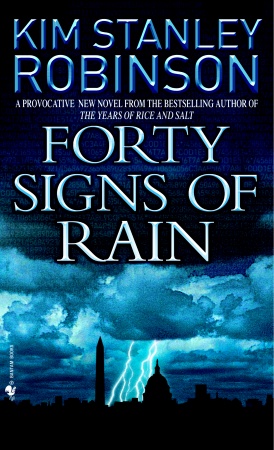
From Kim Stanley Robinson’s novel, Forty Signs of Rain (2004), from his Science in the Capital Trilogy:

The second day of the storm passed as a kind of suspended moment, everything continuing as it had the day before, everyone in the area living through it, enduring, waiting for conditions to change. The rain was not as torrential, but so much of it had fallen in the previous twenty-four hours that it was still sheeting off the land into the flooded areas and keeping them flooded. The clouds continued to crash together overhead, and the tides were still higher than normal, so that the whole Piedmont region surrounding Chesapeake Bay was inundated. Except for immediate acts of a lifesaving nature, nothing could be done except endure. All transport was drowned. The phones remained down, and power losses left hundreds of thousands without electricity. Escapes from drowning took precedence even over journalism (almost), and even though reporters from all over the world were converging on the capital to report on this most spectacular story–the capital of the hyperpower, drowned and smashed–most of them could only get as close as the edge of the storm, or the flood; inside that it was an ongoing state of emergency, and everyone involved with rescues, relocations, and escapes of various kinds. The National Guard was out, all helicopters were enlisted into the effort; the video and digital imagery generated for the world to see was still incidental to other things; that in itself meant ordinary law had been suspended, and there was pressure to bring things back to all-spectacle all-the-time. Part of the National Guard found itself posted on the roads outside the region, to keep people from flooding the area as the water had. (Kim Stanley Robinson, Forty Signs of Rain [New York: Bantam Books, 2004], 345-6.)

Oh How Things Have Changed in the Second Nuclear Age

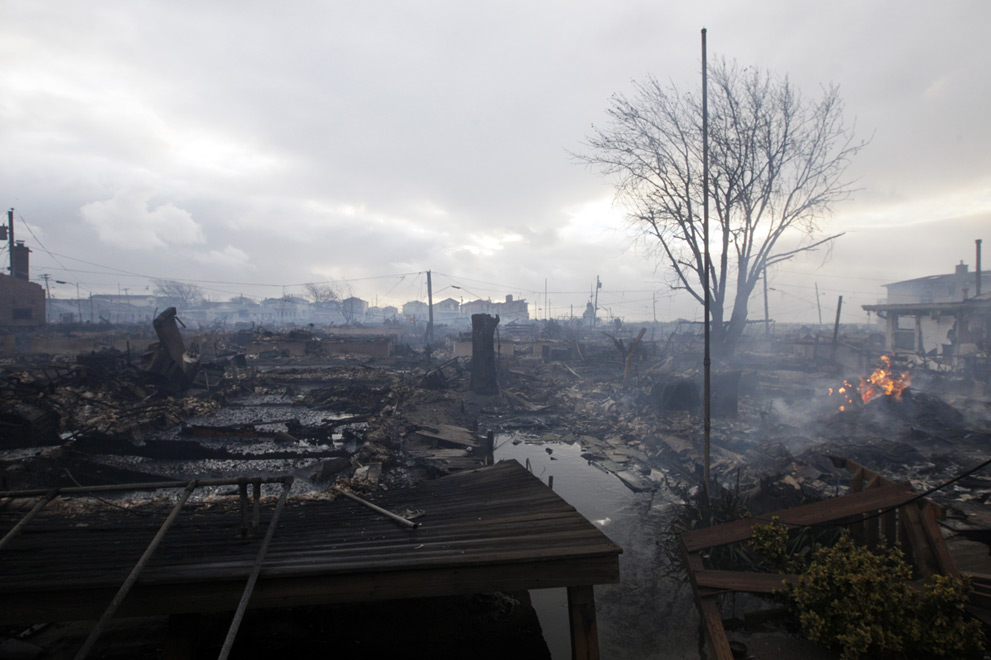
Unsurprisingly, last night’s final Presidential Debate on foreign policy seemed to show Romney concerned w/ only one thing: not letting Iran produce a nuclear weapon (and how many nuclear weapons Pakistan already has). This makes how nuclear policy was discussed in 1984 and 1988 all the more striking in contrast. Heck, thought I’d post the whole weird thing below. (Also, I think Mark Shields’s observation that neither candidate mentioned, Idk, Europe, or India, or Africa, or really anywhere else . . . must give one pause.)

In More Contemporary Nuclear News (and Other Stuff)

Helene Cooper and Mark Landler reported in The New York Times yesterday that, “The United States and Iran have agreed in principle for the first time to one-on-one negotiations over Iran’s nuclear program, according to Obama administration officials, setting the stage for what could be a last-ditch diplomatic effort to avert a military strike on Iran.” Pretty interesting, esp. coming right before the debate, and that “Iranian officials have insisted that the talks wait until after the presidential election [. . .] telling their American counterparts that they want to know with whom they would be negotiating.” Yet another chink of armor for President Obama’s foreign policy CV? A cynical move for tomorrow night’s debate? Very, very interesting.

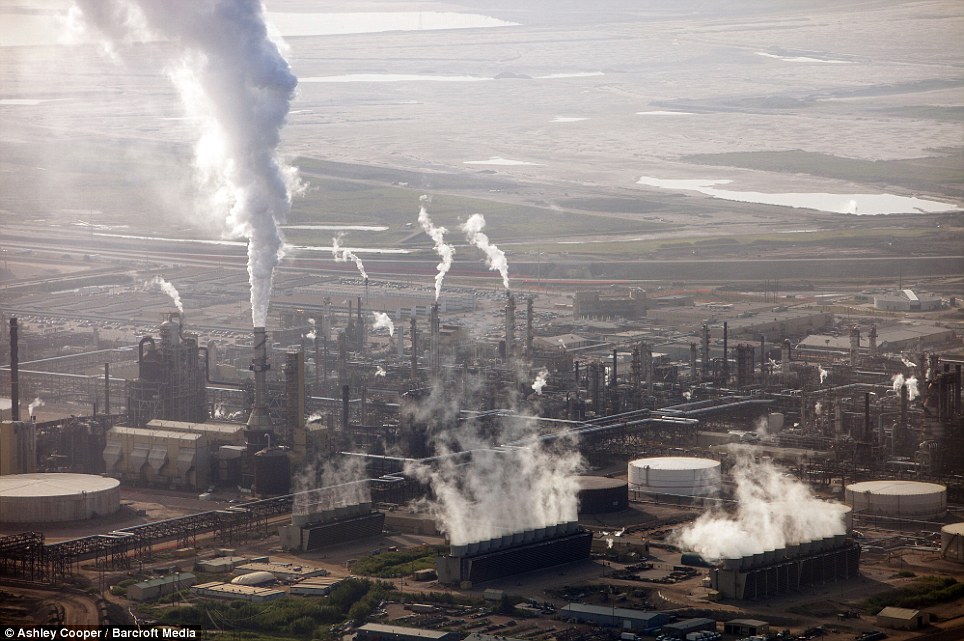
A truly horrifying group of images from the strip mining of Canada’s Tar Sands. A sample:

And a whole class being taught on David Foster Wallace at the John Adams Institute in Amsterdam. (Also, thought I’d relink to this class on DFW taught by Kathleen Fitzpatrick at Pomona College in the Spring of 2009.)