MLA 2026 Panels: “Aesthetics, Politics, and Ecological Overshoot” and “Comics as Physical Objects”

At this year’s Modern Language Association Convention in Toronto, Ontario, Canada (January 8-11, 2026), I will be speaking on a roundtable Aesthetics, Politics, and Ecological Overshoot, and panel, Comics as Physical Objects. I have included the information and tentative abstracts for each paper below.

52. Comics as Physical Objects

Thursday, January 8, 2026, 1:45-3:00 p.m.

Presiding: Edward Whitley (Lehigh U)

Presentations:
1. “A Queer Print History of Comics,” Margaret Galvan (U of Florida)
2. “The Comics Megatext: Floppies, Trades, Marvel Unlimited, Podcasts, and The X-Men,” Bradley Fest (Hartwick C)
3. “Multimedia and Digital Materialities: The Blue Age of (Web) Comics and Fostering Multimodal Literacy,” Devon Harvey (Queen’s U)
4. “Framing Matter: Materiality and the Medium of Comics,” Christina Kraenzle (York U)


The Comics Megatext: Floppies, Trades, Marvel Unlimited, Podcasts, and The X-Men

As Douglas Wolk recently pointed out in his book about reading all of Marvel Comics, “The twenty-seven thousand or so superhero comic books that Marvel Comics has published since 1961 are the longest continuous, self-contained work of fiction ever created.”[1] Though a bit smaller, the over six thousand comics that constitute The X-Men (1963–) also makes it one of the longest narratives ever written. Both are what I call in my current book project megatexts: a massively unreadable twenty-first century form created through collaboration and digital technology to achieve a scale beyond what a single author could do alone and that requires incredibly nontrivial effort on the part of readers to completely traverse. In this talk, I will explore the emergence of comics as a megatextual object in the twenty-first century. In the age of floppies and trades, comics megatexts were largely inaccessible in their totality. With the emergence of platforms such as Marvel Unlimited and paratextual forms like podcasts such as Jay and Miles X-Plain “The X-Men” (2014–), we can now read comics megatexts as megatexts. For all intents and purposes, then, the comics megatext has newly emerged as an accessible and thus coherent form that, like other megatexts, also importantly calls forth collective and creative reading and criticism. Approached in this way, The X-Men in particular offers us a continuously transforming megatextual object that is also a beacon for collaboratively exploring how to build alternative communities and ways of thinking and being for an infowhelming world.


[1] Douglas Wolk, All the Marvels: A Journey to the End of the Biggest Story Ever Told (New York: Penguin, 2021), 1.


602. Aesthetics, Politics, and Ecological Overshoot

Sunday, January 11, 2026, 10:15-11:30 a.m.

Presiding: John Maerhofer (Rutgers U, New Brunswick)

Speakers: Federico Correa Pose (U of Southern California)
Bradley Fest (Hartwick C)
Christopher Gortmaker (U of Chicago)
Brenda Odria Loayza (U of Toronto)
Pedro Gabriel Soares Daher (Maine C of Art and Design)

Megatextual Eco-Utopia: Jonathan Hickman’s X-Men and Mutant Poiesis

In 2019, in one of the more audacious reboots of a long-running megatextual franchise, Jonathan Hickman reimagined the now decades-long political aspirations of Marvel Comics’ X-Men (1963–) franchise in explicitly eco-utopian terms. Rather than continuing to pursue his decades-long dream of mutant and human peaceful coexistence, in House of X/Powers of X (2019) Professor X creates a separatist sovereign nation on the sentient living island Krakoa, an achieved utopia for all mutants. Notable even in its genre for its exploration of alternative presents and various futures, The X-Men franchise’s subsequent five-year pivot fleshes out the politics of a separatist utopia where no mutant dies and the dead are reborn. Despite the ecologically harmonious, sustainable technologies the mutant nation develops and despite their offer to share their miraculous, life-saving drugs and technology with the rest of the world, humans nonetheless turn toward the genocidal destruction of what appears the last, best hope for the continued flourishing for organic life on the planet. As such, Hickman’s eco-utopia emerges not from the dreams of the 1960s but from the despair of the present, a somewhat reactionary imaginary attempting to respond to the slow violence of climate change and the rise and resurgence of far-right, ecocidal extremism in the United States and around the world. Ultimately, however, the mutant survivors of Krakoa discover that their story was not one of separatist paradise gained but historical subjectivity achieved without the yoke of human bigotry and hatred, enabling them to build their world with others, crafting its institutions and practices, its culture and its politics—in short, mutant poiesis—the swift, violent destruction of which should serve as a warning for us in this moment of political destituency.


For previous essays of mine on megatexts and unreadable texts, see:

“Toward a Theory of the Megatext: Speculative Criticism and Richard Grossman’s ‘Breeze Avenue Working Paper.’”

“‘Is an Archive Enough?’: Megatextual Debris in the Work of Rachel Blau DuPlessis.”
“Reading Now and Again: Hyperarchivalism and Democracy in Ranjan Ghosh and J. Hillis Miller’s Thinking Literature across Continents.”

“Writing Briefly about Really Big Things.”

MLA 2025 Panel: Hypergraphia and Hypographia: Literary Maximalism and the Literature of Writer’s Block

At this year’s Modern Language Association Convention in New Orleans, LA (January 9-12, 2025), I will be speaking on a panel discussing Hypergraphia and Hypographia: Literary Maximalism and the Literature of Writer’s Block. I have included the information about the panel and a tentative abstract for the paper I will be presenting below.


65. Hypergraphia and Hypographia: Literary Maximalism and the Literature of Writer’s Block

Thursday, January 9, 2025, 1:45-3:00 pm, Windsor (Hilton Riverside New Orleans)

Presiding: Benjamin Bergholtz (Louisiana Tech U) and Aaron Colton (Emory U)

Presentations:
1. “‘No!—But I Must’: The Blocked Writer in Maximalist Fiction,” Benjamin Bergholtz (Louisiana Tech U) 
2. “The Craft of Writer’s Block: Autofiction, Process, and Pedagogy,” Aaron Colton (Emory U)
3. “Megatextual Kinaesthetics: The Wanderer above the Sea of Elden Ring,” Bradley Fest (Hartwick C) 
4. “Wallace’s Maximalism: Other-Flood and Self-Blockage,” Yonina Hoffman (US Merchant Marine Acad.)


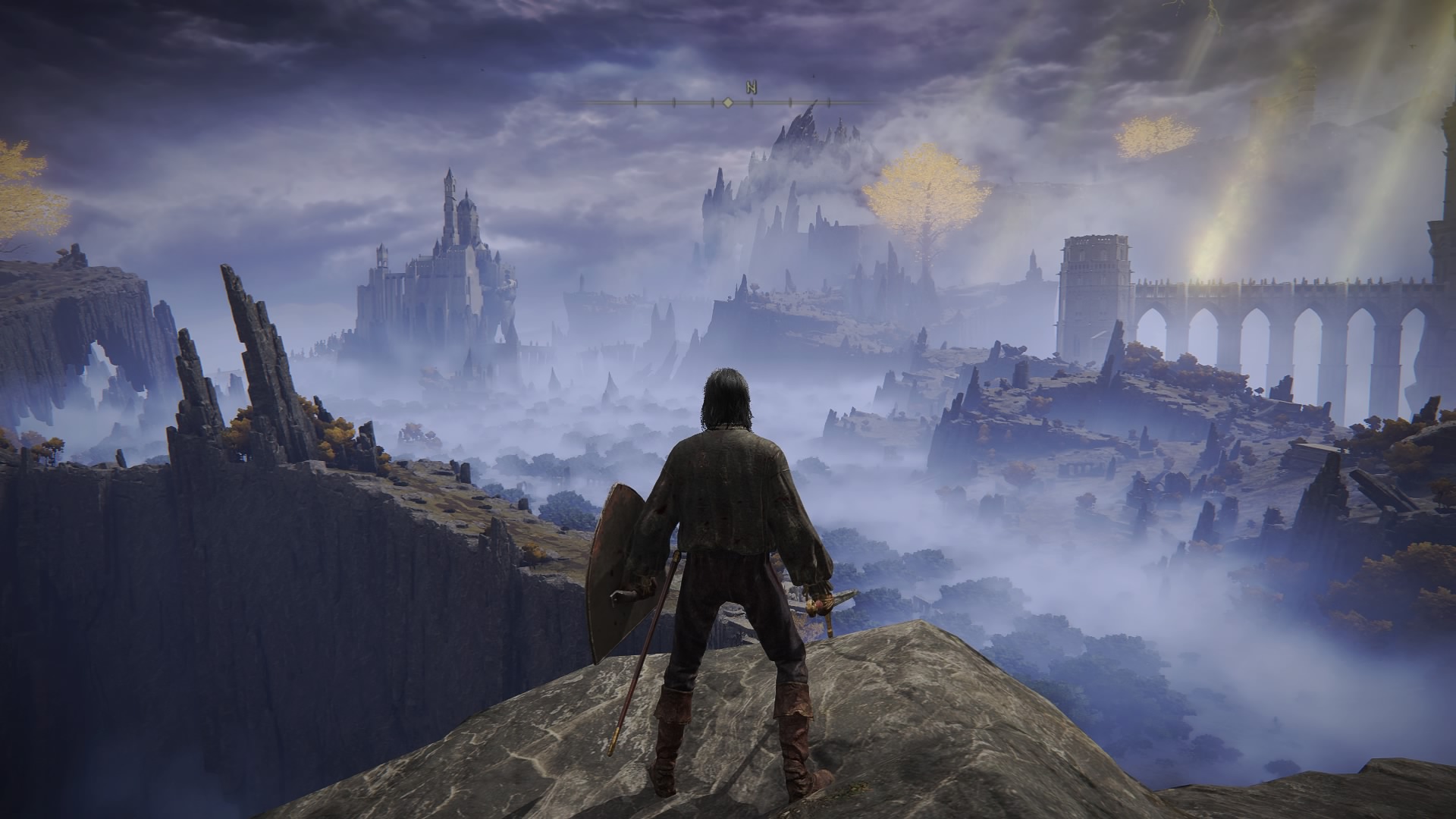
ELDEN RING™_20230207194711

Elden Ring, v. 1.09.1 (Tokyo: Bandai Namco, 2022), PlayStation 4, screenshot by author.


“Megatextual Kinaesthetics: The Wanderer above the Sea of Elden Ring

In the twenty-first century, the maximalist impulse evident in the big, ambitious novel of the twentieth century has expanded toward the creation of massively unreadable works across media, what Fest has elsewhere called megatexts. From experimental literary projects, to popular forms, to transmedia corporate intellectual property, megatexts abound in the twenty-first century and their presence in both avant-garde and corporate cultural production signals that the megatext is an emergent form native to the neoliberal era. Perhaps the most paradigmatic instance of this emerging form is the massive, open-world video game requiring hundreds of hours of playtime to traverse. In the video-game megatext, we see a form striving to create worlds, to build spaces large enough to feel comparable to our own.

In his talk, Fest will focus on FromSoftware’s blockbuster 2022 game Elden Ring as not only a paradigmatic video-game megatext but also the kind of sensorial-conceptual or theoretical text that Patrick Jagoda has recently suggested experimental games can be. Fest will argue that Elden Ring’s open world is an affective, bodily, material sensorium that presents to its players something like what big data feels like, allowing players to experience a haptics of hyperarchivalism, a spatiality of the database. In this way, rather than some monumentally time-sucking waste, Elden Ring might itself constitute a moment of respite, contemplation, and critical engagement with respect to the network society, a moment where the digital realities of contemporaneity, in all their hypermediated and interconnected totality might be critically felt, even if that feeling only occurs as the sensation of a concept.


For previous essays of mine on megatexts and unreadable texts, see:

“Toward a Theory of the Megatext: Speculative Criticism and Richard Grossman’s ‘Breeze Avenue Working Paper.’”

“‘Is an Archive Enough?’: Megatextual Debris in the Work of Rachel Blau DuPlessis.”

“Reading Now and Again: Hyperarchivalism and Democracy in Ranjan Ghosh and J. Hillis Miller’s Thinking Literature across Continents.”

“Writing Briefly about Really Big Things.”

“The Megatext and Neoliberalism.”

“The Time of Megatexts: Dark Accumulation and Mark Z. Danielewski’s The Familiar.”

MLA 2024: Twenty-First-Century Forms

For this year’s Modern Language Association Convention, to be held January 4–7, 2024 in Philadelphia, Pennsylvania, I organized and will be moderating a roundtable on Twenty-First-Century Forms, featuring the following speakers: Andrew Ferguson, Aislinn McDougall, Élika Ortega, Kimberly Southwick-Thompson, Kaushik Tekur, Anna Torres Cacoullos, and Zach Wagner. I have included the information about the panel and, below that, full abstracts from each speaker.

119. Twenty-First-Century Forms

Thursday, January 4, 2024, 5:15–6:30 p.m. (EST)

If one might argue that the novel and lyric poem have become residual forms, what literary forms are emerging in contemporaneity? Panelists explore emergent literary forms of the twenty-first century and their relationship with, instantiation in, or remediation by other (digital) media: Internet writing, social media, print-digital books, film, television, and other hybrid and multimodal narrative and poetic forms.

Speakers
Andrew Ferguson (U of Virginia)
Aislinn McDougall (U of Regina)
Élika Ortega (U of Colorado, Boulder)
Kimberly Southwick-Thompson (Jacksonville State U)
Kaushik Tekur (Binghamton U, State U of New York)
Anna Torres Cacoullos (U of Illinois, Urbana-Champaign)
Zach Wagner (Binghamton U, State U of New York)

Presiding
Bradley J. Fest (Hartwick C)

Continue reading

MLA 2023: Twenty-First-Century Forms

For this year’s Modern Language Association Convention, to be held January 5–8, 2023 in San Francisco, California, I organized and will be speaking on a roundtable on Twenty-First-Century Forms, along with Daniel Burns, Zoe Bursztajn-Illingworth, Kathryn Harlan-Gran, Kevin Pyon, and Elizabeth Sotelo. I have included the information about the panel and, below that, full abstracts from each speaker.

197. Twenty-First-Century Forms

Friday, January 6, 2023, 8:30–9:45 a.m. (PST)

If one might argue that the novel and lyric poem have become residual forms, what literary forms are emerging in contemporaneity? Panelists explore emergent literary forms of the twenty-first century and their relationship with, instantiation in, or remediation by other (digital) media: film, documentary, social media, publishing platforms, transmedia, autotheory, and other hybrid narrative and poetic forms.

Speakers
Dan Burns (Elon University)
Bradley J. Fest (Hartwick College)
Zoe Bursztajn-Illingworth (The University of Texas at Austin)
Kathryn Harlan-Gran (Cornell University)
Kevin Pyon (Pennsylvania State University, Harrisburg)
Elizabeth Sotelo (University of Oregon)

Presiding
Bradley Fest (Hartwick College)

Continue reading

“Twenty-First-Century Forms” at MLA 2023

Richard Grossman, Torah Ball, 2011. Corundum sphere 5″ in diameter inscribed in Hebrew with the Ten Commandments currently buried inside Mount Princeton, Colorado, USA.

Given my ongoing interest in megatexts and other emerging hybrid and transmedia forms, I am organizing a second panel on emergent literary forms of the twenty-first-century for the 2023 Modern Language Association Convention in San Francisco, California (the first was at the 2021 MLA Convention). Please consider submitting an abstract to festb[at]hartwick[dot]edu by March 24, 2022. Here’s the CFP:

Twenty-First-Century Forms

If the novel and lyric poem might be considered residual forms, what literary forms are emerging in the twenty-first century? Panel on emergent literary forms: transmedia, digital, hybrid, remediated, megatexts, other. 250-word abstract, brief bio.

Recording of Twenty-First-Century Forms at MLA 2021

If you attended the virtual 2021 Modern Language Association Conference but were unable to come to the roundtable I organized, Twenty-First-Century Forms, you can watch a recording of it here (I believe for about six weeks). The speakers were (in order): myself, Amy Sara Carroll, Racheal Fest, Christian P. Haines, Hyemin Kim, and Eric Loy. For more information, see my previous post.

MLA 2020 Panel: Bad Books

At this year’s Modern Language Association Convention in Seattle (January 9-12, 2020), I will be speaking on a round table discussing Bad Books. I have included the information about the panel and a tentative abstract for the paper I will be presenting below.


338. Bad Books

Friday, January 10, 2020, 1:45-3:00 pm, 617 (WSCC)

Presiding: Eric Loy

Presentations:
1. “Notes on Notes on Notes: Glenn Ligon Reads James Baldwin,” Paul Benzon (Skidmore C)
2. “Books Behaving Badly: The Raison d’Être behind Perec’s La Disparition,” Priya Wadhera (Adelphi U)
3. “Debilitated Forms and Forms of Debility: On Writing a Failed Book,” Sharon Tran (U of Maryland Baltimore County)
4. “The Space of Megatexts: ‘Reading’ Mark Leach’s Marienbad My Love,” Bradley J. Fest (Hartwick C)


The Space of Megatexts: “Reading” Mark Leach’s Marienbad My Love

At over seventeen million words and consisting of seventeen volumes printed in dense eight-point font, the second edition of Mark Leach’s Marienbad My Love (2008; 2nd ed., 2013) currently holds the record as the world’s longest novel and is what I have elsewhere called a megatext. Composed over the course of thirty years using a number of digital techniques, the result is one of the more spatially imposing works of literature to ever sit on a shelf. Because of this, it also appears that no one has really bothered to read it. Whether this is due to some prejudice against self-publication or critics’ perceptions of authorial vanity, the sheer unreadable size of the text has discouraged anyone from taking Leach’s work all that seriously. I believe this is a mistake and this paper aims to seriously consider a remarkable project that rebelliously pushes against the conceptual, temporal, and physical boundaries of the codex novel. The revisions made to the second edition of the text indicate that not only does Leach intend for people to actually read his book, but also that Marienbad My Love is in fact a complex theoretical statement about the novel in the digital age and a meditation on the present and future of literary writing. In this paper, I will argue that accounting for Marienbad My Love’s material size by finding ways to speculatively (and actually) read this unreadable text will encourage us to rethink how we theorize the novel in the twenty-first century.


For previous essays of mine on megatexts and unreadable texts, see:

“Toward a Theory of the Megatext: Speculative Criticism and Richard Grossman’s ‘Breeze Avenue Working Paper.'”

“Reading Now and Again: Hyperarchivalism and Democracy in Ranjan Ghosh and J. Hillis Miller’s Thinking Literature across Continents.”

“Writing Briefly about Really Big Things.”

“The Megatext and Neoliberalism.”

“The Time of Megatexts: Dark Accumulation and Mark Z. Danielewski’s The Familiar.”

ALA 2019 Panel: US Women Writers and Economic Forms, C19–C21

At this year’s American Literature Association Conference in Boston, Massachusetts (May 23–26, 2019), I will be speaking on a panel discussing US Women Writers and Economic Forms, C19–C21. I have included the information on the panel and a tentative abstract for the paper I will be presenting below.

For previous essays and papers of mine on what I am calling megatexts, see:

“Toward a Theory of the Megatext: Speculative Criticism and Richard Grossman’s ‘Breeze Avenue Working Paper.'”

“The Time of Megatexts: Dark Accumulation and Mark Z. Danielewski’s The Familiar.”

“The Megatext and Neoliberalism.”


Session 20-C : US Women Writers and Economic Forms, C19-C21 (St. George C)
1. “Protestant Work Epic: Labor, Loafing, and Form in Alcott’s Little Women Trilogy,” Schuyler J. Chapman, Glenville State College
2. “Megatextual Debris: Rachel Blau DuPlessis’s Drafts before and after 2008,” Bradley J. Fest, Hartwick College
3. “H.D. and the Entrepreneurial Imagination,” Racheal Fest, SUNY Oneonta


Panel Abstract

US Women Writers and Economic Forms, C19-C21

After the 2008 financial crisis, literary critics have turned increased attention to US economic ideologies and their complicated relationships to cultural production. This panel explores how US women writing across the tradition have responded to the changing economic conditions, discourses, and values that defined their moments. Panelists argue poets and prose writers Louisa May Alcott, Rachel Blau DuPlessis, and H.D. invent novel forms that at once challenge dominant discourses of free enterprise and disclose their patriarchal valences.


Presentation Abstracts

“Protestant Work Epic: Labor, Loafing, and Form in Alcott’s Little Women Trilogy”

Schuyler J. Chapman, Glenville State College

Roughly halfway into Louisa May Alcott’s Little Women, a longtime servant sends a letter to the March-family matriarch, explaining that she and the family’s four daughters have “got on very economical.” The moment underscores the narrative’s persistent attention to the financial texture of the mid-19th century. Although scholars have approached this novel and its two sequels as illustrative of period-specific perspectives on child-rearing, romance, education, and more, few have attended to the novels’ economic theories. In this series, I argue, Alcott crafts a set of consciously epic novels, reflective of both Frye’s and Lukács’s conceptualizations of the genres, as the ideal form through which she can interrogate the sources of and solutions to economic tribulations resulting from early industrial capitalism. Surveying her contemporaries, Alcott urges a return to what Weber would later identify as the Protestant Ethic, rejecting outright the malingering ethos put forth by Hawthorne, Melville, Thoreau, and Whitman. Rather than oppose an economic system that her novels represent as inherently unjust by refusing labor, Alcott proposes undermining the capitalist mode of production and its concomitant social hierarchies through a surfeit of labor, an ideal that finds itself reflected in the prolix and rather uneconomical narrative form she adopts.


“Megatextual Debris: Rachel Blau DuPlessis’s Drafts before and after 2008″

Bradley J. Fest, Hartwick College

In the twenty-first century, digital technologies have made it possible for authors to create massively unreadable works, what I call megatexts, through computational and collaborative composition. The ubiquity of texts that are quite literally too big to read appearing across media—from experimental novels and electronic literature, to television, film, and videogames—signals, as I argue elsewhere, that the megatext is an emergent form native to the era of neoliberalism. But what happens to other long forms, such as the twentieth-century long poem, when written in an era of megatextuality? Rachel Blau DuPlessis’s Drafts (6 vols.; 1987–2013) readily suggests itself as a case study for thinking through the lyric’s transformations in the era of big data and financialization. A long poem that conspicuously draws upon its modernist precursors (Pound, Zukofsky, Olson, et cetera) while disavowing at every level of its composition a patriarchal will toward totality, Drafts responds to the economic and political transformations between the end of the cold war and the 2008 financial collapse by producing a kind of fragmentary, megatextual debris. In this paper I will argue that DuPlessis, rather than simply (and futilely) resist the neoliberal logic of megatextuality, hypertrophically uses the form’s phallogocentrism against itself in order to more broadly interrogate what it means—socially, aesthetically, economically—to write a long poem in the age of hyperarchival accumulation.


“H.D. and the Entrepreneurial Imagination”

Racheal Fest, SUNY Oneonta

Although literary critics interested in neoliberal discourses usually focus on literary and economic texts composed after 1980, many neoliberal intellectuals writing in the US published their most influential theoretical works much earlier, beginning in the 1920s and 1930s. We might therefore productively reread US modernist writers with their neoliberal contemporaries in mind. When we do, I argue, familiar critical narratives about modernist understandings of the nature and function of human creativity shift. Critics often read modernist conceptions of imagination as romantic, transcendental, and incompatible with privileged materialist views of the human. Set against the entrepreneurial conceptions of culture that economists promoted in the early twentieth century, however, modernist writers seem to offer newly visible resources for oppositional projects interested in materialist representations of creativity. To give a sense of how, this paper puts the erotic view of creativity the poet and novelist H.D. develops in the fragmentary text, Notes on Thought and Vision, in conversation with the view of culture her contemporary, the Nobel-prize-winning economist Friedrich Hayek, theorized around the same time. While Hayek subsumes creativity to transcendental market logics he believes culture at its best supports, H.D. conceives imagination as an historical and embodied faculty able to influence others through the sensuous materiality of sound and image. I explore the history of these different visions and evaluate their stakes for our moment.

MLA 2019 Panel: New Nuclear Criticism

At this year’s Modern Language Association Convention in Chicago (January 3-6, 2019), I will be speaking on a round table discussing the New Nuclear Criticism. I have included the information on the panel and a tentative abstract for the paper I will be presenting below. More information about the panel is available at kristingeorgebagdanov.com.


For previous essays of mine on nuclear criticism, see:

““Apocalypse Networks: Representing the Nuclear Archive”;

“The Inverted Nuke in the Garden: Archival Emergence and Anti-Eschatology in David Foster Wallace’s Infinite Jest;

“Geologies of Finitude: The Deep Time of Twenty-First-Century Catastrophe in Don DeLillo’s Point Omega and Reza Negarestani’s Cyclonopedia.”


246. New Nuclear Criticism

Friday, January 4, 2019, 10:15 AM–11:30 AM, Hyatt Regency – Randolph 3

The panel is sponsored by the Association for the Study of Literature and Environment.

Presider: Frances Ferguson, U of Chicago

Presenters: Jada Ach, U of South Carolina, Columbia, Bradley J. Fest, Hartwick C, Jessica Hurley, U of Chicago, Kristin George Bagdanov, U of California, Davis, Kyoko Matsunaga, Kobe City U of Foreign Studies, Inna Sukhenko, U of Helsinki

Session Description: The year 2019 marks the thirty-fifth anniversary of the 1984 colloquium at Cornell University on nuclear criticism and the publication of a special issue of Diacritics collecting the Cornell papers. Do we need a new nuclear criticism? Panelists explore what a new nuclear criticism in the context of ecological crisis might look like by drawing on archives, methods, and approaches not previously included in nuclear criticism’s original manifestation.


Jacques Derrida’s “No Apocalypse, Not Now” at Thirty-Five

Abstract:  2019 will mark the thirty-fifth anniversary of the 1984 colloquium at Cornell University on nuclear criticism and the publication of a special issue of Diacritics collecting its papers. The conference occurred at a historical moment of heightened tension between the United States and the Soviet Union unseen since the chilling days of October 1962. But in the intervening years, which have seen the end of the cold war, a reduction of the US and Russia’s nuclear arsenal, a nuclear treaty with Iran, and waning cultural depictions of global nuclear war, the project of nuclear criticism has seemed less vital and, indeed, at times rather anachronistic. Though significant contributions in the ongoing discussion regarding literature of the first and second nuclear ages have been made by a new generation of scholars such as Paul K. Saint-Amour, John Canady, Daniel Cordle, Daniel Grausam, Jessica Hurley, and others (e.g., the 2013 collection, The Silence of Fallout: Nuclear Criticism in a Post-Cold War World), and nuclear criticism, for others, has been subsumed under a broader concept of risk criticism inspired by the thinking of Ulrich Beck (e.g., the work of Ursula K. Heise and Paul Crosthwaite’s collection, Criticism, Crisis, and Contemporary Narrative [2011]), most would agree that literary and critical engagements with the threat of nuclear war have taken a back seat to more pressing global concerns, particularly the realities of climate change and the emergence of the Anthropocene as an important cross-disciplinary concept for understanding the present.

It seems apparent, however, that in the dark days since November 2016, literary and cultural theorists must once again confront the issue(s) of global (and limited) nuclear war and the cultural, political, economic, and social conditions that allow the persistence of what Elaine Scarry has called a “thermonuclear monarchy” in the US, particularly as this power now rests in such unpredictable hands. So the time is ripe to not only revisit the concept of nuclear criticism, as this panel proposes to do, but one of its most important, founding documents: Jacques Derrida’s “No Apocalypse, Not Now: Full Speed Ahead, Seven Missiles, Seven Missives” (1984).

This paper will reconsider Derrida’s seminal text in light of two major transformations. First, I will track and assess what Derrida calls the “nuclear referent,” particularly as it has found its way into twenty-first-century depictions of ecological disaster, representations I will suggest have now reinscribed themselves in the contemporary cultural imagination of nuclear war. Second, I will again take seriously “No Apocalypse, Not Now”’s emphasis on the fabulous textuality of nuclear war and its threat to the archive, particularly in light of the dissemination and proliferation of new exceptionalist national fantasies via the internet visible in “fake news” and the resurgence of US nationalism. This paper will argue that Derrida’s essay–and nuclear criticism more broadly–considered at the intersection of these two cultural transformation, might provide us with reinvigorated tools for confronting the new nuclear realities of contemporaneity.