ALA 2019 Panel: US Women Writers and Economic Forms, C19–C21

At this year’s American Literature Association Conference in Boston, Massachusetts (May 23–26, 2019), I will be speaking on a panel discussing US Women Writers and Economic Forms, C19–C21. I have included the information on the panel and a tentative abstract for the paper I will be presenting below.

For previous essays and papers of mine on what I am calling megatexts, see:

“Toward a Theory of the Megatext: Speculative Criticism and Richard Grossman’s ‘Breeze Avenue Working Paper.'”

“The Time of Megatexts: Dark Accumulation and Mark Z. Danielewski’s The Familiar.”

“The Megatext and Neoliberalism.”


Session 20-C : US Women Writers and Economic Forms, C19-C21 (St. George C)
1. “Protestant Work Epic: Labor, Loafing, and Form in Alcott’s Little Women Trilogy,” Schuyler J. Chapman, Glenville State College
2. “Megatextual Debris: Rachel Blau DuPlessis’s Drafts before and after 2008,” Bradley J. Fest, Hartwick College
3. “H.D. and the Entrepreneurial Imagination,” Racheal Fest, SUNY Oneonta


Panel Abstract

US Women Writers and Economic Forms, C19-C21

After the 2008 financial crisis, literary critics have turned increased attention to US economic ideologies and their complicated relationships to cultural production. This panel explores how US women writing across the tradition have responded to the changing economic conditions, discourses, and values that defined their moments. Panelists argue poets and prose writers Louisa May Alcott, Rachel Blau DuPlessis, and H.D. invent novel forms that at once challenge dominant discourses of free enterprise and disclose their patriarchal valences.


Presentation Abstracts

“Protestant Work Epic: Labor, Loafing, and Form in Alcott’s Little Women Trilogy”

Schuyler J. Chapman, Glenville State College

Roughly halfway into Louisa May Alcott’s Little Women, a longtime servant sends a letter to the March-family matriarch, explaining that she and the family’s four daughters have “got on very economical.” The moment underscores the narrative’s persistent attention to the financial texture of the mid-19th century. Although scholars have approached this novel and its two sequels as illustrative of period-specific perspectives on child-rearing, romance, education, and more, few have attended to the novels’ economic theories. In this series, I argue, Alcott crafts a set of consciously epic novels, reflective of both Frye’s and Lukács’s conceptualizations of the genres, as the ideal form through which she can interrogate the sources of and solutions to economic tribulations resulting from early industrial capitalism. Surveying her contemporaries, Alcott urges a return to what Weber would later identify as the Protestant Ethic, rejecting outright the malingering ethos put forth by Hawthorne, Melville, Thoreau, and Whitman. Rather than oppose an economic system that her novels represent as inherently unjust by refusing labor, Alcott proposes undermining the capitalist mode of production and its concomitant social hierarchies through a surfeit of labor, an ideal that finds itself reflected in the prolix and rather uneconomical narrative form she adopts.


“Megatextual Debris: Rachel Blau DuPlessis’s Drafts before and after 2008″

Bradley J. Fest, Hartwick College

In the twenty-first century, digital technologies have made it possible for authors to create massively unreadable works, what I call megatexts, through computational and collaborative composition. The ubiquity of texts that are quite literally too big to read appearing across media—from experimental novels and electronic literature, to television, film, and videogames—signals, as I argue elsewhere, that the megatext is an emergent form native to the era of neoliberalism. But what happens to other long forms, such as the twentieth-century long poem, when written in an era of megatextuality? Rachel Blau DuPlessis’s Drafts (6 vols.; 1987–2013) readily suggests itself as a case study for thinking through the lyric’s transformations in the era of big data and financialization. A long poem that conspicuously draws upon its modernist precursors (Pound, Zukofsky, Olson, et cetera) while disavowing at every level of its composition a patriarchal will toward totality, Drafts responds to the economic and political transformations between the end of the cold war and the 2008 financial collapse by producing a kind of fragmentary, megatextual debris. In this paper I will argue that DuPlessis, rather than simply (and futilely) resist the neoliberal logic of megatextuality, hypertrophically uses the form’s phallogocentrism against itself in order to more broadly interrogate what it means—socially, aesthetically, economically—to write a long poem in the age of hyperarchival accumulation.


“H.D. and the Entrepreneurial Imagination”

Racheal Fest, SUNY Oneonta

Although literary critics interested in neoliberal discourses usually focus on literary and economic texts composed after 1980, many neoliberal intellectuals writing in the US published their most influential theoretical works much earlier, beginning in the 1920s and 1930s. We might therefore productively reread US modernist writers with their neoliberal contemporaries in mind. When we do, I argue, familiar critical narratives about modernist understandings of the nature and function of human creativity shift. Critics often read modernist conceptions of imagination as romantic, transcendental, and incompatible with privileged materialist views of the human. Set against the entrepreneurial conceptions of culture that economists promoted in the early twentieth century, however, modernist writers seem to offer newly visible resources for oppositional projects interested in materialist representations of creativity. To give a sense of how, this paper puts the erotic view of creativity the poet and novelist H.D. develops in the fragmentary text, Notes on Thought and Vision, in conversation with the view of culture her contemporary, the Nobel-prize-winning economist Friedrich Hayek, theorized around the same time. While Hayek subsumes creativity to transcendental market logics he believes culture at its best supports, H.D. conceives imagination as an historical and embodied faculty able to influence others through the sensuous materiality of sound and image. I explore the history of these different visions and evaluate their stakes for our moment.
MLA 2019 Panel: New Nuclear Criticism

At this year’s Modern Language Association Convention in Chicago (January 3-6, 2019), I will be speaking on a round table discussing the New Nuclear Criticism. I have included the information on the panel and a tentative abstract for the paper I will be presenting below. More information about the panel is available at kristingeorgebagdanov.com.


For previous essays of mine on nuclear criticism, see:

““Apocalypse Networks: Representing the Nuclear Archive”;

“The Inverted Nuke in the Garden: Archival Emergence and Anti-Eschatology in David Foster Wallace’s Infinite Jest;

“Geologies of Finitude: The Deep Time of Twenty-First-Century Catastrophe in Don DeLillo’s Point Omega and Reza Negarestani’s Cyclonopedia.”


246. New Nuclear Criticism

Friday, January 4, 2019, 10:15 AM–11:30 AM, Hyatt Regency – Randolph 3

The panel is sponsored by the Association for the Study of Literature and Environment.

Presider: Frances Ferguson, U of Chicago

Presenters: Jada Ach, U of South Carolina, Columbia, Bradley J. Fest, Hartwick C, Jessica Hurley, U of Chicago, Kristin George Bagdanov, U of California, Davis, Kyoko Matsunaga, Kobe City U of Foreign Studies, Inna Sukhenko, U of Helsinki

Session Description: The year 2019 marks the thirty-fifth anniversary of the 1984 colloquium at Cornell University on nuclear criticism and the publication of a special issue of Diacritics collecting the Cornell papers. Do we need a new nuclear criticism? Panelists explore what a new nuclear criticism in the context of ecological crisis might look like by drawing on archives, methods, and approaches not previously included in nuclear criticism’s original manifestation.


Jacques Derrida’s “No Apocalypse, Not Now” at Thirty-Five

Abstract:  2019 will mark the thirty-fifth anniversary of the 1984 colloquium at Cornell University on nuclear criticism and the publication of a special issue of Diacritics collecting its papers. The conference occurred at a historical moment of heightened tension between the United States and the Soviet Union unseen since the chilling days of October 1962. But in the intervening years, which have seen the end of the cold war, a reduction of the US and Russia’s nuclear arsenal, a nuclear treaty with Iran, and waning cultural depictions of global nuclear war, the project of nuclear criticism has seemed less vital and, indeed, at times rather anachronistic. Though significant contributions in the ongoing discussion regarding literature of the first and second nuclear ages have been made by a new generation of scholars such as Paul K. Saint-Amour, John Canady, Daniel Cordle, Daniel Grausam, Jessica Hurley, and others (e.g., the 2013 collection, The Silence of Fallout: Nuclear Criticism in a Post-Cold War World), and nuclear criticism, for others, has been subsumed under a broader concept of risk criticism inspired by the thinking of Ulrich Beck (e.g., the work of Ursula K. Heise and Paul Crosthwaite’s collection, Criticism, Crisis, and Contemporary Narrative [2011]), most would agree that literary and critical engagements with the threat of nuclear war have taken a back seat to more pressing global concerns, particularly the realities of climate change and the emergence of the Anthropocene as an important cross-disciplinary concept for understanding the present.

It seems apparent, however, that in the dark days since November 2016, literary and cultural theorists must once again confront the issue(s) of global (and limited) nuclear war and the cultural, political, economic, and social conditions that allow the persistence of what Elaine Scarry has called a “thermonuclear monarchy” in the US, particularly as this power now rests in such unpredictable hands. So the time is ripe to not only revisit the concept of nuclear criticism, as this panel proposes to do, but one of its most important, founding documents: Jacques Derrida’s “No Apocalypse, Not Now: Full Speed Ahead, Seven Missiles, Seven Missives” (1984).

This paper will reconsider Derrida’s seminal text in light of two major transformations. First, I will track and assess what Derrida calls the “nuclear referent,” particularly as it has found its way into twenty-first-century depictions of ecological disaster, representations I will suggest have now reinscribed themselves in the contemporary cultural imagination of nuclear war. Second, I will again take seriously “No Apocalypse, Not Now”’s emphasis on the fabulous textuality of nuclear war and its threat to the archive, particularly in light of the dissemination and proliferation of new exceptionalist national fantasies via the internet visible in “fake news” and the resurgence of US nationalism. This paper will argue that Derrida’s essay–and nuclear criticism more broadly–considered at the intersection of these two cultural transformation, might provide us with reinvigorated tools for confronting the new nuclear realities of contemporaneity.

“Too Big to Read: The Megatext in the Twenty-First Century,” Lecture at Hartwick College

As part of Hartwick’s Faculty Lecture Series, I will be giving a talk on May 2, 2018 at 12:20 pm in the Eaton Lounge of Bresee Hall at Hartwick College in Oneonta, New York. The title of my lecture is “Too Big to Read: The Megatext in the Twenty-First Century,” and I will be presenting preliminary chapter from my work in progress of the same name.

In this new project, I am investigating the impact of massive textual accumulation on contemporary literary production and reception. With the increasing space made available by digital technology, texts are being created that are simply gigantic, unthinkably large compared to the previous century’s storage capacities. For instance, conceptual artist Michael Mandiberg recently printed out the entirety of Wikipedia in over seven thousand bound volumes, at some point in the near future Richard Grossman will publish a three-million-page “novel,” Breeze Avenue, and 2016 saw the appearance of No Man’s Sky, a videogame containing eighteen quintillion planets. I argue that with the appearance of such massively unreadable cultural artifacts—texts that are, quite literally, too big to read—the digital age has seen the emergence of a new transmedia form: what I call the megatext. I define megatexts as unreadably large yet concrete aesthetic and rhetorical objects that are produced and conceived as singular works and that depend upon digital technology and collaborative authorship for their production. Using the working paper for Grossman’s forthcoming Breeze Avenue as a case study, this lecture will present a theory of speculative criticism for approaching these massive texts. Drawing upon Timothy Morton’s concept of the hyperobject and suggesting that megatexts have roots in literary postmodernism, this talk will explore some of the ways that megatexts respond to the conditions of the Anthropocene and open up new spaces for imaginative reading, creation, and understanding in contemporaneity.


For a (longer) published version of this lecture, see “Toward a Theory of the Megatext: Speculative Criticism and Richard Grossman’s ‘Breeze Avenue Working Paper,” in Scale in Literature and Culture, ed. Michael Tavel Clarke and David Wittenberg (New York: Palgrave Macmillan, 2017), 253-80.

For other parts of this work in progress, see “The Megatext and Neoliberalism” and “The Time of Megatexts: Dark Accumulation and Mark Z. Danielewski’s The Familiar,” both available on my academia.edu page. I also have a forthcoming short essay discussing this project: “Writing Briefly about Really Big Things,” in Begging the Question: Chauceriana, Book History, and Humanistic Inquiry (Mythodologies II), by Joseph A. Dane (Los Angeles: Marymount Institute Press, forthcoming 2018).

Keyword Seminar on Length at the 2018 Society for Novel Studies Conference

I will be leading a keyword seminar on length at the 2018 Society for Novel Studies Conference, May 31-June 2 at Cornell University. I have included a description of the seminar and the names of the other presenters below. Other keyword seminars can be found here.


Keyword Seminar on Length at 2018 Society for Novel Studies Conference

Bradley J. Fest with Alex Creighton, Alley Edlebi, Andrew FergusonJason Potts, Robert Ryan, and Aaron Vieth

Description

From multi-season serial television, to cinematic universes, to immense videogames, narratives across media appear to have gotten longer in the digital age. Can the same be said of the novel? On the one hand, authors have written lengthy novels throughout the form’s history. On the other, the issue of novelistic length seems newly pressing now that digital technologies have given writers the capacity to author books that are unreadably massive (e.g., Richard Grossman’s forthcoming three-million-page Breeze Avenue or Mark Leach’s seventeen-million-word Marienbad My Love). This seminar invites its participants to take up questions about length with regard to the role and status of the novel historically and at present. How does the history of print narrative influence how we think about novel length in the twenty-first century? Are there upper and lower limits to how long a novel can be (and why would such limits matter)? What is the relationship between the novel and other transmedia meganarratives? What is the legacy of the twentieth century’s “big, ambitious novel”? And, going forward, how do scholars study print and digital texts that are too big to read?

Mark Z. Danielewski on Facebook Live and “The Time of Megatexts”

Note: it appears that Danielewski had to postpone the Facebook Live event due to technical difficulties. I’ll be posting again when it has been rescheduled.

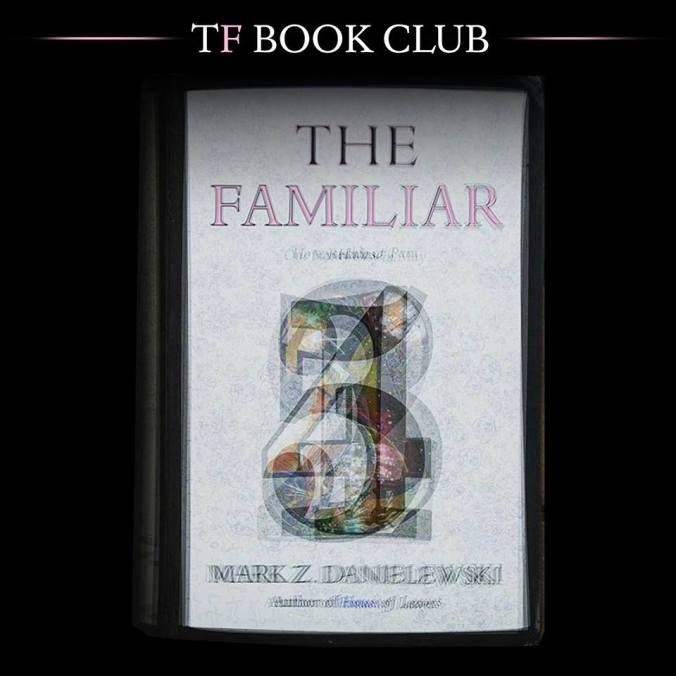
Mark Z. Danielewski will be appearing on Facebook Live to talk with the members of The Familiar (Volume 1-5) Book Club about his remarkable novel, The Familiar (2015-). He has distributed my recent conference paper, “The Time of Megatexts: Dark Accumulation and Mark Z. Danielewski’s The Familiar,” in advance. I invite you to read my essay and join in what should be an interesting conversation.

The Time of Megatexts: Dark Accumulation and Mark Z. Danielewski’s The Familiar

Next week I will be presenting a paper on a panel titled “The Power of Digital Talk” at the 2017 Society for Literature, Science, and the Arts Conference at Arizona State University in Tempe, AZ, November 9-12. The abstract for the paper is below.


Thursday, November 9, Session 1 2:00-3:30pm: 1E “The Power of Digital Talk”

Chair: Julie Funk

“The Time of Megatexts: Dark Accumulation and Mark Z. Danielewski’s The Familiar,” Bradley J. Fest, Hartwick College.

“A Tech-Lover’s Discourse: Roland Barthes, Longing, Loss, and Separation Anxiety in Non-Use Discourse,” Julie Funk, University of Waterloo, Critical Media Lab.

“World Wide Walden: Toward a Thoreauvian Ethics of Screen Time,” John Tinnell, University of Colorado.


The Time of Megatexts: Dark Accumulation and Mark Z. Danielewski’s The Familiar

With the disastrous effects of rising atmospheric carbon becoming increasingly observable and the relentless pace of neoliberal capital pursuing ever-increasing profit, the twenty-first century appears to be a time of dark accumulation. Increasingly, the risks facing the overdeveloped world stem not from absence but from overwhelming presence: everywhere there is a problem of too much. And it appears that such horrifying accumulation goes for contemporary experiences of time as well. An author known, perhaps most famously, for exploring spatial and textual accumulation, Mark Z. Danielewski’s new project, The Familiar (2015–), a twenty-seven-volume serial novel in progress, turns his attention to the multiplying temporalities of the Anthropocene. From the deep time of its cosmic frame tale and the shifting temporalities of globalization experienced by its cosmopolitan characters, to its confrontation with planetarity and its bi-annual, serialized release schedule, The Familiar asks its readers to confront what it means to live in and at too many times. In this paper I will explore The Familiar as an example of what I call a megatext—an unreadably large yet concrete aesthetic and rhetorical transmedia object, produced and conceived as a singular work, and which depends upon digital technology and collaborative authorship for its production—and argue that Danielewski’s massive novel emerges from and responds to a world in which time is no longer out of joint, but overwhelmingly and catastrophically multiple.

For a previous paper on The Familiar, delivered at the 2016 Society for Novel Studies Conference, see my “The Megatext and Neoliberalism.” (This links to my academia.edu page.)

“The Megatext and Neoliberalism” and “Metaproceduralism: The Stanley Parable and the Legacies of Postmodern Metafiction”

I’ll be giving two talks in Pittsburgh over the next two months on May 13 and June 22, 2016.


1. Friday, May 13, 2016 — 2:30 – 4:30. Part of a panel on “The Novel in or against Neoliberalism” at the 2016 Studies in the Novel Conference, The Novel in or against World Literature, Wyndham University Center – Oakland Room II.

Chair: Jen Fleissner, Indiana University

“The Megatext and Neoliberalism,” Bradley J. Fest, University of Pittsburgh

“The Novel in India and Neoliberalism,” H. Kalpana, Pondicherry University

“The Novel and Neoliberal Empathy,” Alissa G. Karl, The College at Brockport-SUNY

“Immanent Value in The Golden Bowl,” Paul Stasi, University at Albany-SUNY


The Megatext and Neoliberalism

With the steadily increasing storage capacity and processing power of contemporary information technology, enormously large texts are beginning to emerge that rival the books and libraries once imagined by Jorge Luis Borges. For instance, at some point in the near future, poet and novelist Richard Grossman will install Breeze Avenue—a five thousand volume, three million page “novel”—as a reading room in Los Angeles, and will also make this text available online in a fluid version that will change roughly every seven minutes for a century. Grossman’s text is, quite simply, too big to read; it is a megatext. This paper will consider the appearance of the unreadably massive novel as an emergent form native to the neoliberal era.

The writing, publication, and distribution of megatexts are impossible without the informatic, technological, and economic transformations of neoliberal globalization. For instance, the composition of Breeze Avenue would be inconceivable without big data and algorithmically generated text, without significant funding and personal wealth (Grossman was a high-level executive for a multinational financial firm in the 1970s), and without transforming the labor of the author from writing to managing. Mark Z. Danielewski’s twenty-seven volume meganovel-in-progress, The Familiar (2015-    ), takes full advantage of contemporary digital composition and production to create a work deeply enmeshed in the digital present by self-reflexively remediating the new media forms made possible by the distributed networks and posthuman technologies of the twenty-first century—including electronic literature, premier serial television, social media, videogames, and YouTube. And Mark Leach’s seventeen volume, ten thousand page, open source, digitally generated meganovel, Marienbad My Love (2008), takes advantage of crowd-sourced, collective authorship, reflecting the always-on unpaid digital microlabor that has come to characterize work in the overdeveloped world. Understanding such texts as unique outgrowths of and important critical reflections upon the age of neoliberalism allows us to explore important questions about the role of the novel in the twenty-first century and the possibilities for responding to the nonhuman logics of contemporaneity.


2. Wednesday, June 22, 2016, 1:30 – 3:00, I’ve organized a panel on “Videogame Adaptation” with Jedd Hakimi and Kevin M. Flanagan, colleagues in the Film Studies Program at the University of Pittsburgh, for the Keystone DH 2016 Conference, Hillman Library, University of Pittsburgh. (A schedule of the conference.)


Videogame Adaptation

baby

As videogames continue to emerge as a dominant twenty-first-century form, it is becoming clearer that they have complex relationships to other media. This panel, part of a larger collaborative project, will address issues of adaptation and videogames from a transmedia perspective, drawing particularly on the resources provided by film and literary studies.


Videogame Adaptation: Some Experiments in Method
Kevin M. Flanagan, University of Pittsburgh

This paper outlines the concerns and conceptual practices of videogame adaptation, noting the many ways in which videogames shape, or are shaped by, ideas, narratives, and mechanics from other media. In situating videogames into the discourses of textual transformation that animate current work in adaptation studies, I argue that traditional approaches to adaptation in English departments (which privilege novel-to-film adaptation in a one-to-one correspondence) have a lot to learn from games, which function as adaptations at all stages of their production and consumption. I also demonstrate how adaptation studies challenges claims to medium specificity that form a foundational conceit of videogame studies.


Metaproceduralism: The Stanley Parable and the Legacies of Postmodern Metafiction
Bradley J. Fest, University of Pittsburgh

Most critics of contemporary literature have reached a consensus that what was once called “postmodernism” is over and that its signature modes—metafiction and irony—are on the wane. This is not the case, however, with videogames. In recent years, a number of self-reflexive games have appeared, exemplified by Davey Wreden’s The Stanley Parable (2013), an ironic game about games. When self-awareness migrates form print to screen, however, something happens. If metafiction can be characterized by how it draws attention to language and representation, this paper will argue how self-reflexivity in videogames is best understood in terms of action and procedure, as metaproceduralism.


Playing Los Angeles Itself: Experiencing the Digital Documentary Environment in LA Noire
Jedd Hakimi, University of Pittsburgh

Almost everything about the predominantly faithful depiction of 1947 Los Angeles in the recent, police-procedural videogame LA Noire (2011) was based on archival material, including period maps, photography, and film footage. And while scholars have thought extensively about how film spectators experience mediated depictions of real-world cities, the videogame player’s parallel experience has been relatively unexplored. Accordingly, I take LA Noire’s simulacrum as an opportunity to reflect on what happens when a real-world environment is adapted into the setting for a videogame. Specifically, I position LA Noire in the tradition of the “city-symphony” film and a particular sub-set of Film Noir known as the “semi-documentary” to make the case LA Noire contains crucial aspects of the documentary image. Consequently, LA Noire is not so much creating a fictional, diegetic world, as it is presenting our own world back to us in a manner that changes the way we experience the world in which we live.

MLA 2016 Panel: The Anthropocene and Deep Time in Literary Studies

At this year’s MLA Convention in Austin, Texas, I will be on a panel on The Anthropocene and Deep Time in Literary Studies. I have included the information on the panel and an abstract for the paper I will be presenting below.


670. The Anthropocene and Deep Time in Literary Studies

Saturday, 9 January, 5:15–6:30 p.m., 6B, ACC

Program arranged by the forum LLC 20th- and 21st-Century American

Presiding: Heather Houser, Univ. of Texas, Austin

Speakers: Gerry Canavan, Marquette Univ.; Bradley J. Fest, Univ. of Pittsburgh; Kristin George Bagdanov, Univ. of California, Davis; Rebecca Wilbanks, Stanford Univ.

Session Description:

The notion of the Anthropocene was coined in 2000 to highlight that human beings’ transformation of the planetary environment will be visible in the geological strata. Beyond its crucial influence in the environmental humanities, the Anthropocene links to discussions of deep time in literary studies. This session taps into and elaborates on these two ongoing discussions.


“Fictional Quantities That Make Themselves Real”: Speculation, Petropolitics, and Deep Time in Reza Negarestani’s Cyclonopedia

Since its publication in 2008, Reza Negarestani’s experimental work of “theory-fiction,” Cyclonopedia: Complicity with Anonymous Materials, has become somewhat of a literary touchstone for a variety of writers and thinkers revolving in the orbit of speculative realism. Resembling what would happen if Deleuze and Guattari collaborated with H. P. Lovecraft, Cyclonopedia is a serious, albeit ironic encounter with non-correlationist thought, with speculation, deep time, and hyperobjects of all kinds. It is also a rigorous literary attempt to think through climate change, the War on Terror, and the petropolitical realities of the twenty-first century. This paper will explore a variety of issues that converge in Negarestani’s remarkable book. Beginning with Cyclonopedia’s implicit emphasis on how speculation is necessary for thinking the present (rather than, say, rationalism, measurement, or management), this paper will argue that Negarestani’s encounter with geology and nonhuman hyperobjects indicates that experimental literature may be uniquely suited to thinking about deep time and the realities of climate change in a way unavailable to more conventional narratives. If Steven Shaviro has recently suggested that “at its best, speculative philosophy rather resembles speculative fiction,” then Negarestani’s “novel” is evidence of what might happen when speculative philosophy becomes speculative fiction. Cyclonopedia is not only an important text for thinking about nonhuman entities and deep time in an age of observable climate change, it is also an important entry into the ancient debate between poetry and philosophy. Less a “novel after theory” than theory as novel, Cyclonopedia demonstrates that literature will continue to play an important role for understanding the Anthropocene.

Panel Abstract: Utopian Geologies

I just got word that a panel I organized was accepted for the 2015 Society for Utopian Studies Conference in Pittsburgh, Pennsylvania, taking place November 5-8. I have included the general abstract for the panel, and the abstracts for each individual paper.

The panel will take place on Saturday, 7 November 2015, 8:30 -10:45 am.


Utopian Geologies

Panelists: Racheal Forlow, Dan Malinowski, and Bradley J. Fest

In the twenty-first century, the Anthropocene has emerged as an important concept for understanding the impact of human life on the planet. As activists, journalists, and scholars attempt to respond to the challenges this new epoch presents, many invoke deep time as a significant mode of thinking. This panel will take up the question of how the utopian imagination, long a site for speculating about the future, might contend with such geologic timescales. Responding to the conference topic of “global flows” by discussing things that flow at very, very slow paces, each paper will consider an important literary encounter with utopian geology. From Walt Whitman’s emergent poesis, to Kim Stanley Robinson’s posthuman environmental ethics, to the emphasis on human finitude in recent speculative thinking, these papers all signal a desperate need to reinvest in the imagination in the face of observable climate change.


Walt Whitman’s Geologic Imagination and the Future

Racheal Forlow, University of Pittsburgh

Western utopian traditions imagine how human activities might create better futures. Today, those who pursue projects of this kind confront a singular set of challenges. Scientists argue climate change and a range of other environmental emergencies threaten the future of the species. Because most agree the activities a tradition of Enlightenment thinking privileges produced these threats, the present seems to demand we conceive anew the ways we hope to project and build better worlds. Some artists, intellectuals, and activists committed to this work therefore suggest we abandon anthropocentric views of the universe and autonomous views of human individuals for more broadly materialist accounts. In this paper, I argue a tradition of American poetry Walt Whitman originates offers projects of this kind historical and conceptual resources. Whitman treats the human faculties contemporary projects require—among these imagination, reason, and feeling—in thoroughly material terms. In “Song of Myself” (1855), he imagines human creative power is an evolutionary force that emerges out of deep, geologic history. So conceived, the human is not a powerful, autonomous agent that dominates what is not identical to it. Instead, the species participates in a broader set of transformative processes. I believe recognizing US traditions offer this alternative vision of the human might serve attempts to project and build futures in the novel ways contemporary crises compel.


Should We Eat the Dirt? Kim Stanley Robinson’s Mars Trilogy, Geology, and New Materialism

Dan Malinowski, Rutgers University

No matter where humanity goes, it will shape and be shaped by its environment. In this talk, I will explore the ways in which Kim Stanley Robinson’s Mars Trilogy (1994-96), through the long time-spans in which it occurs, allows us to follow the flow of human society on literally untouched land, providing a useful thought experiment for exploring the ethics of the relationship of humanity to geological features. I will examine the debates surrounding terraforming enacted within these novels, highlighting their central aporia: namely, how a utopian society can (or cannot) coexist with a posthuman ethics towards the natural landscape. I will show how the recent work in the New Materialism can articulate this problem more productively than the Heideggerian model of geological ethics proposed by Fredric Jameson in his essay on the trilogy. In doing so, this paper will articulate a view of the world in which the interactions of the “dead” world and its new inhabitants flow back and forth in an ongoing and multi-directional process, a consideration inseparable from any utopian possibility whether here on Earth or there on Mars.


Speculative Criticism, Black Metal Theory, and Utopia: Richard Grossman’s “Torah Ball”

Bradley J. Fest, University of Pittsburgh

In recent years, invoking Fredric Jameson’s famous quip about it being easier to imagine the end of the world than the end of capitalism has become something of a cliché. Given the realities of observable climate change and the seeming inability for human institutions to make the broad, sweeping changes necessary for responding to life in the Anthropocene, one might find it difficult to disagree with claims about the foreclosure of the utopian imagination. So it is perhaps surprising that a variety of thinkers, emerging from the school of Speculative Realism (or New Materialism), have been emphasizing species finitude, particularly with regard to deep, geologic timescales. Rather than explore possible utopian futures, writers like Ray Brassier, Nicola Masciandaro, Reza Negarestani, Eugene Thacker, McKenzie Wark, Evan Calder Williams, and others, often writing under the heading of “Black Metal Theory,” frequently invoke the utter inevitability of human extinction. As part of a larger project of articulating what I am calling “speculative criticism,” this paper will explore what such dark geologies might offer for both the study of literary works massively extended in space and time and the pressing need to reconceive and reinvest in the utopian imagination in the twenty-first century.