I am looking forward to a fun, productive, and challenging spring semester at the University of Pittsburgh. I’ll be teaching three classes: two sections of Narrative and Technology (ENGLIT 0399; class blog here) and a course that is being offered for the first time, Interactive Literature (ENGLIT 1001; class blog here). I owe Mark Best considerable credit for Interactive Literature as I drew many ideas about organizing the course from the design of his initial proposal.
Archival Pedagogy
Immersive Pedagogy: Teaching Videogames In and Out of the Classroom
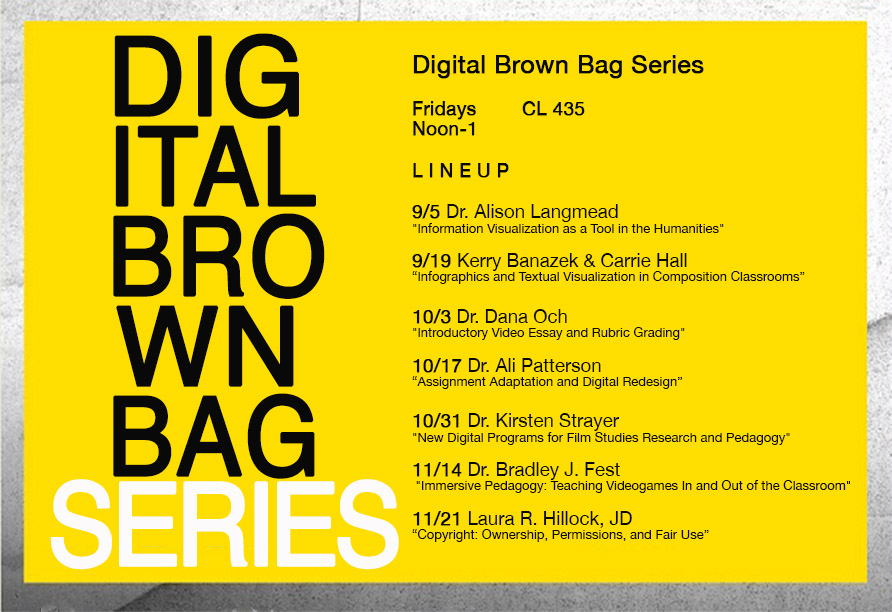
As part of the Digital Brown Bag Series, a series of talks on various ways one might incorporate digital tools into their teaching and scholarship, tomorrow, November 14, from 12:00 – 1:00, I am giving a presentation on “Immersive Pedagogy: Teaching Videogames In and Out of the Classroom” at the University of Pittsburgh in room 435 of the Cathedral of Learning. Here’s a brief description of what I will be addressing:
Teaching videogames present a number of pedagogical challenges and possibilities that are not involved with teaching more traditional media objects. Many things can go wrong when teaching videogames: they can (and do) frequently break down or are incompatible with certain machines; they are hardware dependent, thus limiting the games that can be included in a syllabus; they are actionable rather than passive—they need to be played—meaning that students with less familiarity or skill with videogames can struggle. But videogames also open up a number of pedagogical avenues that are unavailable to other media: they can be radically immersive, collective, and social, reconfiguring the classroom into a virtual space that can extend significantly beyond the physical boundaries of traditional instruction; they provide new ways of looking at and interacting with media objects in the classroom, promoting new pedagogical methods of critical engagement; and they are, inevitably, fun, inviting students to participate in what I call “critical play.” This presentation will discuss some of the logistical, critical, and theoretical challenges presented by teaching videogames, how these challenges might be addressed, and some exciting pedagogical possibilities that are opened up by bringing videogames into the classroom. The presentation will conclude with an interactive demonstration of how one particular videogame, The Stanley Parable (Galactic Café, 2013), might be taught. (This talk largely reflects my experiences teaching Narrative and Technology.)
Many September Links
As predicted, I have been quite busy indeed and have not had a chance to post anything over the past couple of weeks. A bunch of fascinating stuff has been happening, a bunch of interesting books are coming out, etc., so I’m sad that I’ve been remiss in my duties. Hopefully this large batch of links will make up for that.
Apocalypse and After
George Dvorsky, “Have Humans Already Conquered the Threat of Extinction?”
Or not. Graham Turner and Cathy Alexander, “Limits to Growth Was Right: New Research Shows We’re Nearing Collapse.”
Jessica Corbett and Ethan Corey, “5 Crucial Lessons for the Left from Naomi Klein’s New Book.”
Eric Holthaus, “New Study Links Polar Vortex to Climate Change.”
And who knows where to put this one: Alison Flood, “Margaret Atwood’s New Work Will Remain Unseen for a Century.”
End of August Links
Environment and Apocalypse
Hamilton Nolan, “Doom Draws Nearer.”
Daniel Cech, “How the Apocalypse Would Happen if Heaven Were a Small Nonprofit.”
Robert O. Self, “Cataclysm in Suburbia: The Dark, Twisted History of America’s Oil-Addicted Middle Class.”
Emma Hansen, “From Nuclear Bombs to Killer Robots: How Amoral Technologies Become Immoral Weapons.”
Beginning of the Semester Links, Fall 2014
Tomorrow I return to the classroom at the University of Pittsburgh for another semester. As I imagine that this will also mean I’m about to be considerably busier, and that this will mean a bit less posting on the ole blog (links or otherwise), some links to mark the occasion.
Disaster and Environmental
Daniel Politi, “Napa Valley Earthquake Is the Strongest to Hit the Bay Area Since 1989.”
Ferguson
Douglas Williams, “Love Me, Ferguson, I’m a Liberal.”
Alexandra Schwartz, “On Being Seen: An Interview with Claudia Rankine from Ferguson.”
Matt Apuzo and Michael S. Schmidt, “In Washington, Second Thoughts on Arming the Police.” Continue reading
Ferguson and Other Links
Ferguson
The running blog from Ferguson‘s latest: Ben Mathis-Lilley and Elliot Hannon, “Officer Who Stopped Michael Brown Did Not Know He Was a Robbery Suspect.”
Robert Stephens II, “In Defense of the Ferguson Riots.”
An open letter from David Simon.
Rembert Browne, “The Front Lines of Ferguson.”
“This Time, For Once, What It Is, It Is.”
Daniel Politti, “After a Day of Calm, Ferguson Reignites: Looting, Clashes with Police and Tear Gas.”
Jack Mirkinson, “Police Threaten to Shoot, Mace Reporters in Ferguson.”
Dylan Scott, “Mayor Defends Police: I Can’t Second-Guess These Officers.”
Jamelle Bouie, “The Militarization of the Police.”
The militarization of US Police.
Sahil Kapur, “House Democrat Unveils Bill to Demilitarize Local Police.”
Rand Paul, “We Must Demilitarize the Police.”
“There’s a Police Coup Going on Right Now in Ferguson, MO.”
Matthew Yglesias, “Enough is Enough in Ferguson.”
Mychal Denzel Smith, “The Death of Michael Brown and the Search for Justice in Black America.”
LaDoris Hazzard Cordell, “Policing the Police.”
Joe Coscorelli, “Obama Treads Lightly, Again, on Ferguson: ‘Listen and Heal,’ Don’t ‘Holler and Shout.'”
Kareem Abdul-Jabbar, “The Coming Race War Won’t Be About Race.”
And a must see: John Oliver on Ferguson.
Fall Semester 2014
In a little over a week I start teaching three classes at the University of Pittsburgh that I am greatly looking forward to: two sections of Narrative and Technology (ENGLIT 0399; class blog here), and a brand new upper-division course that I designed for English Majors that fulfills an historical period requirement: Postmodern Literature (ENGLIT 1350). I am quite excited about both classes.
On the Death of Robin Williams and Other Links
Nuclear and Environment
Sarah Stillman, “Hiroshima and the Inheritance of Trauma.”
McKenzie Wark, “Critical Theory After the Anthropocene.”
International
Geoff Manaugh and Nicola Twilley, “Ebola and the Fiction of Quarantine.”
Leigh Phillips, “The Political Economy of Ebola.” “Ebola won’t be solved, because it isn’t profitable to do so.”
The Salaita Affair and Other Links (and New Involvement in Iraq)
There have been many responses by notable people to the Steven G. Salaita issue. Corey Robin has a ton of links on the issue, including a tweet by Glenn Greenwald, and a piece by Peter Schmidt in The Chronicle of Higher Education. Former president of the MLA, Michael Bérubé, has written an open letter to Chancellor of the University of Illinois at Urbana-Champaign, Phyllis Wise. Cary Nelson, former president of the American Association of University Professors, has written a piece defending Wise’s decision. Some background on Nelson. John K. Wilson has criticized UIUC in “Fighting the Twitter Police.” Sarah T. Roberts, “Steven Salaita: The University of Illinois is not an Island.” And here’s a recent piece by Salaita himself on academic freedom, “The Definition of Academic Freedom, for Many, Does Not Accommodate Dissent.”
In other news:
Dwight Garner seems to think that David Shafer’s Whiskey Tango Foxtrot may be the book of the summer in “Maybe There’s a Whole Other Internet.”
In hyperarchival news, Monte Reel reports on “The Brazilian Bus Magnate Who’s Buying Up All the World’s Vinyl Records.”
And I’m starting to get the itch for the new semester:
Joshua Rothman, “What College Can’t Do.”
“Rogeting: Why ‘Sinister Buttocks’ Are Creeping into Students’ Essays.”
And, just breaking, President Obama has announced that he has authorized airstrikes and humanitarian aid in Iraq. The Washington Post has a transcript of the announcement.
“Literally” Two-Thousand Fourteen Links
Nuclear and Environment
US War Department’s Archival Footage of the Bombing of Hiroshima.
H. Bruce Franklin, “Hiroshima, Nagasaki, American Militarism,” a review of Paul Ham‘s Hiroshima Nagasaki: The Real Story of the Atomic Bombings and Their Aftermath.
Mark Strauss, “Federal Employee Gets Fired After Writing an Article Criticizing Nukes.”
Lindsay Abrams, “Researchers: Warming Responsible for Siberia’s Mysterious Hole.”

