I’m eager to begin another semester at the University of Pittsburgh. This spring I am teaching three classes: Seminar in Composition (ENGCMP 0200), Reading Poetry (ENGLIT 0315), and Introduction to Critical Reading (ENGLIT 0500). I have taught all three courses before and enjoy each one. Seminar in Composition is a newly redesigned course on the campus novel and the syllabus can be found on my Academia.edu page. I’d be happy to send along the syllabi for the other classes to interested parties, which tweak previous versions. (Among other texts, I’m eager to return to Mark Z. Danielewski’s House of Leaves [2000] in Introduction to Critical Reading, and quite excited to read Claudia Rankine’s Citizen [2014] in Reading Poetry). I have again decided not to do any class blogs this semester. For the blogs of previous classes, see the category “Teaching” to the right.
Archival Pedagogy
Fall Semester 2015
I’m eager to begin a new semester at the University of Pittsburgh. This fall I am teaching a number of classes: Narrative and Technology (ENGLIT 0399), Introduction to Critical Reading (ENGLIT 0500), and Postmodern Literature (ENGLIT 1350). I have taught all three courses before and enjoy each one. The syllabus for Introduction to Critical Reading can be found on my Academia.edu page and I’d be happy to send along the others to interested parties, which tweak previous versions. I have decided not to do any blogs for any of my classes this semester, partially as an experiment, but also because I am trying to limit how much time I spend in front of a screen. For the blogs of previous classes, see the category “Teaching” to the right.
Many April Links: Catching Up
Another semester is coming to a close, and I finally have a chance to sit down and sort through the backlog of links that have been piling up over the past few months. So, with no further ado, links.
Nuclear, Environment, Ruins
Thomas Erdbrink, “Iran’s Leaders Fall Into Line Behind Nuclear Accord.”
William J. Broad, “Hydrogen Bomb Physicist’s Book Runs Afoul of Energy Department.”
John R. Bolton, “To Stop Iran’s Bomb, Bomb Iran.” Um, no.
Douglas Birch and R. Jeffrey Smith, “South African Nuclear Cache Unnerves US.”
“South Africa Rebuffs US Attempts to Take Over Its Nuclear Material.”
Jon Greenberg, “The Odd Reality of Iran’s Centrifuges: Enough for a Bomb, Not Power.”
Charlie Jane Anders, “Nanotech Could Make Nuclear Bombs Much, Much Tinier.”
Andreas Malm, “The Anthropocene Myth.”
99% Invisible, “Ten Thousand Years.”
Robin Mackay’s “A Brief History of Geotrauma”
I have been working on Reza Negarestani‘s Cyclonopedia: Complicity with Anonymous Materials (2008) and I ran across this fascinating introduction to Negarestani by Robin Mackay that I cannot help but share. The work below is tilted “A Brief History of Geotrauma, or: The Invention of Negarestani.”
Spring Semester 2015
I am looking forward to a fun, productive, and challenging spring semester at the University of Pittsburgh. I’ll be teaching three classes: two sections of Narrative and Technology (ENGLIT 0399; class blog here) and a course that is being offered for the first time, Interactive Literature (ENGLIT 1001; class blog here). I owe Mark Best considerable credit for Interactive Literature as I drew many ideas about organizing the course from the design of his initial proposal.
Immersive Pedagogy: Teaching Videogames In and Out of the Classroom
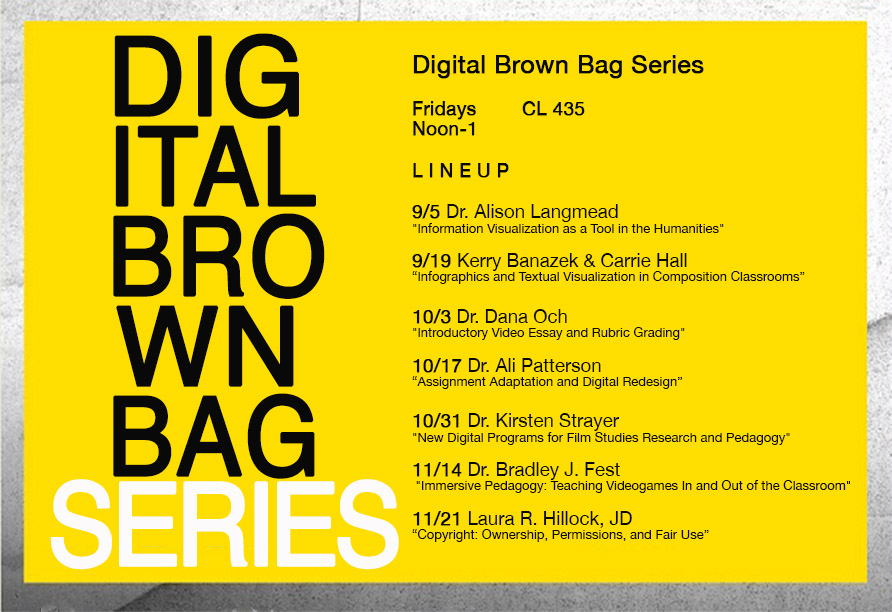
As part of the Digital Brown Bag Series, a series of talks on various ways one might incorporate digital tools into their teaching and scholarship, tomorrow, November 14, from 12:00 – 1:00, I am giving a presentation on “Immersive Pedagogy: Teaching Videogames In and Out of the Classroom” at the University of Pittsburgh in room 435 of the Cathedral of Learning. Here’s a brief description of what I will be addressing:
Teaching videogames present a number of pedagogical challenges and possibilities that are not involved with teaching more traditional media objects. Many things can go wrong when teaching videogames: they can (and do) frequently break down or are incompatible with certain machines; they are hardware dependent, thus limiting the games that can be included in a syllabus; they are actionable rather than passive—they need to be played—meaning that students with less familiarity or skill with videogames can struggle. But videogames also open up a number of pedagogical avenues that are unavailable to other media: they can be radically immersive, collective, and social, reconfiguring the classroom into a virtual space that can extend significantly beyond the physical boundaries of traditional instruction; they provide new ways of looking at and interacting with media objects in the classroom, promoting new pedagogical methods of critical engagement; and they are, inevitably, fun, inviting students to participate in what I call “critical play.” This presentation will discuss some of the logistical, critical, and theoretical challenges presented by teaching videogames, how these challenges might be addressed, and some exciting pedagogical possibilities that are opened up by bringing videogames into the classroom. The presentation will conclude with an interactive demonstration of how one particular videogame, The Stanley Parable (Galactic Café, 2013), might be taught. (This talk largely reflects my experiences teaching Narrative and Technology.)
Many September Links
As predicted, I have been quite busy indeed and have not had a chance to post anything over the past couple of weeks. A bunch of fascinating stuff has been happening, a bunch of interesting books are coming out, etc., so I’m sad that I’ve been remiss in my duties. Hopefully this large batch of links will make up for that.
Apocalypse and After
George Dvorsky, “Have Humans Already Conquered the Threat of Extinction?”
Or not. Graham Turner and Cathy Alexander, “Limits to Growth Was Right: New Research Shows We’re Nearing Collapse.”
Jessica Corbett and Ethan Corey, “5 Crucial Lessons for the Left from Naomi Klein’s New Book.”
Eric Holthaus, “New Study Links Polar Vortex to Climate Change.”
And who knows where to put this one: Alison Flood, “Margaret Atwood’s New Work Will Remain Unseen for a Century.”
End of August Links
Environment and Apocalypse
Hamilton Nolan, “Doom Draws Nearer.”
Daniel Cech, “How the Apocalypse Would Happen if Heaven Were a Small Nonprofit.”
Robert O. Self, “Cataclysm in Suburbia: The Dark, Twisted History of America’s Oil-Addicted Middle Class.”
Emma Hansen, “From Nuclear Bombs to Killer Robots: How Amoral Technologies Become Immoral Weapons.”
Beginning of the Semester Links, Fall 2014
Tomorrow I return to the classroom at the University of Pittsburgh for another semester. As I imagine that this will also mean I’m about to be considerably busier, and that this will mean a bit less posting on the ole blog (links or otherwise), some links to mark the occasion.
Disaster and Environmental
Daniel Politi, “Napa Valley Earthquake Is the Strongest to Hit the Bay Area Since 1989.”
Ferguson
Douglas Williams, “Love Me, Ferguson, I’m a Liberal.”
Alexandra Schwartz, “On Being Seen: An Interview with Claudia Rankine from Ferguson.”
Matt Apuzo and Michael S. Schmidt, “In Washington, Second Thoughts on Arming the Police.” Continue reading
Ferguson and Other Links
Ferguson
The running blog from Ferguson‘s latest: Ben Mathis-Lilley and Elliot Hannon, “Officer Who Stopped Michael Brown Did Not Know He Was a Robbery Suspect.”
Robert Stephens II, “In Defense of the Ferguson Riots.”
An open letter from David Simon.
Rembert Browne, “The Front Lines of Ferguson.”
“This Time, For Once, What It Is, It Is.”
Daniel Politti, “After a Day of Calm, Ferguson Reignites: Looting, Clashes with Police and Tear Gas.”
Jack Mirkinson, “Police Threaten to Shoot, Mace Reporters in Ferguson.”
Dylan Scott, “Mayor Defends Police: I Can’t Second-Guess These Officers.”
Jamelle Bouie, “The Militarization of the Police.”
The militarization of US Police.
Sahil Kapur, “House Democrat Unveils Bill to Demilitarize Local Police.”
Rand Paul, “We Must Demilitarize the Police.”
“There’s a Police Coup Going on Right Now in Ferguson, MO.”
Matthew Yglesias, “Enough is Enough in Ferguson.”
Mychal Denzel Smith, “The Death of Michael Brown and the Search for Justice in Black America.”
LaDoris Hazzard Cordell, “Policing the Police.”
Joe Coscorelli, “Obama Treads Lightly, Again, on Ferguson: ‘Listen and Heal,’ Don’t ‘Holler and Shout.'”
Kareem Abdul-Jabbar, “The Coming Race War Won’t Be About Race.”
And a must see: John Oliver on Ferguson.
 The Hyperarchival Parallax