For anyone who recognizes the banner to this here blog. . . they’ll understand why I’m posting this. But anyway, a new Fallout game set in Las Vegas has been announced, and though I don’t think a single detail has been released, we get yet another post-apocalyptic, freakout-wasteland to explore in the near future. Thank Abaddon for video games that give us post-nuclear scenarios–I can convince myself I’m doing work when I’m really just wasting time. Can’t wait.
Author: Bradley J. Fest
“Snowmageddon”
Today I experienced my first ever “snow day,” as my Reading Poetry class along w/ the rest of the University of Pittsburgh’s classes got canceled; and to commemorate it I thought I’d add a couple more “Apocalyptexts”: basically things I’ve read recently during a bout of mild yet much deserved academic irresponsibility. For someone who grew up in Tucson, Arizona, a snow day is completely novel. The closest I ever came to anything resembling a snow day was school being canceled b/c of floods, but that really isn’t the same thing at all, for the rains, when they come—even when they are torrential and flood the streets w/ feet of water—are a blessing: they slake the perpetual thirst of the desert. For this snow day, however, it isn’t even snowing (it’s actually sunny and quite nice, if cold, outside). The nearly 2 feet of snow that got dumped on the ‘burgh b/t Friday evening and Saturday morning is basically still on the ground, and doesn’t look like it’s going anywhere anytime soon (there’s another 3-6 inches expected Wed.). The storm that hit the mid-atlantic states this past weekend dumped the most snow pittsburgh has seen since 1992, and is one of the 4 worst snow storms in terms of inches since they started keeping track of this stuff. Basically, it’s kinda epic. (Though the pics below don’t quite do it justice, esp. since things have “melted” a bit in the past couple of days.) Wandering around the city has been surreal. I haven’t been driving b/c my back-wheel drive pickup truck would not get very far—esp. w/o the sandbags in the back I’ve been procrastinating putting there all winter—though I do have a large amount of respect for the many inhabitants I’ve seen valiantly digging their cars out and spinning their wheels down streets it looks like no one has even tried to plow. There has been an infectious sense of joy amidst what they are still calling a “state of emergency” (or maybe it’s just me, whose current life is such as to be minimally effected by this type of inclement weather). More people are walking around the streets than I’ve ever seen before, and people are generally smiling and cordial, esp. those brave souls who have gone to work, opened much needed services and stores, and basically kept the whole capitalist train running. My thanks. But I am sitting at home, warm and happy, pouring hot water down my pipes to unfreeze them (they weren’t that frozen thankfully) so I could do some much-needed laundry. So what better way to spend a snow day, to endure what Barack Obama called “snowmageddon” (no fooling), to do some apocalyptic blogging? My thoughts precisely. On to some Apocalyptexts.
Also, someone has recently pointed me toward this delightful apocalyptic flash video, check it out.
Some pics (though they aren’t as apocalyptic as could be, as I just stepped outside to do them, rather than, as I shoulda, taken my camera when I was wandering around the city earlier):
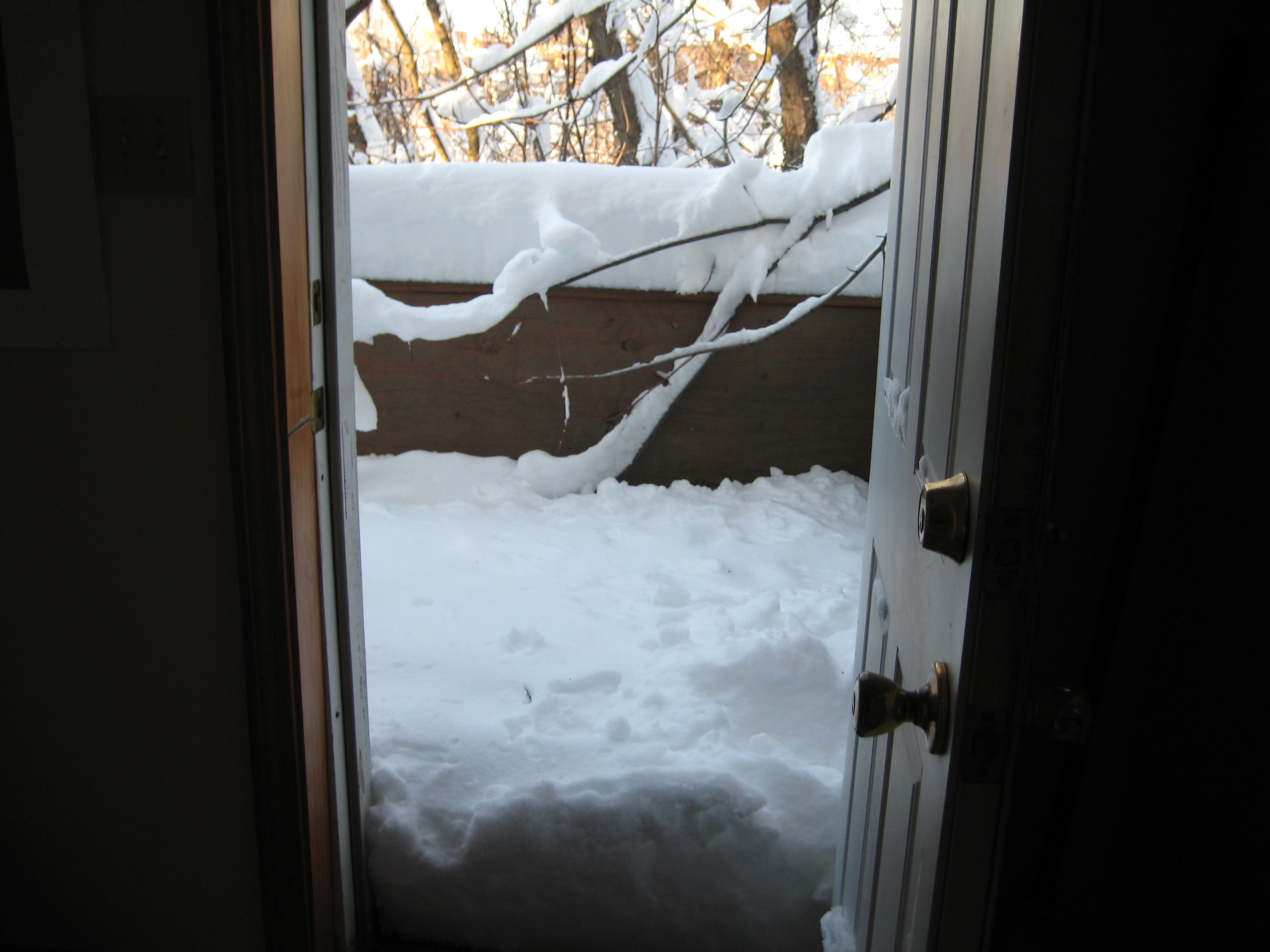
wait, that tree limb isn't supposed to be there. . . .

Yep, that tree limb has definitely decided to come hang out on the porch. there's also a grill, a table, and some chairs out here somewhere. . . .
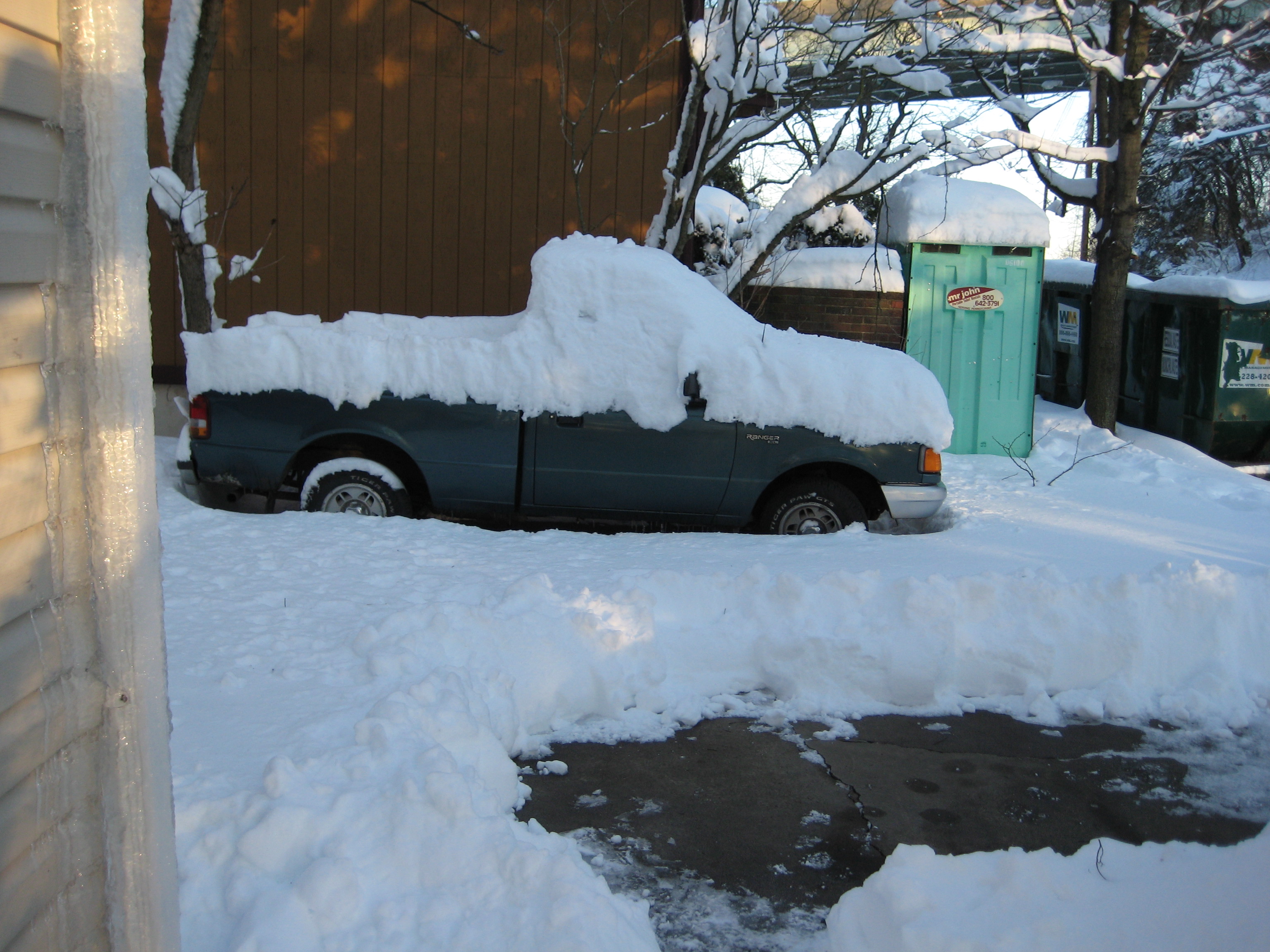
I'm not going anywhere.
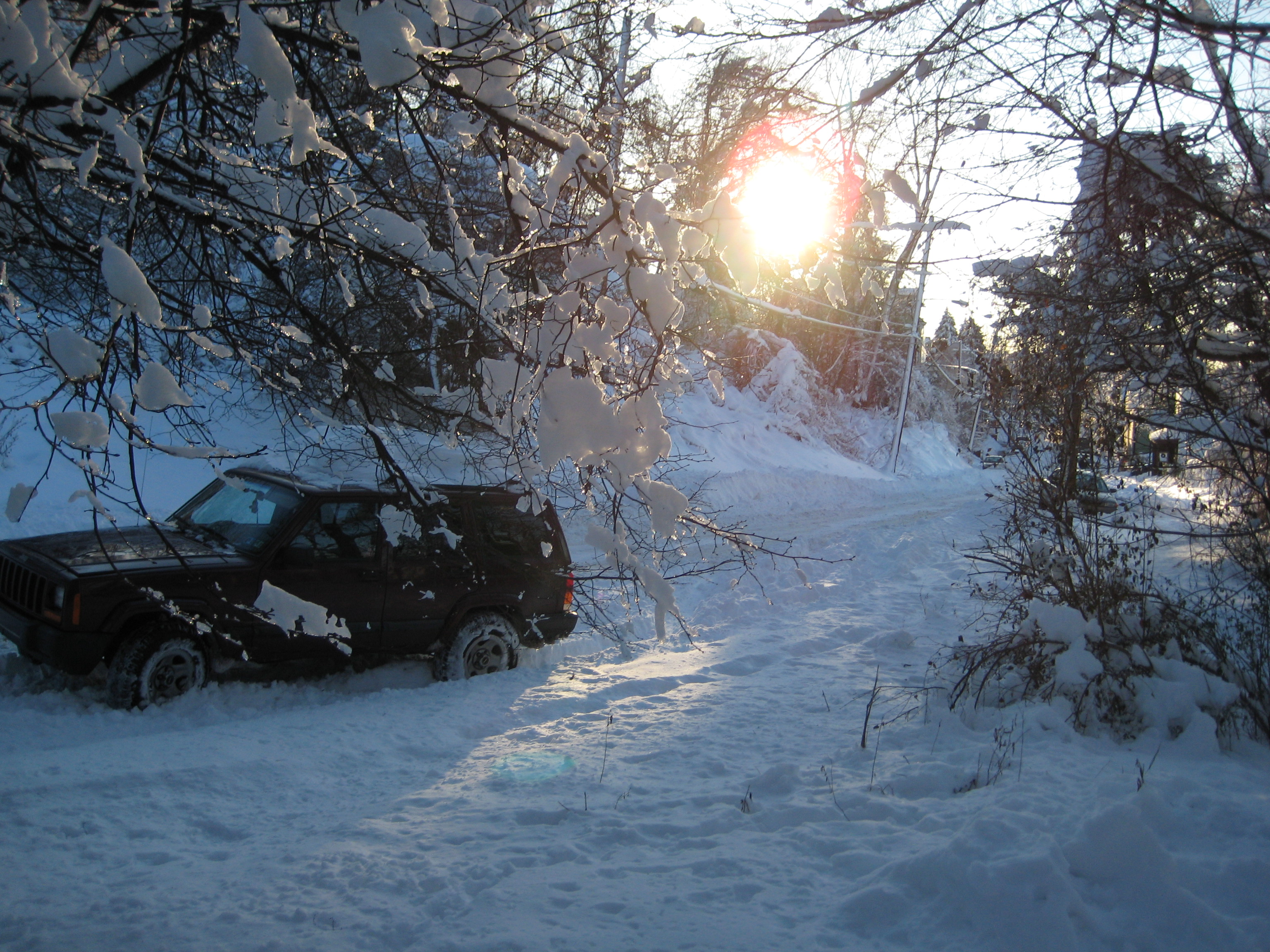
holy nuclear winter batman!

tree, please don't fall on our house.
I’ll try to be more prescient and try to take my camera elsewhere, but not today. cheers.
In the Words of Daft Punk, the Archive Won’t Stop, Can’t Stop; or, Why The Book of Eli Makes me Feel Good About My Choices in Life Even if it is a Terrible Film
I have to admit that the recently released The Book of Eli (The Hughes Brothers, 2010)[1] constitutes a moment of personal gratification for myself and my recently completed PhD project in that it only serves to further cement the work I did there.[2] In short, a bulk of my project constituted a revivification of the now long dead and mostly forgotten practice of “nuclear criticism,” a theoretical framework most explicitly laid out in Jacques Derrida’s “No Apocalypse, Not Now (Full Speed Ahead, Seven Missiles, Seven Missives),” which he delivered in1984 at a colloquium on nuclear criticism at Cornell University. At the time, Derrida argued that all literature is marked by the nuclear epoch in that the historical and literary archive is that which is most threatened by nuclear war. What The Book of Eli represents so dramatically is exactly this logic: whatever else may be going on in its world, the real stakes of the post-apocalyptic wasteland Denzel Washington (Eli) traverses throughout the film are ultimately archival ones.
Disregarding for a moment the conflicted and confusing Christian ideology which infects the film like an out-of-control tumor, as well as the film’s problematic geography, weak characterization, the presence of Mila Kunis,[3] and its overall ridiculous premise, this film is about a book, and not just any book, it is about the Christian Bible.[4] Denzel has been told by a voice (Christian God) to carry the only remaining Bible west, and that he would not only be protected during this journey,[5] he would “know” when he arrived where he needed to be.[6] Threatening his progress is Gary Oldman’s character, who is desperately seeking a Bible for its powers of populace-manipulation (think Nietzsche’s Genealogy of Morals). There is also a pretty great scene when a bunch of books are plopped down on Oldman’s desk, right after he was reading a biography (?) of Mussolini; he of course instructs his underlings to burn these books (archival destruction!).
The real crux of the film for myself is the reason it gives for there being only one Bible remaining. Basically, after what appears to be global nuclear war, the survivors got together and burned all the Bibles in the world, blaming this text for the devastation. (This also implies that this was a religiously motivated war, like b/t Islamic States and Christian ones, rather than a good ole’ ideological nuclear war.) Denzel’s ultimate task is to bring this Bible, which he memorizes—so doesn’t need the actual object (memory as archive. . .)—to Alcatraz, where a printing press and archive has been set up to rebuild civilization. The film ends with the Christian Bible being placed on a rack of books including the Torah and the Qur’an, as well as a host of other religious texts.[7]
In all of this, The Book of Eli is a deeply confused film. It simultaneously acknowledges the really insidious, destructive aspects of religion while attempting to uphold the importance of the Bible’s teaching—namely “faith.” Denzel-as-blind-prophet directly communicating w/ God as signaling the importance of the restoration of the New Testament (one would assume the Old Testament was present on that shelf already. . . .) runs directly into the Bible as “just another book” in the last scene. The Apocalypse portrayed is simultaneously one caused archivally (by religion) and one that can be lived-through afterward only archivally (by, again, religion). (Need I mention that if the nuclear war wasn’t the Apocalypse of Revelations, it is, in Derrida’s phrase, “still to come” in the space of the film. . . .)[8] The film, ultimately, has no idea what it is trying to communicate, no idea where it stands, no idea what Christianity really has to do w/ anything, other than being a convenient trope for an apocalyptic film.
And, at day’s end, this is what is so impressive about the film. Its archivally apocalyptic logic overwhelms it, takes center-stage, and demonstrates that the archive’s destruction (or restoration) is the limit of the nuclear. Once one invokes such a post-apocalyptic landscape, all questions become archival. The visual presentation of the film is at times breathtaking—man I love what CGI enables w/r/t post-apocalyptic landscapes—but in every case, the visuals are simply archival markers of what has been destroyed: the Golden Gate Bridge, Nuclear Power Stations, Freeways, old burned-out automobiles, gigantic craters, and of course the presence of “Western” towns run by a malignant “boss” (Oldman’s character is unsubtly named “Carnegie”). The main object Denzel carries around as a marker of the “good” of humanity, the Bible aside, is in-and-of-itself an archive: an old beat-up iPod (man he loves listening to that iPod).
Basically, the Bible in The Book of Eli is merely a stand-in for archival maintenance or restoration. It doesn’t really matter what book it is in the space of the film, only that the Bible is perhaps the most manipulatively affective sign of this restoration[9] and that it allows all sorts of other heavy-handed bullshit to enter the narrative space.[10] In short, The Book of Eli is yet another marker of the reliance of aesthetics upon imagining the archive as both producing apocalyptic destruction and saving the world from that very same destruction. This is nothing new, of course, but the overt manner in which this happens throughout the film combined w/ the work I just completed, makes it a singularly interesting (for me at least) instance of this, and one which shouldn’t be ignored just b/c the film is so awful.
[1] This is actually a slightly odd entry into the Hughes oeuvre, as they had previously made films like From Hell (2001), American Pimp (1999), Dead Presidents (1995), and Menace II Society (1993).
[2] In other words, during my written project exams I referred to its imminent release, and while we were waiting to get started with my oral exams, my committee and I had a brief conversation about it. Needless to say, if The Book of Eli proves anything, it is that I will always have a career talking about archivally apocalyptic films. . . .
[3] And how “hot” she looks in a world where pretty much all the other characters look like irradiated mutants, i.e. Tom Waits’ cameo (though he does look alright).
[4] Btw, I’m going to spoil this movie all over the place here, so don’t read on if you care about such things. (I’m going to spoil it in 3, 2, 1. . . .) That said, it wouldn’t really hurt you knowing whatever it is I’m going to say b/c you already know what is going to more-or-less happen the minute the film opens—i.e. both my friend Adri and I kinda knew Eli was blind pretty early on, and just sorta forgot this fact as the film progressed, making the big “reveal” or “plot twist” pretty funny/not surprising at all (that he was blind the whole time and, lo and behold, the book he was carrying around was in brail!)—poor Gary Oldman.
[5] Consequently, ridiculous action scenes ensue where Denzel is pretty much a badass.
[6] For those of you looking for a clear analogue b/t Denzel and the biblical Elijah, there is none. The closest it gets is Malachi 4:1-5: “See, the day is coming, burning like an oven, when all the arrogant and all the evil-doers will be stubble; the day that comes shall burn them up, says the Lord of hosts, so that it will leave them neither root nor branch. But for you who revere my name the sun of righteousness shall rise, with healing in its wings. You shall go out leaping like calves from the stall. And you shall tread down the wicked, for they will be ashes under the soles of your feet, on the day when I act, says the Lord of the hosts. . . . Lo, I will send you the prophet Elijah before the great and terrible day of the Lord comes. He will turn the hearts of parents to their children and the hearts of children to their parents, so that I will not come and strike the land with a curse.” (Note: this is taken from The New Oxford Annotated Bible. Other Bibles place this as Malachi 3:19-24.)If indeed Elijah-as-prophet-of-messiah-and-eschaton is the reference for Denzel, then the film botches this quite badly—i.e. the burning has already happened. The film makes a point of stressing how humans (not God) caused this destruction, however, so within the theological-eschatological space of the film, perhaps all this means is that the messiah and “real” burning (the landscape of the film looks pretty burned though. . .) is in the future—the apocalypse hasn’t “happened” yet. Kunis’ character, Solara, also seems to be an analogue for the biblical figure Elisha, but again, the Christian or Old Testament themes are pretty damn loose everywhere here, so reading the film in such a way doesn’t really generate much (or so I believe).
[7] There is also something to be said about this being a “‘New’ King James Bible,” rather than a translation from the Hebrew or Greek. English gets privileged as the language of God in a very real way, which, the more I think about it, is deeply disturbing. (To say nothing about the textual inaccuracies of the King James Bible. . . .)
[8] This is also to say nothing about the cannibals, George and Martha (Washington) and the shootout which occurs at their (little) house (on the apocalyptically devastated prairie—i.e. also see my entry on apocalyptic Westerns w/r/t The Road).
[9] Furthermore, the film doesn’t even address the glaring fact that the Bible is the best-selling book of all time, and to destroy every copy but one is ludicrous, no matter how fanatical the Firemen or Tetragrammaton Clerics may be.
[10] In that, it really isn’t much better than something like the Left Behind series, and may in fact be more insidious b/c of the presence of Denzel rather than, say, Kirk Cameron.
This is Just to Say
That today I passed my PhD exams with distinction. Onward to dissertating and further apocalyptics. If academia is anything, it is a confirmation that there is no such thing as an end. Hopefully I will get a few more posts up here in the near future now that I’m not going crazy w/ other things. Look forward to something on the Book of Eli, which hits theaters this Friday.
Apocalyptexts 01: The Chronicles of Riddick
Apocalyptexts[1] #01: The Chronicles of Riddick[2]
The Chronicles of Riddick (David Twohy, 2004) is w/o a doubt one of the smarter movies made in the aughts.[3] (And no, I don’t mean in terms dialogue, for it is wretched where that is concerned. . . .) In the words of others mixed w/ myself: it’s like Dirty Harry meets Han Solo, Shakespeare, the second Iraq War, Messianic (neo-evangelical) Christianity, video games, postmodern irony,[4] and Hitler.[5] For instance, a thought experiment:
how many other films begin w/ an obviously world-ending (and purely) evil force bent on “conversion “ for its “POV”—literally injecting willing applicants into its military program—and then jump to a Hoth-on-steroids-Vin-Diesel-running-amok middle, ending w/ said anti-hero sitting on that selfsame evil throne? (Answer: none.)
I remember Ted Gerstle[6] dragged my ass to this film, and, even though we walked in about ten minutes late, it was still astounding. Twohy had done something no one else had ever done before (kidding): make an amazing SF film that no one saw. Of course it didn’t hurt that Pitch Black was incredible, but TCoR[7]did something no other SF “action” film had done before: make me recall 2001.[8]
Sure, the fact that the ebullient choral tracks accompanied the equivalent of monoliths “falling from the sky to destroy a helpless population” helped, but it seemed to be an updated Arthur C. Clarke-vision of the future, a LeBron for an MJ[9] (if you will. . .), a “what would happen if Vinge made a horror film”-type scenario.
I cannot help but argue that it has been one of the greater crimes of this decade that no one let Twohy[10] make a sequel to this film—further, a sequel that was so obviously and gratuitously needed![11] (TCoR is something I might in fact put in my top 20 [meaning #1] of my sequel worthy films. Wtf would he have done? He had no Lynchian escape hatch [see: all Lynch’s films since the mid-90s]). He would’ve had to actually write something, which, of course, was something he had built his career on refusing to do. And this is ultimately the tragedy of TCoR: it far more represented Twohy’s orgasm than it did foreplay for something greater—i.e. there will never be a TCoR sequel. . . .
And that’s sad really. (It is like if Milemarker hadn’t released Anaesthetic after Frigid Forms Sell.[12] All that setup, no payoff?)
In other words. . . this is all to say. . . Avatar bores me. So yes: 1) I cannot help but feel like it is a piece of abstract expressionism to which analysis is forever denied; 2) the narrative is boring, sucky, and downright contrived; and 3) I’m gonna miss the early aughts, in which CGI only counted for, like, 50% of the movie rather than, idk, all of it.
TCoR took its apocalypticism seriously—as in: if you can’t break off the knife after stabbing the dictator in the head, why bother type way. Riddick ain’t a bad Bartleby figure, so if we can’t see how it would be if he ran an “Evil Empire,” then we’re all, collectively, fucked. Please Twohy, make a sequel.
[1] Sorry, couldn’t help myself.
[2] So seriously, I’ve decided to start a new portion of this here thing (don’t worry, “Repackaging the Archive Part IV” is coming. . .). Apocalyptexts: where the world blows up and I feel like talking about it.
[3] viz. the last decade. (I’m committed to using this term, so if it doesn’t catch on, I’m screwed. [This is also an attempt to not conceal the fact that David Twohy is perhaps a gigantic douchebag.])
[4] Otis Nixon.
[5] And did I mention that the dialogue is horrible, w/ the exception of: “I’ll kill you w/ my teacup.”
[6] Excuse me on the spelling of this Ted, the googles turned up a bunch of fat guys quick, who obviously aren’t you. (Why aren’t you more easily locatable—i.e. I refuse to use facebook. . . .)
[7] I think I might be pretty into using this acronym for the remainder of anytime I talk about this heaping pile of gold-plated dung.
[8] Of course I’m lying here. Solaris is w/o a doubt the best exemplar of post-2001 filmmaking.
[9] Sorry, I’ve been reading Bill Simons’ excellent The Book of Basketball (New York: Ballantine Books, 2009) recently (i.e. since 24 hours ago [I haven’t slept it was that interesting. . .]) and cannot help at this moment but relate everything to my favorite, and the world’s most interesting (I will stand behind this to the death) sport.
[10] No matter how much of a douchebag he is.
[11] Unlike, idk, so many others.
[12] Ik. u have no idea. look it up.
Excerpt from “The Inverted Nuke in the Garden”
So I’ve just finished drafts of my project papers, and as they address some of the concerns of this blog, I thought I would post a short excerpt from the second one, titled “The Inverted Nuke in the Garden”:
That this total destruction of the archive immediately opens a field for the production of more literature, that clearing away the ground will inevitably make way for subsequent archival accumulation, makes [Hawthorne’s “The Earth’s Holocaust”] parable speak equally to the logic of archives themselves and of the anagogic phase of literature. For Hawthorne’s speaker does indeed receive an answer to his query about whether or not “everything” was consumed from a “grave friend”: “Come hither tomorrow morning—or whenever the combustible portion of the pile shall be quite burnt out—and you will find amongst the ashes everything really valuable that you have seen cast into the flames. Trust me; the world of tomorrow will again enrich itself with the gold and diamonds, which have been cast off by the world to-day. Not a truth is destroyed—nor buried so deep among the ashes, but it will be raked up at last.”[1] Though the parable ultimately ends on a discussion of the human “Heart,” of “the little, yet boundless sphere, wherein existed the original wrong”[2]—that it is this which cannot be destroyed by all the burning Alexandrias one can imagine—the real anagogic lesson of Hawthorne’s tale resides in those very ashes. In articulating its destructive encyclopedic logic, Hawthorne makes quite clear that one can never totally destroy the archive. In the very manner that Whitman’s poetry cannot archivally accumulate itself infinitely but must leave off somewhere, Hawthorne’s text makes clear that something will remain, that even the dust and ashes are archival. If we recall Derrida’s two fantasmatic limits of the text, the infinite book and the destruction of the archive, both Whitman and Hawthorne point to the fantastic nature of these limits. They cannot be experienced. As the nuclear cannot be experienced, its material possibility marks the limits of anagogy, both in terms of destruction and accumulation.
[1] Nathaniel Hawthorne, “Earth’s Holocaust,” Nathaniel Hawthorne: Tales and Sketches (New York: The Library of America, 1982), 904, emphases mine.
[2] ibid., 906.
Music
This week’s soundtrack to the Apocalypse: Frodus, We Washed Our Weapons in the Sea (“We will be vindicated!) and the entire Eluvium catalogue.
Hot Metal Bridge Issue 6: Return to Earth
Please check out the latest issue of hotmetalbridge, Return to Earth. Of special note is Christophe Collard’s “Remediating New Media, Staging Hypertext.” I just started reading Wilson, which he discusses, and am finding it to be quite fantastic. Expect my own comments upon it here soon.
Midnight Tonight!
Just realized that the US/Russia post-Cold War nuclear missile treaty is up in two short hours at midnight tonight! How untimely, esp. w/ my recent posts.
The Road: A Brief Comment on the Post-Apocalyptic Western
So I recently saw John Hillcoat’s excellent adaptation of The Road (2009), and though there are probably a number of ways to talk about it, as the film offered a plethora of post-apocalyptic issues to consider, what struck me most was the continuing resonance of the post-apocalyptic narrative w/ the Western genre. I was only made aware of this after seeing the film, but Hillcoat also directed the fabulous The Proposition (2005), an Australian Western written by, of all people, Nick Cave.
The Proposition not only proved that there are still productive paths to pursue in the genre in general, but that this gritty, morally ambiguous, post-spaghetti Western was able to transcend the genre’s traditional US borders and communicate w/ other post-colonial experiences of something like the “frontier” in a serious manner. The fact that the Australian Outback is just as appropriate a setting for a Western as the United States beckons to a far larger relevance to the Western genre (as, of course, did the multitude of Italian Westerns of the late ‘60s and early ‘70s), a relevance that goes far beyond privileging the American experience of the frontier as singular and unique. The Proposition offers a version of a colonial past, of the nineteenth century, steeped in blood as it was, which does not shirk the weight of history, as did so many specifically American Westerns. It clearly and unambiguously understands how the colonial war machine worked on the frontiers, interstices, boundaries, and edges of the “civilized” world; in other words, the violent logic of The Proposition can clearly be read as an extension of the logic of British colonialism. Despite the perceived temporal distance of the Western genre, its lessons still resonate today, if for no other reason than so many of today’s violent encounters occur in just such marginal spaces: harsh, blasted landscapes where not only the rule of law has been suspended, but access to something resembling “civilization” is one or two steps removed at best. Merely to inhabit Australia was, in some sense, to already be criminal, and there are of course many such zones today.
Furthermore, The Proposition, being the (at least critically) successful film that it was,[1] its indie and Sundance cred (perhaps) paved the way for No Country for Old Men and There Will Be Blood cleaning up at the 2008 Oscars. (It need hardly be noted here that No Country was also a Cormac McCarthy adaptation.) In a few short years, a genre that had been perceived dead, had bounced back not only w/ gusto, but with critical and box office success.[2] I have a number of times myself declared, and don’t necessarily disbelieve this statement today, that it is quite difficult if not impossible to make a (“traditional”) Western after Unforgiven (1992). Much like Gran Torino (2008) was a send-off of Eastwood as an actor, Unforgiven represented to Eastwood his final statement on the Western, the culmination of his many years in the genre. Though the ‘90s saw some excellent Westerns made after Unforgiven, there didn’t appear to be much more to say w/in the realm of its specific mode. Jarmusch’s Dead Man (1995) is perhaps a perfect example of this. It is thoroughly and unapologetically a Western, delivers one of the best soundtracks in the genre from Neil Young, and does much to quite self-reflexively play w/ Western tropes, but for all that, it does not have a clear genealogical descent from past-Westerns, a genealogy defined in the 70s and 80s by Eastwood, and sewn-up tight w/ Unforgiven. Dead Man, despite its successes, was strangely and perhaps purposely divorced from the genre, sending out feelers for how to continue, how to stay relevant, and how to change.[3]
So what, if anything, does this all have to do w/ The Road and w/ post-apocalyptic narratives? For one, when I finally figured out who directed the McCarthy adaptation, it came as no surprise to me that it was John Hillcoat. That he would have been tapped to direct a(ny) McCarthy novel made to me complete sense. But, peculiarly, the logic of this was not based on McCarthy’s own long interest in the Western. Rather, it directly and clearly presented me w/ the now long affinity b/t the Western and the post-apocalypse. As early as Walter M. Miller Jr.’s Canticle for Leibowitz (1960), w/ its setting in the Arizona or New Mexico desert, there has been a symbiosis b/t the genres. (Examples of this would be too long to list, but suffice it to say even the forthcoming Book of Eli clearly picks up on this.) The Road, even filmed in Western Pennsylvania (Pittsburgh, yay!) as it was, unambiguously plays w/ many Western conventions: the journey, the lone hero (w/ son), a haunting past before the protagonist’s or civilzation’s fall—specifically in the form of a lost woman (Charlize Theron)—a moral “code” by which the hero lives by (good guys and bad guys—i.e. those who eat humans and those who don’t), a tragic but noble fate, and, ultimately, riding off into the sunset for a “better tomorrow.” Mix in a harsh, unforgiving landscape, restless and dangerous “natives,” an old wise coot, even a reappearance of Guy Pearce. . . take away the end of the world stuff, and one has a pretty solid formula for a Western.
This, of course, should not be surprising at all, considering McCarthy’s previous work, and the obvious apocalypticisim of something like Blood Meridian, but The Road the novel, w/ its lack of specific geographical referent, the quite vague cause of the Apocalypse (as opposed to the film where it is a bit more clear that it is nuclear in nature), and the persistent, all-encompassing ash,[4] reads far more like wandering outside the windows of Beckett’s Endgame than it does Apocalypse-made-Western. The novel’s prose is sparse and simplistic, as opposed to the baroque eloquence of Blood Meridian, and it has striking existential moments wholly—and I think for the better—missing from the film:
“He walked out in the gray light and stood and he saw for a brief moment the absolute truth of the world. The cold relentless circling of the intestate earth. Darkness implacable. The blind dogs of the sun in their running. The crushing black vacuum of the universe. And somewhere two hunted animals trembling like ground-foxes in their cover. Borrowed time and borrowed world and borrowed eyes with which to sorrow it.”[5]
Suffice it to say, these moments of reflection and prosodic expression are rare in the novel, and importantly so. The novel is incredibly sparse and consequently ridiculously allegorical in a way simply not possible to successfully portray in an adaptation. And I don’t think this is for the worse. To me, it doesn’t so much matter whether the novel or the film is “better.” In fact, each seems to stand on its own quite adequately. The differences b/t each could be listed and nit-picked ad nauseum, but I think simply the difference b/t the mediums is enough to place each in different aesthetic, or generic, regimes. In other words, the visual image provided by the film creates a much clearer Western generic marker than does the work of the novel. I agree that this could be debated, esp. b/c it is difficult to read McCarthy at all w/o the Western in mind, but to my thinking, The Road the novel is McCarthy attempting to take on some quite different, more (as mentioned before) Beckettian material than his previous work, and I think he is ultimately successful in doing so. The film’s stunning, if still harrowing and drab visuals, create a specificity, a “real” referent, a localization, and a sense of the past which are all absent from the novel. This, of course, is simply a result of pointing the camera at something (I assume), but even the presence of Charlize-Theron-as-memory,[6] which was definitely played-up in the adaptation, reveals the sovereignty of Hillcoat’s lens no matter what the source-material.
This is all a long way of suggesting a couple of hypotheses which would take me much more time and thought to fully flesh out, but since I already have been far from brief in getting to them, will be so to conclude. 1) That perhaps the real disappearance of the Western, if in fact we mark it around the 1992 appearance of Unforgiven, was in fact the result of something quite different. Namely, the end of the Cold War. W/ the threat of nuclear war, presumably, off the table, the aesthetic logic of the Western—its reliance on harsh, blasted, post-apocalyptic landscapes—ceased to have the same subconscious cultural cache than it did previous to 1992. Eastwood himself had long relied on overtly religious or apocalyptic themes in his work (see High Plains Drifter and Pale Rider), and though Unforgiven may not be as clearly apocalyptic, it definitely puts to rest the avenging, angel-of-death type of messianic judge who Old Munny clearly is even there.[7] 2) That it is perhaps not retroactively inappropriate to re-read many Westerns as ultimately tarrying w/ thoughts of the nuclear or the post-apocalyptic. I’m esp. inclined to include Leone here.[8] What was able to break the Western out of its celebration of the US was implicitly an awareness of how this very cowboy logic would/might lead to the final scene in Dr. Strangelove: waving a cowboy hat while riding the bomb. . . . The brutality and violence of the Spaghetti Western, more than simply historically revisionistic, was actually an imagined future, a projection of the same sort we get in The Postman or perhaps even Syriana. 3) Finally, that the re-invigoration of the Western genre is inextricably linked to changes in the apocalyptic imagination and the plethora of present day global conflicts. The specific lack of nuclear narratives of late (see my postings on 2012 and its addendum), have consequently led to a more subtle, less-overt apocalypticisim in the Western, one that now highlights oil and border crossing (No Country and Blood respectively) rather than the nuclear. Suffice it say, however, that if we place The Road firmly in the Western tradition, it is apparent that the nuclear is still very much w/ us, but that it has been sublimated to such a degree that it takes an overt nuclear post-apocalypse to reveal a Western, rather than the other way around. This is not necessarily to suggest that perhaps the Western has been wholly absorbed into other genres, and can only function, say, how it does in Star Wars, but it is to say that, b/t Unforgiven and The Proposition, something has changed, and whatever that change is, the ultimate result is The Road.
All in all, I’m almost embarrassed to be even be posting all this, as it seems far too obvious, but hopefully what it really speaks to is how The Road is an incredibly timely and important film, esp. compared to something like 2012. It is, in other words, no accident that it was filmed in Pittsburgh, as the atmosphere of economic collapse both past and present, simply oozes in every frame. And who knows, maybe even right now Hollywood execs are contemplating what would be a truly terrifying film—one which didn’t have recourse to the fantasmatic nuclear or whatever to destroy the world, but might simply show what could have happened, and still might, in our current economic climate. I can only imagine these films would also find the burgh adaptable. 28 Years Later anyone?
[1] And of course it didn’t hurt that it was bolstered by some star power: Nick Cave’s screenplay and Guy Pearce’s captivating role as the protagonist.
[2] For instance, on Wikipedia’s list of Westerns released in the 2000s, it says only 4 were released in 2004 (which I don’t quite believe). Of these, one was a French film, Blueberry, that went straight to DVD (though it does look fascinating) and Disney’s animated Home on the Range. How this last fits into the “Western,” I’m not quite sure, but then again. . . (thank you Wikipedia), it also lists From Dusk till Dawn 3, Grey Owl—a Richard Attenborough production(!)—Shanghai Noon (w/ Jackie Chan), The Last Samurai, Joss Whedon’s Serenity (which isn’t such a stretch. . .), The Quick and the Undead, and The American Astronaut (which is excellent, but perhaps not a Western). Suffice it to say, that this list is classic-Wikipedia in many ways. Not only does it not even include No Country or There Will Be Blood, but what is there is quite suspect. My point still stands, however, that from a #-of-releases-per-year-in-the-genre standpoint, in the early aughts (read before 2005, the year The Proposition was released) there was a distinct slowdown in the production of Westerns. Afterward, in addition to No Country and Blood we received a number of more-or-less classic western films that probably wouldn’t have even been made in the first place if not for the mid-aughts Western revival, among them: 3:10 to Yuma (a fair remake), Appaloosa, The Assassination of Jesse James by the Coward Robert Ford, and Seraphim Falls.
[3] An oft overlooked and at times fascinating film, Way of the Gun (2001) w/ Ryan Phillipe and Benicio del Toro, also attempted this if in a wholly different direction. Unapologetically a nod to Butch Cassidy and the Sundance Kid, Way of the Gun, however, ultimately found itself w/o a solid generic foundation other than its references to older films in a strikingly similar, if wholly non-parallel manner to Dead Man.
[4] The ash is noticeably absent from the film, except in its washed-out light, perhaps simply b/c it would have been nearly impossible to portray this visually and still be able to construct an interesting image. The film is already bleak, who wants to watch a completely gray film?
[5] Cormac McCarthy, The Road (New York: Alfred A. Knopf, 2006), 110.
[6] Btw, why is it that Theron so often plays a role in which the drab, even ugly appearance of her only serves to highlight how “beautiful” she is? Would this effect even be possible w/ a “truly” ugly, or even an “average-looking” woman?
[7] Again, to invoke Dead Man, Jarmusch’s idiosyncratic way of tarrying w/ the apocalypticisim of the Western was in not-at-all-subtle references to William Blake.
[8] For the purposes of brevity, I’m not going to even get into Mad Max or such. And, of course being Australian, Hillcoat does give a nod to the Thunderdome in the wardrobe of many of the characters in The Road.

