I have been teaching Jonathan Franzen’s Freedom (2010) for the past five weeks. During that time the University of Pittsburgh received 125+ (and counting) bomb threats,[1] with as many evacuations. That the conjunction of these things would lead a college literature course to ask more general questions of “freedom,” what it means to be free, what role institutions play, etc., is obvious. And we have had quite an interesting discussion of some of these issues. But, particularly within the context of Franzen’s novel, there are some deeper and more fundamental questions regarding freedom that these threats raise.
The terrorism the university is experiencing threatens basic academic freedoms. And not in the usual sense we ivory tower dwellers mean when discussing things like tenure or FERPA, but how something as simple as Mixmaster is powerful enough to threaten the very foundations of a major public institution. The effects such threats have on an urban campus like Pitt, with its attendant hospital buildings, adjacent universities and colleges, is considerable. And the threats are now beginning to spread outside the university.[2] When 34,000 students and attendant faculty are undergoing continual evacuations, to the point that attendance policies have been thrown out the window, the stress and anxiety in the urban/academic landscape is palpably evident.
And here we are, talking about Franzen’s novel, having a very interesting discussion online, and my students are afraid to come to class. The facebooks, with its multiple grad student/student/professor connections, has only exacerbated the situation. (Like, we all know more-or-less immediately that, in a completely unrelated incident, this happened the other day.[3]) And yet we are having class. And frankly, this has been one of the most interesting classes I have had the privilege of teaching, largely due to the fortitude of my students who are coming to class. I have made it clear to them that their attendance has ceased to be mandatory. Sure, not all of my students were there for the past two weeks, but many of them were.[4]
So it struck me last week, that since the questions of the course largely involved postmodern representation, with all the simulacra and simulation of White Noise (1985), the spectacle of 9/11 in the American imaginary, and various other writings of disaster, the form of these bomb threats and the affect they are producing deserves particular attention. Pitt is experiencing, quite simply, a simulation of terrorism, terrorism as simulation. The other night I was reading a particularly strong interpretation of the presence of aerial warfare in Virginia Woolf’s Mrs. Dalloway, and could not help but note how Paul K. Saint-Amour’s analysis of false air-raid alarms after World War I was particularly apt for the current situation:
The same assessments implied that the panic induced by false alarms was in some ways more disruptive than that caused by actual raids. Unlike the realized physical violence of a raid, a false alarm provides no catharsis for the sense of endangerment it produces; it mobilizes anxiety without providing it with a kinetic output. Thus the very falsity of the alarm emphasizes a condition of hideously prolonged expectation, a state of emergency that is both perennial, in having been detached from the arrival of violence in a singular event, and horribly deferred—the advance symptom of a disaster still to come.[5]
These bomb threats have effectively revealed that what was once an advance symptom of a disaster “to come,” has become the disaster in-and-of-itself. The state of exception, the feeling my students have of being constantly threatened, has become the norm. Campus life has adjusted, and already the bomb threats have become an old, perhaps tired point of conversation. The institution has already internalized the state of exception. Receiving 3 or so text messages daily from the university’s Emergency Notification Service is not only unsurprising,[6] but expected. And this is one aspect of what is so frightening about these bomb threats. They may never end.
Further, it was reported in both The Wall Street Journal and Forbes today that the FBI has seized the servers of activist group Riseup Networks in an effort to track the emails that are making up the bulk of the threats. Riseup provides an email service so that activists and whistleblowers can remain anonymous. Says the spokesperson for Riseup, Devin Theriot-Orr, “Our position is that anonymous speech is vital to a thriving democracy. Anonymous remailers are used by democracy activists, people in oppressive regimes and whistleblowers. There isn’t a way to run an anonymous remailer that allows good anonymous speech and not bad anonymous speech.” Theriot-Orr further added that, “[The FBI’s raid] is an attack on all forms of anonymous communications.”[7] That whoever is making these bomb threats is taking advantage of a system designed to protect freedom of speech is particularly disturbing.
Compounded with the fact that recent suspects included a transgender couple once associated with the satellite Johnstown campus, there is something disconcerting about the turn these threats are taking. At the time of this writing it is unclear why these threats are being made. No demands have been made public, and no ideological position has been taken by whoever is issuing these threats. Nonetheless, so far there is an undeniable political dimension to the (public) targets of the FBI’s investigation. And the fact that the FBI has seized the server of a group whose explicit goal is to protect speech, raises some very complex questions regarding security and privacy.
It has been difficult as an instructor to think through these questions vis-à-vis teaching Freedom. For Franzen’s novel complexly explores questions of, quite simply, freedom, and the difficulty of being “truly free.” As Lev Grossman writes in his article on Franzen for Time magazine,
For Franzen’s characters, too much freedom is an empty, dangerously entropic thing. After all, energy companies are free to ravage and poison the breeding grounds of the cerulean warbler. If Patty and Walter divorced, they would be free, but it’s a freedom they would do almost anything to avoid. At her lowest ebb, Patty reflects that she “had all day every day to figure out some decent and satisfying way to live, and yet all she ever seemed to get for all her choices and all her freedom was more miserable.” And no one is freer than a person with no moral beliefs. “One of the ways of surrendering freedom is to actually have convictions,” Franzen says. “And a way of further surrendering freedom is to spend quite a bit of time acting on those convictions.”[8]
The bomb threats have made clear that a certain level of security is necessary, and I for one, as someone who is both professionally frustrated by the constant disruption of these threats, and concerned for my student’s physical and psychological well-being,[9] want these threats to end. The question of what restrictions on freedom are necessary to achieve such a conclusion, however, when it seems quite apparent that no one has any idea who is behind the threats, and that we have gone far beyond the question of does-freedom-of-speech-protect-your-right-to-yell-fire-in-a-crowded-theater, makes the current situation a particularly problematic one. For the threat being experienced by the entire Pitt community, costing millions of dollars, potentially doing damage to Fall enrollments, and further exacerbating the financial situation of an institution already making large cuts due to decreased state funding, is, at this point, fundamentally discursive.
For my final lecture of the year yesterday, this is something I emphasized to my students. For, no matter what one may think of Freedom (warts and all [or my own take, which I am of course not as emphatic about at this point]), our reading of the novel in the context of both the larger questions of the course and the ongoing bomb threats has served to emphasize that risk projection is an incredibly powerful force in the postmodern imagination. And perhaps, despite Franzen’s own worries about the role of the Novel in the late-20th c., that reading literature forces us to ask questions about freedom, representation, and disaster, about the increasingly precarious position of public vs. private discourse, this hopefully foregrounds the vital role studying the humanities can play in attempting to comprehend and imagine an alternative to the terror Pitt has experienced for months. If I myself have learned anything from my students this semester, it is that there is something important about getting together, carrying on, and talking seriously about a novel that deals with serious issues, perhaps especially in adverse conditions. And if nothing else, I am incredibly in debt to my students for that.
[1] And, crazily, the bomb threats already have their own Wikipedia page. See link above.
[2] I do not think it improper to point out that these threats are beginning to resemble spam. . . .
[3] Further, thinking that my students would feel safer outside the frequently threatened Cathedral of Learning, they are now expressing fear about the openness of the park we are in, and the possibility of a shooting.
[4] To add another layer of mediation, not only do I find myself frequently searching “bomb threats at Pitt,” I also just got a text message (one of many), informing me that the Cathedral hasn’t blown up this time either, in so many words.
[5] Paul K. Saint-Amour, “Air War Prophecy and Interwar Modernism,” Comparative Literature Studies 42.2 (2005): 140.
[6] In fact, Pitt has recently started a video campaign played on monitors at various points on campus requesting that students not opt out of the ENS. Seriously though, receiving many text messages every day is quite annoying.
Also check out this vid from MSNBC.
[7] Qtd. in Andy Greenberg, “FBI Seizes Activists’ Anonymizing Server in the Probe of Pittsburgh’s Bomb Threats,” Forbes (19 April 2012), http://www.forbes.com/sites/andygreenberg/2012/04/19/fbi-seizes-activists-anonymizing-server-in-probe-of-pittsburghs-bomb-threats/.
[8] Lev Grossman, “Jonathan Franzen: The Wide Shot,” Time176. 8 (23 August 2010): 46, http://www.time.com/time/magazine/article/0,9171,2010185,00.html.
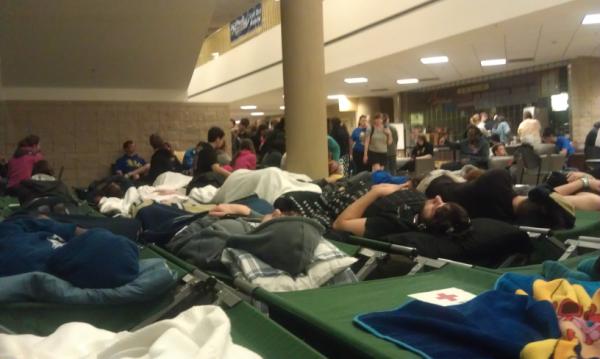
[9] One of the more despicable aspects of the threats has been the frequent and continual threats to student dormitories at late hours of the night or early morning. For instance, students have been forced to sleep on cots in the gymnasium during these threats.