Alternate Nuclear History: Manhattan Projects

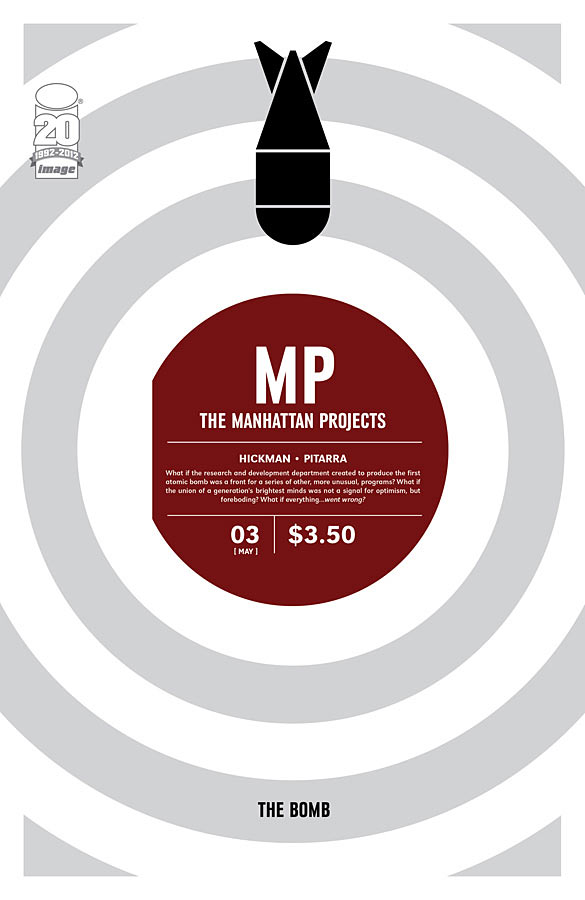
I’ve picked up the first three issues of The Manhattan Projects, written by Jonathan Hickman and drawn by Nick Pitarra, and I am finding it absolutely delightful. The premise is pure alternate nuclear history joy: “What if the research and development department created to produce the first atomic bomb was a front for a series of other, more unusual, programs? What if the union of a generation’s brightest minds was not a signal for optimism, but foreboding? What if everything . . . went wrong?” (from the cover). Already in the first three issues, a insane Robert Oppenheimer suffers from multiple personality disorder, and gets to mow down killer Japanese samurai robots

Wernher von Braun has a robotic arm, Richard Feynman is a narcissistic pretty boy, Harry Daghlian is an irradiated skull, F.D.R. becomes the world’s first artificial intelligence (“We have nothing to fear but. . . ourselves” are his first posthuman words), and, as Chris Sims has pointed out in an early review, “Albert Einstein is The Manhattan Projects’ Wolverine. . . . Seriously: Einstein is the sensational character find of 2012.” (Wired also has a review and an interview with Hickman here.) And perhaps the least compelling aspect of the book so far is the end of its third issue, which reimagines Hiroshima in a darkly humorous fashion. I’m really looking forward to continue reading this.


No Pulitzer for DFW’s The Pale King. . . or Anything Else

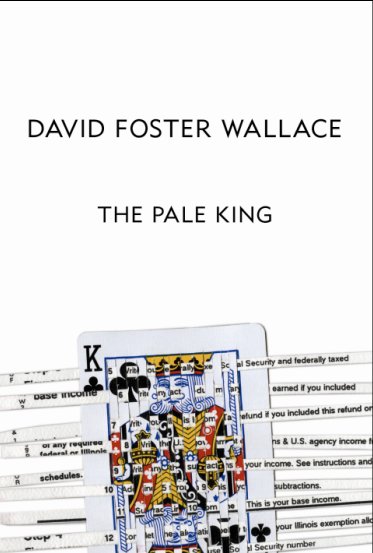
So again, I somehow missed some DFW news (or non-news), but DFW’s The Pale King was one of three finalists for the Pulitzer Prize, the other two being Denis Johnson’s Train Dreams and Karen Russell’s Swamplandia. As Ann Patchet wrote in an op-ed for the New York Time, “And the Winner Isn’t. . . ,”:

With book coverage in the media split evenly between Fifty Shades of Grey and The Hunger Games, wouldn’t it have been something to have people talking about The Pale King, David Foster Wallace’s posthumous masterwork about a toiling tax collector (and this year’s third Pulitzer finalist)? Wallace is not going to have another shot at a win, which makes the fact that no one could make up their minds as to whether or not he deserved it all the more heartbreaking. (The Times also had a few people weigh in on who should have won the award.)

In my mind, however, the decision by the Pulitzer board makes a kind of sense. Admittedly, I haven’t read Johnson or Russell’s books yet, but if we just allow for the moment that The Pale King was the best U.S. novel of 2011, then the lack of an award speaks volumes. The Pale King is fantastic, but it obviously unfinished, and as such, I would have a hard time giving it any kind of award. (I guess I’m of the mindset that awards should be given for complete, fully realized works. My weird conservatism I guess.) Giving no award, however, is a kind of implicit acknowledgment of The Pale King’s value–i.e. in a year when one of the best novels was unfinished, and clearly had quite a ways to go toward completion, perhaps no one should win. In other words, I don’t think The Pale King is award-worthy, but in a year when an unfinished DFW novel is “more worthy” than a host of other texts, no one should get it. This isn’t a travesty, or the Pulitzer dropping the ball, or them doing harm to the ailing literary establishment, or not doing their part to encourage reading, etc. (and of course they did give out many other awards). Rather, it is a quiet statement that acknowledges DFW by not acknowledging him. And perhaps for such an unpublished, posthumous novel, no matter how deserving it or the rest of his writing may have been for a gaggle of awards (I need hardly mention Infinite Jest was roundly snubbed come award-time), the decision displays a kind of quiet poetic justice. (I also have to imagine he would have appreciated this sort of thing.) In a time when we are all too ready to quickly level hyperbolic and unfounded judgments and critiques against anything and everything, when loudly voiced opinion seems to be the only discourse with any traction in the public sphere, choosing not to judge, refraining from a decision, being mindful that doing nothing is preferable to doing something just for the sake of doing it, in short, preferring not to. . . perhaps the Pulitzer went to the only person that could win it in a year that saw the publication of one of the most important writers of the late 20th-c.’s final, posthumous, unfinished work: no one else.
Memory and the Baseball Archive

Over at the excellent Triple Canopy, Colby Chamberlain interviews Bryan Zanisnik, whose recent installation, “Every Inch a Man,” features Zanisnik “spend[ing] five hours a day, Thursday through Sunday, inside a Plexiglas booth, reading a copy of Philip Roth’s The Great American Novel (1973) while wearing goggles to protect his eyes from the baseball cards and outdated currency being blown about by the fans installed within the booth’s base.”

Zanisnik on the individualized baseball card (hyper)archive: “I was looking at [my baseball card] collection for the first time in probably twenty years, yet when I picked up individual cards I could remember all sorts of details: which position in the outfield someone played, which year he made the All-Star team. This physical interaction stirred up dormant long-term memories.From that point on, I began conceiving of these sets and installations as physical manifestations of childhood memory—albeit ones structured by commodity culture. It’s the visual and tactile qualities of these consumer objects that activate a set of memories for me and hopefully for others as well. ” “Baseball Card as Madeleine” indeed.

Bryan Zanisnik, 18 Years of American Dreams, 2010

Wow, Quite the Mega-Text

A good friend of mine just directed my attention to Richard Grossman’s Breeze Avenue, a massive text that will eventually be 3,000,00 pages, 15 terabytes of information, roughly 5% of the entire Library of Congress.[1] Does the term “mega-text” even cover something this large?


[1] Note: An earlier version of this post claimed that this 15 terabytes would be “more than the entire Library of Congress.” As so much on Grossman’s site, the details of the project keep changing.

Perhaps it Isn’t the Nuclear Apocalypse We Should Fear, But Our Own Stupdity

io9 reports on two bombs that were accidentally dropped on the Carolinas in 1958. (They didn’t explode.)

io9 on 5 other times “we almost nuked ourselves. . . . The sad lesson is that we have less to fear from naked aggression than we do from incompetence and bad engineering.”

And a fairly authoritative and comprehensive account of U.S. Nuclear Weapons Accidents.