Nuclear Morale Crisis?

On 8 May 2013, Michael R. Gordon for The New York Times and others reported that “The Air Force removed 17 officers assigned to standing watch over nuclear-tipped Minuteman missiles after finding safety violations, potential violations in protecting codes and basic attitude problems.” This has caused the AP  to ask “Is There a Morale Crisis in the US Nuclear Force?” Well, yes. And it is history and those damned politicians’ faults. If they just stopped trying to reduce the nuclear arsenal, morale would be higher. An excerpt:

Bruce Blair, a former missile launch officer and now a national security scholar at Princeton University, said Friday that morale has dropped in part because the ICBM mission that originated in 1959, deterring the Soviet Union from attacking the U.S. or Europe, is less compelling than it was generations ago.

“This dead-end career is not the result of shrinking nuclear arsenals, but rather because the Cold War ended decades ago and because so few senior commander jobs exist within the missile specialty,” Blair said. “Most crews can’t wait to transfer out of missiles into faster-track careers such as space operations, but the Air Force doesn’t make it easy.”

[Air Force Secretary Michael] Donley came close to blaming the White House for any malaise. He said that when officers see “the national leadership” contemplating more nuclear reductions “this does have a corrosive effect on our ability to maintain focus on this mission.” He also said “critics or others” contribute to this when they suggest getting rid of the ICBM force entirely.

Yeah, because this should all be our primary concern with regard to nuclear weapons: that the morale of soldiers stays high. I don’t know what to say.
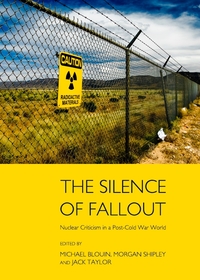
“Apocalypse Networks: Representing the Nuclear Archive” in The Silence of Fallout: Nuclear Criticism in a Post-Cold War World

Silence of Fallout Cover

Michael J. Blouin, Morgan Shipley, and Jack Taylor have edited a great collection of essays on nuclear criticism, The Silence of Fallout: Nuclear Criticism in a Post-Cold War World (this links to the publisher page). I have an essay in the collection, “Apocalypse Networks: Representing the Nuclear Archive,” that any reader of this blog would probably find quite interesting. And of course there are a number of other interesting essays by accomplished scholars and nuclear critics. You can preview the table of contents, the preface, and the introduction here. And the book is now readily available for order from Amazon and of course other places. (Probably the quickest way to get it would be going directly to CSP’s site.)

I’ve included the Table of Contents below:

Preface, John Canaday

Introduction: The Silence of Fallout, Michael J. Blouin, Morgan Shipley, and Jack Taylor

Chapter One: “What Works”: Instrumentalism, Ideology, and Nostalgia in a Post-Cold War Culture, Jeff Smith

Chapter Two: Specters of Totality: The Afterlife of the Nuclear Age, Aaron Rosenberg

Chapter Three: Queer Temporalities of the Nuclear Condition, Paul K. Saint-Amour

Chapter Four: Apocalypse Networks: Representing the Nuclear Archive, Bradley J. Fest

Chapter Five: Cut to Black: Nuclear Criticism in a Post-September 11th America, Joseph Dewey

Chapter Six: The Pixilated Apocalypse: Video Games and Nuclear Fears, 1980-2012, William Knoblauch

Chapter Seven: Depictions of Destruction: Post-Cold War Literary Representations of Storytelling and Survival in the Nuclear Era, Julie Williams

Chapter Eight: Allegories of Hiroshima: Toward a Rhetoric of Nuclear Modernism, Mark Pedretti

Chapter Nine: War as Peace: Afterlives of Nuclear War in David Foster Wallace’s Infinite Jest, Jessica Hurley

Chapter Ten: The Hunger Games: Darwinism and Nuclear Apocalypse Narrative in the Post-9/11 World, Patrick B. Sharp

Chapter Eleven: Legacy of Waste: Nuclear Culture After the Cold War, Daniel Cordle

Chapter Twelve: In a dark wud: Metaphors, Narratives, and Nuclear Weapons, John Canaday

Accumulating Ruin and a Pleasant Apocalypse

Adam Rothstein has a pretty interesting little essay for The State, titled “The Accumulation of Ruin-Space.” In it he asks,

But the question for these ruin-spaces is, how long will the[y] exist? We seem to have an attraction to ruins—we want them and seek them out, though never with the same functional desire with which we seek out current structures. What will we do in the future as these ruin-spaces pile up, unable to be destroyed because of their enforced temporality as preserved agedness? The earth is becoming a solid mass of scar tissue, as the tracks of human endeavor scour crosshatching into its surface.

Is the earth becoming a hyperarchive of ruins?

And also at The State, Asher Kohn writes about Central Asia as a post-apocalyptic space in “A Pleasant Post-Apocalypse.” He suggests that “[t]he history of Central Asia is in many ways a history of eschatologies; not a graveyard of empires but perhaps a graveyard of belief systems.” While “eschatological” might be a bit extreme to describe the history he traces, nonetheless, his description of the landscape of post-Soviet Russia bears considering:

It is truly very difficult to explain how Soviet geoforming was such a disaster. Whole seas were turned into steppe. Whole steppes were turned into blast zones. Whole blast zones were restructured to focus on an alien frontier. There is no real way to overestimate the effect this must have on the people who live in the region. Pastoralism is an artifact, not an economy. Islam was tortured by Soviet hubris. Language changes made it impossible for a grandson to communicate with his grandmother. And the land, the very essence of life itself, the only connection a person might have with the folkways of the parents, grandparents, and ancestors of their society, is turned to factory farms and dust and ash. In the 21st century, Central Asia is a post-apocalyptic world.

The article also has some wonderful pictures.

https://i0.wp.com/www.thestate.ae/wp-content/uploads/2013/04/Picture-39.png

Weaponizing the Weather

Jacob Darwin Hamblin has an essay up on Salon titled, “We Tried to Weaponize the Weather.” He writes:

The years between the first hydrogen bomb tests and the Limited Test Ban Treaty in 1963 saw more than just increased anxiety about the effects of nuclear testing on weather. They also saw increased interest in large-scale, purposeful environmental modification. Most climate modification enthusiasts spoke of increasing global temperatures, in the hopes that this would increase the quantity of cultivated land and make for fairer weather. Some suggested blackening deserts or snowy areas, to increase absorption of radiation. Covering large areas with carbon dust, so the theory went, would raise temperatures. Alternatively, if several hydrogen bombs were exploded underwater, they might evaporate seawater and create an ice cloud that would block the escape of radiation. Meteorologist Harry Wexler had little patience for those who wanted to add weather and climate modification to the set of tools in man’s possession. But by 1958 even he acknowledged that serious proposals for massive changes, using nuclear weapons as tools, were inevitable. Like most professional meteorologists, in the past he had dismissed the idea that hydrogen bombs had affected the weather. But with the prospect of determined experiments designed to bring about such changes, he warned of “the unhappy situation of the cure being worse than the ailment.”

Oh the things we’re learning about the terrible ideas people had during the first nuclear age.

Real Nuclear Wastelands

Kate Brown in an article for Slate, “Life in a Real Nuclear Watsteland,” writes about contaminated areas of Russia:

The Techa became a flowing radioactive reservoir in 1949 when engineers at the plutonium plant ran out of underground storage containers for high-level radioactive waste. A Dixie cup of this waste could kill everyone in a large ballroom. Compelled by the arms race, the plant director ordered it dumped in the Techa River. The men running the plant didn’t tell anyone about this decision. The 28,000 Russian, Bashkir, and Tatar farmers living on the river—drinking, cooking, and bathing with river water—had no idea. In the 1950s and ’60s special forces resettled most of the 16 contaminated villages on the Techa, but a few villages were too large and expensive to move, so they stayed. Muslumovo is one.

Dissertation Defended

On a bit of a personal note, yesterday I defended my dissertation, “The Apocalypse Archive: American Literature and the Nuclear Bomb.” As I move now toward turning it into a book, the first thing I’m gonna change will probably be the title. Onward toward more nuclear criticism and hyperarchival realism.

Assured Use of Space

My brother just alerted me to this relatively new and ongoing concern of the US Department of Defense: the assured use of space. He was also nice enough to point me toward an article that nicely lays out the global risks associated with space, “Mutually Assured Destruction: Space Weapons, Orbital Debris and the Deterrence Theory for Environmental Sustainability,” published in volume 37 of Air & Space Law. Among the article’s other concerns, Surya Gablin Gunasekara writes: “this article argues that the theory of Mutually Assured Destruction as applied to the space environment and the international space legal framework supply enough deterrence to prevent the widespread use of space weapons without the need for additional international agreements.” This adds a whole new wrinkle to my ongoing thinking about disaster, and further complicates notions of archival destruction because of how vital a role US communication satellites play in the global telecommunications infrastructure.

All Nuclear Reactors in the US are Flawed

As Matthew L. Wald reports in yesterday’s New York Times, “All 104 nuclear power reactors now in operation in the United States have a safety problem that cannot be fixed and they should be replaced with newer technology.” This flaw became apparent after the Fukushima meltdown, which the Times reported on here. This is a striking admission, coming as it does from the former chairman of the Nuclear Regulatory Commission.