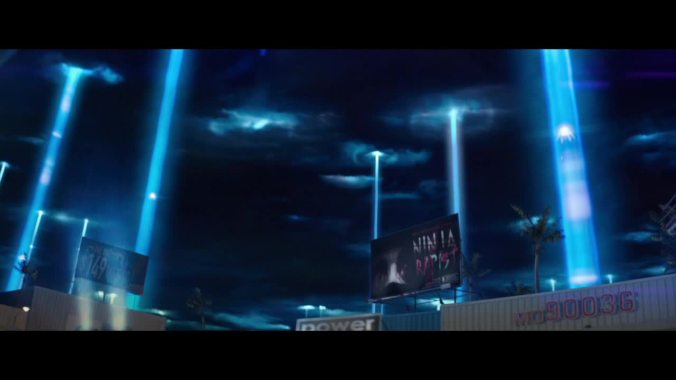
So, let’s get this out of the way quickly. This is the End (dir. Evan Goldberg and Seth Rogen, 2013) is a terrible movie. (I had a previous inkling that it was going to be pretty wretched.) It is adolescent (if self-consciously so), puerile (viz. Satan’s giant phallus), and misogynist, among its other sins. Perhaps most damning: it is poorly imagined. There are a number of other ways that actors playing themselves in a movie about the end of the world at James Franco’s house could have gone. Seriously. This is a brilliant premise but This is the End is embarrassing.
Despite this pretty damning opinion, the spirit of The Hyperarchival Parallax’s subtitle obliges me to give this onanistic bropocalypse its due. For if nothing else, the film is somewhat fun. This is largely due to the constant metafiction the film is engaged in: Michael Cera is a degenerate, the Back Street Boys exist(ed) (right!?), Aziz Ansari is not generally liked, etc. And this is funny/interesting b/c each actor plays themselves. (Or at least it is supposed to be [and often is] funny.)
But the true failure of This is the End lies in never asking itself what its basic premise means. Namely, what does it mean to make a film about the “Christian” Apocalypse with a cast of goofballs (who made it big for whatever reason) playing themselves in 2013? Yes, the film is self-aware about how indulgent of a film it is (is it really though?), but if you are going to parody the currently (very) popular craze with representing megadeath and mass-destruction—and in a time of danger, a time of surveillance, climate change, war, revolution, torture, and disaster—without once asking why one might make such a film nor why such a film might be interesting, timely, or important at this late and exhausted date in 2013 . . . this is a mistake.
To my mind, This is the End is a product of the 2013 orgy of disaster (see fn. 3) finally turning in on itself. And it is about time. (Whatever one may think about David Foster Wallace’s irony or sincerity) This is the End is very necessarily ironic in this time of serious-ass superhero movies destroying significant amounts of urban real-estate over and over. But it is not ironic enough. There are too many dick and fart jokes, and not enough acknowledgment of what it is and what it is doing: that it is metafiction satirizing contemporaneity and its multiplying disastrous projections of national fantasy. This is the End, if nothing else, emphasizes that we should be wary of the sincere expression of eschatological national fantasy at the present time.
 The Hyperarchival Parallax