Nuclear Activism

To return to one of the main threads of this blog–all things nuclear–which has been going down slightly different paths over the past month, I give you the following excerpt from Devon Fredericksen’s interview with Terry Tempest Williams, activist and author of When Women Were Birds (2013), among many other books:

I believe the first time I found my voice was when I crossed the line at the Nevada Test Site in 1988. It was one year after my mother died. It was one year before my grandmother would die, and I found myself the matriarch of my family at thirty. With the death of my mother, grandmothers, and aunts—nine women in my family have all had mastectomies, seven are dead—you reach a point when you think, “What do I have to lose?” and you become fearless. When I crossed that line at the Nevada Test Site as an act of protest because the United States government was still testing nuclear bombs in the desert—it was a gesture on behalf of the Clan of the One-Breasted Women—my mother, my grandmothers, my aunts. And I didn’t do it alone. I was with hundreds of other women who had suffered losses in Utah as a result of atomic testing, as a result of our nuclear legacy in the West. I crossed that line with Jesuit priests, with Shoshone elders, with native people who had also lost lives because of the radiation fallout in the Shivwits’ lands.

Some Thinking on the Present and Future of Disaster

Some wonderfully bleak things I’ve run across this week: Margaret Ronda’s, “Mourning and Melancholia in the Anthropocene,” in Post45; and I am eagerly waiting for Liam Sprod‘s Nuclear Futurism: The Work of Art in the Age of Remainderless Destruction (Zer0 Books, 2013) to arrive in the mail. Post45 also has a fairly interesting piece from October on Thomas Pynchon: David J. Alworth, “Pynchon’s Malta,” Post45.

Nuclear Pasts and Presents

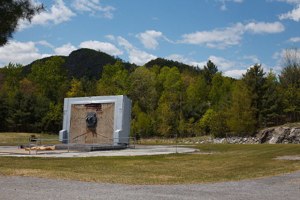
Mark Frauenfelder, founder of Boing Boing, has reported about this little gem he found on Realtor.com: 87 Hale Hill Lane, Lewis, NY 12950. Or, to be less precise, an old missile silo that has been converted into a home. It’s on sale for only $750,000. Scott Garner (who I assume is the listing agent) has explicitly advertised it as: “Live in the Launch Control Center of this Cold War Missile Silo.”

missile silo

On the phenomenon of old missile silos and bunkers being repurposed, see photographer Richard Ross‘s Waiting for the End of the World (New York: Princeton Architectural Press, 2004), a fairly wonderful photo-essay on the subject. Sarah Vowell also interviews Ross in the book.

silo

The Nuclear Uncanny of Robert Longo

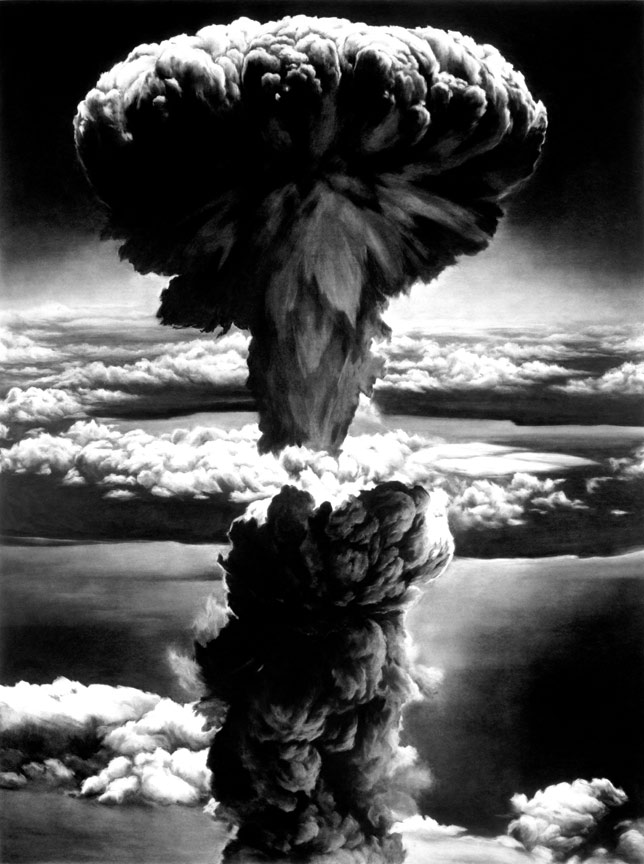
When looking earlier today at a bunch of striking photorealist painting and drawing, I came across the image below. It is a charcoal drawing of the nuclear bombing of Nagasaki by artist Robert Longo. (Strangely enough, in addition to being an artist, he also directed the 1995 film Johnny Mnemonic, based on a William Gibson short story. It was Longo’s only feature film.) He has a whole series of charcoal drawings of nuclear explosions. His website is here. His work is also currently part of a group exhibition, “Disaster: The End of Days,” at the Galerie Thaddaeus Ropac in Paris.

Robert Longo Drawing of Nagasaki

Nuclear Morale Crisis?

On 8 May 2013, Michael R. Gordon for The New York Times and others reported that “The Air Force removed 17 officers assigned to standing watch over nuclear-tipped Minuteman missiles after finding safety violations, potential violations in protecting codes and basic attitude problems.” This has caused the AP  to ask “Is There a Morale Crisis in the US Nuclear Force?” Well, yes. And it is history and those damned politicians’ faults. If they just stopped trying to reduce the nuclear arsenal, morale would be higher. An excerpt:

Bruce Blair, a former missile launch officer and now a national security scholar at Princeton University, said Friday that morale has dropped in part because the ICBM mission that originated in 1959, deterring the Soviet Union from attacking the U.S. or Europe, is less compelling than it was generations ago.

“This dead-end career is not the result of shrinking nuclear arsenals, but rather because the Cold War ended decades ago and because so few senior commander jobs exist within the missile specialty,” Blair said. “Most crews can’t wait to transfer out of missiles into faster-track careers such as space operations, but the Air Force doesn’t make it easy.”

[Air Force Secretary Michael] Donley came close to blaming the White House for any malaise. He said that when officers see “the national leadership” contemplating more nuclear reductions “this does have a corrosive effect on our ability to maintain focus on this mission.” He also said “critics or others” contribute to this when they suggest getting rid of the ICBM force entirely.

Yeah, because this should all be our primary concern with regard to nuclear weapons: that the morale of soldiers stays high. I don’t know what to say.

Weaponizing the Weather

Jacob Darwin Hamblin has an essay up on Salon titled, “We Tried to Weaponize the Weather.” He writes:

The years between the first hydrogen bomb tests and the Limited Test Ban Treaty in 1963 saw more than just increased anxiety about the effects of nuclear testing on weather. They also saw increased interest in large-scale, purposeful environmental modification. Most climate modification enthusiasts spoke of increasing global temperatures, in the hopes that this would increase the quantity of cultivated land and make for fairer weather. Some suggested blackening deserts or snowy areas, to increase absorption of radiation. Covering large areas with carbon dust, so the theory went, would raise temperatures. Alternatively, if several hydrogen bombs were exploded underwater, they might evaporate seawater and create an ice cloud that would block the escape of radiation. Meteorologist Harry Wexler had little patience for those who wanted to add weather and climate modification to the set of tools in man’s possession. But by 1958 even he acknowledged that serious proposals for massive changes, using nuclear weapons as tools, were inevitable. Like most professional meteorologists, in the past he had dismissed the idea that hydrogen bombs had affected the weather. But with the prospect of determined experiments designed to bring about such changes, he warned of “the unhappy situation of the cure being worse than the ailment.”

Oh the things we’re learning about the terrible ideas people had during the first nuclear age.

Real Nuclear Wastelands

Kate Brown in an article for Slate, “Life in a Real Nuclear Watsteland,” writes about contaminated areas of Russia:

The Techa became a flowing radioactive reservoir in 1949 when engineers at the plutonium plant ran out of underground storage containers for high-level radioactive waste. A Dixie cup of this waste could kill everyone in a large ballroom. Compelled by the arms race, the plant director ordered it dumped in the Techa River. The men running the plant didn’t tell anyone about this decision. The 28,000 Russian, Bashkir, and Tatar farmers living on the river—drinking, cooking, and bathing with river water—had no idea. In the 1950s and ’60s special forces resettled most of the 16 contaminated villages on the Techa, but a few villages were too large and expensive to move, so they stayed. Muslumovo is one.

Continuing (Nuclear) Tensions in East Asia

Tensions are continuing to mount between North Korea, its neighbors, and the US. The New York Times reported Tuesday that N. Korea is restarting a nuclear reactor to produce plutonium for weapons. Despite this, and other recent developments, the White House feels its all just blustery bravado. Whatever the bravado, however, the US still moved a missile defense system to Guam, according to The Guardian.

Even my local paper is getting in on the action (via the AP): “North Korea warned early today that its military has been cleared to attack the United States using “smaller, lighter and diversified nuclear” weapons, while the United States said it was strengthening protection in the region and seeking to defuse the situation. Despite the intense rhetoric, analysts do not expect a nuclear attack by North Korea, which knows that the move could trigger a destructive, suicidal war that no one in the region wants. The North is not believed to have the ability to launch nuclear-tipped missiles, but its other nuclear capabilities aren’t fully known.” I am not reassured.

And to make matters worse in the region, the tensions between Japan and China are increasing, as The New York Times also reported that Japan simulated a battle recapturing an island from a clearly Chinese invader. There is obviously cause for concern, as Martin Fackler writes: “Until recently, a simulated battle against Chinese forces would have been unthinkably provocative for Japan, which renounced the right to wage war — or even to possess a military — after its march across Asia in World War II resulted in crushing defeat.”Again, this is cause for considerable concern.

North Korea Responds to Sanctions

As The New York Times is reporting today (and pretty much everyone else): “Angrily responding to the United Nations Security Council’s unanimous decision to impose tightened sanctions, North Korea said on Friday that it was nullifying all nonaggression agreements with South Korea, with one of its top generals claiming that his country had nuclear-tipped intercontinental ballistic missiles ready to blast off.”