On the Death of Robin Williams and Other Links

Nuclear and Environment

Sarah Stillman, “Hiroshima and the Inheritance of Trauma.”

McKenzie Wark, “Critical Theory After the Anthropocene.”


International

Geoff Manaugh and Nicola Twilley, “Ebola and the Fiction of Quarantine.”

Leigh Phillips, “The Political Economy of Ebola.” “Ebola won’t be solved, because it isn’t profitable to do so.”

Continue reading

I’m Finally on Twitter! (and Other Links)

I’ve finally given in and created a Twitter account. You can follow me @BradleyFest.


In other news.

Nuclear

The diary of Mike Kirby, who worked with atomic weapons for years.


Iraq and International

“To the defense of Erbil: this was the main cause that drew President Obama back to combat in Iraq last week, two and a half years after he fulfilled a campaign pledge and pulled the last troops out” (Steve Coll, “Oil and Erbil”).

Rod Nordland and Helene Cooper, “Capitalizing on US Bombing, Kurds Retake Iraqi Towns.”

Conor Friedersdorf, “President Obama Risks Misleading Us Into War.”

Michael Tomasky, “Why Liberals Should Back Iraq Intervention.” Hmm.

On Putin’s current stance toward the US: David Remnick, “Watching the Eclipse.”

And boundary 2 has just made this fascinating article from their newest issue available: “Democracy: An Unfinished Project” by Susan Buck-Morss.

Continue reading

“Literally” Two-Thousand Fourteen Links

Nuclear and Environment

US War Department’s Archival Footage of the Bombing of Hiroshima.


H. Bruce Franklin, “Hiroshima, Nagasaki, American Militarism,” a review of Paul Ham‘s Hiroshima Nagasaki: The Real Story of the Atomic Bombings and Their Aftermath.

Mark Strauss, “Federal Employee Gets Fired After Writing an Article Criticizing Nukes.”

Lindsay Abrams, “Researchers: Warming Responsible for Siberia’s Mysterious Hole.”

Continue reading

August Links

Its been a couple weeks since I’ve posted any links, so there’s a bunch of stuff here.


Disaster, Nuclear, Environment, and Deep Futures

John Oliver on America’s Insecure Nuclear Arsenal.


Willie Osterweil, “The End of the World as We Know It.” On the reactionary politics in ancient apocalypse films.

Josh Marshall, “Disaster Porn, For Once for Real.”

Ross Andersen, “When We Peer Into the Fog of the Deep Future What Do We See–Human Extinction or a Future Among the Stars?”

Radical eco-nihilism. Wen Stephenson, “‘I Withdraw’: A Talk with Climate Defeatist Paul Kingsnorth.”

Paul Kingsnorth, “Confessions of a Recovering Environmentalist.”

Mark Strauss, “Space Junk Is Becoming a Serious Security Threat.”

Robert T. Gonzalez, “Bad News: Scientists Have Measured 16-Foot Waves in the Arctic Ocean.”

Nadia Prupis, “‘There Will Be No Water’ by 2040? Researchers Urge Global Energy Paradigm Shift.”

Continue reading

July Links

(It’s been a few weeks since I’ve posted links, so some of this is already pretty dated, but heck . . it’s also been a jam-packed couple of weeks in the news.)


Nuclear

Nina Strochlic, “Britain’s Nuke-Proof Underground City.”

Forthcoming book: Fabienne Colignon’s Rocket States: Atomic Weaponry and the Cultural Imagination.


Environment

Lindsay Abrams, “The Ocean Is Covered in a Lot Less Plastic Than We Thought–and That’s a Bad Thing.”

James West, “What You Need to Know About the Coming Jellyfish Apocalypse.”

Brad Plumer, “Oklahoma’s Earthquake Epidemic Linked to Wastewater Disposal.”

Continue reading

News From Iraq, Nuclear Weirdness, and Shutting Down a 9 Year Old Boy’s Library

Nuclear

More adventures in nuclear incompetence (feeling like a broken record). David Willman, “$40-Billion Missile Defense System Proves Unreliable.”

The inverted nuke in the garden (seriously, a broken record) . . . : Dylan Matthews, “A New Report Shows Nuclear Weapons Almost Detonated in North Carolina in 1961.”

Alex Wellerstein found this, wow, simply amazing document: assessing post-apocalyptic land values.


Iraq

Robin Wright, “A Third Iraq War?”

Lawrence Wright, “ISIS’s Savage Strategy in Iraq.”

Elliot Ackerman, “Watching ISIS Flourish Where We Once Fought.”

Rod Nordland and Alissa J. Rubin, “Massacre Claim Shakes Iraq.”

Rod Nordland and Suadad Al-Salhay, “Extremists Attack Iraq’s Biggest Oil Refinery.”

David Frum, “Iraq Isn’t Ours to Save.”

J. M. Berger, “How ISIS Games Twitter.”

Moíses Naím, “The Rise of Militarized NGOs.”

Jeffrey Goldberg, “The New Map of the Middle East.”

And Greg Shupak at Jacobin, “No More Imperial Crusades.”

Continue reading

Notes from the Anthropocene: Insuring the Apocalypse and Other Links

Nuclear

More adventures in nuclear incompetence: Lily Hay Newman, “Air Force Security Failed a Takeover Drill at a Nuclear Silo.”


Climate Change, Catastrophe, and the Anthropocene

We’re doomed. “A Galaxy Far, Far Away . . . Will Hit Ours.”

Lindsay Abrams, “Researchers: The Collapse of Greenland’s Ice Sheet Could Be a Bigger Disaster Than We Thought.”

Ari Phillips, “In Landmark Class Action, Farmers Insurance Sues Local Government for Ignoring Climate Change.” Is that what we need? For the insurance companies to get involved?

Yes. McKenzie Funk, “Insuring the Apocalypse.”

Paul Krugman, “Cutting Back on Carbon.”

On the flooding in the Balkans.

Everything is the worst: Ryan Koronowski, “House Votes to Deny Climate Science and Ties Pentagon’s Hands on Climate Change.”

And scientists agree, we should just start calling climate change “You will be burnt to a crisp and die.”

Continue reading

The West Antarctic Ice Sheet Collapse and Other Portents of Doom

Climate Change

The New York Times on the collapse of the West Antarctic Ice Sheet.

Paul Krugman, “Points of No Return.”

Eyder Peralta, “New Report Finds Climate Change Already Having Broad Impact.”

Gerry Canavan on “Dystopia, Anti-Utopia, and the End of the World.”

Peter Frase, “Adjusting to the Apocalypse.”

A very interesting piece at Jacobin reflecting on an analogy between abolitionists and environmentalists: Matt Karp, “A Second Civil War.”

Roger Peet, “A Radical Approach to the Climate Crisis.”

Martin Lukacs, “New, Privatized African City Heralds Climate Apartheid.”

Julie Beck on John Oliver’s “Statistically Representative Climate Change Debate.”

Saskia Sassen, “Countdown to Oblivion: The Real Reason We Can’t Stop Global Warming.”

Mike Wall, “To Combat Climate Change, Humanity Must Act Now, NASA Chief Says.”

Brad Plumer, “Five Horrifying Maps of America’s Massive Drought.”

And “Picture This: U.S. Cities Under 12 Feet of Sea Level Rise.” An example:

The Back Bay in Boston under 12 Feet of Sea Level Rise

The Back Bay in Boston under 12 Feet of Sea Level Rise

But don’t fret, “This Couple is Making Roads Out of Solar Panels, and They Actually Work.”

And Michelle Nijhuis, “How to Laugh at Climate Change.”

Continue reading

Abstract: Apoclaypse on Repeat: William Carlos Williams’s Spring and All and the Nuclear Imagination

Below is an abstract for a paper I will be presenting at the 2014 American Literature Association Conference, taking place May 22-25. I will be presenting this paper on a panel organized by the William Carlos Williams society, titled, “William Carlos Williams: The Poet-Doctor as Environmentalist.” The panel will be taking place 11:10-12:30 on May 23.

Apocalypse on Repeat: William Carlos Williams’s Spring and All and the Nuclear Imagination

Long out of print after their initial publication in 1923, the prose sections of Spring and All offer remarkable critical avenues for discussing William Carlos Williams’s environmentalism. Serving as both a frame for some of his more well-known poetry and a theoretical engagement with the volume’s central concern—the imagination—the prose of Spring and All cannot help but strike a contemporary reader with its anticipation of the post-apocalyptic and eco-disaster narratives of the twentieth and twenty-first centuries. To begin the aesthetic work of poetic composition, Spring and All enacts total destruction followed by material repetition in order to allow Williams to formulate an imagination distinct from a romantic apocalyptic, a formulation essential for the development of his ecopoetics. The imagination in Spring and All is a material force. It is vibrant, organic, and radioactive. It is scientific and geological, and it is concerned with atomic physics well before the atom was split. This paper will argue that Spring and All articulates what I have called elsewhere a nuclear imagination. Drawing upon current reconsiderations of modernism’s relationship to atomic technology and my own conversations with J. Hillis Miller about Williams’s poetry and romanticism, I will suggest that Williams, through embracing this destructive, recursive, ironic, nuclear imagination, abandons an eschatology that could in any way be positive, even as something to be gone “beyond.” In this way, reconsidering Spring and All opens up a space for the contemporary environmental imagination that is neither apocalyptic nor post-apocalyptic, but rather thoroughly material and ecological.

Big News in Science and Other Links

Science

The first evidence for cosmic inflation–i.e., the Big Bang–was discovered this week.

Megan Garber at The Atlantic, “What It’s Like to be Right About the Big Bang?”

The search for Flight MH370 is revealing one thing: the ocean is filled with garbage.

Kim Stanley Robinson alert: Paul Rosenfeld, “Would You Take a One-Way Ticket to Mars?”

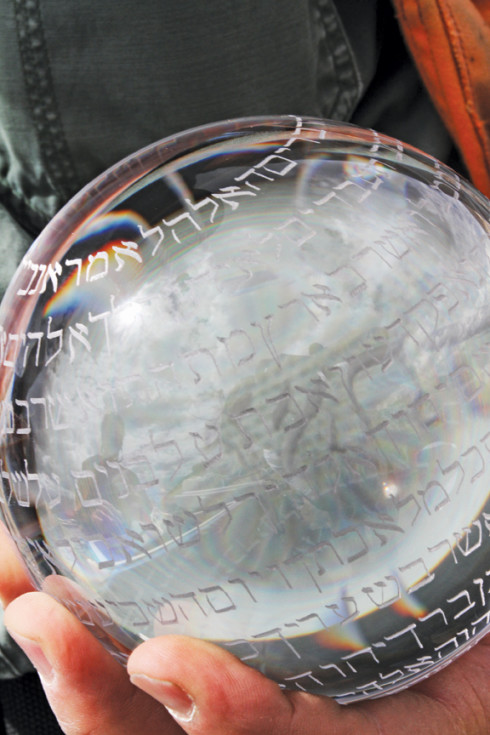
And as part of his forthcoming 3 million page novel, Breeze Avenue (2015), Richard Grossman has buried a crystal ball deep inside of Princeton Mountain in Colorado. The ball, “made of synthetic sapphire, which is almost as indestructible as diamond,” has the Ten Commandments inscribed on it in Hebrew, and in “20 million years, as a result of natural forces carefully calculated by the geologists, the Torah Ball will emerge from its eroded resting place and bear the Ten Commandments down the mountain.” Hyperarchivalists of the deep future rejoice!

Richard Grossman, The Torah Ball (Synthetic Sapphire, Princeton Mountain, 20 Million Years of Erosion, 2011).

Richard Grossman, The Torah Ball (Synthetic Sapphire, Princeton Mountain, 20 Million Years of Erosion, 2011).

Continue reading